

Shocks and struts both control how your suspension moves, but they are not the same part. A shock is a stand-alone damper. A strut is a damper built into a structural assembly that also holds up the spring and keeps the wheel in alignment. Most cars have one type per corner, and some have both: struts on one axle, shocks on the other.
If you landed here because a mechanic said “you need struts” and you wondered whether that’s the same as shocks, this guide sorts it out. It also covers how to check your own car, what the symptoms look like, and how to avoid paying for parts you don’t need.
TL;DR
- Shocks only dampen motion. Struts dampen motion and also act as a structural part of the suspension, supporting the spring and affecting steering and alignment.
- Many cars use struts up front and shocks in the rear. Trucks, vans and older or rear-wheel-drive vehicles often use shocks at the rear, and sometimes at all four corners.
- You can’t swap one for the other. Your vehicle was designed for a specific setup, and the replacement has to match it.
- There is no universal mileage for replacement. Inspect them regularly and replace based on actual condition, not a number on a blog.
- Ask to see the problem. A good shop will show you photos or the part itself before recommending work.
Table of Contents
- What is the difference between shocks and struts?
- Do cars have both shocks and struts?
- What about struts vs. coilovers?
- How do I know if I need shocks or struts?
- When should shocks and struts be replaced?
- Can you replace shocks without replacing struts?
- How much does it cost to replace shocks and struts?
- What to expect after replacement
- Our perspective: diagnose first, then recommend
- Related suspension and steering problems worth ruling out
- Suspension service in Richland Hills
- FAQ
- Sources
What is the difference between shocks and struts?
Both parts do the same basic job: they control the up-and-down motion of your springs. According to KYB, it is the springs that primarily absorb bumps. The damper’s job is to control the spring’s rebound so the car doesn’t keep bouncing, which keeps the tires in contact with the road. Monroe describes the same process as converting kinetic energy into heat, which the hydraulic fluid then dissipates.
The difference is in what else the part has to do.
| Shock absorber | Strut | |
|---|---|---|
| Main job | Dampens spring movement | Dampens movement and supports the spring |
| Structural role | None | Yes, part of the suspension structure |
| Affects steering and alignment | No | Yes |
| If removed | Car is unsafe and uncomfortable but drivable | Car can’t be driven |
| Complexity | Simpler | More complex assembly |
The last two rows come from the manufacturers’ own explanations. Monroe calls struts integrated structural components that are more complex than shocks. KYB puts the structural point bluntly: take off the shocks and the car is still drivable, but take off the struts and the car would collapse.
Why do people say they’re the same thing?
In everyday talk, “shocks” often means the whole damping system, so a mechanic may say “shocks” when your car actually has struts. Both parts are also dampers inside, which is why the terms get blurred. The distinction matters mostly when you’re ordering parts, reading an estimate or comparing quotes.
Do cars have both shocks and struts?
Often, yes. Haynes notes that MacPherson struts are common at the front of many cars, while separate shocks are common at the rear and on many older cars, trucks, vans and rear-wheel-drive vehicles.
Here is a rough guide to what you might find:
- Front-wheel-drive sedans and crossovers: often struts in front, and either struts or shocks in the rear.
- Pickups and many body-on-frame SUVs: commonly shocks, paired with separate coil or leaf springs.
- Many European vehicles: a mix that varies a lot by model, which is one reason it pays to have a technician look at the actual car rather than guess from the make.
These are patterns, not rules. Your owner’s manual, a parts catalog lookup by VIN, or a quick look under the car will give the real answer for your vehicle.
How can I tell what my car has?
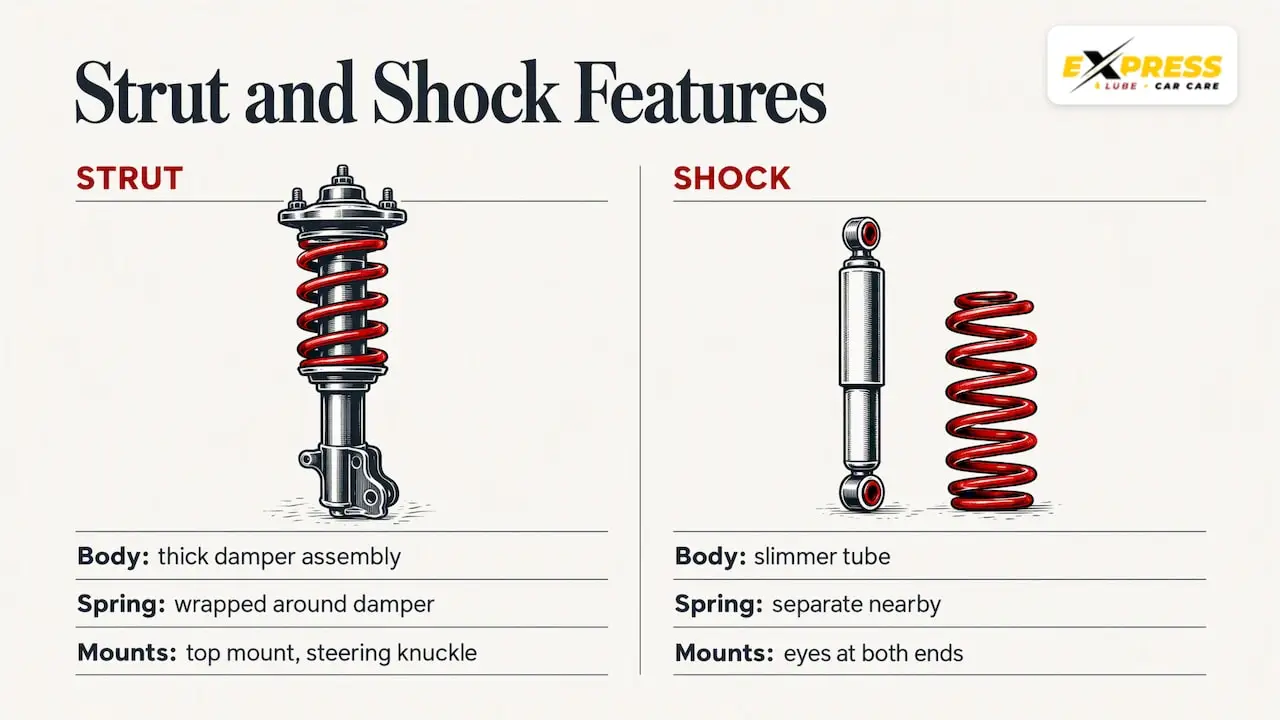
Look behind the wheel. A strut is a thick assembly with the coil spring wrapped around the damper, usually bolted to the steering knuckle and topped with a mount that attaches to the body. A shock is a slimmer tube with a mounting eye at each end, often sitting beside or behind a separate spring. If you can’t tell, don’t worry. We can identify it in minutes when the car is on the lift.
What about struts vs. coilovers?
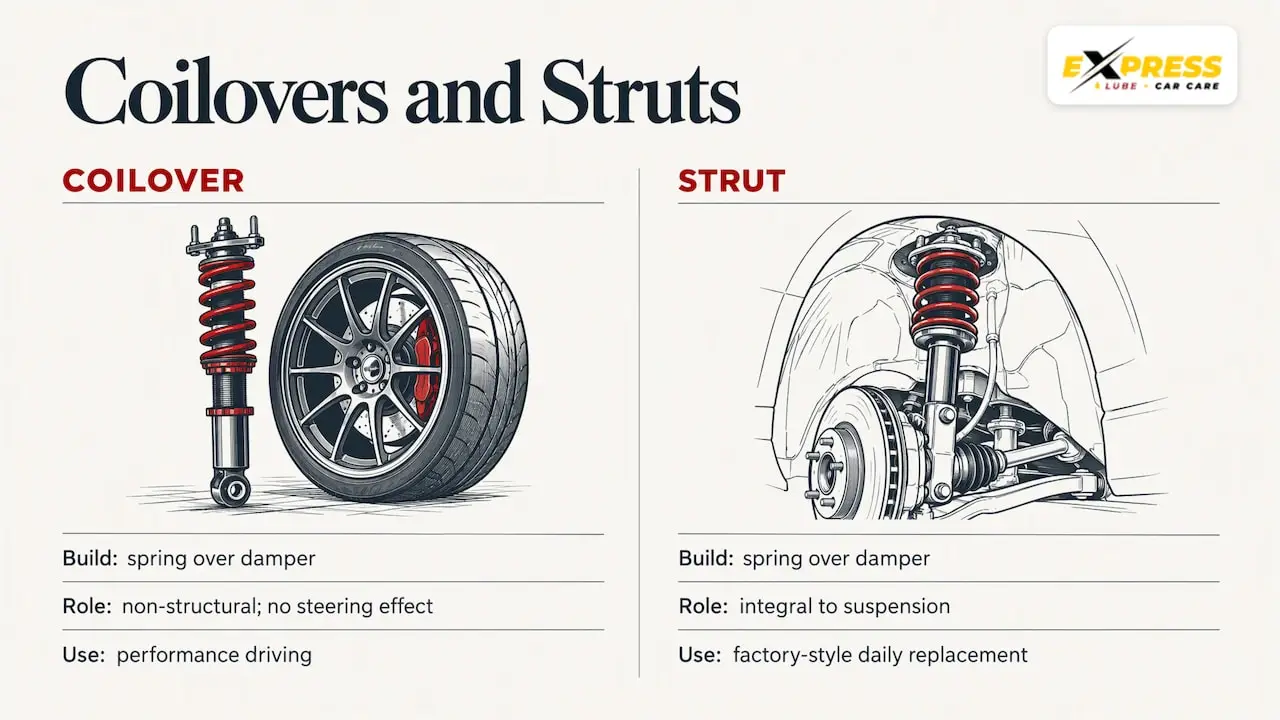
A coilover looks similar to a strut at a glance, because it also packages a spring around a damper. The difference is purpose. Capital One’s explainer describes a coilover as a spring-over-damper unit that can be adjustable but is not a structural part of the car and doesn’t affect steering, while a strut is integral to the suspension.
Coilovers are typically chosen for performance. Shock Warehouse says they show up in track racing, off-roading and aggressive street driving because they offer adjustability. That adjustability comes with upkeep: Vaughn Performance points out that coilover threads need cleaning, especially after off-road use.
For a daily driver on Texas highways, factory-style replacement parts are usually the simpler path. Coilovers make sense when you have a specific goal, like a lowered stance or a particular handling feel, and you accept the tradeoffs.
How do I know if I need shocks or struts?
You don’t pick between them. Your car’s design already decided. The real question is whether the parts you have are worn out. According to Car Talk, common symptoms include:
- Excessive bouncing after bumps or dips
- Loud banging or clunking over bumps
- Sloppy handling
- Nose-diving when you brake
- Swaying in turns
- Steering-wheel vibration
- Uneven tire wear
A few of those overlap with other problems. Steering vibration can come from tire balance or a bent wheel. Clunks can come from worn sway bar links, control arm bushings or even a loose engine mount. Uneven tire wear often points to alignment. That is why diagnosis comes before a parts list. We cover a few more warning signs in our guide to signs you need new shocks.
A quick check you can do in your driveway
- Park on level ground and push down hard on one corner of the car, then let go. A healthy corner settles quickly. One that keeps bouncing deserves a closer look.
- Look at the damper body behind the wheel for oil. A light film of dust and dampness is different from a wet, dripping trail.
- Check your tires for cupping or patchy wear.
- Notice how the car feels in a hard stop or a lane change on the highway.
This is a screening step, not a verdict.
What counts as a leak?
Not every damp shock is a bad shock. In a 2024 technical bulletin published through NHTSA, GM instructs technicians not to replace parts for normal seepage, but to replace them when there are oil drips, trails or extreme wet films coming from the shaft seal. The same document notes that improper diagnosis often leads to replacing parts that are still within spec. That is a bulletin for specific GM vehicles, but the principle applies broadly: look carefully before condemning a part.
When should shocks and struts be replaced?
There is no single mileage that works for every car. Tomorrow’s Technician reports that automakers generally suggest inspecting shocks and struts about every 10,000 to 12,000 miles for degradation, and that replacement is no longer tied to specific mileage intervals because wear is gradual and applications vary so much.
How you drive matters as much as how far. Wear tends to come faster with:
- Rough roads, potholes and construction zones
- Heavy loads, towing or a loaded roof rack
- Lots of stop-and-go driving
- Larger tires or lifted trucks and SUVs
Because wear is gradual, many drivers don’t notice it. The car just slowly gets floatier. A technician’s inspection, ideally when you’re already in for an oil change or tire rotation, catches it earlier than your own feel will. For more on how vehicle type changes service needs, see our piece on why SUVs need more frequent service.

Can you replace shocks without replacing struts?
Yes, if your car has both and only one type is worn. They’re separate parts on separate parts of the car. What you can’t do is substitute one design for the other. AAA explains that once a vehicle is designed with a specific configuration, the parts can’t be interchanged and must be replaced with the right type for that suspension.
What about replacing in pairs? Many shops recommend replacing both sides of an axle together so the car handles evenly, and that is a reasonable practice when the parts are the same age and wear. But a 2025 Jeep/RAM bulletin on NHTSA’s site advises diagnosing shocks and struts separately and not replacing a part simply because the one on the opposite side is defective. In other words, the decision should rest on the condition of each part, and a good estimate will explain why.
How much does it cost to replace shocks and struts?
It depends heavily on the vehicle. Car Talk gives an average range of $500 to $2,500 for a pair, with mainstream affordable vehicles around $1,000. Struts generally cost more than shocks because the assembly is more involved, and European, luxury and heavy-duty trucks sit higher in the range.
We don’t publish fixed prices for suspension work, because the right number depends on your car, the parts you choose and what the inspection finds. We’ll give you a written estimate before work begins. Our shocks and struts replacement cost guide explains what drives the total.
One tip from Car Talk worth repeating: if a chain you don’t know tells you that you need shocks or struts, ask to be shown the problem and have the work done at a shop you trust.
What to expect after replacement
New shocks and struts have a short settling period. The 2025 Jeep/RAM bulletin mentioned above notes a break-in of roughly 100 miles (160 km) after replacement, during which performance may normalize. If the car feels slightly different in the first days, that can be part of it. Anything that feels wrong beyond that, such as noises or pulling, is worth a call back.
After struts are replaced, an alignment check is commonly part of the conversation, since struts are part of the structure that holds wheel position. Ask your technician whether it’s recommended for your vehicle.
Our perspective: diagnose first, then recommend
We see the same pattern often. A driver feels a clunk or a floaty ride, hears “it’s the suspension” and is handed a four-corner quote with no explanation. We think that’s backwards.
Our ASE-certified technicians start with the lift, a hands-on inspection and, where it helps, photos through our digital vehicle inspection so you can see what we see. A leaking strut, a worn mount and a loose sway bar link can all produce a similar noise, and they are very different repairs. We would rather tell you which one it is than sell you all three.
We also don’t use universal mileage rules. We base recommendations on your manufacturer’s guidance and how the vehicle is actually used, whether that’s a commuter on Loop 820, a pickup that tows, or a rideshare car that logs long days. Qualifying repairs carry our 24-month/24,000-mile warranty.
— Express Lube & Car Care
Related suspension and steering problems worth ruling out
Because suspension symptoms overlap with other systems, here is how a thorough check usually widens the net:
- Steering and suspension: tie rods, ball joints, control arm bushings and sway bar links can clunk or loosen steering feel.
- Brakes: nose-dive when stopping can come from worn dampers, but pulling or pulsing points to pads, rotors or calipers.
- Tires: cupping and feathering can be caused by worn dampers, alignment or inflation. Checking pressure and tread depth regularly is the cheapest suspension maintenance there is.
- Engine mounts: a heavy thunk on acceleration or shifting can be a failed mount rather than a suspension part. See our guide to engine mount failure.
- High mileage: older vehicles often need several worn parts addressed together. Our high-mileage maintenance guide lays out how we approach that.
Suspension service in Richland Hills
If you’re in Richland Hills, North Richland Hills, Hurst, Bedford or nearby, we inspect and repair shocks, struts and the rest of the steering and suspension system at our shop. Walk-ins are welcome, and you can also schedule ahead. Our shocks and struts service page shows what we handle, and you can browse everything we offer on our services page.
If a suspension repair is larger than you planned for, eligible customers may be able to explore financing through third-party providers such as Koalafi, Snap Finance, American First Finance and Synchrony. Approval and terms are set by the provider, and nothing is guaranteed.
When you’re ready, call us at (817) 284-8478 or stop by 7932 Glenview Drive, Richland Hills, TX 76180. You can also reach us through our website. We’ll inspect first, show you what we find and let you decide.
FAQ
Are shocks and struts the same thing?
No. Both dampen suspension movement, but a strut is also a structural part that supports the spring and helps hold the wheel in position. A shock is only a damper. Mechanics sometimes say “shocks” casually to mean either one.
Is it okay to drive with a bad shock or strut?
It may be drivable, but it isn’t ideal. Worn dampers can lengthen braking, make the car harder to control in turns and wear tires unevenly. A strut that is badly failing can affect steering and alignment, so get a noisy or leaking one inspected promptly rather than waiting.
Can I upgrade to coilovers instead of replacing struts?
On many vehicles, yes, but they’re a performance choice rather than a like-for-like repair. They offer adjustability, but they can feel firmer and need more upkeep. For a daily commuter, standard replacement parts are usually the practical choice.
How often should shocks and struts be checked?
Automakers generally suggest inspection around every 10,000 to 12,000 miles, according to Tomorrow’s Technician, but your owner’s manual and driving conditions should guide you. Having them looked at during routine service, such as an oil change or tire rotation, is an easy habit.
Should I replace shocks and struts at the same time?
Only if both are worn. They’re separate components, and the decision should come from the condition of each one, not from a package. Replacing both sides of the same axle together is common so the car handles evenly.
Sources
- Monroe: Difference Between Shocks & Struts
- KYB: How shocks work
- KYB: What’s the difference between shocks and struts?
- Haynes: Checking your car’s shocks and struts
- Capital One Auto Navigator: What are coilovers?
- Shock Warehouse: Struts vs. coilovers
- Vaughn Performance: Lifting your Subaru or CUV
- Car Talk: Cost to replace shocks or struts
- NHTSA: GM 2024 technical bulletin on shock and strut seepage
- NHTSA: 2025 Jeep/RAM technical bulletin
- Tomorrow’s Technician: Shock & Strut FAQs
- AAA: Difference between shocks and struts