

Your vehicle’s shocks and struts are the unsung heroes of a smooth, stable, and safe ride. They do more than just prevent bouncing; they ensure your tires stay firmly planted on the pavement, giving you critical control when you brake, turn, and navigate uneven roads. But like any hard-working component, they wear out over time, often so gradually that you might not notice the decline until it becomes a serious safety hazard.
Ignoring the subtle warnings can lead to premature tire wear, compromised braking performance, and a dangerous loss of control when you need it most. This guide is designed to help you diagnose the problem before it escalates. We will break down the seven most critical signs you need new shocks, providing clear, actionable insights to help you identify issues early.
From excessive bouncing and nose-diving to strange noises and fluid leaks, we'll cover what to look for, what each symptom means, and simple DIY checks you can perform. We’ll also explain how the ASE-certified team at Express Lube & Car Care in Richland Hills can provide a definitive diagnosis, helping you restore your vehicle’s performance and safety, no appointment needed.
1. Excessive Bouncing After Bumps
One of the most classic and noticeable signs you need new shocks is when your vehicle continues to bounce long after you've hit a bump or pothole. Healthy shock absorbers are designed to do exactly what their name implies: absorb the shock from road imperfections and quickly dampen the vehicle's up-and-down movement, settling the suspension almost immediately. When they wear out, they lose this dampening ability, allowing the energy from the bump to transfer through the springs, causing repeated oscillations.
Instead of a single, firm compression and rebound, the vehicle will feel like it's bobbing on water. This uncontrolled movement not only creates a nauseating, boat-like ride but also significantly compromises your vehicle's stability and your control as a driver.
What to Look For
Pay close attention to how your vehicle behaves in common driving scenarios around Richland Hills and Northeast Tarrant County.
- Potholes & Dips: After hitting a dip in the road, does your car bounce three, four, or even more times before settling? A car with good shocks should rebound once and stabilize.
- Speed Bumps: When driving over a speed bump in a parking lot, even at low speed, do you feel an exaggerated up-and-down motion that continues after you've cleared the bump?
- Uneven Pavement: On roads with rolling or uneven surfaces, does your vehicle feel like it's constantly floating and swaying? This indicates the shocks are failing to keep the tires firmly planted.
DIY Check: The Bounce Test
You can perform a quick, simple diagnostic check right in your driveway. This method is widely recommended by ASE (Automotive Service Excellence) technicians and major shock manufacturers like Monroe and KYB.
- Go to one corner of your parked vehicle.
- Place your hands on the hood or trunk above the tire and push down with your full body weight.
- Release quickly.
- Observe how the vehicle reacts. It should rebound once, maybe twice, and then stop. If it continues to bounce up and down multiple times, the shock at that corner is likely worn and needs a professional inspection. Repeat this process for all four corners.
If you notice this excessive bouncing, it’s a clear signal to have your suspension evaluated. Driving with worn shocks compromises handling, braking, and overall safety. The ASE-certified technicians at Express Lube & Car Care can perform a thorough inspection and confirm if a replacement is needed.
2. Uneven or Excessive Tire Wear
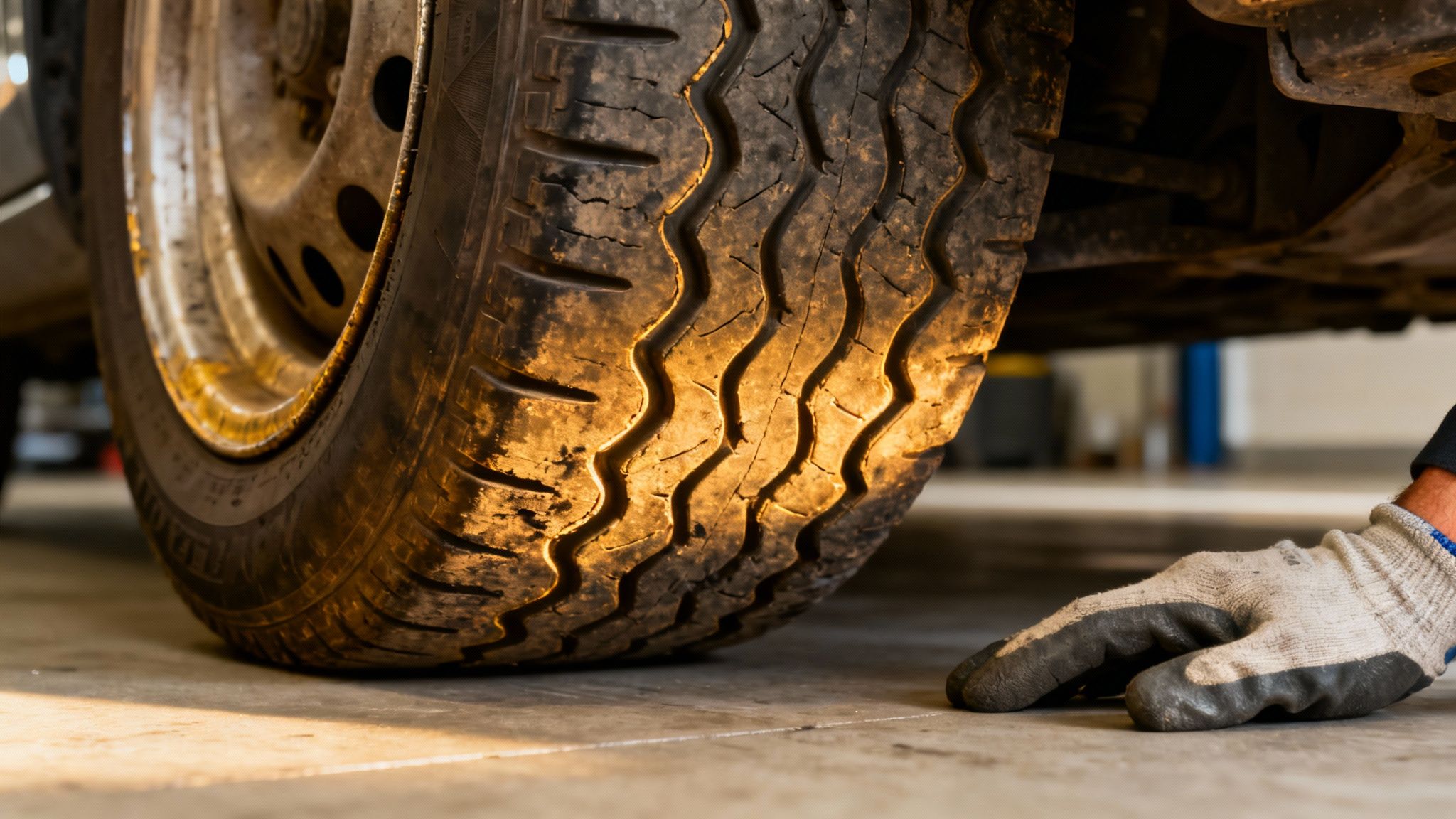
While many drivers associate tire wear solely with alignment, it's often one of the most revealing signs you need new shocks. Healthy shock absorbers are crucial for maintaining consistent and firm contact between your tires and the road. When they become weak, they can no longer control the rapid up-and-down motion of the wheel assembly, causing the tire to bounce, skip, and scuff along the pavement instead of rolling smoothly. This uncontrolled movement leads to very specific and damaging wear patterns.
This accelerated and irregular wear not only shortens the life of your expensive tires but also points to a deeper issue that compromises handling, braking efficiency, and overall vehicle safety. Ignoring it means you'll be replacing tires far more often than necessary while continuing to drive with a faulty suspension.
What to Look For
Tire manufacturers like Michelin and Goodyear often highlight suspension problems as a primary cause of premature tire failure. Inspect your tires regularly for these telltale signs:
- Cupping or Scalloping: This is the most definitive sign of bad shocks. It appears as a pattern of high and low spots or diagonal "scoops" worn into the tread, creating a washboard-like surface you can often feel by hand.
- Accelerated Wear: Are you replacing tires every 20,000 miles when they are rated for 40,000 or more? Worn shocks can dramatically reduce tire lifespan.
- Patchy Wear: You might notice bald spots or areas of significant wear concentrated in specific patches around the tire's circumference, indicating the tire is bouncing erratically on the road surface.
DIY Check: Monthly Tire Inspection
You don’t need to be a mechanic to spot these warning signs. A quick visual and tactile inspection can tell you a lot about your suspension's health.
- Turn your steering wheel all the way to one side to get a clear view of a front tire's tread.
- Visually inspect the entire surface for the patterns mentioned above.
- Carefully run your hand (with gloves, if you prefer) flat across the tread. A healthy tire will feel smooth. If you feel a distinct up-and-down, wavy, or bumpy pattern, this is a strong indication of cupping caused by failing shocks.
- Check the tread depth using the penny test. Insert a penny with Lincoln's head upside down into a tread groove. If you can see all of his head, your tread is worn and the tire needs replacement. Doing this in multiple spots can reveal uneven wear.
If you notice cupping or any other unusual wear, it’s a clear signal to seek a professional opinion. The ASE-certified technicians at Express Lube & Car Care can diagnose the root cause, whether it's the shocks, alignment, or another suspension component, and prevent you from wasting money on another set of tires.
3. Nose Diving During Braking
Another critical indicator that you have failing suspension components is when the front end of your vehicle dips or "nose dives" excessively when you apply the brakes. Functional shocks and struts are crucial for managing the forward weight transfer that occurs during deceleration. When they are worn, they can't effectively counteract this momentum, causing the vehicle's nose to plunge downward while the rear end lifts slightly.
This nose-diving effect is more than just an uncomfortable sensation; it's a significant safety issue. This imbalance can dramatically increase your vehicle's stopping distance, particularly in emergency braking situations. This is one of the more dangerous signs you need new shocks, as it directly impacts your ability to stop safely and avoid collisions.

What to Look For
Pay close attention to your vehicle’s behavior as you brake in various driving conditions around North Texas. You might notice this issue most when coming to a stop at traffic lights or in stop-and-go traffic on highways like Loop 820.
- Routine Stops: When you apply the brakes for a stop sign or red light, does the front of your car lurch forward and dip noticeably before coming to a rest? A healthy suspension keeps the vehicle relatively level.
- Sudden Braking: In a situation requiring a harder-than-normal stop, does the nose dive feel severe, almost like the front bumper is heading for the pavement? This indicates the shocks are completely failing to manage the weight transfer.
- Loaded Vehicle: The effect is often more pronounced when you're carrying heavy cargo or passengers, as the extra weight overwhelms the already weak shocks.
DIY Check: The Braking Observation Test
While a professional diagnosis is necessary, you can gauge the severity of the issue with a simple, safe test. This method is often taught by professional driving instructors and referenced in safety guidelines from organizations like the NHTSA.
- Find a safe, empty parking lot or a quiet, straight road with no traffic.
- Accelerate to a low, safe speed, such as 15-20 mph.
- Apply the brakes firmly and smoothly, as you would for a sudden stop.
- Pay close attention to the motion of your vehicle's front end. A slight dip is normal, but an aggressive, deep plunge or a feeling of instability is a major red flag.
- If the nose dive is significant, avoid hard braking on public roads until the issue is addressed, as your stopping distance is likely compromised.
If you observe a distinct nose dive, it’s a clear signal that your shocks are no longer providing the stability needed for safe braking. The ASE-certified technicians at Express Lube & Car Care can inspect your entire suspension system to confirm the cause and recommend the right repairs to restore your vehicle’s safety and performance.
4. Vehicle Leaning or Swaying During Turns
Another critical indicator that you have failing components is when your vehicle exhibits excessive leaning or swaying through turns. This phenomenon, often called “body roll,” is one of the more unsettling signs you need new shocks. Healthy shocks and struts provide resistance against the centrifugal forces that push your vehicle's body outward during a turn. When they're worn, they can't effectively manage this weight transfer, causing the vehicle to feel unstable and less responsive.
This loss of stability forces the driver to slow down more than usual for corners and can compromise emergency maneuvering. The feeling is often described as the vehicle being “top-heavy” or wallowing through a curve rather than confidently holding its line. This is especially dangerous in taller vehicles like SUVs, minivans, and trucks, where excessive body roll can increase the risk of a rollover.
What to Look For
Think about your daily commute through Richland Hills and surrounding areas. The familiar curves and turns you take every day are the best places to notice a change in your vehicle’s handling characteristics.
- Highway Ramps: As you enter or exit a highway ramp, does your vehicle lean dramatically to the outside of the curve, making you feel like you have to fight the steering wheel to stay on track?
- Routine Corners: On familiar 90-degree turns in your neighborhood, does the car feel like it’s lurching to one side? A vehicle with a healthy suspension should feel planted and stable.
- Lane Changes: During quick lane changes at higher speeds, does your vehicle sway back and forth more than once before stabilizing? This indicates the shocks are not controlling the body’s momentum.
DIY Check: The Curve Test
While driving, you can consciously evaluate your vehicle’s handling to gauge its suspension health. This isn't about aggressive driving, but rather mindful observation in a safe environment.
- Find a safe, familiar curve or a large, empty parking lot.
- Take the turn at a normal, safe speed.
- Pay close attention to how much the vehicle’s body leans. Does it feel excessive compared to how it used to handle?
- Notice if you have to make extra steering corrections mid-turn to keep the vehicle on your intended path.
- If the vehicle feels loose, unstable, or leans significantly more than you remember, it’s a strong signal that your shocks have degraded and can no longer provide adequate stability.
If your vehicle feels more like a ship at sea than a car on the road, it’s time for a professional evaluation. The ASE-certified experts at Express Lube & Car Care can accurately diagnose suspension issues and restore your vehicle’s safety and handling performance.
5. Visible Shock Absorber Fluid Leaks or Oil Stains
While many suspension issues are felt rather than seen, a leaking shock absorber is one of the most definitive visual signs you need new shocks. Shock absorbers are hydraulic components, filled with pressurized fluid that manages the compression and rebound of your suspension. When the seals inside the shock fail due to age or damage, this critical fluid begins to escape, leaving behind telltale evidence.
Once this fluid is lost, the shock can no longer provide the necessary dampening force, rendering it useless. Even a small leak indicates that the internal seals have been compromised and the shock is on its way to complete failure. This is a clear, non-negotiable warning that immediate replacement is required to maintain vehicle safety and prevent further suspension damage.
What to Look For
You don't need to be a mechanic to spot a leaking shock. With a good flashlight, you can perform a quick visual check of your suspension components in your own garage.
- Wet or Oily Shock Body: The most obvious sign is a shock absorber that looks wet or is covered in a layer of oily grime. Dust and road dirt naturally cling to this leaking fluid, creating a dark, greasy appearance that stands out from other dry, dusty suspension parts.
- Fluid Drips on Pavement: If the leak is severe, you might notice small puddles or drips of oily fluid on your driveway or garage floor, directly underneath the corner of the vehicle where the faulty shock is located.
- Stains in the Wheel Well: Check the areas surrounding the shock and inside the wheel well. Leaking fluid can be slung around as the wheel turns, leaving oily stains or splatters on nearby components.
DIY Check: The Visual Inspection
This simple check is a standard diagnostic procedure used by ASE-certified technicians and can be done during routine tasks like checking your tire pressure.
- Park your vehicle on a level surface and ensure it's turned off and the parking brake is engaged.
- For a better view, use a flashlight to look behind each wheel at the shock absorber. It’s the piston-like component, usually mounted vertically.
- Carefully examine the entire body of each shock absorber. Look for any signs of wetness, active dripping, or an accumulation of oily dirt and grime. A healthy shock should be relatively dry and clean.
- Compare all four shocks. If one appears significantly dirtier or oilier than the others, it is a strong indicator of a leak.
Ignoring a fluid leak is not an option; it’s a guarantee of poor handling, longer braking distances, and accelerated wear on your tires and other suspension parts. If you see any evidence of a leak, contact the ASE-certified team at Express Lube & Car Care for a professional inspection and replacement.
6. Clunking or Rattling Noises from Suspension
Unusual sounds coming from your vehicle are often the first alert that something is wrong, and this is especially true for your suspension. Persistent signs you need new shocks can manifest as distinct clunking, rattling, or knocking noises. These sounds typically occur when driving over bumps, dips, or uneven pavement and indicate a mechanical issue within the shock absorber or its mounting components.
When shocks wear out, their internal valves and pistons can fail, causing components to collide internally. Alternatively, the rubber bushings and mounts that secure the shock to the vehicle's frame can degrade and break, allowing the entire shock assembly to move excessively and strike other suspension parts. Ignoring these noises can lead to further damage and compromise vehicle safety.
What to Listen For
Become an active listener during your daily drives around Richland Hills and Northeast Tarrant County. A specific sound can provide valuable clues about the problem's source.
- Distinct Clunk Over Bumps: Do you hear a loud, metallic clunking sound from one corner of your car when you hit a pothole or speed bump? This often points to a worn-out shock mount or a loose fastener.
- Persistent Rattling on Rough Roads: Does your vehicle produce a rattling or knocking sound that is noticeable on uneven roads but seems to disappear on smooth pavement? This could be a sign of a failing internal shock component.
- Worsening Noises Under Load: If you notice the sounds are louder or more frequent when your car is loaded with passengers or cargo, it puts extra stress on the suspension and can amplify the noise from failing shocks.
How to Isolate the Sound
Pinpointing the source of a suspension noise can help our technicians diagnose the issue faster. Try these simple listening exercises safely.
- Find a safe, empty parking lot or a quiet local street with minor imperfections like small bumps or uneven sections.
- With the radio off and windows down, drive slowly over these imperfections.
- Listen carefully to determine which corner of the vehicle the noise is coming from (front-left, rear-right, etc.).
- Try to describe the sound. Is it a sharp "clunk," a dull "thud," or a high-pitched "rattle"? The more specific you can be, the better.
- If it's safe to do so, have a passenger record a short video or audio clip of the noise with their phone to play for our technicians.
These noises are your vehicle’s way of telling you that a critical component is failing. Because a loose or broken shock can affect steering control and stability, you should never ignore them. The ASE-certified team at Express Lube & Car Care can quickly and accurately diagnose suspension noises and determine if shock replacement is the solution.
7. Difficulty Maintaining Vehicle Control on Wet or Slippery Roads
One of the most dangerous signs you need new shocks is a noticeable loss of control on wet, icy, or slippery roads. Effective shock absorbers are critical for keeping your tires firmly planted on the pavement, allowing them to maintain grip. When shocks are worn, they can't manage the suspension's movement effectively, causing the tires to bounce subtly and lose consistent contact with the road. On a dry day, this might be barely noticeable, but on a wet surface, that split-second loss of contact is all it takes to hydroplane or skid.
This creates a significant safety hazard, especially during the sudden, heavy downpours common in North Texas. A vehicle with failing shocks can feel unpredictable and “loose” when you need stability the most, dramatically increasing the risk of an accident during adverse weather conditions. The suspension's inability to adapt to the slick surface compromises braking, accelerating, and cornering.
What to Look For
Pay close attention to your vehicle's behavior the next time you're driving in the rain or on slick roads. These are clear indicators of compromised suspension performance.
- Hydroplaning: Does your vehicle hydroplane or lose traction more easily than it used to, even at moderate speeds on wet highways like Loop 820 or SH-183?
- Instability While Braking: When you apply the brakes on a wet road, does the vehicle feel like it wants to slide, fishtail, or take longer to stop? Worn shocks can contribute to a loss of traction during braking.
- "Squirrelly" Feeling: Do you feel a lack of confidence or a "squirrelly," unpredictable sensation when changing lanes or navigating curves on wet pavement? This suggests the tires are not maintaining consistent contact.
- Loss of Grip on Acceleration: When accelerating from a stop on a wet surface, do your tires spin or slip more than they should? Healthy shocks help manage weight transfer to maintain traction.
Proactive Safety Tip: Don't Wait for a Storm
The worst time to discover your shocks are bad is during a severe weather event. Being proactive is key to ensuring your family's safety on the road.
- Pay Attention in Mild Conditions: Note any changes in handling during light rain or on damp roads. Don't dismiss minor slips or slides.
- Seasonal Checks: Make a suspension inspection part of your vehicle's seasonal preparation in the spring and fall, ahead of the rainiest and iciest months.
- Reduce Speed: If you suspect an issue, significantly reduce your speed on wet roads until you can have the vehicle inspected. Give yourself more following distance and avoid sudden maneuvers.
- Seek Professional Inspection: If you notice any of these symptoms, don't wait. The problem will only get worse and puts you at unnecessary risk.
Unstable handling in wet weather is a serious red flag. For a definitive diagnosis, the ASE-certified technicians at Express Lube & Car Care can perform a comprehensive suspension check to ensure your vehicle is safe and ready for any weather conditions in Richland Hills and beyond.
7-Point Comparison: Signs You Need New Shocks
| Warning Sign | Implementation Complexity 🔄 | Resource Requirements ⚡ | Expected Outcomes 📊⭐ | Ideal Use Cases 💡 | Key Advantages ⭐ |
|---|---|---|---|---|---|
| Excessive Bouncing After Bumps | Low — simple bounce test, obvious in drive | Minimal inspection; possible shock replacement (moderate time/cost) | Rapidly restores ride comfort and stability; high safety benefit ⭐⭐⭐ | Routine driving checks, immediate safety concerns | Easily noticed, quick to diagnose, prompts prompt service |
| Uneven or Excessive Tire Wear | Moderate — visual analysis and pattern diagnosis | Tire inspection, rotation, alignment and likely shocks replacement | Longer tire life, better fuel economy, improved handling ⭐⭐⭐ | Regular maintenance, fleet tire management, pre-trip checks | Prevents repeated tire costs; visible early warning |
| Nose Diving During Braking | Low–Moderate — perceptible during braking maneuvers | Brake and shock inspection; possible shock/brake service (moderate) | Improved braking stability, reduced stopping distance; safety-critical ⭐⭐⭐ | Emergency-braking scenarios, family commuting, heavy loads | Clear safety indicator; immediate driver-detected warning |
| Vehicle Leaning or Swaying During Turns | Moderate — needs dynamic cornering assessment | Professional suspension check, possible shocks, sway bar or alignment work | Restored cornering control and reduced rollover risk ⭐⭐⭐ | Highway curves, SUVs/trucks, loaded vehicles | Direct handling improvement; reduces rollover/instability risk |
| Visible Shock Absorber Fluid Leaks or Oil Stains | Low — visual confirmation is definitive | Visual inspection; typically shock replacement required (straightforward) | Restores damping function and prevents further suspension damage ⭐⭐⭐⭐ | Routine under-vehicle checks, oil-change inspections | Tangible proof of failure; easy to document for warranty/repair |
| Clunking or Rattling Noises from Suspension | Moderate — requires road test and pinpointing source | Diagnostic road test, inspection of mounts/bushings/shocks; possible parts replacement | Eliminates progressive damage and unexpected failures; diagnostic value ⭐⭐ | Drivers noticing persistent noises, delivery/fleet vehicles | Audio cue encourages timely inspection; can be recorded for diagnosis |
| Difficulty Maintaining Control on Wet/Slippery Roads | Moderate–High — may only appear in adverse conditions | Comprehensive inspection (shocks, tires, alignment); likely multi-component work | Significant improvement in traction and all-weather safety; critical impact ⭐⭐⭐⭐ | Wet-climate driving, family transport, commercial routes | High safety relevance; motivates urgent, proactive repair |
Don't Wait for a Breakdown—Restore Your Ride's Safety Today
Recognizing the subtle (and not-so-subtle) warnings your vehicle sends is the most critical step toward maintaining control and safety on the road. The journey through the key signs you need new shocks has highlighted how interconnected your vehicle's systems truly are. What might begin as a seemingly minor annoyance, like extra bouncing over a speed bump, is actually a clear signal that your car's stability is compromised.
Ignoring these symptoms doesn't just lead to a rougher ride; it creates a domino effect of potential dangers and expenses. A bouncy suspension can quickly evolve into poor braking performance, unpredictable handling during turns, and a dangerous loss of traction on wet roads. Your tires, forced to work overtime without proper damping, will wear down unevenly and prematurely, costing you hundreds of dollars in unnecessary replacements.
From Symptoms to Solutions: Your Actionable Next Steps
The power is now in your hands. You've learned to identify the telltale symptoms:
- The lingering "bounce test" failure after hitting a pothole.
- The unsettling "nose-dive" when you apply the brakes.
- The unnerving sway or lean as you navigate a corner.
- The cupped or scalloped patterns appearing on your tire treads.
These are not just quirks your car has developed; they are direct calls for action. The simple, at-home checks we've discussed, like the bounce test and visual inspections for fluid leaks, are your first line of defense. They empower you to move from being a passive passenger to an informed vehicle owner, capable of catching problems before they escalate into roadside emergencies.
The True Value of a Healthy Suspension
Ultimately, investing in your vehicle's suspension is an investment in your safety and peace of mind. A car with healthy shocks and struts is a car that responds predictably. It stops shorter, corners with confidence, and maintains a firm grip on the road, especially in adverse weather conditions. This isn't a luxury repair; it's a foundational component of vehicle safety that protects you, your passengers, and others on the road.
Don't dismiss these crucial warning signs. Proactively addressing a failing suspension system restores the precise handling and comfort your vehicle was designed to provide. By taking the next step and seeking a professional inspection, you ensure that small issues don't become major, costly failures. Your drive through Northeast Tarrant County should be smooth, stable, and secure, and it all starts with a healthy suspension.
Ready to eliminate the bounce and restore your vehicle's stability? The ASE-certified experts at Express Lube & Car Care in Richland Hills offer comprehensive suspension inspections and quality shock and strut replacement services. Drive in today for a fast, no-appointment-needed assessment and get back on the road with confidence.