

So, you're wondering if synthetic oil is really better for your car. The short answer? From a pure performance and engine protection standpoint, it's a resounding yes.
This isn't just marketing hype or garage talk; it's a conclusion backed by decades of engineering, testing, and real-world results from drivers just like you.
The Definitive Answer on Synthetic Oil
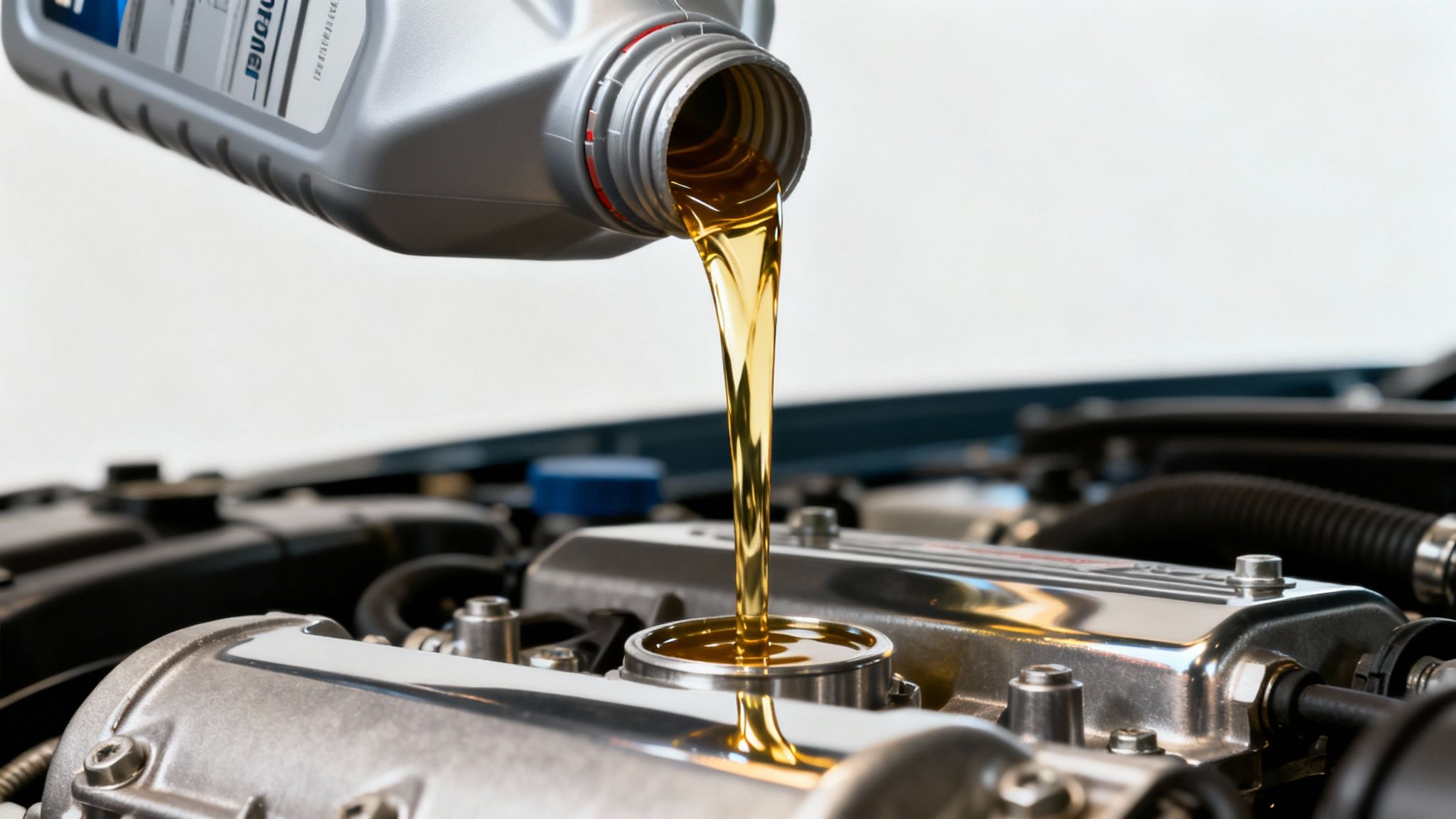
Think of it this way: conventional oil is a refined natural product, kind of like filtered well water. It does the job, but it has natural impurities and inconsistencies. Synthetic oil, on the other hand, is created from the ground up in a lab. Scientists engineer its molecules to be uniform and pure, which directly translates to better, more predictable performance inside your engine.
This precise engineering gives synthetic oil a clear edge in a few critical areas that every driver should care about:
- Superior Engine Protection: It creates a stronger, more resilient film over moving parts, significantly reducing wear and tear.
- Extreme Temperature Performance: Synthetics flow smoothly on a cold winter morning and resist breaking down under intense summer heat, protecting your engine when it's most vulnerable.
- Keeps Your Engine Cleaner: Advanced additives in synthetic oil are much better at preventing the buildup of harmful sludge and carbon deposits.
- Longer Oil Change Intervals: Its robust chemical structure means it doesn't degrade as quickly, letting you go longer between oil changes.
The data backs this up. Studies have shown that synthetic oils can reduce engine wear by up to 47% compared to conventional oils, especially under demanding conditions like towing or stop-and-go traffic. This durability allows for much longer drain intervals—often 10,000 to 15,000 miles, which is a huge leap from the typical 3,000-5,000 mile window for conventional oil. For more technical details, SNS Insider offers in-depth analysis on lubricant performance.
Key Takeaway: The price difference isn't just for a fancy label. You're paying for advanced science that delivers measurable improvements in engine protection, longevity, and overall performance.
To help you see the differences at a glance, we put together a simple table.
Quick Look Synthetic vs. Conventional Oil
| Attribute | Synthetic Oil | Conventional Oil |
|---|---|---|
| Origin | Chemically engineered in a lab | Refined from crude oil |
| Molecular Structure | Uniform and consistent | Irregular and varied |
| Performance | Excellent in extreme temperatures | Adequate in moderate conditions |
| Engine Cleanliness | High resistance to sludge | More prone to deposit formation |
| Longevity | Extended drain intervals | Shorter drain intervals |
| Cost | Higher initial price | Lower initial price |
While conventional oil meets the basic requirements to keep your engine running, synthetic oil is designed to exceed them. Now, let's dive deeper into what these differences really mean for your car.
Understanding What Makes Synthetic Oil Different
To really get why synthetic oil is a better choice for most modern cars, we need to go beyond the marketing and look at how it’s actually made. The difference isn't just about extra filtering; it's about building the oil from the ground up, molecule by molecule.
Conventional motor oil comes straight from crude oil pulled out of the ground. It gets refined, sure, but that process can only remove so many impurities. You're left with oil molecules that are all different shapes and sizes. Think of it like trying to build a wall with a pile of random rocks—it works, but it’s got gaps and weak spots.
Synthetic oil, on the other hand, is engineered in a lab. Chemists take ultra-pure base oils and design molecules that are perfectly uniform in size and shape. This process gets rid of all the junk and inconsistencies you find in conventional oil. What you end up with is a lubricant built for one purpose: protecting your engine.
The Engineered Advantage
This uniformity at the molecular level is synthetic oil's secret weapon. Because every molecule is identical, it creates a stronger, more consistent film of protection over your engine's moving parts. There are no "weak links" in the chain.
The real edge synthetic oil has is its purity and consistency. By engineering the oil molecule by molecule, chemists eliminate the unstable stuff that breaks down under heat and stress—which is what causes engine sludge in the first place.
This engineered design leads to some huge real-world benefits:
- Less Friction: Uniform molecules slide past each other smoothly, which means less drag inside your engine and potentially better fuel economy.
- Extreme Temperature Stability: The strong molecular bonds in synthetic oil don't break down easily in high heat, and it flows better in the cold for easier starts.
- Superior Cleanliness: Synthetics are packed with higher-quality additives that do a much better job of suspending dirt and preventing sludge from building up.
Basically, conventional oil is something we find, while synthetic oil is something we make. That control allows it to offer protection that crude oil simply can't match. When you understand the science, it's easy to see why it outperforms conventional oil in almost every way and answers the question, "is synthetic oil better?" with a definite yes for today's engines.
How Does Oil Perform in Real-World Conditions?
Lab results are one thing, but what really matters is how your motor oil holds up during your daily commute. Whether you're facing a frosty North Texas morning, a brutal summer afternoon, or just stop-and-go traffic on the 820, your engine is under constant stress. To answer the question "is synthetic oil better?" we have to look at how it handles these real-world challenges.
The key difference is that synthetic oil is engineered from the ground up. Its pure, uniform molecules create a consistent, durable layer of protection that conventional oil’s rough, irregular structure just can’t replicate.
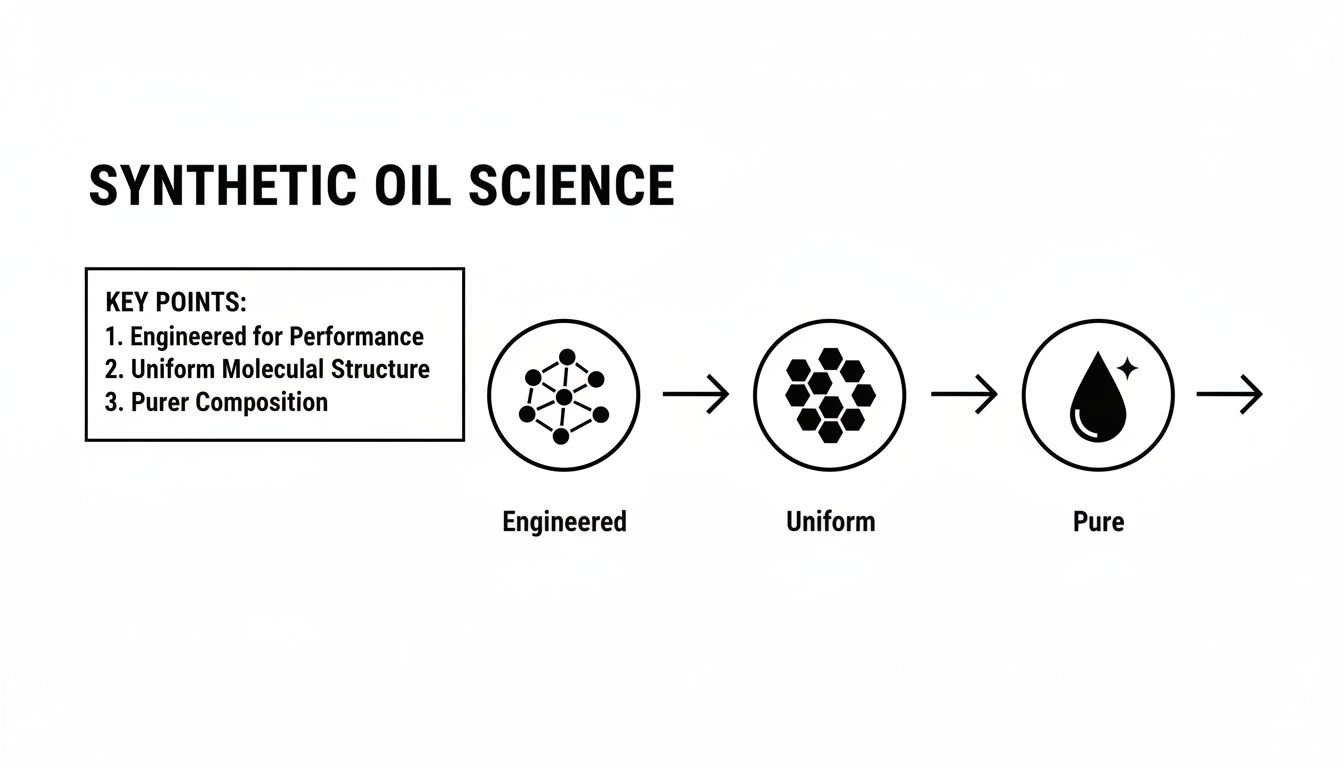
This uniform design isn't just for show—it translates directly into more reliable protection when your engine needs it most. Let's break down three critical scenarios where this engineered advantage makes all the difference.
Protection During Cold Starts
Starting your car on a cold morning is one of the toughest things you can ask of your engine. Conventional oil gets thick and sluggish in low temperatures, flowing like cold molasses. This means it takes way too long to circulate and lubricate critical components, causing a lot of friction and wear in those first few crucial seconds.
Synthetic oil, on the other hand, is designed to stay fluid even when the temperature plummets. It flows much faster on startup, ensuring vital parts like bearings, pistons, and your valvetrain get lubricated almost instantly. That rapid circulation minimizes the harsh metal-on-metal contact that leads to long-term engine damage.
Real-World Impact: Picture two identical cars on a freezing day. The engine running synthetic oil gets lubrication up to 40% faster than the one with conventional oil. That dramatically cuts down on startup wear and helps the engine last longer.
Stability at High Temperatures
Engines don’t just deal with cold—they generate a massive amount of heat, especially in modern turbocharged vehicles or when you're towing a trailer. High temperatures are the natural enemy of conventional oil. Heat causes it to break down, thin out, and evaporate, a process known as volatility. When oil gets too thin, it can’t maintain a proper protective film, leading to accelerated wear.
This is where synthetic oil’s stability really shines. Its robust molecular structure resists thermal breakdown far better than conventional oil ever could. It holds its viscosity and protective qualities even under extreme heat, making sure your engine stays shielded. This incredible resilience is a major reason why so many automakers now require it from the factory.
Resistance to Sludge and Deposits
Over time, oil breaks down from oxidation and contamination. This process creates sludge—a thick, tar-like gunk that clogs up vital oil passages, starves your engine of lubrication, and can lead to catastrophic failure. Because they start with more impurities, conventional oils are far more likely to form this kind of nasty buildup.
Synthetic oils are packed with high-quality detergents and dispersants that keep your engine impressively clean. They're excellent at neutralizing corrosive acids and trapping contaminants in suspension until they get drained out at your next oil change. This active cleaning prevents sludge before it can start. Of course, a clean oil filter is essential, too; you can learn more about its role by reading our guide on proper filter replacement.
Ultimately, by resisting breakdown and actively cleaning your engine, synthetic oil ensures everything operates efficiently for a lot longer. It's proof that the benefits aren't just theoretical—they're something you can count on every time you drive.
Calculating the True Cost of Your Oil Change
The number one reason drivers hesitate to switch to synthetic oil is the price tag. When you see that a full synthetic oil change costs more upfront than a conventional one, it's natural to wonder if you're really getting your money's worth.
But to answer that question, you have to look past the initial receipt. The real value of synthetic oil isn’t about what you pay today—it’s about what you save down the road.
The Long-Term Financial Equation
The most immediate saving comes from going longer between oil changes. Conventional oil usually needs replacing every 3,000 to 5,000 miles. A quality full synthetic, on the other hand, can easily protect your engine for 10,000 miles or more, depending on your car and how you drive it.
That means you might only need one synthetic oil change for every two or even three conventional ones. Suddenly, that initial price difference doesn't seem so big. You're also saving yourself the time and hassle of multiple trips to the shop each year.
To put it into perspective, let's look at a quick cost comparison for a typical driver.
Annual Cost Breakdown: Synthetic vs. Conventional
| Cost Factor | Synthetic Oil (Example) | Conventional Oil (Example) |
|---|---|---|
| Cost Per Oil Change | $90 | $55 |
| Miles Per Year | 12,000 | 12,000 |
| Change Interval | 10,000 miles | 4,000 miles |
| Annual Changes Needed | 1-2 | 3 |
| Total Annual Cost | $90 – $180 | $165 |
As you can see, the annual costs often end up being very close, and in some cases, synthetic can even be cheaper. This calculation doesn't even touch on the other hidden savings.
Uncovering the Hidden Savings
Beyond just fewer oil changes, synthetic oil’s advanced chemistry saves you money in other, less obvious ways.
For starters, it reduces friction far better than conventional oil. Its molecules are uniform and glide past each other with less resistance, which means your engine doesn't have to work as hard. This small improvement in efficiency can lead to a 2-3% boost in fuel economy. It might not sound like much, but those little savings at the gas pump really add up over a year.
The biggest financial benefit, though, is preventing expensive repairs. Synthetic oil forms a stronger, more durable film on your engine's internal parts, drastically reducing wear and tear.
Consider these long-term advantages:
- Less Wear on Engine Parts: Better protection against heat, sludge, and friction means your pistons, bearings, and other critical components last longer. This can help you avoid major repair bills.
- Fewer Breakdowns: A cleaner, cooler-running engine is a more reliable engine. Synthetic oil lowers the risk of part failure, which can save you thousands.
- Better Resale Value: A service history showing consistent use of premium synthetic oil is a huge selling point. It tells a potential buyer that the vehicle was maintained to the highest standard.
When you weigh the slightly higher cost against fewer oil changes, better gas mileage, and a healthier engine, the choice becomes much clearer. If you're looking for a middle-of-the-road option, our guide on the oil change interval with synthetic blend can help you decide.
When Should You Choose Synthetic Oil?

So, is synthetic oil really worth it for your car? The answer comes down to how you drive and what you drive. For a lot of modern vehicles, synthetic isn't just a luxury—it’s a necessity for keeping the engine running right for the long haul.
The engineered, uniform molecules in synthetic oil give it a level of protection that conventional oil just can't touch when things get tough. If your driving habits or vehicle fall into any of these categories, making the switch is one of the smartest moves you can make.
High-Performance and Turbocharged Engines
Modern engines, especially the turbocharged ones found in everything from pickups to sedans, run incredibly hot. A turbo can spin at over 200,000 RPM, generating extreme heat that puts a ton of stress on the oil responsible for cooling and lubricating it.
Under that kind of heat, conventional oil starts to break down and cook. This can lead to nasty carbon deposits—a problem known as "coking"—that clogs up oil passages and can ruin a turbo in no time. Synthetic oil is built to handle the heat, resisting breakdown and keeping those high-performance parts protected.
Heavy Towing or Hauling
Putting a heavy load on your vehicle—whether it’s a camper, a boat, or a work trailer—forces your engine to work overtime. It runs hotter and at higher RPMs for longer stretches, which is the perfect recipe for thinning out and degrading conventional oil.
Why It Matters: In a hard-working engine, the oil's main job is to keep a strong, protective film between all the moving metal parts. Synthetic oil has superior "shear stability," which means it holds its thickness (viscosity) under pressure, preventing the metal-on-metal wear that kills engines prematurely.
Extreme Hot and Cold Weather
Texas weather puts a unique strain on motor oil. During a cold snap, conventional oil gets thick like molasses, which means it flows poorly when you first start your engine. For those first critical seconds, your engine is essentially running without proper lubrication. Synthetics are engineered to stay fluid even in the cold, circulating instantly for immediate protection.
On the flip side, our brutal summer heat can cause conventional oil to thin out and even evaporate, leaving your engine vulnerable. Synthetic oil is far more resistant to high-temp breakdown and has lower volatility, ensuring it maintains its protective qualities on even the hottest days.
Whether you're dealing with a surprise freeze or a scorching August afternoon in Richland Hills, synthetic offers far more reliable year-round protection. That's why we offer a full range of professional oil change services to match your car's specific needs.
Common Questions About Synthetic Oil
Even with the benefits laid out, you probably have a few practical questions. Let's clear up some of the most common concerns drivers have when considering the switch.
Can I Mix Synthetic and Conventional Oil?
Absolutely. You can switch back and forth between conventional, synthetic blend, and full synthetic oil without harming your engine. Modern oils are designed to be fully compatible with each other.
Just remember, you only get the full performance perks—like longer drain intervals and superior engine protection—with a consistent, full synthetic oil change. If you go back to conventional, you also need to go back to the shorter 3,000-5,000 mile change schedule.
Will Synthetic Oil Void My Car's Warranty?
Not at all. Using synthetic oil is perfectly safe for your warranty, as long as it meets the specifications listed in your owner’s manual. The key is to use the right viscosity grade (like 5W-30) and performance standard (like API SP).
In fact, most newer vehicles, especially those with high-performance or turbocharged engines, now require full synthetic oil just to maintain the warranty. Always double-check your manual, but you can be confident that a high-quality oil that meets or exceeds the manufacturer's standard is a good thing.
Is Synthetic Oil a Good Idea for My Older Car?
Yes, it’s often one of the best things you can do for a high-mileage vehicle. Many oil manufacturers produce "high-mileage" full synthetic formulas for this exact reason.
These oils are packed with special additives and seal conditioners that help rejuvenate aging gaskets and seals. This can slow down or even stop minor oil leaks and reduce the amount of oil your engine "burns off" between changes. Plus, their powerful detergents gently clean out years of sludge buildup, which helps the engine run healthier for longer.
Ready to give your engine the protection it deserves? The ASE-certified pros at Express Lube & Car Care are ready to help. Swing by our Richland Hills shop for a quick, professional oil change—no appointment necessary. Learn more about our oil change services and get directions today!