

So, how long can you really go between oil changes with a synthetic blend? As a rule of thumb, you’re looking at an interval between 5,000 and 7,500 miles, or whenever your car’s oil life monitor tells you it’s time.
This makes it a fantastic upgrade from conventional oil’s much shorter lifespan, without making the full jump in price to a 100% synthetic.
The Smart Middle Ground for Oil Changes
Trying to pick the right motor oil can feel overwhelming, but synthetic blends make the choice a lot easier. Think of it as the perfect hybrid—it takes the affordable, reliable base of conventional mineral oil and mixes in high-performance synthetic additives.
What does that do for your engine? It means you get much better resistance to high heat and engine sludge. This keeps critical parts cleaner and helps your engine run smoother for longer. For the everyday driver, this balanced formula really hits the sweet spot. You get a noticeable boost in engine protection and can go longer between service appointments, making it a smart, practical choice for most modern cars on the road today.
Understanding the Mileage Advantage
Synthetic blend oils are perfect for drivers who want more out of their oil without the premium price tag of a full synthetic. Industry-wide, the consensus for synthetic blends is an oil change every 5,000 to 7,500 miles. That’s a huge leap—about 50-67% longer—than the old 3,000-5,000 mile interval for conventional oil. If you want to dive deeper, you can learn more about the industry standards for synthetic oil change intervals and see how these recommendations are made.
This chart gives a quick visual breakdown of where the different oil types land.
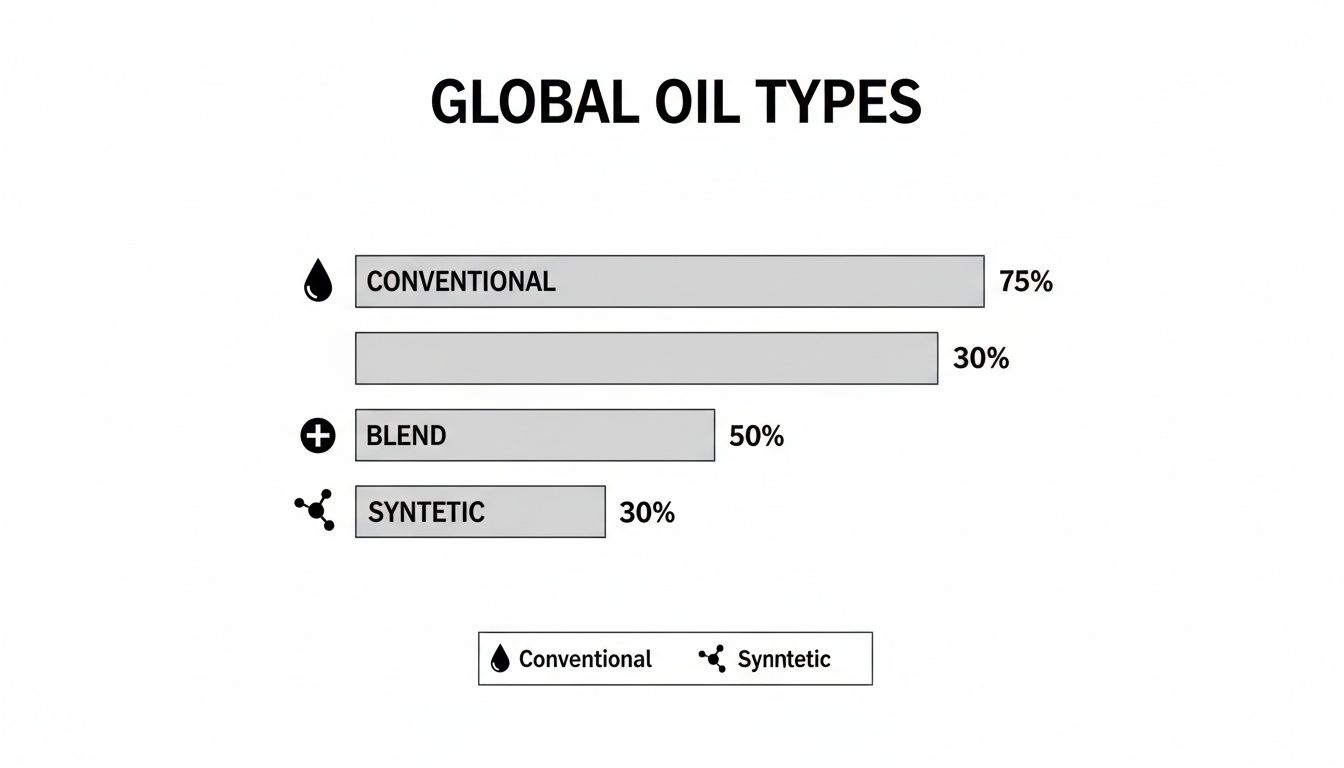
As you can see, the synthetic blend sits comfortably in that middle zone, giving you a serious mileage boost over conventional for just a small increase in cost. It’s easy to see why it’s become such a popular go-to for drivers who want both value and performance.
Motor Oil Comparison at a Glance
To help put it all into perspective, here’s a quick comparison of the three main types of motor oil you’ll find.
| Oil Type | Typical Change Interval (Miles) | Performance Characteristics | Best For |
|---|---|---|---|
| Conventional | 3,000 – 5,000 | Provides basic lubrication and standard protection. | Older vehicles with simpler engine designs; drivers focused on budget-friendly maintenance. |
| Synthetic Blend | 5,000 – 7,500 | Offers improved protection against heat, oxidation, and sludge buildup. | Daily commuters and family vehicles looking for better performance and longer service intervals. |
| Full Synthetic | 10,000 – 15,000+ | Delivers maximum protection in extreme hot and cold temperatures and under heavy-duty conditions. | High-performance, turbocharged, and luxury vehicles; drivers who want the absolute longest intervals. |
Each type has its place, but the synthetic blend offers that ideal balance of protection, longevity, and cost for the vast majority of cars and drivers.
What Exactly Is Synthetic Blend Oil?
Before we talk about how often you should change your oil, let’s break down what a synthetic blend actually is. It’s not quite conventional, but it’s not fully synthetic either. Think of it as the best of both worlds, designed to give your engine a serious upgrade without the premium price tag.
The simplest way to picture it is a strategic mix. You start with a reliable, cost-effective conventional oil base and then enrich it with a healthy dose of high-performance synthetic oil.
This hybrid approach delivers a huge boost in protection and longevity over old-school conventional oil.
The Power of the Blend
The “magic” really comes from the synthetic part of the formula. Synthetic oil is engineered in a lab, meaning its molecules are pure and uniform. This structure makes it incredibly resilient to extreme heat and cold. When you mix that into conventional oil, those superior qualities get shared throughout the blend.
This gives synthetic blend oil much better resistance to two of your engine’s worst enemies: heat and sludge.
- Fighting Thermal Breakdown: When your engine runs hot, conventional oil can start to thin out, evaporate, and break down, leaving crucial parts vulnerable. The synthetic additives in a blend help it maintain its thickness and stability, ensuring your engine stays protected even under stress.
- Preventing Sludge: Over time, oil oxidizes and can form a thick, gunky sludge that clogs up vital oil passages. Synthetic blends are formulated to resist this process, which keeps your engine cleaner and running more efficiently for longer.
The bottom line? A synthetic blend gives you about 70% of the performance perks of a full synthetic—like better wear protection and a cleaner engine—at a much more budget-friendly price.
It’s All in the Additives
Beyond the oil itself, synthetic blends are loaded with a sophisticated package of additives. These are the unsung heroes working behind the scenes, acting like vitamins for your engine to keep it in peak condition between oil changes.
Here’s a quick look at the key players in that additive pack:
- Detergents: These actively clean away existing deposits from engine surfaces, stopping sludge before it even has a chance to build up.
- Dispersants: They grab onto contaminants like soot and tiny metal particles, keeping them suspended in the oil until they’re trapped by the filter.
- Anti-Wear Agents: This is a big one. They form a microscopic, protective layer on metal-on-metal surfaces, dramatically reducing friction and wear on parts like pistons and bearings.
- Viscosity Modifiers: These clever additives help the oil stay at the perfect consistency, whether you’re starting your car on a cold morning or driving on the highway in the Texas heat.
By combining a stronger base oil with these powerful additives, synthetic blend oil offers a significant leg up in engine protection. That improved formula is exactly why you can go longer between changes with a synthetic blend oil change interval compared to a conventional one.
Decoding Manufacturer Recommendations for Your Car

When it comes to car maintenance, your owner’s manual is the bible. But let’s be honest, sometimes it feels like it’s written in a different language. For synthetic blend oil changes, this manual is still your best source of truth.
The old 3,000-mile rule is a thing of the past. Modern engines and advanced oil formulas—like synthetic blends—have completely changed the game. Today, major brands like Honda, Toyota, and Ford have much longer recommended service intervals.
Manufacturers have crunched the numbers, pushing the typical synthetic blend oil change interval to a much healthier 5,000 to 7,500 miles for most cars and trucks. For popular models like the Ford F-150 and Chevy Silverado, they often specify 7,500 miles under normal conditions. This isn’t just a guess; it’s a data-backed shift that keeps your warranty intact and your engine happy. If you want to dive deeper, it’s worth learning how manufacturers determine these intervals.
Normal vs. Severe Driving Conditions
One of the most important—and most misunderstood—parts of your manual is the difference between “normal” and “severe” driving schedules. Most of us assume our daily commute is “normal,” but you might be surprised.
A huge number of drivers, maybe even most, actually fall into the “severe” category without ever realizing it. Figuring out which one you are is the key to protecting your engine.
Knowing where you fit directly impacts how often you should be changing your oil. An honest look at your driving habits is the best thing you can do for your car’s long-term health.
Identifying Your Driving Style
So what’s the difference? It has less to do with being a lead-foot and more about the stress your routine puts on your engine and its oil.
You probably have a “Normal” driving schedule if you:
- Spend most of your time on highways at a steady speed.
- Take longer trips that let the engine get fully warmed up.
- Live in a mild climate without extreme heat or cold.
- Rarely tow anything or load up the car with heavy gear.
On the other hand, you should follow the “Severe” schedule if you do any of the following, because these habits break down oil much faster.
You fall into the “Severe” driving category if you:
- Frequently make short trips (less than five miles).
- Sit in a lot of stop-and-go city traffic.
- Regularly tow a trailer or carry heavy loads on a roof rack.
- Drive in extreme heat or freezing cold.
- Drive on dusty, sandy, or heavily salted roads.
For most of us, our daily drive is a mix of these things, which firmly plants us in the severe category. If that sounds familiar, it’s a smart move to aim for the shorter end of your recommended oil change interval to keep your engine properly protected.
Factors That Shorten Your Oil Change Interval
That 5,000 to 7,500-mile guideline for a synthetic blend oil change is a great starting point, but it’s not set in stone. Think of it more like a best-case scenario. Real life, with its traffic jams, short trips, and Texas heat, has a way of wearing down your oil much faster.
Your motor oil is a lot like an athlete. One running a marathon on a flat, cool day can go a lot farther than another running uphill in blistering heat. Your engine oil faces similar challenges, and certain conditions will use up its protective additives much quicker than you’d think.
How You Drive Matters Most
The single biggest factor influencing your oil’s lifespan is how you drive every day. A lot of us think our commute is “normal,” but what manufacturers consider “severe service” might surprise you—it includes a lot of very common driving habits.
If your routine involves any of these, you’ll need to shorten your oil change interval to keep your engine safe:
- Frequent Short Trips: Do you often drive less than five miles at a time? If so, your engine probably isn’t reaching its ideal operating temperature. This allows condensation and unburnt fuel to mix with the oil, creating a nasty sludge that gums up your engine.
- Stop-and-Go Traffic: City driving is brutal on oil. The constant braking and accelerating, combined with a lack of steady airflow, makes engine temperatures spike. That heat is the enemy of oil, causing it to break down chemically and lose its ability to lubricate.
- Towing or Hauling Heavy Loads: Putting your vehicle to work hauling a trailer or loading up the roof rack puts a massive strain on the engine. All that extra effort generates a ton of heat, pushing your oil to its thermal limits and thinning it out.
Your Vehicle’s Age and Environment
It’s not just about your driving style. Your car’s age and the world around it play a huge part in how long your oil lasts. An older engine works differently than a new one, and our local climate can be just as tough as heavy traffic.
An engine with over 100,000 miles often needs its oil changed 15-20% more frequently. Normal wear and tear can lead to increased oil consumption and higher levels of contaminants circulating through the system.
A few other critical things to keep in mind:
- Vehicle Age and Condition: As engines get older, seals can wear out. This leads to more “blow-by,” where combustion gases sneak past the piston rings and contaminate the oil, quickly degrading its protective additives.
- Extreme Temperatures: We know all about intense summer heat here. High temperatures accelerate oil breakdown. On the flip side, cold winter starts are tough, too, because the oil is thick and doesn’t circulate well, causing extra wear in those first few moments.
- Dusty or Dirty Roads: Kicking up dust on gravel or construction-heavy roads introduces tiny particles into your engine. Your air filter catches most of it, but some always gets through, turning your oil into a gritty, abrasive paste.
Keeping your filters clean is your best defense against contaminants. Our guide to engine and cabin air filter replacement services explains just how vital this simple service is for your engine’s long-term health.
How Your Driving Habits Impact Oil Longevity
To put it all together, the “normal” interval on the bottle is just a guide. Your reality is what truly matters. This table breaks down how common driving conditions affect your synthetic blend oil, helping you decide if you need to come in sooner.
| Factor | Impact on Interval | Recommended Adjustment |
|---|---|---|
| Frequent Short Trips (< 5 miles) | Shortens | Change oil 1,000-1,500 miles sooner. |
| Heavy Stop-and-Go Traffic | Shortens | Reduce interval by at least 1,000 miles. |
| Towing or Hauling | Significantly Shortens | Change oil after any long trip or 30-40% sooner. |
| Extreme Heat or Cold | Shortens | Reduce interval by 500-1,000 miles. |
| Dusty/Dirty Environments | Shortens | Change oil more frequently and check air filter often. |
| Mostly Highway Driving | Lengthens | Can often go to the upper end of the recommended range. |
| High-Mileage Engine (>100k miles) | Shortens | Reduce interval by 15-20% to manage contaminants. |
Ultimately, paying attention to how and where you drive is the best way to protect your engine. If you’re consistently putting your vehicle through these tougher conditions, a more frequent oil change is the cheapest insurance you can buy for your engine’s health.
Warning Signs That Your Car Needs an Oil Change

While the sticker on your windshield and your owner’s manual give you a great starting point for your oil change interval with synthetic blend, your car has its own ways of telling you it needs service. Learning to spot these clues is one of the best ways to stop a small issue from turning into a major, wallet-draining repair.
Think of your engine oil as its lifeblood. When it starts to break down, the entire system feels the strain. By knowing what to look (and listen) for, you can catch degraded oil before it causes any real trouble.
Checking the Dipstick The Right Way
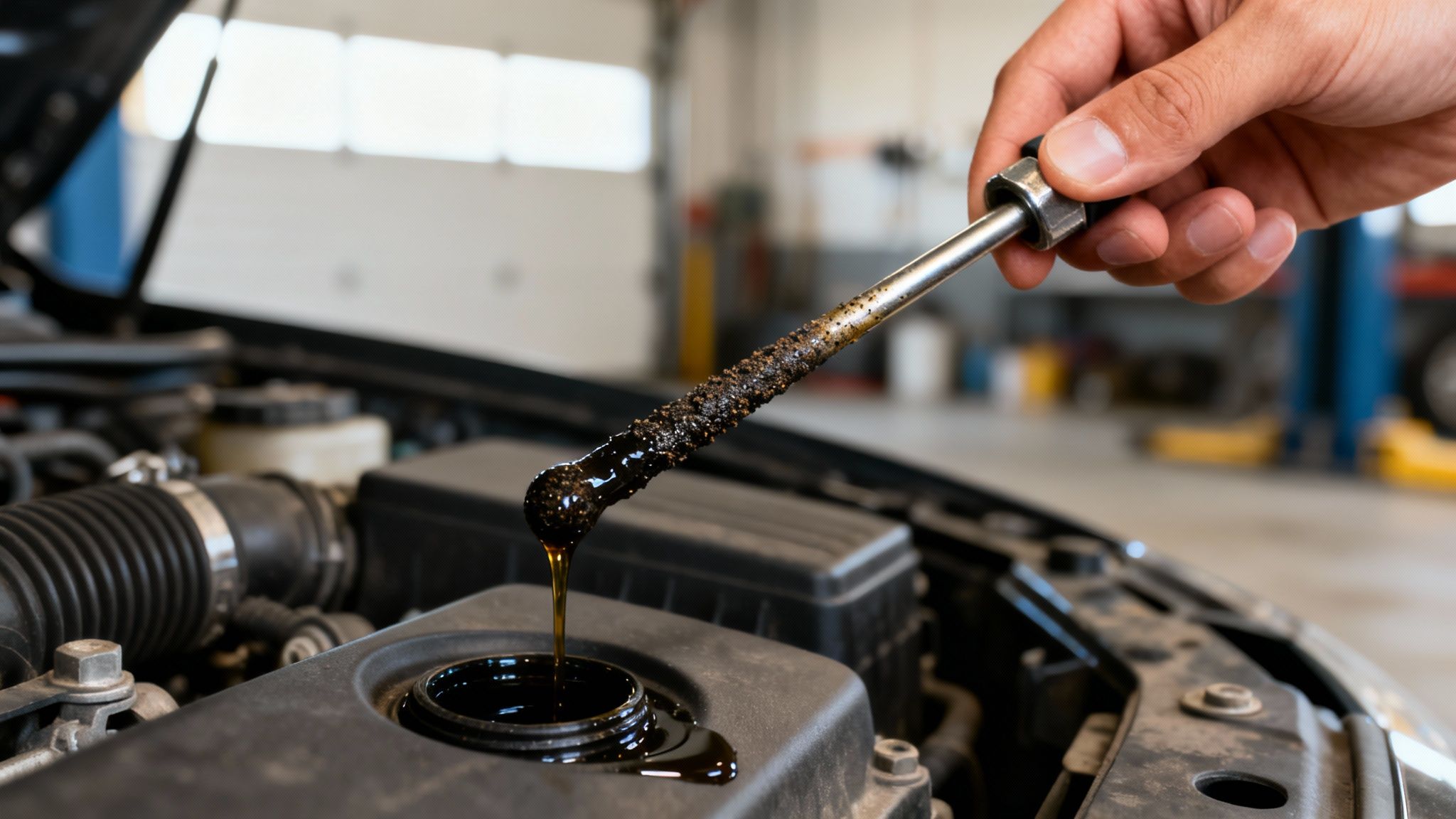
The most direct method is the good old-fashioned dipstick check—a simple task that takes less than a minute. For an accurate reading, make sure your car is parked on a level surface and the engine has been off for at least five minutes to let the oil settle.
Pull the dipstick out, wipe it clean with a rag, push it all the way back in, and then pull it out one more time. Now, take a close look.
- Color and Texture: Fresh, clean oil is a light, translucent amber color. It’s normal for it to darken as it cleans your engine. But if the oil is pitch black, thick, or feels gritty between your fingers, its lubricating days are over. It needs to be changed right away.
- Oil Level: The level should be between the “Full” and “Add” marks. If it’s low, you might have a leak or your engine could be burning oil. Either way, it’s a sign that a professional look-over at Express Lube & Car Care is a smart move.
Other Telltale Warning Signs
Beyond the dipstick, your car will often give you other signals that something’s off. Paying attention to new sounds, strange smells, and dashboard lights can save you a world of headaches.
One of the clearest signs of old, worn-out oil is more engine noise. If you suddenly hear new ticking, rumbling, or knocking sounds, it often means the oil has thinned out and isn’t cushioning the metal parts like it should.
Be on the lookout for these other key indicators:
- Check Engine Light: This light can pop on for dozens of reasons, but low oil pressure or poor oil condition is a common one. Don’t ignore it.
- Visible Exhaust Smoke: Seeing blue or grayish smoke puffing out of your tailpipe is a classic sign that oil is leaking past the seals and getting burned up in the engine.
- Burnt Oil Smell: If you get a whiff of a sharp, acrid oil smell inside your car, it often means you have a leak that’s dripping onto a hot part of the engine.
Catching these signs early and taking action is the secret to a long and healthy engine life.
Choosing the Right Service for Your Vehicle
Knowing the right oil change interval with synthetic blend is a great start, but it’s only half the job. Getting that service done right is what truly protects your engine and gives you peace of mind on the road.
A quick-lube place might seem convenient, but the quality can be a total gamble, and a botched oil change can put your vehicle at serious risk.
Choosing a professional service center isn’t just about getting new oil; it’s about getting expertise. The difference is in the details—like using the exact oil grade your manufacturer calls for, installing a quality filter, and filling it to the proper level. The wrong oil type, or even a little too much, can cause big performance problems down the line.
Professional service is an investment in your vehicle’s longevity. It protects your engine from premature wear, maintains your warranty, and ensures every component works exactly as it should.
The Value of ASE-Certified Technicians
This is where having ASE-certified technicians handle your oil change makes a huge difference. These are professionals who have proven their skills and knowledge. They understand the specific needs of different engines, whether it’s a modern GDI engine in a new SUV or the motor in an older, reliable truck.
At Express Lube & Car Care, our certified team does way more than a simple drain-and-fill. They perform a thorough check to catch potential issues before they become expensive headaches.
The benefits are clear:
- Precision Work: We always use the correct grade and amount of synthetic blend oil.
- Quality Parts: We only use high-quality filters and products that meet or exceed factory standards.
- Peace of Mind: You can drive away with confidence, knowing an expert serviced your car.
When you need reliable, expert work, checking out professional oil change services ensures the job is done right, protecting your investment for thousands of miles to come.
Common Questions About Synthetic Blend Oil
Even after laying out all the facts, a few key questions always seem to come up when drivers think about making the switch to a synthetic blend. Getting straight answers helps you make the right call for your car and your budget, so you can feel confident in your maintenance decisions.
Let’s clear up some of the most common uncertainties.
Can I Switch From Conventional to Synthetic Blend?
Yes, absolutely. Moving from conventional oil to a synthetic blend is not only perfectly safe, it’s one of the simplest upgrades you can make for your engine’s long-term health. The stronger detergents in synthetic blends can even help clean out some of the gunk and sludge left behind by older, conventional oils.
Will Using a Blend Void My Car’s Warranty?
Not a chance. As long as the synthetic blend you use meets the exact viscosity grade (like 5W-30) and performance standard (like API SP) recommended in your owner’s manual, your warranty is completely safe. The important thing is using the right type of oil, not a specific brand.
Can I Top Off My Oil With a Different Type?
You can in a pinch, but it’s really not a good idea for the long run. If you mix a synthetic blend with conventional oil, you’re just diluting all those protective additives you paid extra for. This reduces its effectiveness and shortens the oil change interval with synthetic blend. It’s always best to stick with the same oil.
Think of it this way: all motor oils are compatible, but mixing them compromises performance. It’s like putting regular gas in a car that requires premium—it’ll run, but you lose the benefits.
Is Synthetic Blend Good for High-Mileage Cars?
It’s an excellent choice. Many synthetic blends are designed specifically for engines with over 75,000 miles. These high-mileage formulas include special additives and seal conditioners that help reduce leaks and provide extra cushioning for worn internal parts, making them a very smart investment. For more details on keeping all your vehicle’s systems in top shape, our guide on fluid exchange services has some great insights.
Ready to give your engine the balanced protection and performance it deserves? The ASE-certified technicians at Express Lube & Car Care are ready to help with a fast, professional oil change—no appointment needed. Swing by today for service you can count on.