

Your car’s transmission is an incredibly complex piece of machinery, full of gears, clutches, and intricate hydraulic passages. What keeps it all working together smoothly? A special liquid called transmission fluid. A transmission fluid change is simply the process of draining out all the old, worn-out fluid and replacing it with fresh, clean fluid.
Think of it like an oil change, but for your gearbox. It's a critical maintenance task that keeps one of your vehicle's most expensive components from wearing out prematurely.
What Is a Transmission Fluid Change Explained Simply
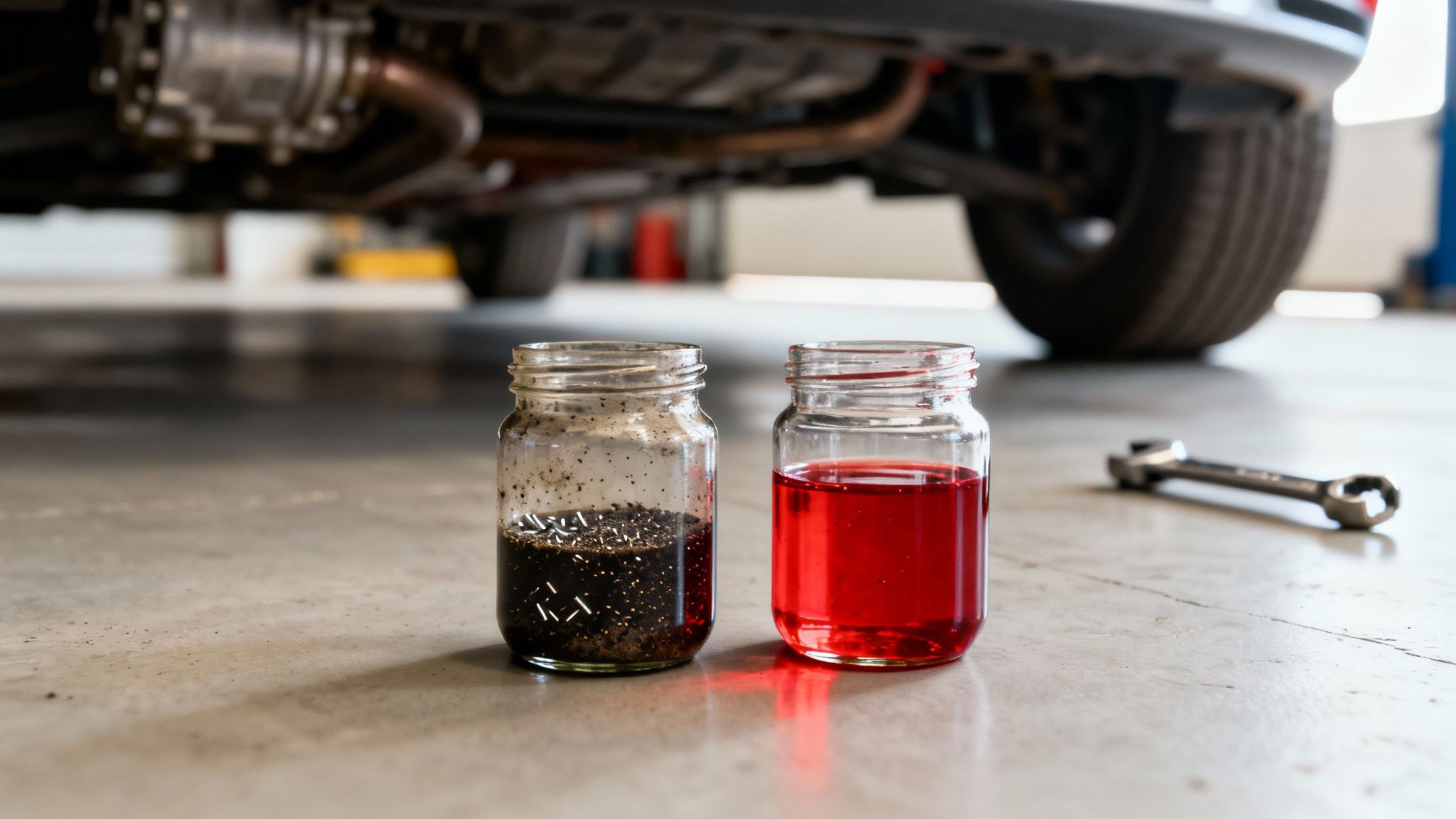
Over tens of thousands of miles, the fluid inside your transmission is subjected to intense heat and pressure. It gradually breaks down, losing its protective qualities and picking up tiny metal shavings and other gunk from the moving parts.
Imagine trying to cook with the same pan of oil for months. It gets dark, sludgy, and stops doing its job. Old transmission fluid is no different—it can’t protect your gears properly, which leads to rough shifting, overheating, and eventually, a catastrophic failure.
A fluid change flushes out all that harmful contamination and refills the system with a fresh supply designed to do its job right.
For a quick overview, this table breaks down the essentials.
Transmission Fluid Change at a Glance
| Key Aspect | Simple Explanation |
|---|---|
| What It Is | Draining old, dirty transmission fluid and replacing it with new, clean fluid. |
| Why It's Done | To remove contaminants and restore the fluid's ability to lubricate and cool. |
| Main Benefit | Prevents major wear and tear, extends the life of your transmission. |
| Key Risk of Skipping | Overheating, poor shifting, and potential for a very expensive transmission failure. |
Basically, it's a small investment in maintenance that helps you avoid a massive repair bill down the road.
The Role of Fresh Fluid
New transmission fluid is engineered to perform three crucial tasks that keep your gearbox happy:
- Lubrication: It forms a thin, protective barrier over gears and clutches, stopping them from grinding against each other.
- Cooling: It acts like a coolant, absorbing the massive amount of heat generated by friction and carrying it away from vital components.
- Hydraulic Pressure: In an automatic transmission, this fluid is what creates the hydraulic force needed to actually change gears. Clean fluid means smooth, crisp shifts.
A transmission fluid change isn’t just about swapping out a liquid. It’s about giving your transmission the lifeblood it needs to survive. Neglecting this service is one of the surest ways to turn a routine maintenance item into a multi-thousand-dollar nightmare.
The numbers show just how vital this service is becoming. The market for automatic transmission fluid is projected to hold a dominant 56.22% share in 2025. The entire global market is expected to grow from USD 3.85 billion in 2024 to USD 6.05 billion by 2035, driven by the need to maintain today's increasingly complex transmissions.
You can learn more about different types of transmission services we offer and why they matter. When you understand what a transmission fluid change is, you stop seeing it as just another expense and start seeing it as a smart investment in your car's long-term health.
Why Transmission Fluid Is Your Transmission's Best Friend
To get why a transmission fluid change is so important, you have to think of the fluid as the ultimate multitasker inside your gearbox. It’s not just some oil. This stuff is a highly-engineered liquid that does several critical jobs all at once. Frankly, without it, your transmission wouldn't survive a single trip down the road.
Inside your transmission, hundreds of metal parts are spinning and sliding against each other at incredible speeds. The fluid’s main job is to act as a master lubricant, creating a paper-thin film between every single gear, clutch, and bearing. This slick barrier is the only thing stopping catastrophic metal-on-metal grinding that would shred your transmission's delicate internals in minutes.
The Unsung Hero of Heat Management
Beyond just keeping things slick, transmission fluid is also a full-time coolant. The constant friction inside a working transmission generates a massive amount of heat, especially in stop-and-go traffic or when you're towing a trailer. The fluid is always circulating, soaking up this intense heat and whisking it away to the transmission cooler, working a lot like the radiator that cools your engine.
This cooling function is absolutely vital. When fluid gets old and starts to break down, it can't manage heat anymore.
An overheated transmission is a dying transmission. Degraded fluid can't dissipate heat, causing seals to harden, clutches to burn, and components to warp, which quickly leads to failure.
Once the fluid loses its ability to keep things cool, you're on a fast track to one of the most expensive repair bills any car owner can face.
A Hydraulic Powerhouse for Smooth Shifting
In an automatic transmission, the fluid has one more job: it's a hydraulic powerhouse. It’s the muscle that actually makes shifting happen. When you speed up or slow down, your car's computer tells the transmission to shift, and it’s the fluid's pressure that engages the right clutches and bands to move from one gear to the next.
For that to work right, the fluid has to be clean and have the perfect thickness, or viscosity.
- Healthy Fluid: Gives you the exact hydraulic pressure needed for quick, crisp, and nearly seamless gear changes.
- Degraded Fluid: Gets thick with gunk or too thin from heat. This causes pressure drops that lead to delayed shifts, jerking, or the feeling that the gears are slipping.
Bottom line: the fluid is directly responsible for how your car feels when it shifts. When it’s fresh, your drive is smooth. When it's old and contaminated, the whole system struggles, giving you those classic warning signs that your transmission is begging for a fluid change.
7 Telltale Signs Your Car Is Crying for New Fluid
Your car can't talk, but it definitely knows how to send you a message when something's wrong. When it comes to your transmission, these warnings often start small but can turn into big, expensive problems fast.
Learning to spot these symptoms early helps you get a transmission fluid change before a minor issue becomes a major failure. Think of it like a low battery warning on your phone—it’s a clear signal to act before everything shuts down.
1. Unusual Whining or Clunking Noises
One of the first things you might notice is strange sounds. A high-pitched whine, a low hum, or a sudden "clunk" when the car shifts gears are all common red flags. These noises usually mean the fluid isn't lubricating properly anymore, causing metal parts to grind against each other.
2. Gears Are Slipping
This one is alarming and downright unsafe. Gear slipping is when your car jumps out of gear while you're driving, or the engine revs up high but the car doesn't speed up. It feels like a sudden loss of power and means the old fluid can't create enough hydraulic pressure to hold the gears in place.
3. Delayed or Hesitant Shifting
Ever feel your car pause for a second before lurching into gear when you pull away from a stoplight? That hesitation is a classic sign of old, contaminated fluid. Sludge and gunk are slowing down the flow, delaying your transmission's response.
Key Takeaway: Smooth, instant gear changes depend on clean, effective fluid. Any delay, jerkiness, or hesitation during shifting is a direct indicator that your transmission fluid is struggling to do its job.
4. A Distinct Burning Smell
If you catch a whiff of something acrid and slightly sweet—almost like burnt toast—it’s a serious warning. That smell means your transmission is overheating. The fluid has broken down so much that it can no longer cool the components, and it's essentially cooking itself.
5. Visible Fluid Leaks
Transmission fluid is usually a bright, slick red. If you spot reddish puddles under your car, you've got a leak. Low fluid from a leak will quickly cause every other symptom on this list, so it's critical to get it checked out immediately.
6. Overheating Transmission
You probably don't have a temperature gauge just for your transmission, but an overheating one can make your engine run hotter than usual. You might also feel an unusual amount of heat coming from under the car. This is a sign of a transmission working way too hard because its fluid has lost its cooling ability.
7. The Check Engine Light Appears
Finally, the dreaded check engine light is your car's last-ditch effort to get your attention. Modern cars have sensors that detect transmission problems like high temperatures or gear slippage. If that light comes on, a mechanic's diagnostic scan can reveal a transmission error code, which often traces back to bad fluid.
Ignoring these signs is a huge gamble. Industry reports show that over 50% of transmission failures are linked directly to old, degraded fluid, with repairs costing an average of $4,000 in the U.S. You can learn more about these trends at PrecedenceResearch.com. For drivers in Richland Hills, this makes preventative maintenance at a trusted shop like Express Lube & Car Care a much smarter financial move.
How Often You Should Change Your Transmission Fluid
So, when is the right time for a transmission fluid change? There’s no single magic number that works for every car. You’ll often hear a general guideline of every 30,000 to 60,000 miles, but that’s really just a starting point.
For the most accurate recommendation, your vehicle’s owner's manual is always the best place to look. But keep in mind, how you drive has a massive impact on how quickly that fluid wears out. Certain driving conditions put a huge strain on your transmission, forcing the fluid to work overtime to keep everything cool and running smoothly.
Factors That Shorten Service Intervals
If your daily drive is more of a workout than a leisurely cruise, you'll want to aim for the lower end of that mileage range—closer to 30,000 miles. These "severe driving conditions" are more common than you might think:
- Frequent Towing: Hauling a boat or trailer is one of the toughest jobs for your transmission, generating a ton of extra heat.
- Heavy Stop-and-Go Traffic: City driving with constant braking and accelerating wears things out much faster than steady highway speeds.
- Driving in Extreme Heat: High outdoor temperatures make it harder for your transmission to stay cool, especially in a Texas summer.
- Mountainous Terrain: Constantly shifting up and down steep hills puts a serious strain on your transmission components.
It's a fact: a transmission running just 20 degrees Fahrenheit hotter than normal can cut the life of its fluid in half. Severe driving conditions push these temperature limits all the time, breaking down the fluid much faster.
Conventional vs. Synthetic Fluid: The Game Changer
The kind of fluid in your transmission also plays a huge role in how long it lasts. Let's break down the two main types.
Most cars come with conventional fluid, which is petroleum-based and offers solid, standard protection. It lines up perfectly with that typical 30,000 to 60,000-mile service interval.
Then there's synthetic fluid, which is engineered in a lab for superior performance and a much longer lifespan. Synthetics hold up way better under extreme heat and pressure, sometimes pushing the service interval out to 100,000 miles or even more.
The differences are pretty clear:
Conventional vs Synthetic Transmission Fluid
| Feature | Conventional Fluid | Synthetic Fluid |
|---|---|---|
| Performance | Provides standard protection for normal driving. | Offers superior protection under extreme heat and heavy loads. |
| Lifespan | Typically needs changing every 30,000 to 60,000 miles. | Can last up to 100,000 miles or more, depending on the car. |
| Cost | Less expensive upfront for the fluid and service. | More expensive upfront but can save on long-term repair costs. |
| Temperature Range | Less stable at very high and very low temperatures. | Maintains excellent viscosity and protection in all climates. |
Choosing the right fluid is a key part of your maintenance plan, especially if you're wondering how often a transmission flush is needed. Given that proper maintenance can head off up to 70% of transmission failures, spending a little more on a higher-quality fluid is a smart investment that can save you a fortune down the road.
DIY vs. Professional Service: Who Should Change Your Fluid?
It's a question we hear all the time: "Can I just change my own transmission fluid?" While the DIY spirit is great, a transmission fluid change isn't quite like a simple oil change. It's a messy, surprisingly technical job, and a small mistake can lead to some seriously expensive problems.
Doing it yourself means having the right tools, knowing the exact fluid your car needs, and getting the fill level perfect. Too much or too little fluid is a recipe for disaster—it can cause overheating, poor shifting, and permanent damage to your transmission.
The Case for Going to a Pro
For most drivers, leaving this one to a professional is the smartest and safest bet. When you bring your car to a dedicated shop, you're not just paying for new fluid; you're buying expertise, the right equipment, and total peace of mind.
Here's what a professional service really gets you:
- ASE-Certified Technicians: These are pros who know your car inside and out. They know the precise fluid type and the exact amount your specific model requires.
- Specialized Equipment: A shop uses machinery that performs a full fluid exchange, pushing out nearly 100% of the old, contaminated fluid. A simple drain-and-fill in your driveway can leave up to a third of the bad stuff behind.
- The Right Fluid, Guaranteed: Using the wrong transmission fluid can wreck your transmission in a hurry. A pro ensures the manufacturer-specified fluid is used every single time.
- Proper Disposal: Used transmission fluid is considered hazardous waste. A shop handles the disposal correctly, so you don't have to worry about it.
When a trusted technician does the job, it’s done right the first time. They’ll also give things a quick look-over for any early signs of leaks or other problems, which could save you from a massive repair bill down the line.
Remember, how you drive really impacts how often you need service. This chart gives a good general idea.
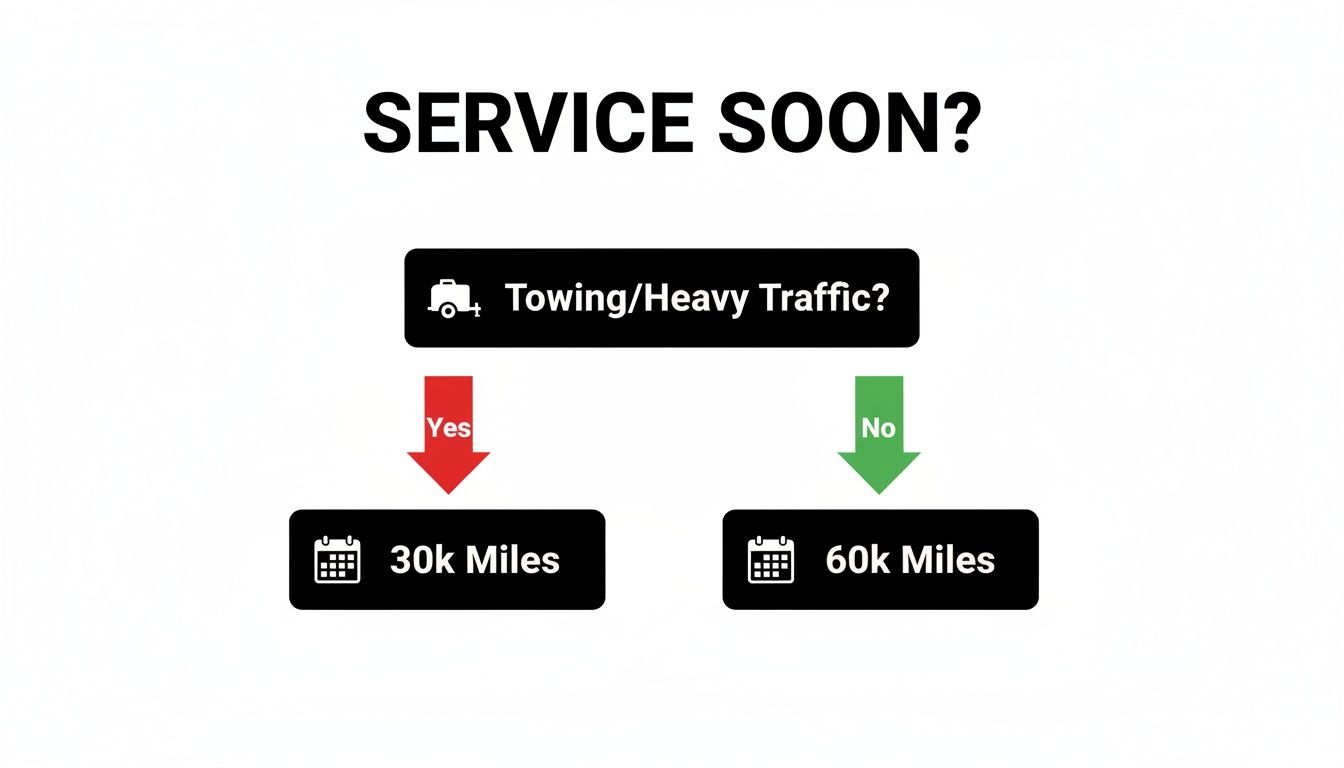
The main thing to notice is that heavy-duty use—like towing or constant stop-and-go city traffic—can cut your service interval in half.
To make sure your vehicle gets the expert care it needs, you can learn more about our comprehensive fluid exchange services and let our team handle it for you.
Your Transmission Fluid Change Questions Answered
To wrap things up, let's tackle a few common questions we hear from drivers about this critical service. Getting straight answers helps you make the best call for your car's long-term health.
What’s the Difference Between a Fluid Change and a Flush?
This is a great question. Think of a transmission fluid change (often called a "drain-and-fill") as scooping about half the old water out of a fish tank and topping it off with fresh water. We drain the fluid from the pan, which gets rid of a good portion of the old stuff. It's a solid, routine maintenance step.
A transmission flush is more like a deep clean for that fish tank. We hook up a special machine to your transmission's cooler lines. This machine pushes new fluid through the entire system—including the torque converter and cooler—while forcing nearly all of the old, contaminated fluid out.
A flush is more thorough, but it isn't automatically the best choice for every car. For an older vehicle with an unknown service history, a powerful flush can sometimes knock loose built-up gunk that might cause problems. Our technicians will always look at your specific car and recommend the safest, most effective service.
How Much Does a Transmission Fluid Change Cost?
The cost can vary pretty widely, usually falling somewhere between $150 and over $400. The final price really depends on your vehicle’s make and model, the type of fluid it needs (synthetics cost more), and whether you're getting a simple change or a full flush. We believe in being upfront, so we'll always give you a clear estimate before we start any work.
Can I Just Top Off My Transmission Fluid If It’s Low?
While you can top it off, it’s really just a temporary band-aid. Low fluid almost always points to a leak, and just adding more doesn't solve that underlying problem. More importantly, topping it off does nothing to remove the old, broken-down fluid full of harmful metal shavings and sludge that are grinding away at your transmission's internal parts. A proper fluid change is the only way to get that gunk out and give your transmission the clean fluid it needs to stay protected.
For any transmission service, from a quick fluid check to a complete exchange, trust the ASE-certified team at Express Lube & Car Care. We provide fast, reliable service with no appointment needed, ensuring your vehicle gets the expert care it deserves. Visit us today to keep your car running smoothly! https://www.expressluberichlandhills.com