

Most drivers can expect a car shocks and struts replacement cost somewhere around $1,000 to $2,500, with national averages running $1,057 to $1,260 per assembly and full four-corner jobs ranging from $1,000 to $5,000 based on the vehicle and parts used. In Richland Hills, the final number can swing up or down depending on whether your car uses simple shocks or more complex strut assemblies, what you drive, and whether you take advantage of local shop specials and community discounts.
If you're reading this after a rough commute on Boulevard 26, a clunk over a pothole, or that floating feeling on the highway, you're asking the right question. Suspension problems usually start as an annoyance, then turn into a safety issue and a bigger bill if they sit too long.
Drivers around Northeast Tarrant County deal with patched pavement, uneven roads, and plenty of stop-and-go traffic. That combination is hard on suspension parts. The tricky part is that shocks and struts often wear gradually, so the car feels a little worse each month until one day you realize braking feels sloppy, the ride is harsh, or your tires are wearing in weird spots.
A good cost guide should do more than throw out a big price range. It should explain what you're buying, why one car costs more than another, where labor goes, and how to avoid paying dealership money when you don't need dealership parts.
Your Guide to Shocks and Struts Costs in Richland Hills
A lot of Richland Hills drivers start looking into shocks and struts after the same kind of drive. You hit a patched stretch near Boulevard 26, the front end feels loose over a dip, and the car takes an extra bounce before it settles down. No warning light. Just a car that suddenly feels less sure-footed than it did a few months ago.
That is usually the point where two questions matter most. How much is this going to cost, and do I need to fix it now or can it wait?
At a local shop, the answer depends on what your vehicle uses and how far the wear has spread. Some cars need a simpler shock replacement. Others use full strut assemblies, which cost more in parts and labor. If mounts, boots, bump stops, or an alignment are part of the job, the estimate climbs from there.
For Richland Hills drivers, national price ranges are only a starting point. Real local estimates make more sense once you factor in the kind of vehicle you drive, whether you want budget, mid-grade, or premium parts, and whether you are comparing an independent shop with dealership pricing. That difference matters if you are trying to keep the car safe without paying for parts or labor you do not need.
I tell customers to look at suspension repair the same way they look at tires. Waiting too long usually does not save money. It often leads to faster tire wear, a rougher ride, and more strain on nearby suspension parts.
What local drivers usually want to know first
- What am I likely to spend: In Richland Hills, many jobs fall somewhere in the low four figures, but the total can move up fast on vehicles with strut assemblies, heavier suspension components, or extra hardware that should be replaced at the same time.
- Why does the price vary so much: The biggest factors are vehicle design, parts quality, labor time, and whether the repair also calls for related components or a wheel alignment.
Local shop policies can help too. At Express Lube Richland Hills, drivers often save by asking about current specials, bundled services, or community-based discounts for military members, first responders, teachers, or fleet customers when available. Those savings will not change what parts your car needs, but they can lower the final bill in a practical way.
One more point matters here. A good estimate should be specific. You should be able to see whether the quote covers just the shock or strut, or the full assembly and any related parts needed to do the job right the first time.
What Your Shocks and Struts Actually Do
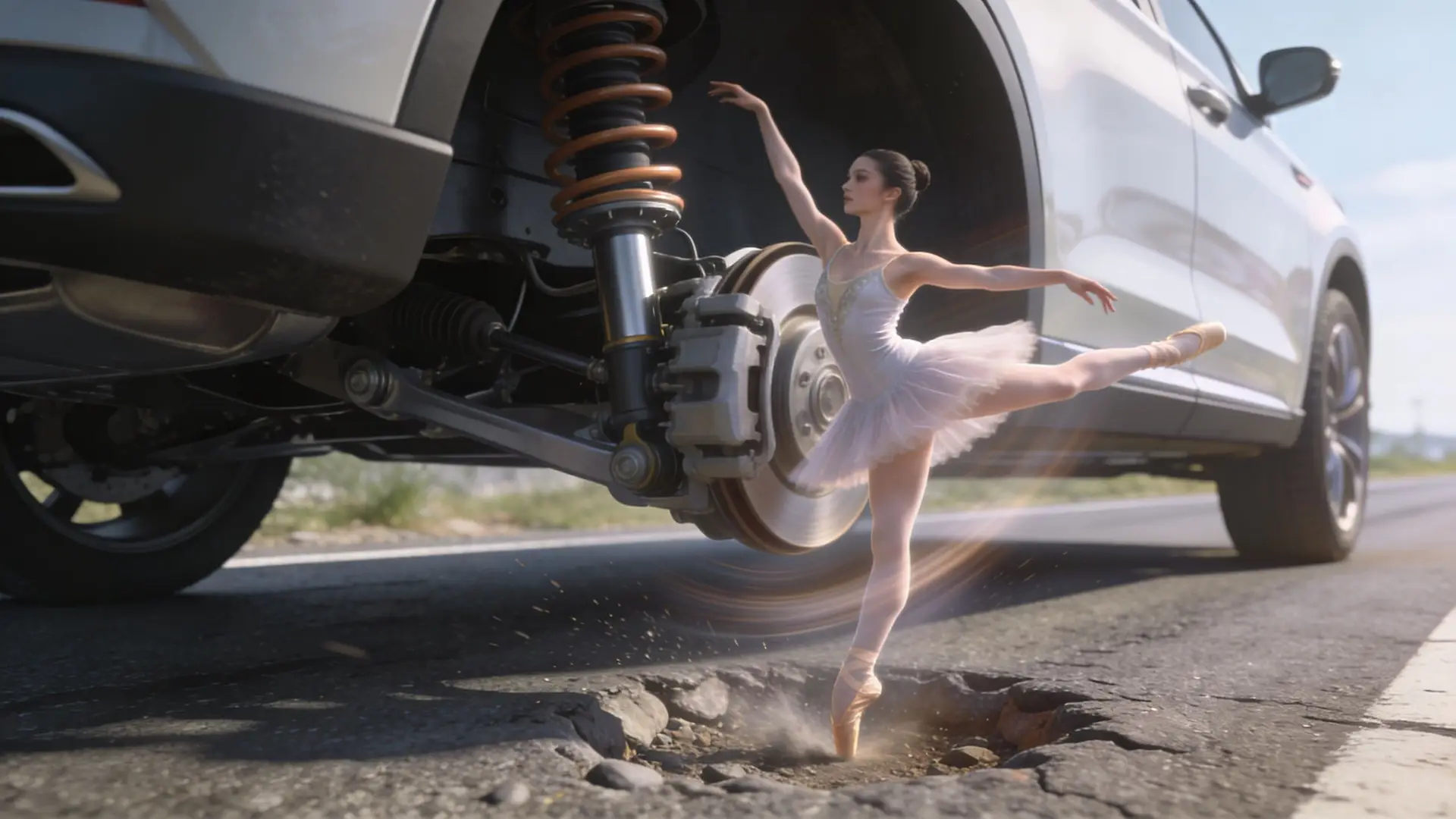
Shocks and struts manage what happens after your tires hit a bump, pothole, railroad crossing, or patched stretch of road. They control spring movement, keep the tires in better contact with the pavement, and help the body settle quickly so the car stays composed instead of bouncing longer than it should.
Without that control, the ride gets sloppy fast. You feel more motion in the seat, more nose dive when braking, and more sway in turns. Around Richland Hills, where one trip can mix smooth highway with rough side streets, that difference is easy to notice.
What a shock does
A shock absorber controls the up-and-down motion of the spring. After the suspension compresses, the shock slows the rebound so the vehicle settles instead of continuing to hop or float.
When a shock wears out, the spring keeps moving more than it should. That is why drivers describe the ride as loose, bouncy, or boat-like. One dip in the road should not cause two or three extra motions afterward.
What a strut does
A strut handles damping too, but it also serves as part of the suspension structure. On many vehicles, especially up front, the strut helps support vehicle weight and helps position the wheel correctly as the suspension moves.
That design changes the repair itself. A strut job often involves more labor, more hardware, and in many cases an alignment check afterward. At the shop, this is one of the first things I explain because a customer may ask why one vehicle only needs simple rear shocks while another needs a more involved front strut assembly.
Why the terms get mixed up
Drivers use the word "shocks" as a catch-all, and that is common. The actual setup may be front struts and rear shocks, or struts on all four corners.
The estimate can look very different depending on which part your car uses.
| Part | Main job | Typical complexity |
|---|---|---|
| Shock | Controls bounce and rebound | Usually simpler |
| Strut | Controls bounce and also serves as a structural suspension component | Usually more labor-intensive |
Why these parts matter beyond ride comfort
Good dampers help the vehicle stay settled during braking, cornering, and rough-road driving. As shocks or struts wear down, the tires can lose some consistency in road contact, and that can make the car feel less predictable.
That also affects other parts you pay for. We often see worn suspension show up alongside uneven tire wear, stress on mounts and bushings, and driver complaints that the vehicle just does not feel planted anymore. If you want a closer look at the symptoms, our guide to signs you need new shocks breaks down what to watch for before the problem gets more expensive.
Good shocks and struts make the car easier to control in the moments that matter most.
Why understanding the part helps you judge the estimate
A rear shock replacement and a front strut replacement are not the same job, even if both get described as suspension work. One may be fairly straightforward. The other may include mounts, boots, bump stops, spring-related parts, and alignment-related labor.
That is why a solid estimate should name the actual parts being replaced. Once you know whether your vehicle has shocks, struts, or both, it gets much easier to decide whether the quote makes sense for your car and your budget in Richland Hills.
Warning Signs That Demand Your Attention
Suspension parts usually don't fail all at once. Your car starts talking to you in small ways first. The trick is knowing which messages matter.
The ride feels loose or floaty
If the car keeps bouncing after you hit a dip or speed bump, the dampers may not be controlling spring movement well anymore. Drivers often describe it as a boat-like ride, especially on highways or frontage roads.
That matters because the tires need steady contact with the road to brake and steer properly. When the suspension lets the body keep moving, the car feels less planted and less predictable.
The front end dives when braking
A healthy suspension helps control weight transfer. If the nose drops hard when you brake, especially in everyday traffic, the front struts or shocks may be weak.
This doesn't always mean the brakes are bad. It often means the suspension isn't managing the vehicle's weight the way it should.
You hear clunks, knocks, or rattles over rough pavement
Noise doesn't always come from the dampers themselves. It can also come from mounts, bushings, or related hardware that wear alongside shocks and struts.
If you're hearing repeated clunks over patched roads, railroad crossings, or driveway entrances, don't ignore it. A quick inspection often catches the issue before it starts affecting other parts.
For a closer look at common symptoms, this guide on signs you need new shocks breaks down what local drivers should watch for.
Your tires are wearing unevenly
Uneven tire wear is one of the biggest clues that suspension trouble has moved beyond ride comfort. If the tread looks patchy, cupped, or worn in strange patterns, the tire may be losing steady contact with the road.
That gets expensive fast because tires are too costly to sacrifice to a suspension problem.
If your car is wearing out tires before their time, don't just replace the tires and move on. Find out why.
Wet-road confidence drops
When shocks and struts wear down, the car can feel less settled in rain. Steering corrections take more effort, and the vehicle may seem to glide or drift over standing water instead of tracking cleanly.
The verified cost and labor guidance notes that improper installation or degraded dampers can raise hydroplaning risk, which is one more reason to act before the problem grows.
A short visual explanation helps if you're trying to compare symptoms with what you're feeling on the road.
When to stop guessing
Use this checklist if you're unsure whether it's time for an inspection:
- Repeated bouncing: The car doesn't settle quickly after a bump.
- Brake dive: The front end drops more than it used to.
- Cornering feels sloppy: The body leans and takes longer to recover.
- Road noise over bumps: Clunks or knocks show up on uneven pavement.
- Odd tire wear: Tread patterns don't look even from side to side.
One symptom might not confirm a bad strut by itself. Several together usually mean it's time to put the vehicle on a lift and inspect the suspension closely.
Breaking Down the Replacement Cost in Richland Hills
A Richland Hills driver usually notices suspension cost the same way they notice a roof leak. The problem starts small, then one estimate says a few hundred dollars and another is well over a thousand. Both can be reasonable, depending on what the vehicle needs.
The price changes fast because "shocks and struts" is a broad label. One car may need a simple pair of rear shocks. Another may need front loaded strut assemblies, new mounts, and an alignment to keep the steering straight after the work is done.
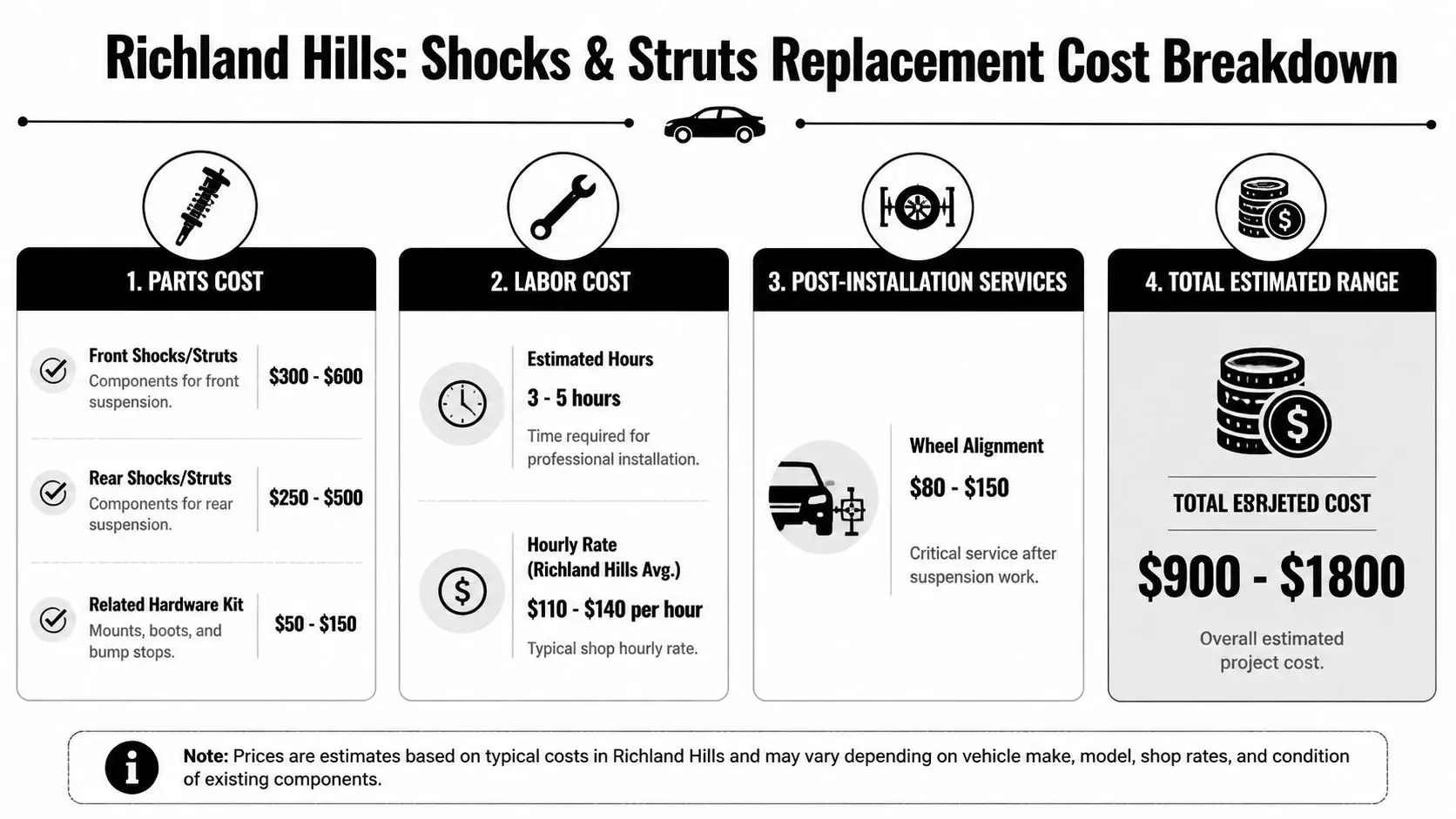
What you are usually paying for
A suspension estimate in our area usually has three parts:
- Parts: shocks, struts, mounts, boots, bump stops, and small hardware that is worn or unsafe to reuse
- Labor: removing the old parts, installing the replacements, and tightening everything to spec
- Related service: alignment after strut work, plus any inspection time if tire wear or noise points to other suspension parts
That last item matters. A quote can look cheaper because it leaves out the alignment or reuses tired mounts.
Why one quote is much higher than another
Parts choice drives a big part of the bill. Factory parts usually cost more. Good aftermarket parts can cut the price and still hold up well for a daily driver. In the shop, I usually tell people to match the part to the plan for the car. If you are keeping the vehicle a few more years and want solid ride quality without dealer pricing, quality aftermarket parts are often the smart middle ground.
The other big difference is whether the estimate uses bare struts or loaded assemblies. Bare struts can lower parts cost, but they usually add labor because the spring and mount have to be transferred. Loaded assemblies cost more up front, but they often save labor and replace more wear items in one shot.
That is why two honest estimates can be far apart.
Practical planning ranges for Richland Hills drivers
For many everyday cars, a pair of rear shocks usually lands at the lower end of the range. A pair of front struts usually costs more. A full set of four can climb quickly, especially on SUVs, trucks, or vehicles that need premium assemblies.
At a trusted independent shop in Richland Hills, drivers often save money compared with dealership pricing, but the primary benefit is clarity. A good estimate should tell you whether the price covers the front, rear, or both, which brand of parts is being used, and whether alignment is included.
Here is a simple way to budget:
| Repair Type | Typical Budget Expectation |
|---|---|
| Rear shocks only, pair | Lower-cost suspension repair |
| Front struts only, pair | Mid-to-higher suspension repair |
| Full set of shocks/struts | Highest total, but often best value if all four are worn |
| Struts with alignment and mounts | Higher upfront cost, fewer comeback issues |
These are planning categories, not flat menu prices. Vehicle design, rust, mileage, and parts brand can all move the number.
What local drivers can do to keep the bill under control
The best savings usually come from catching the problem before it wipes out a set of tires or causes extra steering wear. Replacing worn dampers at the right time is almost always cheaper than buying tires early because the tread got chopped up.
Ask for options. A solid shop should be able to explain the trade-off between premium parts, good aftermarket parts, and whether complete assemblies make more sense than rebuilding your old hardware. Richland Hills drivers should also ask about local promotions, fleet discounts, military discounts, teacher discounts, or seasonal service specials. Community-based savings like those can make a noticeable difference without cutting corners on safety.
For a broader local price context, this guide to auto repair cost comparison helps show how suspension work fits into the bigger maintenance picture.
If you want another plain-English comparison before you approve a quote, this resource offers reliable strut repair info from Express Lube in a format that's easy to compare with your estimate.
What a fair estimate should show
Before you say yes, make sure the quote answers these five questions:
- Which corners are being replaced
- Whether the vehicle has shocks or struts in those positions
- What brand or grade of part is included
- Whether mounts and hardware are new or reused
- Whether alignment is included after the repair
If the estimate is clear on those points, you are usually looking at a shop that respects both your budget and your safety.
Key Factors That Influence Your Final Price
Two vehicles can come in with the same complaint and leave with very different estimates. That's normal. Suspension pricing changes because the parts, labor, and vehicle design aren't all the same.
Struts cost more work than simple shocks
A basic shock replacement is often more straightforward than a strut job. Struts are larger structural units, and many front suspensions use designs that require more disassembly and more precision during installation.
Verified 2026 guidance notes that MacPherson struts have been used in over 70% of sedans since the 1990s, and that this design has increased repair complexity and costs by 30-50% over traditional shocks, according to Lemonade's strut replacement cost guide.
That matters because many everyday commuter cars in Richland Hills fall into that category. What sounds like a simple "shock replacement" over the phone may really be a strut assembly job once the vehicle is identified.
Front suspension usually costs more than rear
Front suspension work often takes more labor because technicians may need extra access around steering and drivetrain components. In practice, front strut jobs are commonly more involved than rear shock replacements.
That's one reason estimates can feel inconsistent if you're comparing front-only pricing to rear-only pricing. A pair of front struts can be a much bigger job than a pair of rear shocks, even on the same vehicle.
Vehicle type changes the whole equation
Sedans, SUVs, and trucks don't load their suspension the same way. Heavier vehicles typically wear parts differently and may use larger or more expensive components.
Verified pricing examples show this clearly. The Ford F-150 and Chevrolet Silverado 1500 sit higher in the pricing spread than smaller commuter cars, while complex luxury suspensions can go much higher still. If you drive a truck, don't compare your estimate to a compact sedan and assume someone is overcharging you.
Alignment isn't an add-on you should skip
After strut replacement, alignment is usually part of protecting the repair. Verified cost data places alignment around $150-$200, and that service helps prevent handling problems and unnecessary tire wear, as discussed in the broader national cost guidance cited earlier.
Skipping alignment to save money can undercut the whole job. If the suspension geometry isn't corrected after the install, the vehicle may pull, steer oddly, or wear tires unevenly.
The cheapest suspension repair is the one you only have to do once.
Local roads and driving habits matter
Texas roads don't wear every car the same way. A commuter that spends its life on patched city streets, expansion joints, and pothole-heavy routes will usually wear dampers faster than a lightly driven weekend vehicle.
That same reality also affects how insurers look at damage. If you're trying to figure out when suspension issues may be covered after a pothole or accident, it helps to understand how car insurance premiums are determined and how wear-and-tear is treated differently from sudden damage.
What tends to raise or lower the bill
A quick summary:
- Higher final price: Front struts, truck applications, OEM parts, related hardware, alignment, and harder access.
- Lower final price: Simple rear shocks, quality aftermarket parts, independent labor rates, and catching wear before it affects tires or related components.
The key is context. A larger estimate isn't automatically a bad one. Sometimes it's the accurate price for a more complex suspension design.
DIY vs Professional Replacement A Richland Hills Perspective
A Richland Hills driver can watch a few videos, borrow tools, and feel ready to replace shocks or struts in the driveway by Saturday morning. By Sunday night, the car may still be on jack stands, one stubborn bolt may be half-rounded, and Monday's commute is now the bigger problem.
That does not mean DIY is always a bad idea. Rear shocks on some vehicles are straightforward. Full strut assemblies are a different level of job, especially on front suspensions where spring tension, rusted hardware, and alignment all come into play.
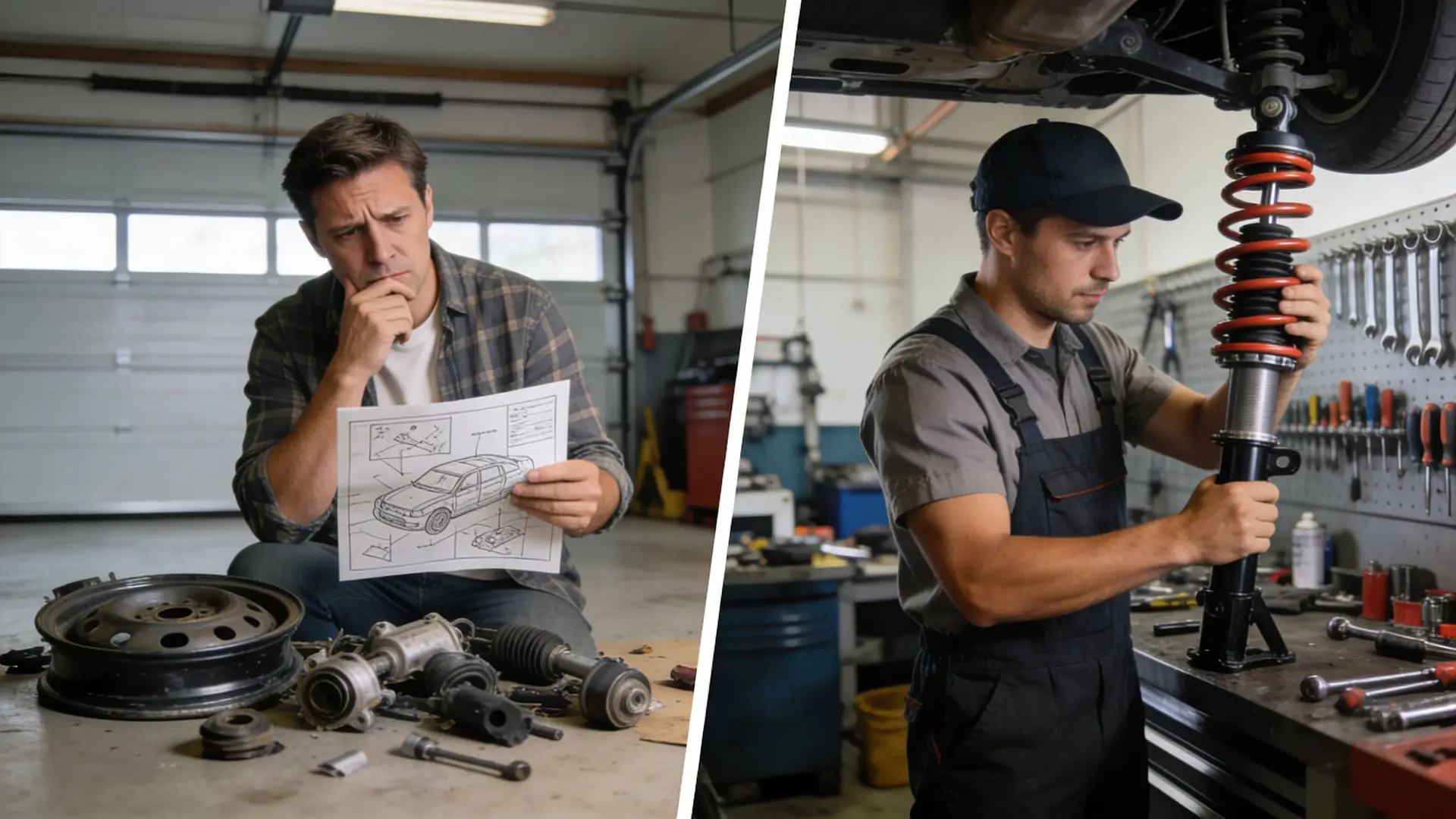
Where DIY can go wrong
The biggest risk is not the part itself. It's the loaded spring and the work around it.
On many vehicles, replacing a strut means dealing with a spring under serious tension or installing a complete quick-strut assembly correctly and safely. A spring compressor used the wrong way can hurt someone fast. Even when the repair goes smoothly, seized fasteners, worn mounts, and limited access can turn a "simple" afternoon project into a full weekend job.
I've seen plenty of local cars come in after a home install with a clunk, uneven ride height, or steering that no longer feels centered. Usually the issue is not effort. It's one missed step, one loose fastener, or one worn related part that was easy to overlook.
Costs DIYers often leave out
DIY savings look good on paper until the side costs show up:
- Special tools: Spring compressors, larger sockets, torque tools, and sometimes cutting tools for rusted hardware
- Replacement extras: Mounts, boots, sway bar links, or hardware that should be changed once everything is apart
- Your time: Lost weekend hours, cleanup, parts runs, and the chance the car is down longer than planned
- Alignment service: Many strut jobs still need a professional alignment afterward
- No labor coverage: If it rattles or wears unevenly, you're doing the diagnosis and redo yourself
That math matters for busy families, commuters, and anyone who cannot afford surprise downtime.
Why professional service often makes better financial sense
At a shop, the job is not just "remove and replace." A trained technician checks the full suspension area, installs the parts to spec, and spots related wear before it becomes another visit. That is a big reason many drivers choose a shop with ASE-certified suspension technicians instead of gambling on a repair that affects braking, tire wear, and stability.
Local value matters too. In Richland Hills, a trusted independent shop can often give drivers a more realistic price than a dealership, and local specials or community discounts can narrow the gap even more. That is usually the smarter play than buying tools for a one-time job and hoping nothing fights back.
Saving on labor only helps if the repair is safe, complete, and done once.
For simple rear shock setups, an experienced DIYer may do fine. For struts, spring-loaded assemblies, or anything with corrosion and alignment concerns, professional replacement is usually the lower-stress and lower-risk choice.
How to Get the Best Value on Your Suspension Repair
A good suspension repair bill starts with the right plan. The drivers who spend the least over time are usually the ones who fix the actual problem, use parts that fit how they drive, and catch the job before bad shocks or struts start wearing out tires and other front-end parts.
Around Richland Hills, the best value usually comes from an independent shop estimate that is clear about what is included. Ask whether the quote covers the parts brand, labor, hardware, and alignment-related work if struts are being replaced. A low number on the phone can grow fast if those items are left out.
Smart ways to keep the total cost under control
- Address symptoms early: A car that bounces, dips hard when braking, or feels loose over bumps can drive up your total cost if you wait.
- Choose parts based on how you use the car: Good aftermarket shocks or struts are often the smart buy for daily drivers. OEM parts may make more sense if you want the exact factory ride or you drive a model with limited aftermarket choices.
- Replace parts in pairs when appropriate: Matching left and right side performance helps handling stay even and can keep you from paying overlapping labor later.
- Review the estimate line by line: Look for mounts, boots, bump stops, and alignment charges so there are fewer surprises at checkout.
I tell local customers this all the time. The cheapest repair is not always the lowest invoice today. It is the one that solves the problem once, protects the tires, and does not send you back in two months for the other side.
Use local discounts the right way
National averages are a starting point. What you pay in Richland Hills depends on your vehicle, the parts you choose, and whether a local shop offers community discounts or monthly specials.
Those savings can be meaningful for households with two or three vehicles, commuters who cannot lose a workday, and small business owners trying to keep service costs predictable.
Look for offers such as:
- Monthly specials for planned repairs
- Military discounts
- First responder and healthcare professional discounts
- Ladies Day offers
The best value comes from three things working together. Accurate diagnosis, quality parts that fit your budget, and a shop that gives local drivers real ways to save without cutting corners.
Frequently Asked Questions about Suspension Repair
A lot of Richland Hills drivers ask these same questions after they hit a rough stretch of road on Highway 183 or notice the car starting to bounce more than it used to. Here are the straight answers I give at the shop.
Should shocks and struts be replaced in pairs
Yes. Replacing left and right together keeps the car more stable under braking, turning, and lane changes.
If one new part is trying to control body movement and the old part on the other side is worn out, the ride can feel uneven. You can also end up paying labor twice if the other side fails soon after.
Does insurance cover shock or strut replacement
Usually no, if the parts wore out over time.
Insurance may help if the damage came from a covered accident or a specific road hazard claim, like hitting a curb hard enough to bend suspension parts. In that case, the shop should document what failed and what impact damage is visible.
How long do shocks and struts last in local driving
There is no single mileage that fits every vehicle. In Richland Hills, service life depends a lot on commute length, road conditions, speed bumps, potholes, and how much weight the vehicle carries.
A daily commuter on decent roads may go much longer than a work SUV that sees rough pavement, railroad crossings, and a full load of gear. The better approach is to watch for ride changes, tire wear, and noise instead of waiting for one exact number on the odometer.
Is alignment really necessary after strut replacement
In most cases, yes.
Strut replacement can change alignment angles enough to affect steering feel and tire wear. Skipping the alignment might save money that day, but it can cost more later if the front tires start wearing on the inside or outside edges.
Are aftermarket struts a bad idea
No. Many aftermarket struts are a good fit for budget-minded repairs, especially on older daily drivers.
The part choice matters more than the label. A quality aftermarket unit from a brand with a solid track record can save money and ride well. Cheap no-name parts often come back with noise, poor ride control, or a shorter service life. That is why I usually match the recommendation to the vehicle, the customer's budget, and how long they plan to keep the car.
If your vehicle feels bouncy, unstable, noisy over bumps, or just not right, Express Lube & Car Care can help you sort out what the suspension needs and what it should reasonably cost. Their ASE-certified team in Richland Hills offers clear recommendations, fair pricing, walk-in convenience, and community-minded savings that make it easier to get safe, dependable repairs without overspending.