

You leave the oil change feeling good. Fresh oil, new filter, one more maintenance item handled. Then the oil pressure light comes on before you even get far from the shop, or later that day in traffic.
That gets your attention fast, and it should.
A low oil pressure after oil change warning doesn’t automatically mean the engine is ruined. Sometimes the cause is simple, like an oil level issue or a filter problem. But this is one warning light that you should treat as urgent until proven otherwise.
The right response is calm, not casual. Pull over safely. Shut the engine off. Check a few things you can inspect without tools. If the warning stays on, or you don’t find an obvious simple cause, stop there and get professional help.
That Sinking Feeling A Low Oil Pressure Light After Service
This is one of the most frustrating situations a driver can face. You just paid for maintenance that’s supposed to protect the engine, and now the dash is warning you about the one system that engine depends on most.
Oil pressure is what moves engine oil where it needs to go. Bearings, camshafts, valvetrain parts, and other internal components rely on that flow. When pressure drops, lubrication drops with it. That’s why the warning matters even if the engine still seems to run “okay.”
Most drivers ask the same questions right away:
- Is it safe to keep driving for a few minutes?
- Could the shop have made a mistake?
- Is it just a bad sensor?
- Can I check anything myself first?
Those are fair questions. The problem is that the light itself doesn’t tell you which answer applies. It only tells you there may be inadequate oil pressure right now.
If this happened shortly after routine service, there are a handful of common possibilities. The oil may be low. The filter may not be sealing correctly. The wrong viscosity may have gone in. In less common situations, air can get trapped in the system and the pump can lose prime. Some vehicles also turn out to have a faulty sender or gauge issue rather than an actual pressure loss.
Start with the safe assumption that the warning is real. That protects the engine while you sort out the cause.
If you want a good baseline on what a proper service should include, this overview of an oil and filter change service helps clarify what should have been checked during the visit.
Your First Response Stop Driving Immediately
The first decision matters more than anything else. If the oil pressure light comes on, get off the road safely and turn the engine off.
Stop driving immediately if the oil pressure warning stays on.
That advice isn’t dramatic. It’s mechanical reality. Industry data summarized by Heavy Vehicle Inspection notes that 73% of engine failures are related to lubrication issues, and driving with low oil pressure for even 30 seconds can cause bearing damage that may cost $3,000 to $8,000 to repair.

What to do in the first minute
Use a simple order of operations.
Signal and move to a safe spot
Pick a shoulder, parking lot, or side street. Don’t slam on the brakes or make a risky lane change.Shut the engine off
Don’t let it idle while you “see if the light clears.”Set the parking brake and turn on hazard lights
Your safety comes first, especially if traffic is close.Look and listen before opening the hood
If you smelled burning oil, heard knocking, or saw smoke, that’s useful information. Don’t restart the engine to confirm it.
What not to do
Drivers often make the same costly mistakes after this warning comes on.
- Don’t try to limp home if it’s only a short distance.
- Don’t assume fresh oil means everything is fine.
- Don’t restart repeatedly to “test” whether the light stays on.
- Don’t keep revving the engine in neutral or park.
A low pressure problem can be a minor service error, but the engine doesn’t care why pressure is low. It only reacts to whether oil is reaching moving parts.
When the warning is especially urgent
Some situations call for zero debate.
If the light came on with engine noise, hesitation, or a sudden drop on the gauge, treat it like an active lubrication problem until a technician proves otherwise.
Heavy Vehicle Inspection also notes that normal warm idle pressure should be 25 to 40 PSI, and warm idle below 20 PSI calls for immediate diagnosis. Pressure below 10 PSI means the vehicle shouldn’t be driven at all, according to the same source.
If your vehicle has a real oil pressure gauge, that reading matters. If it only has a warning light, assume the safest path and leave the engine off until you perform the checks below.
Essential DIY Checks You Can Perform Safely
Once the engine is off and you’re parked safely, there are a few checks you can do without tools. The goal isn’t to diagnose every possible failure. The goal is to find the obvious problems that a driver can spot without creating more risk.
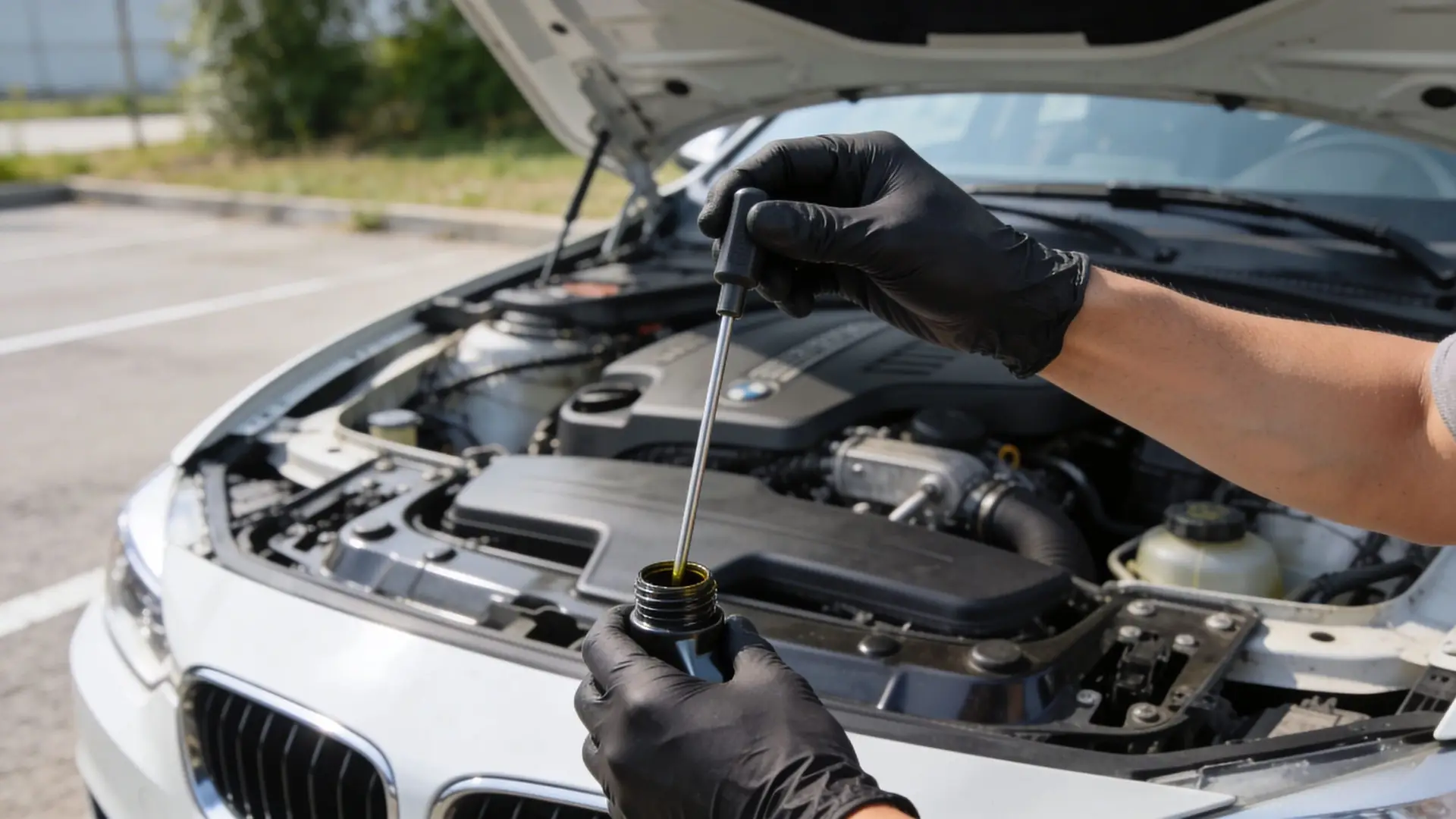
If you’ve never checked oil before, this guide on how to check your car oil level gives a good visual refresher.
Check the dipstick correctly
Wait a few minutes after shutting the engine off so the oil can settle.
Then:
- Park level if possible so the reading is more accurate.
- Pull the dipstick and wipe it clean with a rag or paper towel.
- Reinsert it fully, then pull it back out and read the level.
- Look at the oil itself, not just the mark.
You’re checking for three things at once.
First, is the oil level very low? If it is, the engine may not have enough oil in the pan to maintain stable pressure.
Second, does the oil look abnormal? Fresh oil can vary in color, so don’t panic over color alone. What matters more is whether it looks milky, foamy, or contaminated.
Third, does it smell strongly like fuel? That can point to a separate problem that needs shop-level diagnosis.
Inspect around the oil filter
A filter issue is one of the first places I’d look after a pressure warning that shows up soon after service.
Improper oil filter installation is a significant cause of post-change pressure faults. ASE guidance cited by Xpress O Lube recommends pre-filling new filters with fresh oil because it can reduce dry-run risk by 80% to 90%. The same source notes that over-tightening can crack the canister, and a non-OEM filter can create a bypass valve mismatch that may drop pressure by 20 to 50 PSI.
What you’re looking for at the filter
Don’t touch a hot exhaust or reach into tight spots blindly. Use your phone light if needed.
Look for:
Fresh wet oil on or below the filter
That suggests a leak, a loose filter, or a sealing issue.Oil spraying or dripping actively
If you see active dripping, don’t restart the engine.A crooked filter
A filter that isn’t seated square can leak or fail to seal.Signs of a double gasket problem
Sometimes the old filter gasket sticks to the engine and the new filter gets installed on top of it. That can cause a fast leak.
If you change your own oil from time to time, a step-by-step DIY oil change guide is useful for comparing what should happen during filter removal, gasket inspection, and reinstall.
Inspect the drain plug area
Now check under the front of the vehicle if it’s safe to do so.
You do not need to crawl fully underneath. A quick visual can still tell you a lot.
Look for:
- Fresh oil on the splash shield or pan
- A drip forming at the drain plug
- A small puddle where you stopped
- Oil streaking backward from airflow while driving
A loose drain plug can leak enough oil to lower the level quickly. A damaged washer or sealing surface can do the same.
What a driver can safely decide at roadside
Use this quick decision guide.
| What you find | What it likely means | Safe next step |
|---|---|---|
| No oil on dipstick | Oil level may be critically low | Do not restart. Call for help |
| Active leak at filter or plug | Service or sealing problem | Do not drive |
| Oil level normal, no visible leak, light stayed on | Could be viscosity, filter, sensor, or internal issue | Needs professional diagnosis |
| Light went off only after adding oil, no leak seen | Temporary low level may have been the issue | Monitor closely and have it checked soon |
Later, if you want to watch a basic visual walkaround before touching anything, this video is a decent starting point:
Roadside rule: If you’re uncertain whether the issue is minor or serious, treat it as serious.
What works at roadside is observation. What doesn’t work is guessing, restarting repeatedly, or assuming the warning is harmless because the service was just done.
Decoding the Common Causes of Post-Change Pressure Drops
When the dipstick and leak check don’t give you a clear answer, the next step is interpretation. A pressure warning after service usually points to a short list of causes. Some are simple corrections. Some are not.
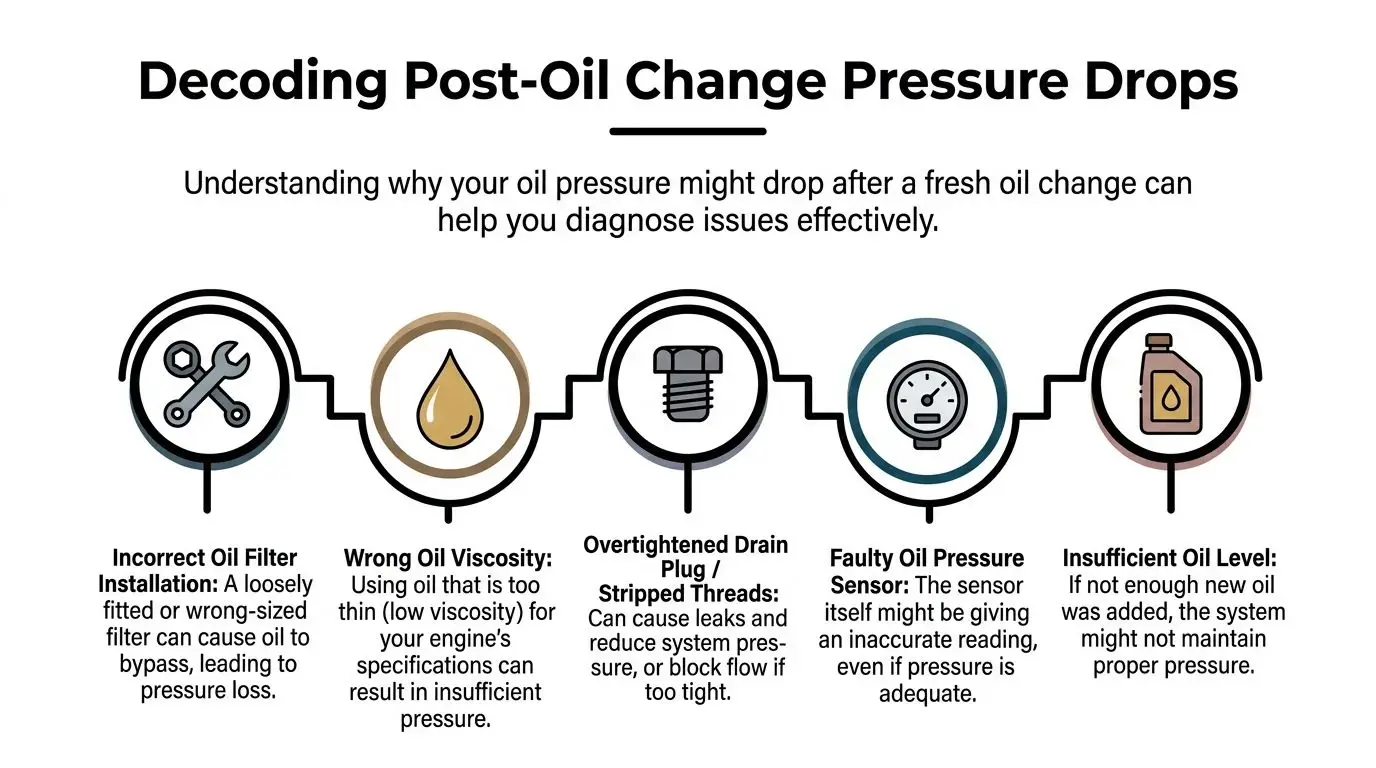
If you want a broader mechanical background, this article on what can cause low oil pressure helps connect post-service problems with longer-term engine wear issues.
Wrong oil viscosity
This is one of the most common reasons a vehicle shows low oil pressure after oil change even though the level looks right.
The oil has to match the engine’s required viscosity. If it’s too thin for the application, pressure can fall once the engine warms up and the oil thins further. That’s why some drivers say the warning appears mostly at idle or in traffic, not right after startup.
A documented summary from the Classic Broncos discussion notes that incorrect oil viscosity is responsible for 20% to 35% of low pressure cases after an oil change, and one vehicle that switched from conventional to full synthetic 10W-30 showed a 44% variance in warm idle pressure while remaining mechanically sound (Classic Broncos).
Filter problem versus filter installation problem
Drivers often lump these together, but they aren’t identical.
A filter installation problem means something went wrong during service. The filter may be loose, cross-threaded, damaged, or not sealing correctly.
A filter problem means the part itself may be wrong for the engine or defective internally. That can affect the bypass valve behavior and oil flow.
Typical clues
- A warning that appears immediately after service points more strongly to installation or part choice.
- Oil around the filter usually supports an installation issue.
- Normal oil level with a persistent warning and no leak can still be a filter-related flow problem.
Low oil level from an incomplete fill or a leak
This one is simple in concept but easy to miss if nobody confirms the final level carefully.
If the system is underfilled, or if oil leaked out after the vehicle left, the pump may pull oil inconsistently, especially during braking, turning, or idling hot. That can trigger an oil pressure warning even if the engine still sounds normal at first.
A low level can also create foaming or aeration in some situations. Aerated oil doesn’t protect like solid oil flow.
Faulty oil pressure sender or sensor
This is the best-case mechanical outcome. The warning may be false.
A bad sender can trigger the light even when actual pressure is fine. But you don’t know that from the dashboard alone. That’s why guessing is risky. The vehicle still needs a real pressure test before anyone should declare the engine safe.
A warning light can be caused by a sensor. It can also be caused by genuine pressure loss. The first professional step is proving which one it is.
Oil pump loss of prime
This cause gets missed in a lot of casual advice.
A documented case shared in a YouTube technical discussion showed an oil pump losing prime after an oil change, resulting in zero oil pressure until the system was re-primed (YouTube case reference). It’s more likely when air enters the system during draining and refilling, particularly in certain designs or after conditions that make priming harder.
This isn’t the first thing most drivers should assume, but it belongs on the list when:
- the oil level is correct
- the filter appears fine
- there’s no obvious leak
- and pressure is still absent
Internal wear that service happened to reveal
Sometimes the oil change didn’t create the problem. It exposed one that was already there.
An older engine with bearing wear, sludge restriction, or a weak pump may have been borderline before the service. A change in oil condition, viscosity behavior, or filter flow can reveal the weakness quickly.
That doesn’t mean the service was necessarily done wrong. It means the engine now needs testing instead of assumptions.
Quick symptom comparison
| Symptom pattern | More likely causes |
|---|---|
| Light came on right after service | Filter issue, oil level, wrong viscosity |
| Light mostly appears hot at idle | Viscosity mismatch, internal wear, weak pressure at temperature |
| Zero pressure with correct level and no leak | Loss of prime, severe flow issue, major internal problem |
| Gauge reading odd but engine sounds normal | Sensor or sender issue, but must be verified |
What works here is pattern recognition. What doesn’t work is deciding the cause from one clue alone.
Advanced Diagnostics When to Call The Professionals
Once you’ve done the safe visual checks, there’s a hard limit to what you can prove in a parking lot. Pressure has to be measured, not guessed.
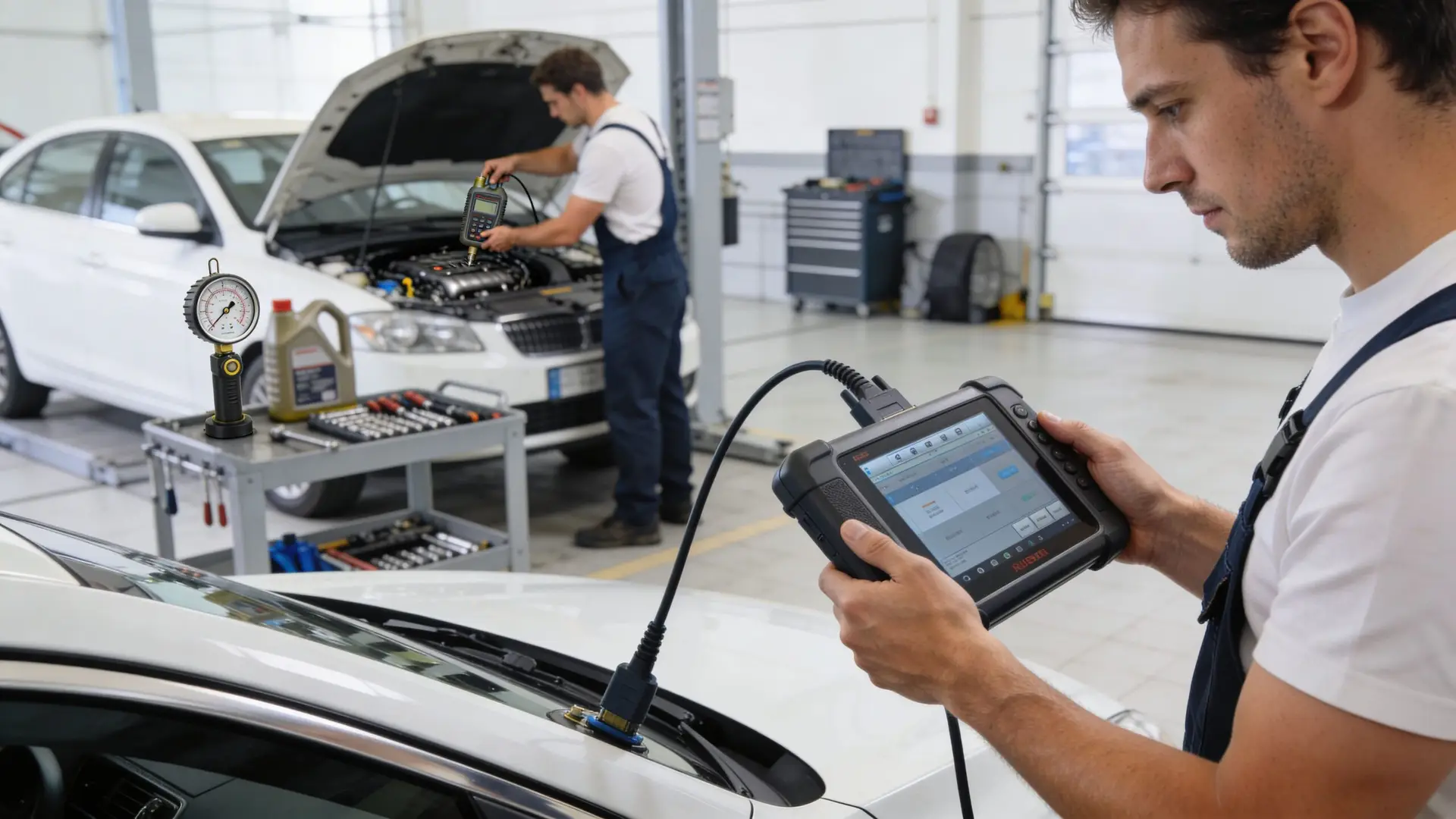
The first test that matters
A good technician starts by installing a mechanical oil pressure gauge.
That test bypasses the vehicle’s dash reading and tells you what the engine is producing. It’s the dividing line between a real lubrication problem and an electrical reporting problem.
Heavy Vehicle Inspection lists normal pressure ranges as 50 to 80 PSI on cold start, 25 to 40 PSI at warm idle, and 40 to 65 PSI while cruising at 2000 to 3000 RPM (Heavy Vehicle Inspection). If warm idle pressure drops below 20 PSI, immediate diagnosis is warranted, according to that same source.
What technicians check next
Once actual pressure is confirmed, the diagnosis gets more targeted.
If pressure is low
A technician may inspect for:
- Incorrect oil viscosity
- Filter restriction or bypass issues
- Sludge that limits oil pickup or flow
- Oil pump weakness
- Bearing wear that bleeds off pressure internally
- Loss of prime in the oiling system
If pressure is normal
The focus shifts toward:
- Oil pressure sender failure
- Wiring issues
- Instrument cluster or gauge problems
- Intermittent electrical faults
Why diagnosis is cheaper than gambling
Many expensive engine failures start when the driver hopes it’s “just a sensor,” keeps using the vehicle, and turns a manageable problem into a major repair.
According to the same Heavy Vehicle Inspection source, driving with low oil pressure for even 30 seconds can lead to bearing damage costing $3,000 to $8,000. Compared with that, paying for proper diagnosis is the inexpensive decision.
If the warning remains and you don’t have confirmed pressure readings, the vehicle is not safe to keep driving on assumptions.
The practical line between DIY and shop work
A driver can safely check the level, look for visible leaks, and note exactly when the warning appears.
A professional should handle the rest when:
- the light stays on after the oil level is confirmed
- the engine makes noise
- the pressure gauge reading is low
- there’s no visible leak but the warning persists
- the problem started right after service and the cause isn’t obvious
That’s not about making the problem sound bigger than it is. It’s about using the right tools before engine parts pay the price.
Your Next Steps for a Safe Return to the Road
At this point, the decision is usually clearer.
If you found an obvious issue, corrected it safely, and the warning is gone, you still need to watch the vehicle closely. Check the oil level again after a short period. Look underneath for fresh leakage. Pay attention to idle quality and any new noise.
If the warning stayed on, came back, or never made sense in the first place, stop treating it like a maybe. Get the vehicle inspected before more damage happens.
A simple decision guide
Safe to monitor briefly
You found a clear minor issue, corrected it, and the warning is gone with no noise or leak.Needs professional diagnosis now
The light remains on, returns, or appears with normal oil level and no obvious leak.Needs towing, not driving
The engine is noisy, pressure reads very low or zero, or you see active oil loss.
For some owners, the diagnosis reveals a simple correction. For others, it confirms a bigger engine problem that changes the economics of the vehicle. If a repair estimate eventually pushes you toward disposal instead of repair, options like junk car removal services can at least help you understand what end-of-life handling looks like.
The key point is simple. Don’t let uncertainty make the decision for you. With oil pressure warnings, delay is what turns a service issue into an engine issue.
If your vehicle has low oil pressure after an oil change, let the team at Express Lube & Car Care check it the right way. Our ASE-certified technicians can verify actual oil pressure, inspect the filter and oil system, and give you a clear answer without the guesswork. Stop by for fast, honest help before a warning light becomes an engine repair.