

Some oil use is normal in an Audi, especially a turbocharged one. Needing to add a quart every few thousand miles is common. Needing to add one every 1,000 miles or less is the point where you should stop assuming and start measuring. Audi’s own position is that some consumption is part of normal engine operation, but consumption beyond the manufacturer’s limits is a technical issue that needs a professional look. This guide shows you how to measure it, what usually causes it, and what a real fix looks like.
We’re a full-service shop in Richland Hills, and we see European cars every week. Here’s how we’d walk through it with you at the counter.
TL;DR
- Many manufacturers treat about one quart per 1,000 miles as the outer edge of acceptable. Some owners and forums report Audi’s allowance for the 2.0T is about that, so get your own owner’s manual and a written measurement before you decide anything.
- The usual suspects are worn or stuck piston rings, a failing PCV (crankcase ventilation) system, worn valve seals and external leaks. A turbo issue can also play a part.
- Don’t wait for blue smoke. Modern catalytic converters can hide it, so the dipstick is your real warning.
- Check the oil level every other fuel stop, and don’t stretch oil change intervals on a car that’s using oil.
- Our ASE-certified technicians can run a diagnosis with a digital inspection, so you see photos of what we find. Walk-ins are welcome.
Table of Contents
- How much oil is normal for an Audi?
- Why some Audis burn oil
- Why you may not see smoke
- How to measure your Audi’s oil consumption
- Signs that point to a problem
- Recalls, lawsuits and warranty
- What a proper diagnosis looks like at our shop
- Fixing oil consumption: your realistic options
- Keep the oil fresh while you’re tracking consumption
- Our perspective: measure first, then decide
- Get your Audi checked in Richland Hills
- FAQ
- Sources
How much oil is normal for an Audi?
Every engine uses a little oil. A thin film stays on the cylinder walls, and a small amount burns off each time the piston moves. Turbocharged, small-displacement engines run hot and under pressure, so they tend to use more than a relaxed naturally aspirated engine.
The number you’ll see quoted most is one quart per 1,000 miles. Forum posts and shop pages repeat it for Audi’s 2.0 TFSI. We can’t point you to an official Audi page that states it for every model, so treat it as a rule of thumb. Your owner’s manual and a dealer’s written statement carry more weight. You can find your model’s manual and maintenance schedule through Audi USA’s service and parts page.
Here’s a practical way to read the numbers:
| What you’re seeing | What it usually means | What to do |
|---|---|---|
| Level barely moves between changes | Normal | Keep checking monthly |
| Down about a quart every 3,000 to 5,000 miles | Common for turbo engines, worth tracking | Log it, check more often |
| Down a quart every 1,000 miles | At the limit many makers allow | Get a diagnosis |
| Down a quart in under 1,000 miles | Likely excessive | Get a diagnosis soon |
| Low-oil warning between changes | Don’t ignore | Top off and book service |
One figure from a parts-and-tech site: for the MINI engines it covers, more than one quart per 750 miles is considered excessive and needs more diagnosis. That’s useful if you drive a Mini Cooper, since the same logic applies: measure first, then decide.
Why some Audis burn oil
Oil burning isn’t one problem. It’s a symptom with several possible causes. Here are the ones we check first.
Piston rings
Piston rings seal the combustion chamber and scrape excess oil off the cylinder wall. If they wear, stick or don’t seat well, oil gets past them and burns. This is the cause most associated with Audi’s 2.0-liter turbo engines. Consumer Reports flagged Audi’s 2.0-liter turbocharged four-cylinder and 3.0-liter V6 among the main offenders in its analysis of 2010 to 2014 model-year vehicles.
That’s a repair that often involves opening up the engine. It’s not something to guess at, so we diagnose before we quote.
PCV system
The PCV valve and its hoses let crankcase pressure vent safely back into the intake. When it sticks or a diaphragm tears, pressure builds and oil can get pulled into the intake or pushed past seals. It’s one of the cheaper causes to fix, which is why we check it early. Fixing it first can save you from a bigger repair if it turns out to be the culprit.
Valve seals and valve guides
Worn valve seals let oil seep down into the cylinder, usually after the car sits. You’ll often see a puff of smoke on startup. It can also show up on a cold start in the morning.
Carbon buildup
Many modern direct-injection engines build up carbon on intake valves and in combustion areas. It can contribute to ring sticking and poor sealing. It’s rarely the whole story, but it’s often part of it.
External leaks
Sometimes the oil isn’t burning at all. It’s leaking from a valve cover gasket, oil filter housing, oil cooler line or turbo line. Spots on your driveway are a clue, but not a reliable one, because oil can run onto the skid plate and drip somewhere else. A photo inspection helps a lot here. We wrote about this exact problem for another European brand in our BMW oil leak guide, and the same method applies to Audi.

Turbocharger seals
A turbo with worn seals can pass oil into the intake or exhaust. You may notice a loss of power, a whine, or smoke under boost.
Why you may not see smoke
Most people expect burning oil to look like a blue cloud behind the car. That’s not reliable anymore. Consumer Reports notes that catalytic converters can mask the smoke that used to give the problem away, so an engine can use a lot of oil with no visible warning.
That’s the quiet danger. The same article points out that long factory change intervals, sometimes up to 10,000 miles, make checking the level yourself more important. If the oil runs low long before the next scheduled change, the engine is the one that pays.
There’s an exhaust cost too. The EPA’s guidance says vehicles with excessive fuel or lubricating oil consumption should be repaired before other emissions work. That guidance is written for diesel retrofit technology, so we’re not applying it as a rule for your gasoline Audi. The general idea still holds: oil that gets into the exhaust is hard on emissions parts, and a catalytic converter is a pricey thing to replace.

How to measure your Audi’s oil consumption
You don’t need special tools, only patience and a notebook or phone note. If you want a refresher on the basics, read our guide on how to check your car’s oil level.
- Start with a known level. Park on flat ground with the engine off for several minutes. Check the dipstick or the oil level display, and top off to the full mark if needed.
- Write down the odometer. Note the mileage and the level.
- Drive normally. Keep your regular routes. Don’t baby the car or push it hard just for the test.
- Recheck every 500 miles. Always on level ground, always the same way, always after the engine has rested.
- Record what you add. If you add a quart, write down the miles since the last fill.
- Calculate. Divide miles driven by quarts used. If it’s 1,000 miles or fewer per quart, bring it in.
The most accurate version is to have the oil changed to a known fill, then drive until the level is a measured amount low. A shop can do that for you with a proper record. Many Audis use an electronic oil level sensor rather than a dipstick, so the dashboard reading may be less precise than you’d like. If your model has a dipstick, use it.
Signs that point to a problem
Beyond your own numbers, watch for these:
- A low-oil message or oil pressure light between changes
- Smoke at startup, or under hard acceleration
- A burning smell after a drive
- Fouled spark plugs or misfires
- A check engine light with a catalyst efficiency or misfire code
- Oil spots where you park
Our piece on signs your car needs an oil change covers more of the everyday warning signs. If a low oil pressure light appears, see what to do about low oil pressure.
Recalls, lawsuits and warranty
Before you pay for any big repair, check three things.
Recalls. Some Audi issues are recalls, not just oil consumption. For example, certain 2013 to 2017 A8, S6, S7 and RS7 models with 4.0L engines were recalled because of an oil strainer that can clog with carbon deposits and starve the turbocharger of oil. Consumer Reports covered the recall, and the repair is done free at authorized service centers. Enter your VIN on the NHTSA recall lookup or ask an Audi dealer.
Class actions. Oil consumption in the 2.0L turbo has led to litigation. One example: a 2022 Missouri suit alleged piston ring problems in 2012 to 2017 Audi models. Whether a case applies to you depends on your state, model year and the current status of the case. We aren’t lawyers, so if you think you may qualify, talk to an attorney or check the official settlement site.
Warranty. If your Audi is still under factory warranty, document your oil use and have the dealer record it in writing. That paper trail matters later. If you’re out of warranty, that’s where an independent shop like ours comes in.
What a proper diagnosis looks like at our shop
We don’t guess, and we don’t start with the most expensive answer. For an Audi that’s using oil, the process goes like this:
- Interview. How much are you adding, how often, and over how many miles? Do you drive mostly short trips or highway?
- Digital vehicle inspection. Our ASE-certified technicians look over the engine bay and underside, and you get photos of what they find. That makes it easy to see a leaking gasket or a wet hose for yourself.
- Scan for codes. Misfire, catalyst and fuel-trim codes tell us whether oil is reaching the cylinders or the exhaust.
- Check the cheap causes first. PCV components, hoses, gaskets and visible leaks.
- Deeper tests when needed. If the simple causes don’t explain it, we talk through options such as a consumption test, compression or leak-down testing, and what a ring or engine repair would mean.
- Clear options. You get the findings, what’s urgent and what can wait, before any work starts.
If the answer is internal engine wear, we’ll tell you plainly. Our engine repair and replacement service covers diagnostics through replacement, and repairs that qualify carry our 24-month/24,000-mile warranty.
Fixing oil consumption: your realistic options
People search for an easy fix. Sometimes there is one. Often there isn’t. Here are the paths in order of cost and commitment.
| Option | When it fits | Honest limits |
|---|---|---|
| Repair external leaks | Oil is leaking, not burning | Only helps if leaks are the cause |
| Replace PCV parts | Faulty PCV or hoses | May not fix ring wear |
| Intake and carbon service | Carbon is part of the picture | Not a cure for worn rings |
| Valve seal repair | Smoke at startup, seal wear | Labor varies by engine |
| Piston ring and piston repair | Internal wear confirmed | A major repair; compare against the car’s value |
| Engine replacement | Severe damage or wear | Largest investment |
| Monitor and top off | Mild, steady use | Needs diligence, doesn’t fix anything |
We don’t publish repair prices because they depend on your model, engine and findings. You’ll get a written estimate after diagnosis. If you’d rather spread the cost, ask us about car care financing.
As for oil additives and thicker oil as a “fix”: we’d be careful. Some owners try them. Using the oil grade your owner’s manual specifies is the safe default for your engine, and an additive can’t repair worn rings. Ask us before changing the grade.
Keep the oil fresh while you’re tracking consumption
An engine that burns oil needs good oil more than most. Short intervals aren’t wasteful for these cars. See why oil change intervals matter for your engine, and what to expect from oil changes on European cars. If you drive for Uber, Lyft or deliveries, the extra stop-and-go makes it even more important. Our rideshare oil change guide explains why. Skipping a visit also carries risks, as we explain in why skipping an oil change appointment is a bad idea.
An oil change is also a good time for a look around. Here’s what an oil change inspection should cover.
Our perspective: measure first, then decide
We see the same pattern with European cars. An owner is told by someone that “it’s normal,” and keeps driving without checking the dipstick. A few thousand miles later the oil light comes on. Or the owner panics, assumes the engine is finished, and nearly sells a car that only needed a PCV repair and a leak fixed.
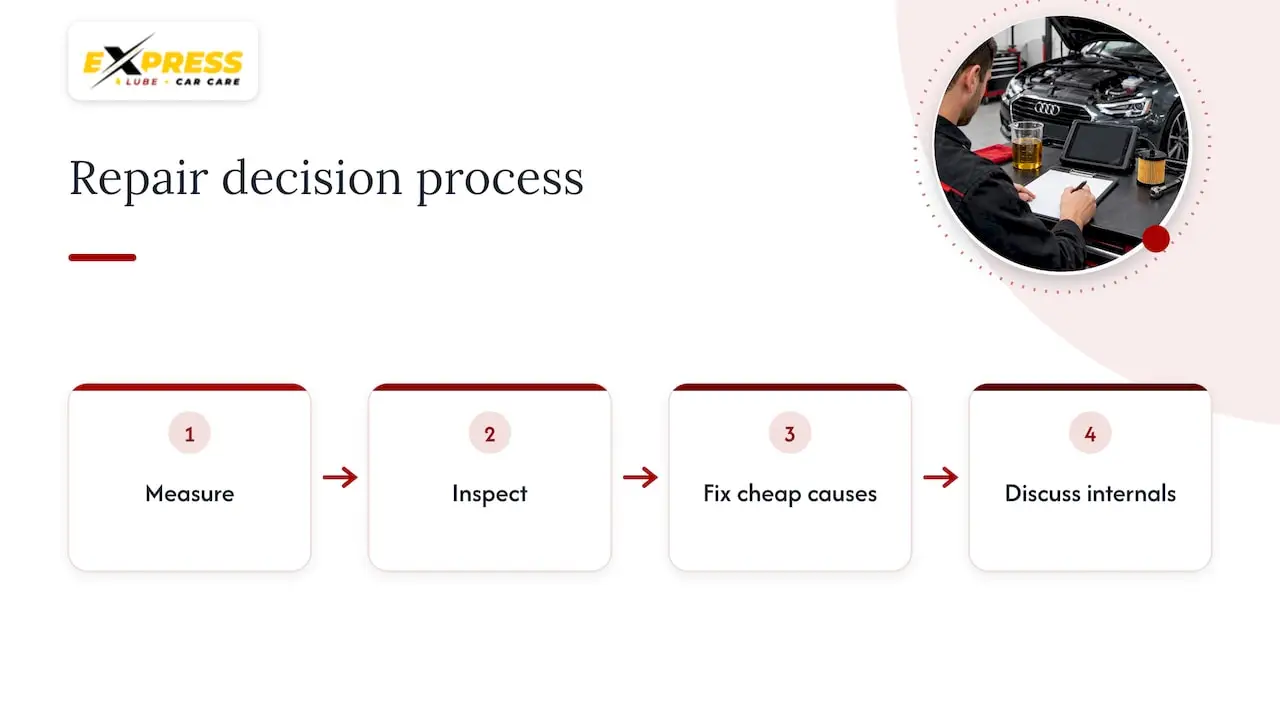
Both mistakes come from not having numbers. That’s why we start with a measurement and a digital inspection with photos, so you can see what our ASE-certified technicians see. We’d rather tell you a car is fine and send you home with a tracking sheet than sell you work you don’t need. And when the engine does need work, you get honest pricing, a clear explanation, and a 24-month/24,000-mile warranty on qualifying repairs.
The same goes for Mini Cooper owners. Mini engines can be thirsty too, and the process is identical: measure, inspect, fix the cheap causes first, and only then talk about internal repairs.
— Express Lube & Car Care
Get your Audi checked in Richland Hills
If your Audi is adding a quart every 1,000 miles or less, or you’re just not sure what it’s doing, come see us. We take walk-ins or appointments, and same-day service is available when possible. Browse all of our services or see current oil change and service specials. We also serve drivers from North Richland Hills and around Tarrant County.
Ready to schedule? Call us at (817) 284-8478.
FAQ
Why do Audis burn so much oil?
Most cases trace to worn or sticking piston rings, a faulty PCV system, worn valve seals or external leaks. Turbocharged engines run hot and under pressure, which makes them more prone to using oil. A diagnosis tells you which cause applies to your car.
How can I fix my Audi’s oil consumption?
Start by measuring how much you’re using over 500-mile intervals. Then have a shop check the PCV system, gaskets and leaks, which are the cheaper causes. If internal wear is confirmed, the fix is a piston ring or engine repair, and no additive replaces that.
Is it normal to add a quart of oil between changes?
It can be, if your change interval is long and the quart is the only top-off. Needing a quart every 1,000 miles or less is the point where we’d recommend a diagnosis. Check your owner’s manual for your model’s specification.
Does a Mini Cooper use oil the same way?
Some do. For one Mini engine family, a technical source treats more than one quart per 750 miles as excessive. The measuring method is the same as for an Audi.
Is there a lawsuit about Audi oil consumption?
There have been class actions over piston ring problems in the 2.0L turbo engines, including a 2022 Missouri case. Whether you qualify depends on your state, model year and the case status, so ask an attorney or check the official settlement site.
Sources
- Excessive Oil Consumption Isn’t Normal, Consumer Reports
- Some Newer Cars Can Burn Lots of Oil, Consumer Reports
- Audi Recalls Sedans for a Stalling Problem, Consumer Reports
- Technical Bulletin: Diesel Oxidation Catalyst Installation, Operation, and Maintenance, EPA
- Service & Parts, Audi USA
- Audi Piston Ring Problems Cause Class Action Lawsuit, CarComplaints.com
- MINI Cooper R56 Oil Consumption Diagnosis, Pelican Parts