

European cars have longer oil changes because their engines require specially formulated synthetic oils that meet strict ACEA emissions standards and support tighter engineering tolerances than most domestic vehicles. These aren’t just marketing claims. The oil specifications, emissions hardware, and engine designs found in vehicles from Germany, Sweden, and the UK genuinely demand a different maintenance approach. European manufacturers recommend intervals of 10,000–15,000 miles, while specialists advise 7,500–10,000 miles for real-world driving conditions. Understanding the difference between those two numbers could save you thousands in engine repairs. At Express Lube & Car Care, we work with European vehicle owners regularly, and the questions about oil change frequency come up every single week.
Why European cars have longer oil changes: the engine and emissions connection
European engines are built to tighter manufacturing tolerances than most American counterparts. That means smaller clearances between moving parts, higher operating pressures, and more heat generated during normal driving. Full-synthetic oils with superior thermal stability are the only oils capable of protecting these engines reliably. A conventional or semi-synthetic oil simply breaks down too fast under those conditions.
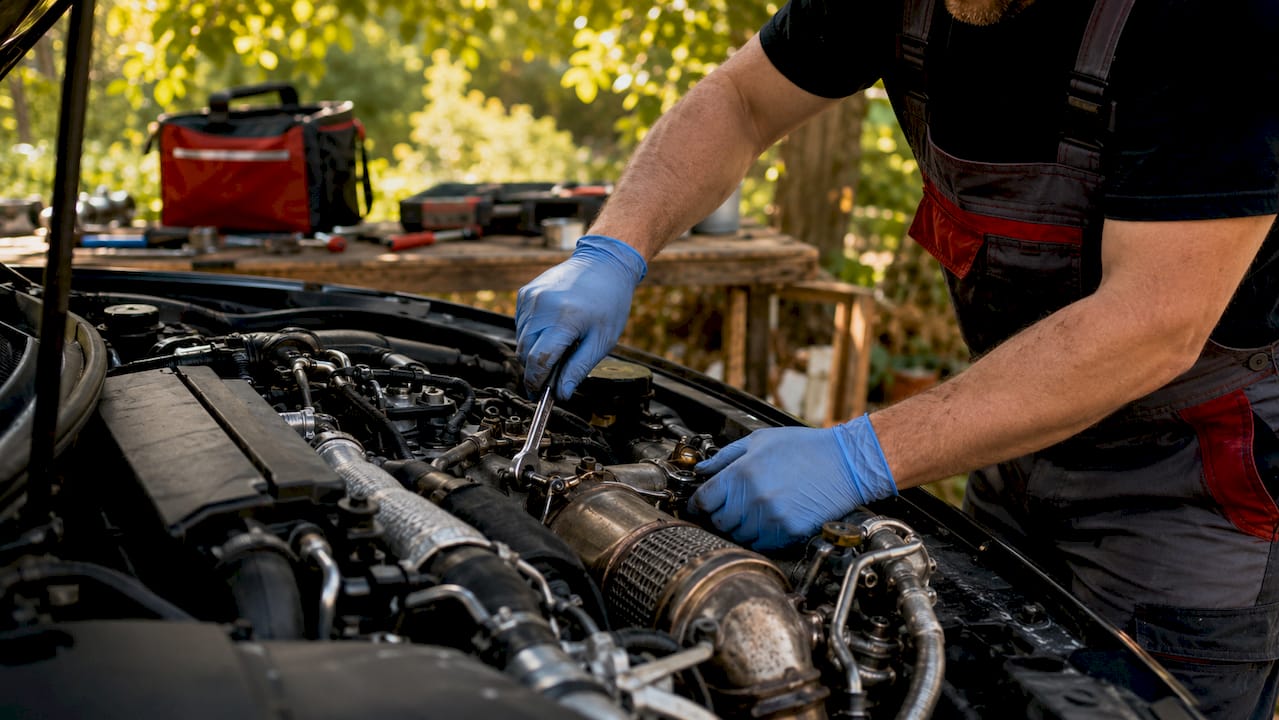
Emissions hardware adds another layer of complexity. Most modern European vehicles, especially diesels, use diesel particulate filters (DPFs) and catalytic converters to meet strict European Union emissions regulations. These components are sensitive to sulfur, phosphorus, and ash content in engine oil. Incorrect oil can cause DPF failure costing $1,250 to $2,500 within 50,000–80,000 miles. That is a steep price for using the wrong product at an oil change.
This is where low-SAPS oil formulations come in. SAPS stands for sulfated ash, phosphorus, and sulfur. European oils are specifically blended to keep these elements below limits set by ACEA, the European Automobile Manufacturers’ Association. Keeping SAPS low protects the DPF and catalytic converter while still providing adequate engine lubrication.
Turbocharging is another factor. The majority of modern European engines, from compact hatchbacks to performance sedans, use turbocharged engines. Turbos spin at extremely high speeds and generate intense heat. Oil that degrades quickly under heat will coke inside the turbo bearings, causing premature failure. Full-synthetic oils with high thermal stability resist this breakdown, which is one reason oil change frequency for European vehicles can stretch further than with conventional oils.
- Tighter engine tolerances require oils with higher film strength
- DPFs and catalytic converters demand low-SAPS formulations
- Turbocharged engines need oils that resist thermal breakdown
- Higher operating temperatures accelerate oil degradation in stop-and-go traffic
Pro Tip: If your European car uses a diesel engine, always confirm the oil is rated for DPF-equipped vehicles before purchasing. The wrong oil can clog your filter silently over thousands of miles.
How European and American oil standards differ
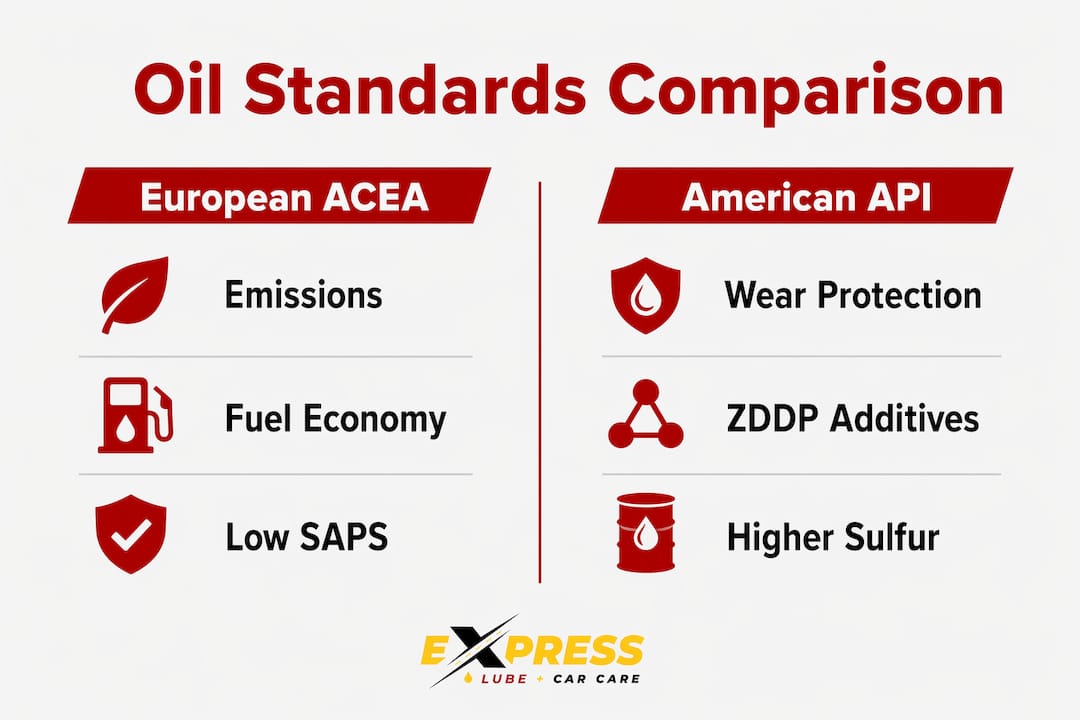
ACEA and API are the two dominant oil classification systems, and they prioritize very different things. ACEA prioritizes emissions compliance and fuel economy, while API focuses primarily on wear protection and controlling oil residue. The result is two distinct families of additive packages that are not interchangeable.
American API-rated oils use higher levels of zinc dialkyldithiophosphate (ZDDP) for wear protection. European ACEA oils reduce ZDDP and other high-SAPS additives to protect emissions hardware. Swapping an API oil into a European engine does not just void your warranty. It can shorten the life of your DPF and catalytic converter significantly.
OEM approvals take this even further. Meeting the ACEA baseline is not enough for most European manufacturers. VW 504.00 and BMW LL-04 are proprietary approval standards that involve additional tests for bore coatings, turbo heat resistance, and long-drain stability. An oil can carry an ACEA rating and still fail these OEM tests.
| Standard | Primary Focus | Key Requirement | Example Approval |
|---|---|---|---|
| ACEA | Emissions and fuel economy | Low-SAPS formulation | ACEA C3 |
| API | Wear protection and residue control | ZDDP levels | API SP |
| OEM Approval | Engine-specific performance | Proprietary testing | BMW LL-04, VW 504.00 |
European synthetic oil typically costs $10–$15 per quart, compared to $5–$8 for domestic oils. That price gap reflects the more complex additive chemistry required to meet both ACEA and OEM standards. Cutting corners here is false economy. You can find a detailed breakdown of euro car parts and fluid specs that covers approved products for common European models.
Pro Tip: Always look for the specific OEM approval code on the oil bottle, not just the ACEA category. “Meets ACEA C3” is not the same as “BMW LL-04 approved.” The difference matters for your engine.
What are the recommended oil change intervals for European cars?
Factory-recommended intervals of 10,000–15,000 miles sound appealing, but they come with an important caveat. Manufacturers set maximum intervals partly as marketing tools to advertise low ownership costs to fleet buyers. These figures represent the outer limit under ideal conditions, not the optimal interval for long-term engine health.
Specialists consistently recommend 7,500–10,000 miles for most European vehicles driven in real-world American conditions. Short trips, highway driving in Texas heat, and stop-and-go traffic all accelerate oil degradation faster than European test cycles account for. Understanding how many miles between oil changes for your specific model is the starting point for any maintenance plan.
Condition-based service systems like BMW’s CBS (Condition Based Service) and Mercedes’ ASSYST calculate intervals using sensor data from your driving patterns. These systems are genuinely useful, but they have a known limitation. Flexible service systems do not adjust enough for harsh driving, and experts recommend cutting the suggested interval by 20–50% in severe conditions. A CBS readout showing 8,000 miles remaining does not mean 8,000 miles is safe if you drive mostly short trips in summer heat.
High-performance variants require even more attention. BMW M models and Mercedes-AMG vehicles run higher compression ratios, generate more heat, and stress oil faster than their standard counterparts. BMW M and AMG models require more frequent servicing than standard variants, regardless of what the dashboard indicator says.
Change your oil earlier than the factory interval if any of these apply:
- You take frequent short trips under 10 miles
- You drive in extreme heat or cold regularly
- Your vehicle sits unused for weeks at a time
- You tow or carry heavy loads
- Your engine has more than 75,000 miles on it
- You drive a turbocharged or high-performance variant
Additional maintenance considerations for European vehicles
Oil is only one piece of the puzzle. European vehicles carry a set of fluid and service requirements that differ meaningfully from domestic vehicles, and ignoring them creates compounding problems over time.
Brake fluid is a good example. European brake fluids are hygroscopic, meaning they absorb moisture from the air over time. DOT 4 and DOT 5.1 fluids, which are standard in European vehicles, lose boiling point capacity as moisture accumulates. Testing or replacing brake fluid every two years prevents brake fade and protects ABS and stability control components. Most American drivers skip this service entirely because domestic vehicles rarely specify it.
Coolant and transmission fluid intervals also differ. European manufacturers often specify longer coolant change intervals but with specific coolant chemistry that resists aluminum corrosion. Using the wrong coolant type can cause internal corrosion in aluminum engine blocks and radiators. A complete fluid change schedule for your European vehicle should cover all these items together, not just oil.
| Fluid | Typical European Interval | Key Consideration |
|---|---|---|
| Engine oil | 7,500–10,000 miles (specialist) | Must meet OEM approval (e.g., BMW LL-04) |
| Brake fluid | Every 2 years | DOT 4 or DOT 5.1; hygroscopic degradation |
| Coolant | Every 4–5 years | Manufacturer-specific chemistry required |
| Transmission fluid | Every 40,000–60,000miles | Often “lifetime fill” by OEM, but specialists recommend changes |
Proactive maintenance on all these fluids extends engine and drivetrain longevity far beyond what reactive servicing achieves. A luxury car maintenance checklist that covers oil, brake fluid, and coolant together gives you a clear picture of what your European vehicle actually needs year to year.
Key Takeaways
European cars have longer oil change intervals because their specialized synthetic oils, low-SAPS formulations, and OEM-approved chemistry protect advanced emissions hardware and high-tolerance engines far better than standard domestic oils.
| Point | Details |
|---|---|
| ACEA vs. API standards | European ACEA oils prioritize emissions protection; American API oils prioritize wear, making them incompatible with European engines. |
| OEM approvals matter | BMW LL-04 and VW 504.00 go beyond ACEA ratings; always verify the specific approval code on the oil bottle. |
| Factory intervals are maximums | Manufacturer intervals of 10,000–15,000 miles are upper limits; specialists recommend 7,500–10,000 miles for real-world conditions. |
| Condition-based systems have limits | BMW CBS and Mercedes ASSYST underestimate wear in severe driving; reduce suggested intervals by 20–50% in harsh conditions. |
| Brake fluid needs attention too | DOT 4 and DOT 5.1 fluids absorb moisture and should be tested or replaced every two years to maintain braking performance. |
What we’ve learned from servicing European cars in the real world
Here is the uncomfortable truth about European oil change intervals: the factory number is not your friend. I have seen engines from well-maintained European vehicles come in with sludge buildup because the owner trusted the dashboard alert and nothing else. The CBS system on a BMW does not know that you spent three months doing 5-mile school runs in 100-degree Texas heat. It just counts cycles and estimates.
My honest take is that the 10,000-mile factory interval made sense when it was developed for European driving patterns. Long highway stretches, moderate climates, and consistent speeds are what those intervals were calibrated for. American driving, especially in the Dallas-Fort Worth area, looks nothing like that. Short trips, extreme summer heat, and heavy traffic are the norm here. Those conditions degrade oil faster than any algorithm accounts for.
The other misconception I run into constantly is the idea that using a more expensive oil automatically means you can stretch the interval further. That is not how it works. A high-quality BMW LL-04 approved oil still has a finite service life under severe conditions. Spending more on the right oil buys you protection, not permission to skip changes.
My recommendation is simple. Use the correct OEM-approved oil, and change it at 7,500 miles if you drive in typical American conditions. If you drive a turbocharged or high-performance variant, consider 5,000–7,500 miles. The cost of an extra oil change per year is nothing compared to a turbo replacement or an engine rebuild.
— Express Lube & Car Care
European car oil changes done right at Express Lube & Car Care
Owning a European vehicle in Richland Hills means your oil change is not a generic service. It requires the right oil specification, the right approval code, and a technician who knows the difference between ACEA C3 and API SP.
Express Lube & Car Care stocks factory-approved full-synthetic oils for European vehicles and employs ASE-certified technicians who understand OEM specifications. No appointment is needed. Walk in, tell us your make and model, and we will match the correct oil to your engine. Check out our current oil change specials for European vehicles and see what a properly done service looks like. Your engine will thank you for it.
FAQ
Why do European cars go longer between oil changes?
European cars use full-synthetic oils with advanced additive chemistry that resists thermal breakdown longer than conventional oils. Their engines are also designed around these specific oil formulations, which allows extended drain intervals under ideal conditions.
Can I use American API oil in my European car?
No. API-rated oils contain higher levels of sulfated ash, phosphorus, and sulfur that can damage diesel particulate filters and catalytic converters in European engines. Always use an oil with the correct ACEA rating and OEM approval for your vehicle.
How often should I change the oil in my European car?
Specialists recommend 7,500–10,000 miles for most European vehicles driven in real-world American conditions, even if the factory interval is listed as 10,000–15,000 miles. Severe driving conditions like short trips and extreme heat warrant the shorter end of that range.
What does BMW LL-04 or VW 504.00 mean on an oil bottle?
These are OEM-specific approval codes that confirm the oil has passed proprietary tests for bore coatings, turbo heat resistance, and long-drain stability. Meeting the ACEA baseline alone does not guarantee compatibility with these engines.
Does the condition-based service system tell me exactly when to change my oil?
Not exactly. Systems like BMW CBS and Mercedes ASSYST estimate intervals from sensor data but do not fully account for severe driving environments. Experts recommend reducing the suggested interval by 20–50% if you regularly drive in extreme heat, cold, or stop-and-go traffic.