

Before you can fix a car that's burning oil, you have to be absolutely sure that's the problem. The solution isn't just to keep topping it off—that's a temporary patch that ignores a potentially serious mechanical issue. To stop it for good, you’ll need to find and repair the root cause, which often means replacing parts like worn-out piston rings, bad valve seals, or a failing PCV valve.
A permanent repair by a qualified mechanic is always the best route, but first, you need to play detective.
Identifying the Signs of a Car Burning Oil

That puff of blueish smoke coming from your tailpipe is the most obvious giveaway, but your car often sends more subtle signals long before that happens. Catching these early signs is the key to preventing a minor annoyance from snowballing into major engine damage.
One of the first things you'll probably notice is a constantly low oil level on your dipstick. Are you finding yourself needing to add a quart between oil changes, even though you don't see any puddles on your driveway? That’s a classic symptom of your engine consuming oil internally.
Using Your Senses to Diagnose the Problem
Beyond the dipstick, your other senses are surprisingly good diagnostic tools. When you get out of your car after a drive, take a moment to notice any unusual smells. A sharp, acrid odor often means oil is dripping onto hot parts of the engine or exhaust system and burning off.
You should also pay attention to how your car feels and sounds. A car that's burning oil might start to show other performance issues, like:
- Feeling a little sluggish or losing power when you accelerate.
- Idling rougher than it used to.
- Getting worse gas mileage than you remember.
Often, these symptoms creep up slowly, but when you put them all together, they paint a pretty clear picture that your engine needs a closer look.
Simply adding more oil is like trying to fill a leaky bucket instead of just fixing the hole. You're not solving anything. Ignoring the real problem lets the mechanical issue get worse, putting expensive components like your catalytic converter and oxygen sensors at risk.
Quick Symptom Checker for Oil Consumption Issues
If you're noticing a few of these signs, this quick table can help you connect the dots. Use it to narrow down what might be going on under the hood.
| Symptom | What to Look For | Potential Severity |
|---|---|---|
| Blue Exhaust Smoke | Puffs of blue-tinted smoke, especially on startup or during acceleration. | Moderate to High: Clear sign oil is entering the combustion chamber. |
| Low Oil Level | Consistently needing to top off oil between changes, with no visible leaks. | Low to Moderate: Early warning sign of an internal consumption problem. |
| Burning Oil Smell | A sharp, acrid smell after the engine has warmed up. | Low to Moderate: Could be an external leak hitting hot parts or internal burn-off. |
| Oily Spark Plugs | Spark plugs coated in black, sooty, or wet-looking deposits. | High: Confirms oil is getting past the piston rings or valve seals. |
| Poor Performance | Loss of power, rough idle, or a drop in fuel economy. | Moderate: Often accompanies more severe oil consumption. |
This table is a great starting point, but for a definitive answer, sometimes you have to get your hands a little dirty.
If you’re comfortable doing so, pulling a spark plug can tell you a lot. A healthy plug should look light tan or grayish. But if it's coated in black, oily gunk, you’ve found your smoking gun—oil is getting into the combustion chamber where it absolutely doesn't belong.
If you see these symptoms and have a check engine light on, it’s a good idea to learn about running an engine light diagnostic. The sooner you get to the bottom of it, the better your chances are of avoiding a much bigger repair bill down the road.
Uncovering the Mechanical Causes of Oil Consumption
When an engine suddenly starts burning oil, it's never random. It's a clear symptom of a mechanical failure somewhere deep inside.
Your engine is designed to be a sealed system where oil lubricates moving parts but stays completely separate from the air and fuel that get ignited. When that barrier fails, oil gets into the combustion chamber, gets burned up, and you start seeing the tell-tale signs.
The most common culprits are parts that simply wear out from heat, friction, and millions of cycles of work. They lose their ability to maintain a tight seal, letting oil sneak past. Pinpointing which parts fail—and why—is the first real step to a fix.
Worn or Sticking Piston Rings
Picture the pistons inside your engine, flying up and down in their cylinders thousands of times a minute. Each piston has a set of piston rings wrapped around it. These rings do two critical jobs: they seal the combustion chamber to build compression, and they scrape excess oil off the cylinder walls to send it back down to the oil pan.
After tens of thousands of miles, these rings just plain wear down. Once they get too thin or lose their spring-like tension, they can't create that perfect seal anymore. This lets a tiny bit of oil slip past them and into the combustion chamber, where it burns right along with the fuel.
- Real-World Scenario: A 10-year-old daily driver with 150,000 miles suddenly needs a quart of oil every 1,000 miles. The owner can't find any leaks on the driveway. This slow, steady consumption is a classic sign of age-related piston ring wear.
- Another Possibility: Piston rings can also get stuck in their grooves from carbon buildup, usually a result of skipping oil changes. A stuck ring can't press firmly against the cylinder wall, which kills the seal.
Key Takeaway: Worn piston rings are a leading cause of oil consumption in higher-mileage cars. The failure of this one tiny part directly breaches the barrier between the oily crankcase and the fiery combustion chamber.
Hardened and Brittle Valve Stem Seals
Another critical seal lives at the very top of the engine. Every cylinder has intake and exhaust valves, and each valve has a small, rubber-like valve stem seal. Its job is to let the valve slide up and down freely while stopping oil from dripping down the valve stem and into the cylinder.
But after years of constant exposure to intense heat, these little seals get hard, brittle, and cracked. Once they lose their flexibility, they can't hug the valve stem tightly, and the seal is broken.
This problem often creates a very specific symptom: a puff of blue smoke from the exhaust right when you first start the car. Overnight, oil seeps past the bad seals and pools on top of the pistons. When you fire up the engine, all that pooled oil burns off at once.
A Faulty PCV Valve
Finally, there's a less obvious but incredibly common cause: the Positive Crankcase Ventilation (PCV) valve. This is a small, cheap part designed to vent the normal pressure that builds up inside the engine's crankcase. It reroutes these gases back into the intake so they can be burned off cleanly.
When a PCV valve gets clogged with sludge, it can't do its job. That pressure has to escape somehow, and it often ends up forcing oil past perfectly good seals and gaskets—including the piston rings and valve seals we just talked about. A stuck-shut PCV valve can dramatically speed up oil consumption.
Practical DIY Checks and Immediate Solutions
Before you head to the shop and start spending money, there are a few simple but effective checks you can do right in your own driveway. These are the first things I always recommend, as they can often point you to an easy fix or at least give you a clearer picture of what you're dealing with.
One of the most common culprits is a bad PCV (Positive Crankcase Ventilation) valve. If this little part gets clogged or stuck, it messes with the engine's internal pressure and can start forcing oil where it doesn't belong—right into the combustion chamber. The good news? It's usually a simple, 15-minute job to replace and costs less than $20. It’s amazing how often this cheap part solves a major oil consumption headache.
Start Tracking Your Oil Consumption
First things first, you need to figure out exactly how much oil your engine is actually burning. Just saying "it's using oil" isn't enough; you need hard numbers.
Here’s the process I use:
- Get a starting point: With the engine cold and the car on level ground, check the oil and top it off to the "full" mark on the dipstick. Be careful not to overfill it.
- Log your mileage: Jot down your car's current mileage in a notebook or on your phone.
- Drive like you normally do: Don't change your driving habits. Just drive for the next 500 to 1,000 miles.
- Re-check and measure: Park in the same level spot, let the engine cool completely, and check the dipstick again. If it's low, add oil slowly—maybe a quarter of a quart at a time—until it's full again. Keep track of exactly how much you added.
This gives you a real-world consumption rate, like "one quart every 800 miles." That’s the kind of specific information a mechanic (or you) can actually work with. If you need a refresher on the right way to do this, we've got a great guide on how to check your car oil level accurately.
This flowchart breaks down the common mechanical causes, helping you visualize where the problem might be coming from.
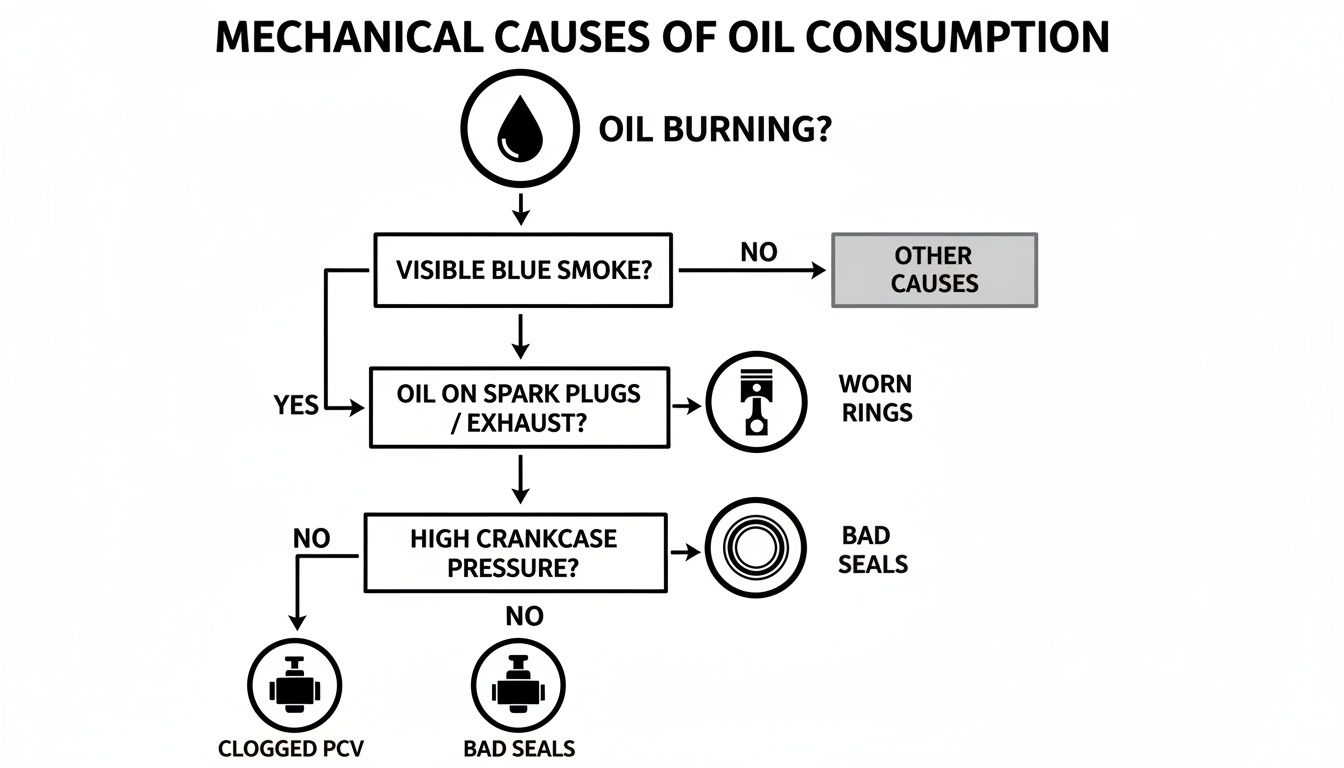
As you can see, oil consumption issues almost always come down to a problem with one of the engine's critical seals—the PCV valve, valve seals, or piston rings.
Consider Using a Thicker Oil
For an older, high-mileage engine, sometimes the simplest Band-Aid is the most effective. Switching to a slightly thicker, or higher-viscosity, oil can often slow down the burn.
For example, if your owner's manual calls for a 5W-20 oil, moving up to a high-mileage 10W-30 or even a 10W-40 can make a noticeable difference.
How it works: Thicker oil has a tougher time squeezing past worn-out piston rings and old, hardened valve seals. It’s not a permanent repair by any means, but it can buy you a lot of time and reduce how often you have to top off the oil.
Just be sure to double-check your owner's manual first. Some modern, sophisticated engines are extremely particular about the oil they use, and going too far off-spec can cause other problems.
While these DIY tricks can offer some relief and help you diagnose the issue, remember they are often just temporary measures. A serious oil consumption problem will eventually need a professional repair.
When It’s Time to Call in the Pros for an Engine Repair
While DIY fixes like thicker oil or a new PCV valve can sometimes slow down minor oil consumption, they’re really just temporary patches. Think of them as a bandage on a much deeper problem.
When the real culprits are worn-out internal parts—like piston rings or valve seals—no additive or quick fix is going to bring them back to life. These are jobs that demand the specialized tools, pristine environment, and hard-earned expertise of an ASE-certified technician.
Deciding to pull the trigger on a major engine repair is a big financial step. For many people with older, high-mileage cars, the cost of an engine rebuild can easily climb higher than the vehicle's actual worth. This is where you have to do the tough math and weigh the cost against how much longer you want to keep your car on the road.
Comparing DIY Fixes vs Professional Repair
This table should help you weigh the feasibility, cost, and complexity of different solutions for fixing oil consumption.
| Repair Task | DIY Feasibility | Estimated Cost Range | When to Call a Pro |
|---|---|---|---|
| Use High-Mileage Oil | High | $40 – $80 | N/A (simple maintenance) |
| Replace PCV Valve | High | $10 – $50 | If the valve is hard to access |
| Replace Valve Cover Gasket | Medium | $20 – $100 (DIY), $150 – $400 (Pro) | If you're uncomfortable with the complexity |
| Replace Valve Seals | Low | $800 – $2,000+ | Always. Requires special tools and precision. |
| Replace Piston Rings | Very Low | $2,000 – $5,000+ | Always. Requires a full engine teardown. |
As you can see, the line is pretty clear. Once you get past basic maintenance and simple part swaps, the complexity and risk jump dramatically. Internal engine work is best left to those with the right tools and training.
What Happens During a Major Engine Repair?
Understanding what these big jobs actually involve can help you make a more confident decision. They aren't just simple part swaps; they’re complex, labor-intensive procedures that mean taking apart a huge portion of your engine.
- Replacing Piston Rings: This is about as deep as you can go. A technician has to pull the entire engine out of the car, completely tear it down, remove the pistons from the cylinders, install new rings, and then put everything back together with absolute precision.
- Replacing Valve Stem Seals: While it’s not a full engine-out job like a ring replacement, it still requires pulling the cylinder head. It’s a delicate process where one wrong move could cause even more damage.
These are not tasks for the average home garage. They require specific tools for measuring tight tolerances, pressing in new seals, and making sure every single bolt is torqued to the manufacturer's exact specs.
A professional repair isn’t just about swapping out a worn-out part. It’s about restoring the engine’s internal health and integrity. When done right, it’s like a factory reset that can give your engine tens of thousands of reliable miles.
How to Talk to Your Mechanic
When you bring your car into the shop, you're its best advocate. Walking in prepared with the right questions helps ensure you get straight answers and transparent service.
Before you approve any work, make sure you cover these bases:
- The Diagnosis: Ask them how they confirmed the problem. Did they run a compression test or a cylinder leak-down test? This shows they’ve actually pinpointed the issue instead of just making an educated guess.
- The Parts: What kind of parts are they using? Will they be OEM (Original Equipment Manufacturer) or a high-quality aftermarket brand?
- The Warranty: Always ask about the warranty. What does it cover, and for how long? A good shop will always stand behind its work—both the parts and the labor.
Knowing what to ask can make all the difference. For more tips on this, check out our guide on what to expect during an engine repair service. At the end of the day, a professional repair is a serious investment in your vehicle’s future.
Proactive Maintenance to Prevent Oil Burning
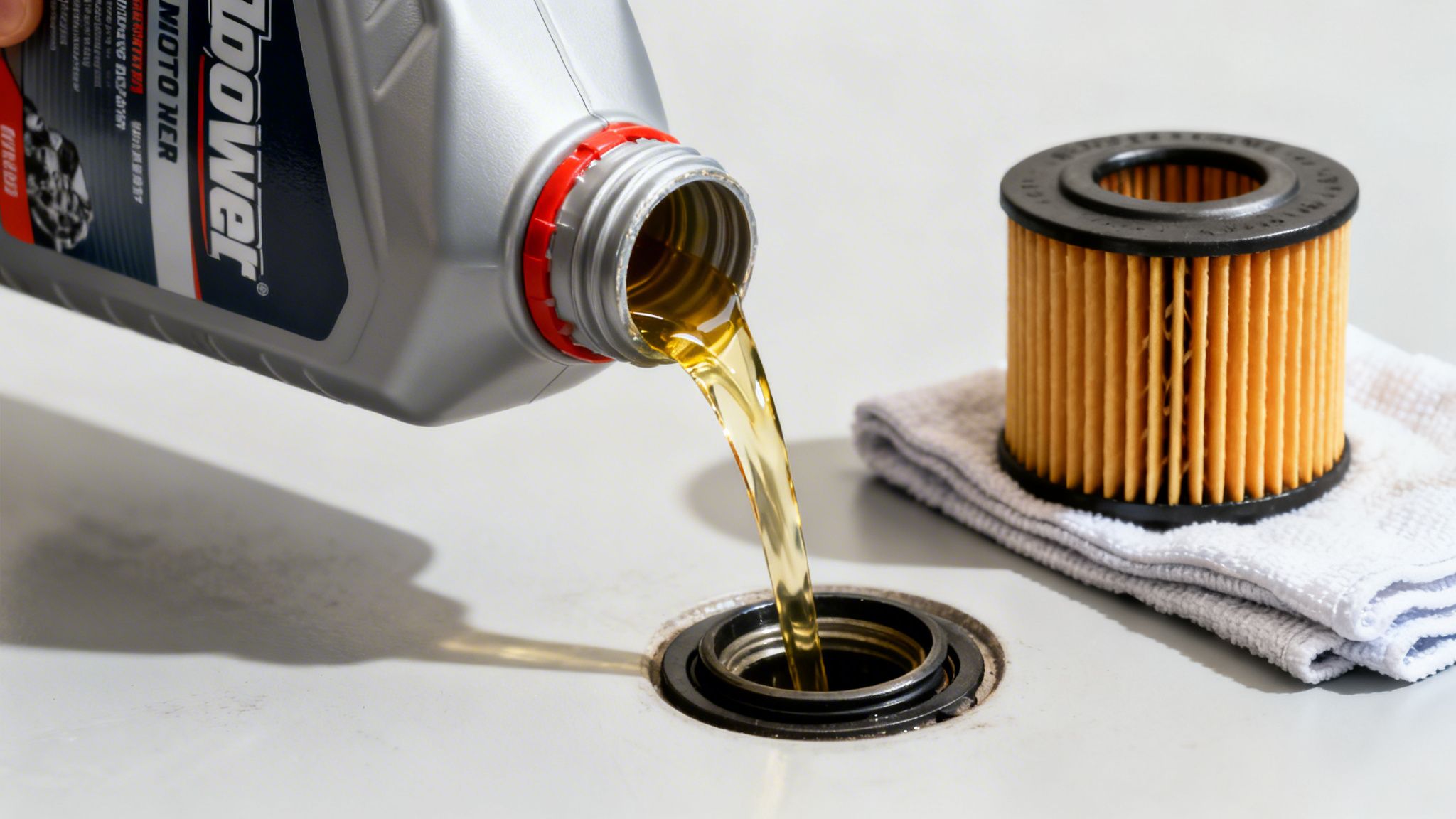
The best way to fix an oil-burning problem is to make sure it never starts. While you can always repair a worn-out engine, a little proactive maintenance goes a long way in preventing the kind of wear that leads to oil consumption in the first place. An ounce of prevention here is truly worth a pound of cure.
It all starts with the humble oil change. Following your manufacturer's service schedule isn't just a friendly suggestion—it’s the single most important thing you can do for your engine's health.
Fresh oil has the right viscosity to create a strong lubricating film between moving parts, like your piston rings and cylinder walls. It also contains detergents that keep sludge from gumming everything up. When sludge builds, it can cause piston rings to stick, breaking that critical seal and letting oil slip past into the combustion chamber.
Beyond the Oil Change
Of course, regular oil changes are just one piece of the puzzle. A few other systems directly impact the parts that keep oil where it belongs.
Your cooling system is your engine’s best friend. Letting your engine overheat, even once, can cause serious damage. That intense heat can warp metal parts and bake rubber valve stem seals until they’re hard and brittle. A cracked or shrunken seal is like an open door for oil to leak down into the cylinders.
Think of it as a simple checklist for engine longevity:
- Consistent Oil Changes: Always use the correct grade specified for your vehicle, like 5W-30 or whatever your manual calls for.
- Cooling System Checks: Keep an eye on your coolant level and condition. A healthy cooling system is your first line of defense against the kind of heat that destroys seals.
- Clean Air Filter: A clogged filter can mess with the air-fuel mixture, which can lead to more engine strain and deposits over time.
By putting in a little time and money now, you're actively protecting the seals and rings inside your engine. This discipline helps them last as long as they were designed to, keeping your engine running clean for years to come.
A Mindset of Prevention
Ultimately, stopping oil burning is about adopting a proactive mindset. Don't wait until you see that puff of blue smoke in your rearview mirror. Pay attention to new noises, check for drips on the driveway, and never, ever ignore a warning light.
Looking at how the pros do it can also offer some perspective. Professional shops rely on top-tier diagnostic tools and organization systems, like Lista Automotive solutions, to keep entire fleets of vehicles in prime condition. They know preventative care is what avoids costly downtime.
By treating maintenance as a non-negotiable part of owning a car, you stop oil consumption problems before they even get a chance to start.
Your Top Questions About Oil Consumption, Answered
Even after you've pinpointed the likely cause, a few questions always seem to pop up. Let's tackle some of the most common ones we hear from drivers dealing with an oil-burning engine.
Think of this as your quick-reference guide for those nagging "what if" scenarios.
How Much Oil Burning Is "Normal"?
This is the million-dollar question, and the answer really depends on your car's manufacturer and its age. A good rule of thumb is that needing to add more than one quart of oil between changes (usually every 3,000-5,000 miles) points to a problem.
That said, some modern turbocharged engines are known to use a bit more oil by design. The real key is knowing what’s normal for your specific vehicle. If you notice a sudden increase in oil consumption, that’s always a red flag worth investigating.
Can I Just Use Thicker Oil or an Additive?
Think of these as temporary fixes, not permanent solutions. Pouring in a higher-viscosity oil or a "stop leak" additive can sometimes slow down minor leaks in an older engine. They work by either swelling up old, hardened seals or by simply being too thick to easily slip past worn piston rings.
These products can be a decent short-term strategy to buy you some time while you figure out a permanent repair. Just remember, they can't fix a mechanically worn part and are no substitute for a proper diagnosis.
Is It Safe to Keep Driving a Car That Burns Oil?
You can, but you have to be extremely diligent about it. The biggest risk is letting the oil level get too low, which will starve the engine of lubrication and lead to catastrophic failure. You absolutely must check your dipstick frequently—at least once a week—and keep the oil topped off.
Keep in mind, burning oil will eventually damage expensive emissions parts, including:
- Your catalytic converter, which can get clogged with ash and residue.
- Your oxygen sensors, which can get fouled up, hurting your engine's performance and fuel economy.
We always recommend getting the issue checked out by a pro to understand how serious it is before you continue driving it long-term.
Will Switching to Synthetic Oil Help?
Honestly, it's a bit of a gamble that depends entirely on why your engine is burning oil. If the problem is sludge or carbon buildup causing the piston rings to stick, a high-quality synthetic oil might actually help. Synthetics have powerful detergents that can sometimes clean and free up those sticky components over time.
But, if the issue is just plain old worn-out seals or rings, the smaller, more uniform molecules in synthetic oil could potentially slip through the gaps even more easily, which could slightly increase your oil consumption. It's definitely not a guaranteed fix.
Navigating oil consumption issues can be tricky, but you don't have to do it alone. If you're in the Richland Hills area and need an expert opinion, the ASE-certified technicians at Express Lube & Car Care are here to help. We offer honest diagnostics and reliable repairs to get you back on the road with confidence. Stop by today for fast, friendly service—no appointment needed. Learn more at https://www.expressluberichlandhills.com.