

An engine light diagnostic is the professional step-by-step process of figuring out exactly why your car's check engine light is on. It's more than just a simple warning; think of it as your car's only way of telling you, "Hey, something needs attention under the hood."
This little light means your vehicle's On-Board Diagnostics (OBD-II) system has logged a fault. The cause could be anything from a gas cap that wasn't tightened properly to a much more serious engine problem.
That Mysterious Light: What It Really Means
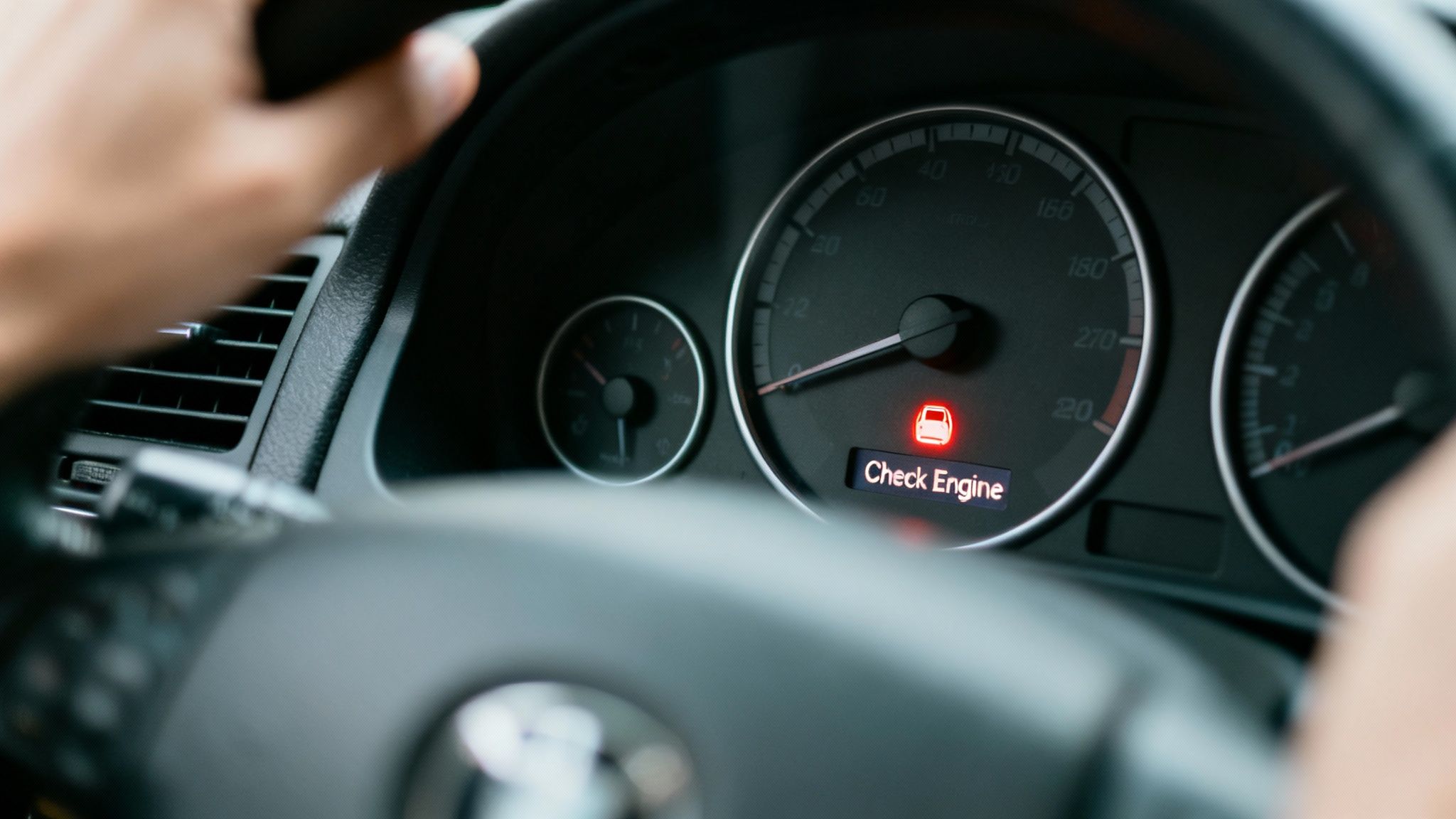
Seeing that little amber engine symbol pop up on your dashboard can definitely be unsettling. Your mind probably jumps straight to worst-case scenarios and the thought of expensive repair bills. But the first thing to know is that the light itself isn't a diagnosis—it's just a general alert.
Think of it like getting a fever. A fever tells you your body is fighting something off, but it doesn’t tell you whether you have a common cold or a more serious infection. In the same way, the check engine light simply means one of the many sensors monitoring your vehicle has reported a reading outside of its normal range.
Your Car's Built-In Messenger
Every car and truck built since 1996 has an On-Board Diagnostics system, or OBD-II. This is your vehicle’s internal computer network, and it constantly keeps an eye on critical components like the engine, transmission, and emissions system. When it flags a problem, it switches on the check engine light and stores a specific Diagnostic Trouble Code (DTC) in its memory.
This system is your car’s first line of defense. An engine light diagnostic is the key to translating those codes into plain English, letting a technician find the root cause before a small issue turns into a big one.
Ignoring the light is a gamble. A minor sensor failure, if left alone, could eventually cause major damage to expensive parts like your catalytic converter. Getting it checked out quickly is the best way to protect your vehicle and your wallet.
For drivers here in Richland Hills, this is where a professional touch makes all the difference. At Express Lube & Car Care, our team uses advanced diagnostic tools to accurately read the signals your car is sending. We offer a fast, reliable engine light diagnostic service to give you clear answers and peace of mind, getting you back on the road safely without a long wait.
How a Professional Engine Light Diagnostic Works
So, what really happens when our ASE-certified technicians run an engine light diagnostic? We're not just plugging in a simple gadget you can buy online. We're connecting directly to your vehicle's brain—its main computer—to have a detailed conversation about its health.
Every modern car has an On-Board Diagnostics (OBD-II) port, which is usually tucked away under the dashboard. Think of it as a universal data connection, but our professional-grade scanners use it to get way more information than a basic code reader ever could.
These advanced tools don't just pull a generic code. They talk to your car's specific computer modules to grab the main Diagnostic Trouble Codes (DTCs) and all the manufacturer-specific data that cheaper scanners can't even see.
The Code Is Just the Beginning
A lot of people think the trouble code is the final answer. It’s not. A code like "P0301 – Cylinder 1 Misfire" is just the starting point—it tells us what happened, but our real job is to figure out why.
That misfire code, for example, could be caused by a handful of different things. Our diagnostic process is all about systematically checking the possibilities to find the real culprit.
- Bad Spark Plug: Is the plug just old and worn out, or is it fouled up?
- Faulty Ignition Coil: Is the coil actually delivering the voltage needed for a spark?
- Clogged Fuel Injector: Is cylinder one getting the right amount of fuel?
- Mechanical Issue: Could there be a deeper problem, like low compression?
Just throwing a new spark plug in there is a total gamble. A real engine light diagnostic takes the guesswork out of the equation so we can fix it right the first time.
Going Beyond the Basic Scan
To get to the bottom of it, our technicians use the scanner to watch live data streams. This lets us monitor your engine's performance in real-time, checking sensor readings, fuel adjustments, and other vitals while the car is running. It's like a doctor monitoring a patient's vital signs to get the full picture.
A Diagnostic Trouble Code points a technician in the right direction, but it's the combination of advanced tools, live data analysis, and hands-on expertise that ultimately solves the puzzle. It’s the difference between seeing a symptom and diagnosing the underlying condition.
We also look at "freeze-frame" data. This is a snapshot of exactly what the vehicle was doing—engine speed, temperature, load, and more—at the very moment the problem was first detected. This little piece of evidence often gives us the final clue we need to nail down the problem, saving you time and money on unnecessary repairs.
Decoding the Most Common Trouble Codes
So, we've pulled a code from your car's computer with an engine light diagnostic. Now the real work starts. These codes, officially called Diagnostic Trouble Codes (DTCs), are basically your car’s way of telling us where it hurts. But they don't speak plain English—it takes a trained technician to translate that alphanumeric message into a clear repair plan.
Some codes point to something simple, like a loose gas cap that just needs a quick twist. Others can signal a serious, expensive problem like a failing catalytic converter. That massive range is exactly why a professional diagnosis is so critical. You have to know what you're dealing with.
This is the basic flow of how it works—we plug our scanner into your car's OBD-II port (usually under the dash) and it gives us the specific code that triggered the light.
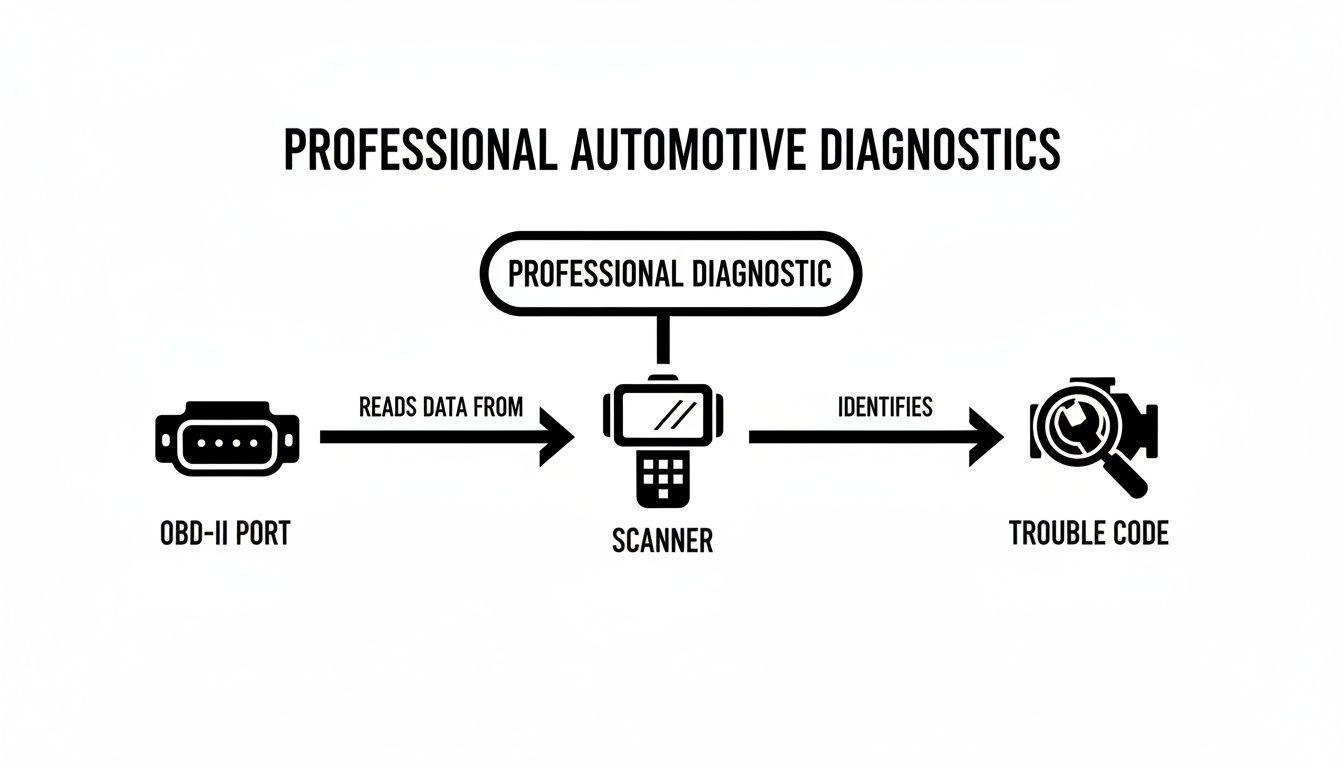
From there, our technicians use that code as a starting point to dig deeper and find the root of the problem.
Common Engine Trouble Codes and What They Mean
While your car can generate thousands of unique codes, we tend to see a handful pop up over and over again. Getting familiar with these common culprits can give you a better idea of what might be going on under the hood.
Just remember, a trouble code points to a symptom, not the final diagnosis. Think of it as a clue, not the whole story.
Here's a quick look at some of the most frequent trouble codes we encounter and what they typically mean for your vehicle.
| Trouble Code (DTC) | Common Problem | Potential Causes | Urgency Level |
|---|---|---|---|
| P0420 | Catalyst System Efficiency Below Threshold | Failing catalytic converter, faulty oxygen sensors, exhaust leak | High |
| P0171 | System Too Lean (Bank 1) | Vacuum leak, faulty mass airflow (MAF) sensor, clogged fuel filter | Medium |
| P0300 | Random/Multiple Cylinder Misfire Detected | Worn spark plugs, bad ignition coils, low fuel pressure | High (especially if light is flashing) |
| P0455 | Evaporative Emission System Leak Detected (Large Leak) | Loose or faulty gas cap, cracked EVAP hose, faulty purge valve | Low |
| P0128 | Coolant Thermostat (Coolant Temperature Below Thermostat Regulating Temperature) | Faulty thermostat, low coolant level, bad coolant temp sensor | Medium |
As you can see, a single code often has several possible causes. For example, a P0300 misfire code doesn't automatically mean you need new spark plugs—it could be a bad ignition coil or a fuel delivery issue. For a deeper dive, you can learn more about the signs of bad spark plugs in our detailed guide.
The key to a proper engine light diagnostic is that a good technician never just reads the code and replaces a part. They use the code as a guide, then test the related components to confirm the actual source of the failure. This methodical approach saves you from paying for parts you don't actually need.
Let's take that P0171 "System Too Lean" code. Instead of just swapping out an oxygen sensor, a pro might perform a smoke test to pinpoint a tiny, hidden vacuum leak. That's the kind of expertise that turns a generic code into a precise and effective repair.
At Express Lube & Car Care, our ASE-certified technicians have the experience and equipment to get it right the first time, getting you back on the road safely and without wasted time or money.
Simple DIY Checks Before You Visit a Mechanic
While a professional engine light diagnostic is the only way to know for sure what’s going on, you aren’t totally helpless when that light pops on. Before you rush over to the shop, there are a few simple and safe things you can check yourself. Sometimes, these little steps solve the problem entirely. At the very least, they give our technicians some valuable clues.
Believe it or not, the most common reason for a check engine light is surprisingly simple: a loose or faulty gas cap. It’s the culprit in a huge number of cases.
Start with the Easiest Fix
Your car’s evaporative emission control system (EVAP) is a sealed, pressurized system. If the gas cap isn’t on tight, it creates a tiny leak that the OBD-II system flags, triggering that pesky light.
Here’s a quick check you can do in just a few seconds:
- Tighten the Gas Cap: Pull over safely, turn off the engine, and give the gas cap a twist. If it was loose, tighten it until you hear it click a few times.
- Inspect the Seal: Take a look at the rubber seal on the cap. If you see cracks or obvious damage, the seal is shot and can’t do its job.
Don’t expect the light to turn off immediately after tightening the cap. It can take a few driving cycles—a couple of short trips over a day or two—for the car’s computer to reset itself. If the light goes away, you’ve found your problem!
Important Takeaway: Always start with the simplest solution. A five-second check of your gas cap could save you a trip to the shop and the cost of a diagnostic scan.
Observe Your Vehicle’s Behavior
If the gas cap wasn't the issue, your next job is to be an automotive detective. Your car is probably giving you other clues to help figure out what’s wrong. Pay close attention to any changes in how it drives, feels, or sounds, no matter how minor they seem.
Gathering this intel makes the professional engine light diagnostic so much faster and more accurate when you bring your car to us. Try to take note of things like:
- Unusual Noises: Are you hearing any new clunks, hisses, or grinding sounds coming from the engine bay?
- Performance Changes: Does the car feel sluggish? Does it hesitate when you hit the gas or idle roughly at a stoplight?
- Strange Smells: Do you smell raw gasoline, burning oil, or something sweet and syrupy (that’s coolant)?
- Reduced Fuel Economy: Have you been stopping for gas more often lately?
It also never hurts to do a quick visual check of your basic fluids, like engine oil and coolant, to see if anything is obviously low. While you're under the hood, making sure your air filter is clean is another smart, simple maintenance step. You can learn more by reading about where the air filter is located in a car in our other guide.
These preliminary checks are great for collecting clues, but they aren’t a replacement for a professional scan. If that light is still staring back at you, it’s time to let the experts at Express Lube & Car Care take a closer look.
Why a Professional Scan Beats a DIY Code Reader
With cheap code readers hanging on the shelf at every auto parts store, it’s tempting to try and figure out that check engine light yourself. While these little gadgets can pull a basic trouble code, they often give you a dangerously incomplete picture of what’s really going on.
Think of it this way: a DIY scanner is like a home thermometer. It can tell you that you have a fever, but it can’t tell you why you have one or what the cure is.
A simple scanner might spit out a generic code like "P0300 – Misfire Detected," making you think a new set of spark plugs will solve the problem. But the real culprit could be a bad ignition coil, a clogged fuel injector, or a tricky vacuum leak. Throwing parts at a generic code is just a costly guessing game.
The Limits of Basic Scanners
A consumer-grade code reader only scratches the surface. It’s designed to give you a one-dimensional clue, but modern cars are far too complex for that.
Here’s what a cheap DIY reader can't do:
- Access Manufacturer-Specific Codes: Your vehicle has a second layer of codes that only professional-grade equipment can unlock. These often hold the most important clues.
- View Live Data Streams: Our technicians can watch your engine's sensors report data in real-time. This lets them see how different systems are interacting and spot anything that looks off.
- Analyze "Freeze-Frame" Data: A professional scan tool captures a snapshot of the exact conditions—your speed, engine temp, RPMs—the moment the fault happened.
This extra data is the difference between a wild guess and an accurate diagnosis. It allows our ASE-certified technicians to find the true root cause of the problem so we can fix the right part the first time.
A generic code points a mechanic in the right direction, but professional diagnostic tools provide the full roadmap. Without them, you’re essentially trying to navigate a maze blindfolded.
There’s a reason the pros rely on advanced equipment. The global vehicle diagnostics market was valued at an incredible USD 47.96 billion in 2024, and professional-grade hardware makes up about 56% of that market. You can find more details about the growing vehicle diagnostics market on databridgemarketresearch.com. It just shows how critical these powerful tools have become.
At Express Lube & Car Care, our investment in state-of-the-art diagnostic tools means you get a precise and efficient engine light diagnostic every single time. We take the guesswork out of the equation to save you time and money, giving you peace of mind that your car is in good hands.
Your Trusted Diagnostic Partner in Richland Hills
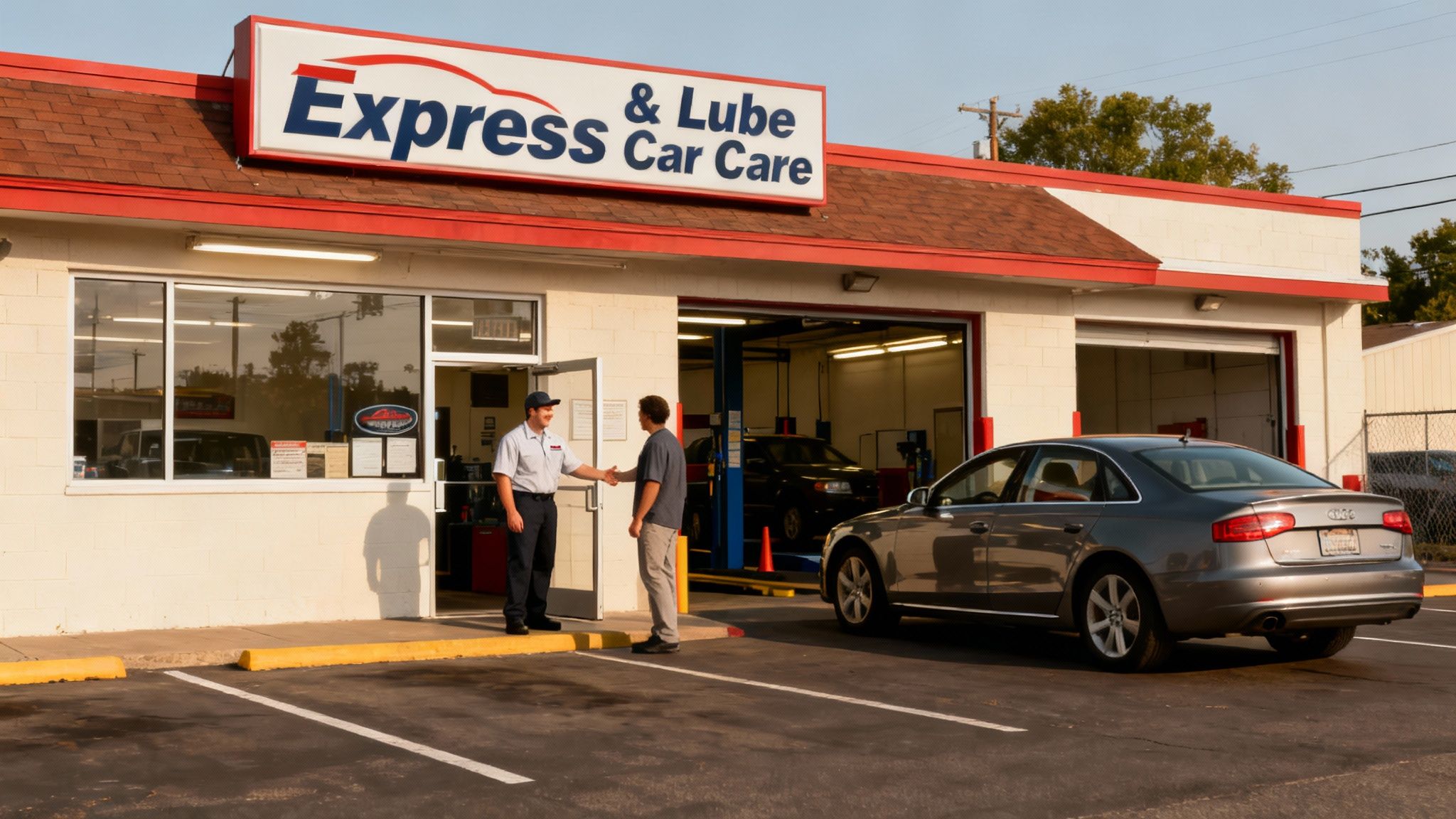
When that check engine light pops on, you need more than just a code reader. You need a trusted local partner who can give you clear answers and solid solutions without the runaround. At Express Lube & Car Care, that's exactly what we do. We combine state-of-the-art diagnostic equipment with the hands-on expertise of our ASE-certified technicians.
We're your go-to experts for any engine light diagnostic right here in Richland Hills.
Our promise is simple: fast, friendly service with no appointment needed. We know your time is valuable. We also believe in talking to you like a neighbor, explaining what we find in plain English so you understand exactly what your vehicle needs. You'll never be left in the dark.
Why Choose Express Lube & Car Care?
Look, we know you have options. We make the choice easy by being convenient, trustworthy, and affordable. Our goal isn't just to read a code; it's to pinpoint the exact problem to prevent it from turning into something bigger and more expensive down the road. If you're curious about what kinds of issues we see, check out our guide on common engine repair needs in Richland.
Modern cars are more complex than ever, and keeping up with that technology is a must. The North American market for automotive diagnostic tools is growing fast because of how sophisticated vehicles have become. For a local Texas shop like ours, having the right advanced diagnostic tools isn't a luxury—it's how we earn your trust and do the job right.
At Express Lube & Car Care, our goal is to turn your uncertainty into confidence. We provide a precise diagnosis and an honest repair plan, ensuring you leave our shop with peace of mind and a vehicle you can depend on.
We're also proud to support our community. We offer special discounts for military personnel, first responders, and on our weekly Ladies Day.
So when you see that light, don't guess. Get real answers from a team you can trust. Just stop by today and let us take a look—we'll take care of it for you.
Answering Your Top Engine Diagnostic Questions
We get it. Seeing that little engine-shaped light pop up on your dash can be stressful and bring up a lot of questions. We hear the same ones from drivers all the time, so let's clear up the confusion around the engine light diagnostic process.
Can I Still Drive with the Check Engine Light On?
This is the big one. If the light is solid and not flashing, you're usually okay to drive to a trusted shop like ours. A steady light is your car’s way of saying, "Hey, something's not quite right, and I need you to get it checked out soon."
A flashing check engine light, however, is a totally different story. That’s a serious warning. It almost always means you have a severe engine misfire that's dumping unburned fuel into your exhaust. This can destroy your catalytic converter in a matter of minutes—a repair that can cost thousands.
Think of it like this: a solid light is a heads-up, but a flashing light is an emergency. Pull over as soon as it's safe and get your vehicle towed. Ignoring it is one of the costliest mistakes a driver can make.
How Long Does an Engine Diagnostic Take?
The first step is quick. We plug our professional-grade scanner into your car’s OBD-II port to pull the diagnostic trouble codes, and that only takes a few minutes.
From there, the time it takes for a full engine light diagnostic really depends on what the code is telling us. A simple, common code might point us directly to the problem, while a more vague or complex issue could require a bit more detective work. We’ll always give you a clear time estimate before we dive any deeper.
Will the Light Go Off After You Fix It?
Absolutely. Once our ASE-certified techs find the root cause and make the right repair, they use our scanner to clear the trouble codes from your car’s computer. That's what turns the check engine light off.
We don't just stop there, though. We always perform a final test drive to make sure the fix is solid and the light stays off. You can drive away with confidence knowing the problem is truly solved.
Don't play guessing games with your car's health. For a fast, accurate, and honest engine light diagnostic, come see the experts at Express Lube & Car Care. No appointment needed—just stop by and we'll figure out what your car is trying to tell you. https://www.expressluberichlandhills.com