

Extra payload doesn’t just sit there. Every pound you load into a truck bed, SUV cargo area, or trailer tongue pushes down on your springs, compresses your shocks, and reshapes how your tires contact the road. The result: your ride height drops, your suspension travel shrinks, your brakes work harder, and your steering can feel noticeably vaguer, all from a duffel bag and cooler you tossed in the back without a second thought.
Here’s the short version. Payload changes the load path through your entire suspension system, and that shift affects everything from spring sag to axle wear to how fast you can stop. The Geotab research on payload mechanics confirms overloading limits front-wheel steering control while increasing braking distance, which is exactly the kind of thing you want to know before your next camping trip, not after a close call on the highway.
What that means in practice:
- Braking gets worse. More weight means more momentum, and your brakes need more distance to shed it.
- Steering gets vaguer. Heavy rear loads shift weight off the front axle, reducing grip right where you steer.
- Components wear faster. Springs, bushings, and shocks absorb more stress with every mile you drive loaded.
Pro Tip: Check your ride height before and after loading. If the rear drops more than an inch or two, you’re carrying enough weight to change how your vehicle handles, even if it doesn’t feel different yet.
Key Takeaways
Payload capacity directly reshapes suspension performance by increasing spring compression, reducing shock travel, shifting axle loads, and lengthening braking distances.
| Point | Details |
|---|---|
| Payload equals GVWR minus curb weight | Check your door jamb placard for exact figures, and remember tongue weight counts fully against that number. |
| Watch for sag and uneven wear | Sagging ride height, bottoming out, and shoulder tire wear all signal a suspension working past its comfortable limit. |
| Upgrades improve handling, not legal limits | Airbags, helper springs, and heavy-duty springs help control load but don’t raise your GVWR without a certified GVM upgrade. |
| Balance the load, not just the weight | Centering cargo between axles reduces oscillation and prevents single-axle overload even at the same total weight. |
| Get a professional check when symptoms persist | Express Lube & Car Care performs full suspension diagnostics, weight checks, and alignment work backed by a 24-month/24,000-mile warranty. |
Table of Contents
- How Payload Capacity Affects Suspension Performance
- Which Suspension Parts Take the Hit From Extra Weight?
- Does Payload Really Change How a Vehicle Handles and Brakes?
- Why Load Placement Matters as Much as Load Weight
- What Are the Warning Signs of an Overloaded Suspension?
- What Are the Legal Limits and Safe Practices for Payload?
- Which Suspension Upgrades Actually Help With Heavier Loads?
- What Routine Steps Protect Your Suspension Under Heavy Loads?
- Quick Comparison: Which Suspension Upgrade Fits Your Situation?
- What Happens During a Professional Suspension Inspection?
- An ASE Technician’s Take on Common Suspension Mistakes
- How Express Lube & Car Care Handles Payload and Suspension Concerns
- Sources
- FAQ
How Payload Capacity Affects Suspension Performance
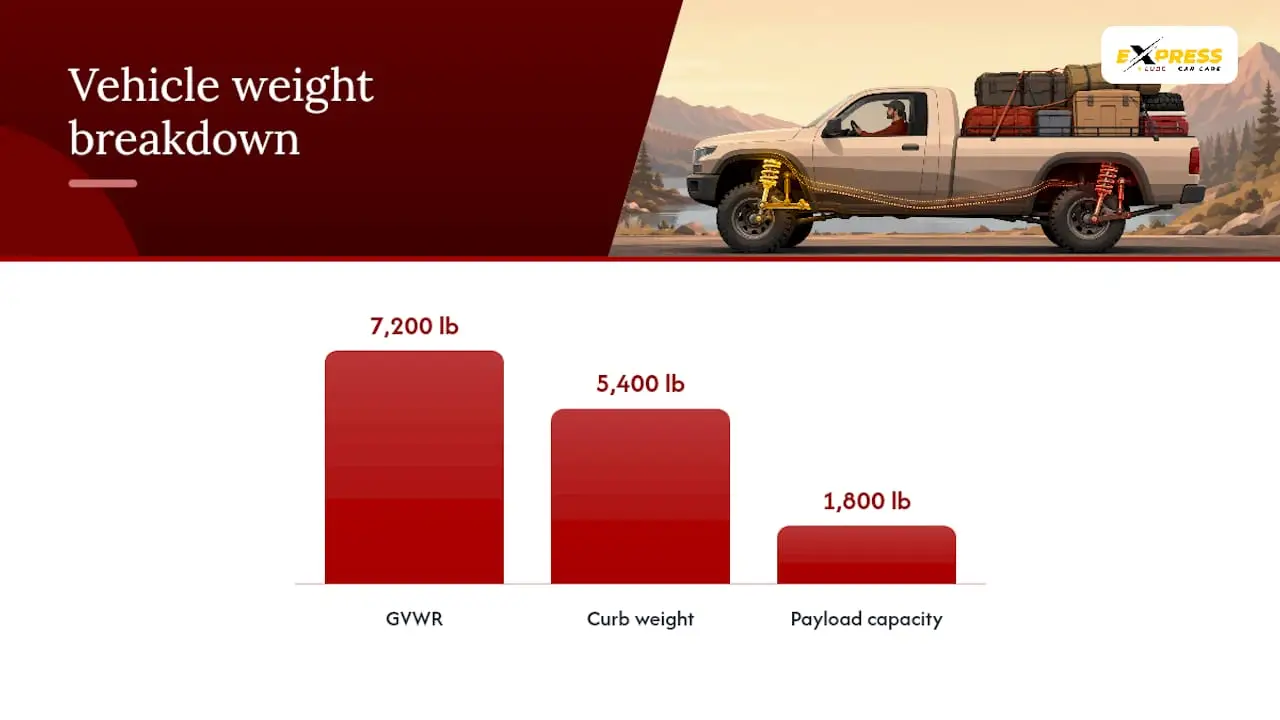
Payload capacity is the maximum weight your vehicle can carry inside the cabin, bed, or cargo area, plus trailer tongue weight, without exceeding what the manufacturer built the suspension, frame, and tires to handle, as explained in this practical guide for drivers. You calculate it with one simple formula: Gross Vehicle Weight Rating (GVWR) minus curb weight. Everything above that number puts stress on parts the engineers didn’t design for.
The math is straightforward once you know your numbers. Say your truck has a GVWR of 7,200 pounds and a curb weight of 5,400 pounds. That leaves 1,800 pounds of payload capacity, and that number has to cover passengers, cargo, aftermarket accessories, and any tongue weight from a trailer. Payload capacity is calculated this way across nearly every consumer vehicle on the road, from compact SUVs to heavy-duty pickups.
A few related terms matter here too. GAWR (Gross Axle Weight Rating) tells you the maximum weight each axle can bear individually, which is why a vehicle can be under its total GVWR yet still overload a single axle if the load sits unevenly. Tongue weight is the downward force a trailer exerts on your hitch, and it counts fully against your payload capacity even though it’s not sitting inside your vehicle.
You’ll find your GVWR and GAWR figures on the door jamb placard, usually on the driver’s side, along with the recommended tire pressures. The owner’s manual and the VIN label under the hood carry the same figures if the sticker has faded.
Owners consistently underestimate what counts toward payload. Here’s what actually eats into that number:
- Every passenger and everything in the cabin, including car seats and floor mats
- Aftermarket gear: bed liners, toolboxes, roof racks, and the roof rack cargo itself
- Fuel, since curb weight assumes a full tank but payload doesn’t get a break for it
- Full trailer tongue weight, not just what’s loaded in the truck bed
One guide on payload capacity for truck owners makes the point that bed liners and toolboxes alone can quietly consume a few hundred pounds of your margin before you’ve loaded a single box.
Pro Tip: Public scales, the kind used at truck stops and recycling centers, give you a real weight, not a guess. Weigh your vehicle empty, then again fully loaded. The difference is your actual payload use, and it’s often higher than owners expect.
Which Suspension Parts Take the Hit From Extra Weight?
Every component in your suspension system reacts differently to added weight, and knowing which part does what helps you spot trouble before it becomes expensive. The load path runs from your cargo area or cabin, through the frame, into the springs and axles, and finally to the tires touching pavement.
Springs are the first line of defense. Coil springs and leaf springs compress under load, and if you’re consistently near or over payload capacity, they lose their ability to return to ride height, a condition mechanics call sag. Once a spring sags permanently, it no longer supports weight the way it did when new.
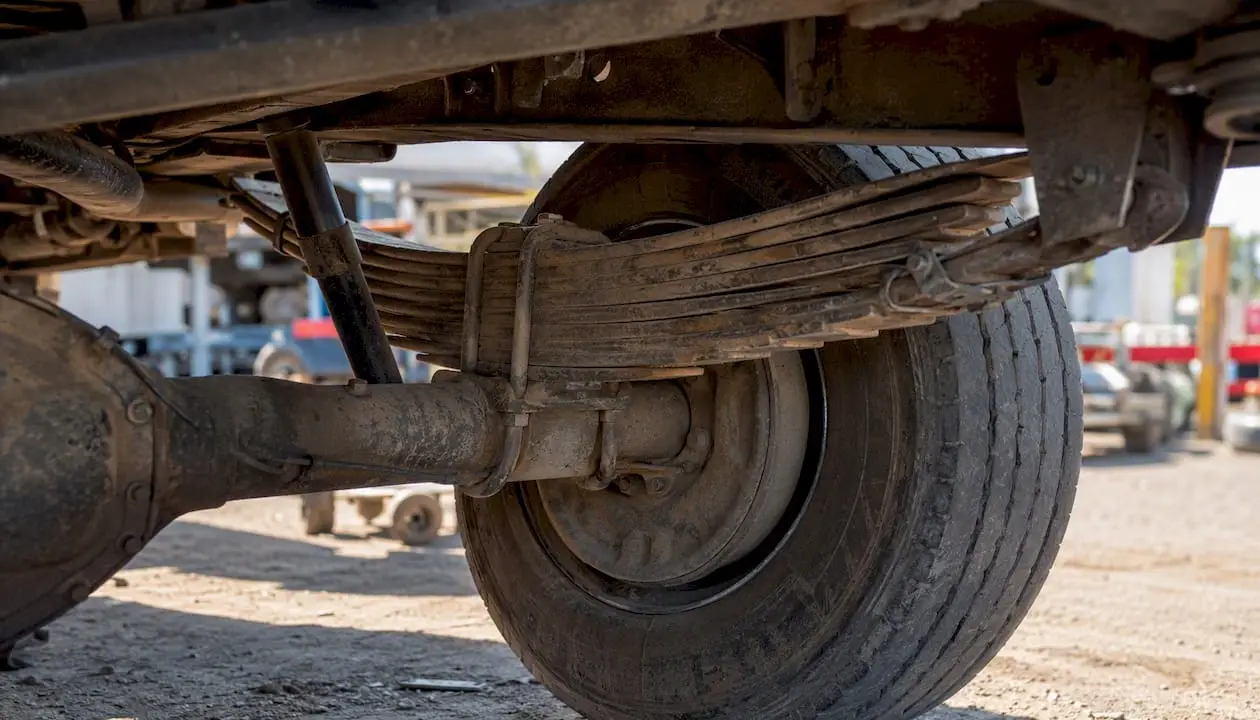
Shocks and struts control how the springs move, and they lose effective travel when the vehicle sits lower under load. Less travel means less cushioning for bumps, so every pothole transmits more force directly into the cabin, and eventually into the shock’s internal seals.
Bushings are the rubber or polyurethane pieces that let control arms and sway bars move without metal grinding on metal. Repeated heavy loading accelerates bushing wear, leading to looser, sloppier handling over time.
Axles, wheel bearings, and control arms all bear increased rotational and lateral stress under heavy payload. Overloading, according to Geotab’s research, places excessive stress on springs, axles, frames, and tires and can accelerate component fatigue well before a typical service interval would suggest.
Tires run hotter and wear faster under sustained heavy loads, particularly on the shoulders if the load isn’t centered. Uneven tire wear from constant heavy loading shows up faster in rideshare and delivery vehicles that carry passengers or cargo all day, every day.
Picture the load path as a chain: cargo weight transfers into the frame, the frame pushes down on the springs and axles, and the axles transfer that force through the wheel bearings into the tires. A weak link anywhere along that chain fails faster under repeated overloading, which is why a full suspension inspection checks every stage rather than just the springs.
Quick inspection checkpoints for each part:
- Springs: Look for visible sag, uneven ride height side to side, or a rear end that sits noticeably lower than the front.
- Shocks/struts: Check for oil leakage on the shock body, reduced bounce-back after pushing down on a corner, or clunking over bumps.
- Bushings: Feel for excess play when rocking the control arm by hand, or listen for clunks during turns.
- Tires: Inspect for shoulder wear, which often signals overloading rather than alignment issues alone.
- Wheel bearings: Listen for humming or grinding that changes pitch with speed.
Pro Tip: A visual sag check takes thirty seconds. Park on level ground, measure from the wheel arch to the ground on all four corners, and compare that against your owner’s manual specs. A consistent difference of more than an inch usually means your springs are compressed beyond their comfortable operating range.
Does Payload Really Change How a Vehicle Handles and Brakes?
Yes, and the change is bigger than most drivers expect. Added weight shifts your center of gravity, alters your suspension geometry, and directly affects braking distance, steering precision, and body roll in corners.
Squat and pitch are the two most visible effects. A heavy load in the bed pushes the rear down and the front up slightly, a condition called squat, which reduces front-tire grip exactly when you need steering precision. Braking does the opposite: weight transfers forward under deceleration, called pitch, and with a heavier total vehicle weight, that pitch is more pronounced and stopping takes longer.
Braking distance increases directly with added weight, and Geotab’s payload research confirms overloaded vehicles experience increased braking distances alongside compromised steering control. That’s not a minor inconvenience. It’s the difference between stopping in time and not.
Body roll in corners increases too, since a higher effective load raises the vehicle’s center of gravity if it’s stacked high rather than spread low and flat. Simulation research on payload changes in heavy vehicles found that shifts in total mass and center of gravity significantly alter vertical and pitch motions, even in vehicles equipped with active suspension systems designed to compensate.
Here’s how different load types compare in practice:
- Heavy cabin load (extra passengers, gear behind the seats): Raises overall weight but keeps the load low and centered, generally the gentlest effect on handling balance.
- Heavy bed load stacked high: Creates the most pronounced squat and the highest center of gravity, increasing rear sag and reducing front-tire contact.
- Heavy tongue weight from a trailer: Compounds bed loading by adding downward force at the hitch, which can overload the rear axle even before you’ve loaded anything in the bed itself.
Never combine heavy tongue weight with a fully loaded bed without checking your GAWR. Both loads stack on the rear axle simultaneously, and it’s entirely possible to stay under your GVWR while blowing past your rear GAWR, a mistake that puts uneven stress on the rear suspension and can compromise braking and stability at highway speed.
Why Load Placement Matters as Much as Load Weight
Where you put the weight matters almost as much as how much weight you’re carrying. Two identical loads, one placed forward and centered, one stacked high and rearward, produce very different handling characteristics even though the scale reads the same number.
Shifting cargo rearward moves your center of gravity backward, unloading the front axle and overloading the rear. Shifting it forward does the reverse. Either extreme changes how your suspension responds to bumps, how your steering feels, and how evenly your brakes can slow each axle.
Heavy-truck research backs this up with hard numbers. Testing on axle weight distribution found that a 70 millimeter suspension lift increased driving-axle weight by 1.84%, and an 80 millimeter lift pushed that closer to 2% axle overload. That’s a meaningful shift from a suspension change alone, before you’ve added a single pound of cargo, and it illustrates how sensitive axle loading is to both ride height and mass placement.
Load position also affects how much your suspension oscillates over rough roads. Research on shock absorber damping found that loading bulk material between the axles rather than directly over one axle reduced vertical oscillation by up to 45%. That’s a dramatic difference for something as simple as sliding a load a few feet forward or back in a trailer or truck bed.
Follow these steps to keep axle loads balanced:
- Weigh each axle separately, not just total vehicle weight, using a public scale that offers per-axle readings.
- Center heavy items between the axles rather than over the rear axle or tailgate, especially for bulk cargo like feed, gravel, or equipment.
- Keep the load low by stacking heavier items on the floor of the bed or cargo area rather than piling them high.
- Secure cargo tightly so it can’t shift rearward under acceleration or forward under braking, which would defeat your careful placement.
- Recheck ride height at all four corners after loading to confirm the vehicle sits level, not leaning to one side or squatting hard at the rear.
Pro Tip: Stage your heaviest items first, directly over or just ahead of the rear axle centerline, then build lighter items around them. This keeps your center of gravity low and centered without requiring a scale for every trip, though a scale check once a season is still worth the ten minutes.
What Are the Warning Signs of an Overloaded Suspension?
Sagging ride height is the most obvious symptom, but it’s rarely the first one you’ll notice. Frequent bottoming out over speed bumps or driveway aprons, longer stopping distances that feel “mushy,” uneven tire wear concentrated on the shoulders, unusual clunking or creaking over bumps, and a subtle drift in your alignment are all signs your suspension is working harder than it was designed to.
Run through these checks yourself before assuming the worst:
- Measure ride height at all four wheel wells and compare to your owner’s manual specification.
- Inspect tire contact patches for shoulder wear, which points to overloading rather than a simple alignment issue.
- Perform a bounce test, pushing down firmly on each corner and watching how quickly it settles. More than one or two bounces suggests worn shocks struggling under load.
- Weigh at a public scale if you regularly carry heavy cargo, particularly if you’ve noticed handling changes recently.
Some issues cross the line from “adjust your driving habits” to “get it looked at professionally.” Visible frame damage, play in the axle or wheel bearings, alignment that keeps drifting even after a correction, or braking performance that’s noticeably degraded all warrant a shop visit rather than a DIY fix. Steering wheel vibration that appears specifically under load, for instance, often points to a bent component or worn bushing rather than a simple balance issue.
When you do bring your vehicle in, a little context saves everyone time:
- Tell the technician your typical payload, not just “sometimes I haul stuff.”
- Mention any aftermarket accessories, trailers, or towing you do regularly.
- Note when the symptoms started, whether it’s gradual sag or a sudden noise after a specific trip.
- Bring weighbridge numbers if you have them.
Watching for warning signs your suspension needs attention early, before a shock fails completely or a spring sags permanently, keeps repair costs lower and your vehicle safer in the meantime.
What Are the Legal Limits and Safe Practices for Payload?
GVWR and GAWR are fixed manufacturer ratings, not suggestions. The engineering research on vehicle weight explains that GVWR is set by the manufacturer and cannot be legally changed by aftermarket suspension work, no matter how good the new springs or shocks feel. Only a certified GVM (Gross Vehicle Mass) upgrade, performed and documented by a qualified engineer or manufacturer program, actually raises your legal payload ceiling.
That distinction trips up a lot of owners who assume airbag suspension or heavy-duty springs increase what they’re legally allowed to carry. They don’t. They improve how your vehicle handles the weight you’re already allowed to carry.
Follow these safety rules to stay within your limits:
- Always account for passengers and tongue weight when calculating remaining payload, not just the cargo you can see.
- Apply the 80% rule for towing, keeping your actual towed load at or below 80% of your vehicle’s maximum rated towing capacity to leave a margin for wind, grade, and braking variability.
- Check both GVWR and GAWR, since it’s possible to stay under total vehicle weight while still overloading one individual axle.
- Never assume “it looks level” means it’s within limits. A lift kit can visually correct sag while the vehicle is still carrying more weight than the axle rating allows.
Overloading also carries consequences beyond handling. Enforcement data on freight and vehicle weight violations shows overweight and axle-overloaded vehicles routinely face fines and penalties in commercial contexts, and the same physics apply to personal vehicles even without a citation on the line. Warranty coverage is the other quiet risk: unauthorized overloading or unapproved suspension modifications can give a manufacturer grounds to deny a warranty claim related to suspension or frame failure.
Pro Tip: Keep a simple folder, digital or paper, with your weighbridge receipts and photos of any suspension upgrades. If you ever need to make a warranty claim or sell the vehicle, proof that you stayed within rated limits and used documented upgrades is worth far more than your word alone.
Which Suspension Upgrades Actually Help With Heavier Loads?
Every common suspension upgrade changes how your vehicle handles payload, but none of them raise your legal weight limit on their own. The Michigan Mobility research on payload upgrades is direct about this: airbag suspension and helper springs improve load leveling and ride support but don’t change the legal payload rating unless paired with a certified GVM upgrade.
Airbag suspension systems add adjustable air-filled bladders that you inflate based on load, restoring ride height and leveling out squat under heavy cargo. They’re excellent for owners who alternate between empty and heavily loaded trips, like contractors or weekend towers, since you can adjust firmness on demand rather than living with stiff springs full time.
Helper springs are simpler and cheaper, adding supplemental support without the adjustability of airbags. They help prevent bottoming out but don’t offer the same fine control, and ride quality when unloaded can feel slightly firmer than stock.
Heavy-duty replacement springs raise the vehicle’s baseline load capacity permanently, which suits owners who almost always carry a heavy load, like a truck used daily for hauling equipment. The tradeoff is a firmer, sometimes harsher ride when the vehicle is empty.
Upgraded shocks improve damping control under load, reducing bounce and improving how quickly the suspension settles after a bump. Pairing new shocks with worn springs, though, doesn’t fix the underlying sag problem, since shocks control motion, not static ride height.
Sway bars reduce body roll in corners, which matters more when a heavier, higher load raises your center of gravity. They improve cornering confidence but don’t affect straight-line load capacity at all.
Lift kits deserve their own caution. Lifting a vehicle changes suspension geometry and often requires an alignment afterward, since lift kits directly affect alignment needs by altering control arm angles and suspension travel. The axle-distribution research cited earlier showed measurable percent-level shifts in axle loading from lift height alone, which means a lift kit can quietly push a vehicle closer to an axle overload even if total payload stays the same.
| What It Does | How It Affects Payload Handling | Primary Benefit | Tradeoffs | Install Complexity/Cost |
|---|---|---|---|---|
| Airbag suspension (ride height/support) | Restores level ride under variable loads, adjustable per trip | Load leveling, comfort flexibility | Requires manual adjustment, added complexity | Medium |
| Helper springs (ride height/support) | Prevents bottoming out under moderate heavy loads | Simple, affordable load support | Firmer unloaded ride, no fine control | Low |
| Heavy-duty springs (ride height/support) | Permanently raises baseline load-carrying comfort | Consistent support for frequent heavy loads | Harsh ride when empty | Medium |
| Upgraded shocks (damping control) | Improves settling and control under load | Better ride quality, reduced bounce | Doesn’t fix spring sag alone | Medium |
| Sway bars (roll control) | Reduces body roll from raised center of gravity | Better cornering confidence under load | No effect on payload capacity itself | Low to Medium |
| Lift kits (ride height/geometry) | Shifts axle load distribution, alters geometry | Ground clearance, aesthetic preference | Alignment changes needed, possible axle overload risk | High |
Quick scan of pros and cons:
- Airbags: Pro, adjustable comfort. Con, another system to maintain.
- Helper springs: Pro, low cost. Con, limited adjustability.
- Heavy springs: Pro, consistent support. Con, firm unloaded ride.
- Shocks: Pro, better damping. Con, doesn’t address sag.
- Sway bars: Pro, less roll. Con, no payload change.
- Lift kits: Pro, clearance and looks. Con, alignment and axle-load risk.
Pro Tip: If you’re deciding between two upgrades, ask what problem you’re actually solving. Sagging under load calls for springs or airbags. Bouncy, unsettled handling calls for shocks. Body roll in corners calls for sway bars. Mixing up the diagnosis wastes money on the wrong fix.
What Routine Steps Protect Your Suspension Under Heavy Loads?
Protecting your suspension under regular heavy use comes down to a short, repeatable routine, not a one-time fix. Here’s the sequence worth following before, during, and after loading:
- Weigh your vehicle empty and loaded at a public scale to know your real numbers, not estimates.
- Balance the load across both axles and side to side, centering weight rather than stacking it high or rearward.
- Set correct tire pressure for the loaded weight, since underinflated tires flex more and generate excess heat under heavy cargo.
- Check ride height at all four corners after loading to confirm the vehicle sits level.
- Perform periodic suspension checks, inspecting springs, shocks, and bushings every few months if you regularly haul near your payload limit.
- Log your weighbridge results over time so you can spot trends, like gradually worsening sag, before they become failures.
Beyond that loading routine, a standing maintenance checklist keeps components from quietly wearing out:
- Inspect shocks and struts for leaks or reduced rebound every 12,000 to 15,000 miles, sooner if you haul heavy loads regularly.
- Check tire tread wear patterns monthly if you’re a delivery or rideshare driver carrying passengers and cargo daily.
- Rotate tires on schedule, since uneven loading accelerates uneven wear.
- Have alignment checked whenever you notice steering pull or after installing a lift kit or heavy-duty springs.
Pro Tip: If your vehicle regularly runs near its payload capacity, whether that’s a work truck or an SUV doing weekend camping duty, cut your shock inspection interval in half. Components under sustained heavy load fatigue faster than the standard service schedule assumes, and SUVs carrying heavier regular loads often need more frequent service than owners expect.
Quick Comparison: Which Suspension Upgrade Fits Your Situation?
Different owners need different solutions, and matching the upgrade to the actual use case saves both money and disappointment.
| Scenario | Recommended Upgrade | Primary Benefit | Tradeoff |
|---|---|---|---|
| Weekend camping setup | Helper springs or airbags | Prevents rear sag with occasional heavy gear | Airbags need manual adjustment each trip |
| Contractor hauling tools daily | Heavy-duty springs | Consistent support for constant heavy loads | Firmer ride when the truck is empty |
| Towing heavy trailers regularly | Airbag suspension plus upgraded shocks | Load leveling and controlled damping under tongue weight | Higher combined cost, more components to maintain |
| Off-road use with occasional heavy cargo | Lift kit paired with heavy-duty springs | Clearance plus load support | Requires alignment work, watch axle-load limits |
| Daily commuter with rare heavy loads | Upgraded shocks alone | Improved control without ride penalty | Doesn’t address sag under sustained heavy loads |
For contractors and frequent haulers, heavy-duty springs paired with a shock upgrade tend to offer the most durable, low-maintenance combination since they don’t rely on manual adjustment between trips.
What Happens During a Professional Suspension Inspection?
A certified shop follows a specific sequence when you bring in a vehicle for a payload or suspension concern, and knowing what to expect makes the visit faster and more useful.
The inspection typically includes:
- Weighing the vehicle and measuring ride height at all four corners against manufacturer specifications.
- Checking springs for sag, shocks for leakage or reduced damping, and axles for play or unusual wear.
- A test drive to evaluate handling, braking feel, and any noise or vibration under normal driving conditions.
- An alignment check, since suspension sag or lift changes often shift alignment angles.
- Load simulation for owners who regularly tow or haul, verifying how the suspension responds under representative weight.
After the inspection, expect a written summary covering:
- Recommended parts or repairs, with cost ranges explained clearly rather than buried in a work order.
- Upgrade options if your current use case (towing, contracting, frequent heavy hauling) suggests a suspension change would help.
- A realistic timeline for the work, whether it’s a same-day shock replacement or a multi-day parts order for a less common part.
Bring weighbridge numbers if you have them, a description of your typical load (what you carry, how often, and how heavy), a list of any aftermarket accessories, and prior repair records if the suspension has been serviced before. That context lets a technician diagnose faster and recommend the right fix the first time rather than guessing at your use case.
An ASE Technician’s Take on Common Suspension Mistakes
The most common mistake I see isn’t ignorance, it’s assumption. Owners assume that because a lifted truck “looks level” after a suspension modification, it’s fine to load it the same way they always have. But a lift kit changes geometry and can shift axle loading in ways that aren’t visible just by looking at ride height. The truck can look perfectly level and still be closer to an axle overload than it was before the lift.
The second mistake is forgetting tongue weight entirely. Owners calculate payload based on what’s visibly sitting in the truck bed and never account for the trailer pushing down on the hitch, which can quietly consume several hundred pounds of margin before a single box goes in the bed.
The third is assuming airbag suspension or helper springs somehow raise legal payload capacity. They don’t. They help the suspension handle the weight you’re already allowed to carry, which matters for comfort and component longevity, but it doesn’t change the number on your door jamb sticker.
Pro Tip: When a customer tells me their truck “feels fine” under load, I still ask for the weighbridge numbers. Ride feel is a poor substitute for an actual scale reading, since modern suspension systems and tires can mask overloading right up until something fails.
How Express Lube & Car Care Handles Payload and Suspension Concerns
If you’ve read this far because your truck squats under load, your SUV feels vague on the highway, or you’re planning a heavier towing setup, the next step is getting real numbers instead of guessing. Express Lube & Car Care offers full suspension diagnostics and repair, including shocks and struts service that covers everything from a basic sag check to a complete component replacement, alongside alignment work for vehicles that have been lifted or are showing uneven tire wear from heavy use.
Every repair comes backed by a 24-month/24,000-mile warranty, so if you’re weighing a heavier-duty spring upgrade or new shocks before towing season, you’re covered well past the drive home. Larger suspension jobs can also be financed rather than paid upfront, which matters if a full spring-and-shock replacement comes up sooner than your budget planned for. Walk-ins are welcome, ASE-certified technicians handle every inspection, and current service specials can take some of the cost pressure off a first visit. Stop by for a ride-height check and a straight answer on whether your suspension is keeping up with what you’re actually hauling.
Sources
- Payload capacity
- The influence of the suspension upon the axle weight distribution for heavy trucks
- Influence of the Size and Distribution of Load on the Damping Coefficient of Shock Absorbers in Passenger Vehicles
- Effects of payload changes in heavy machinery and a suspension control system to compensate for these changes
FAQ
Does Upgrading Your Suspension Increase Payload?
No. Suspension upgrades like airbags, helper springs, or heavy-duty coils improve how your vehicle handles the weight it’s already rated for, but only a certified GVM upgrade legally changes your payload rating.
What Happens If I Exceed My Truck’s Payload Capacity?
Exceeding payload capacity increases braking distance, reduces steering control, and accelerates wear on springs, axles, and tires, raising the risk of component failure over time.
Does a Suspension Lift Affect Payload Capacity?
A lift kit doesn’t raise your legal payload rating, but it can shift axle load distribution. Testing found a 70 to 80 millimeter lift increased driving-axle weight by roughly 1.5% to 2%, which can push a vehicle closer to axle overload.
What Is the 80% Rule for Towing?
The 80% rule recommends keeping your actual towed load at or below 80% of your vehicle’s maximum rated towing capacity, leaving a safety margin for wind, grade changes, and braking variability.
How Do I Know If My Vehicle Is Overloaded?
Watch for sagging ride height, frequent bottoming out, longer braking distances, and uneven shoulder tire wear. A quick check at a public scale gives you a definitive answer beyond how the vehicle feels to drive.