

The difference is thickness at operating temperature. Both oils flow the same way on a cold start (that’s the “5W”), but 5W-30 stays a bit thicker once the engine is hot, and 5W-20 stays a bit thinner. Neither one is better in general. The right one is whichever grade your vehicle’s manufacturer specifies for your exact engine, and that is printed in your owner’s manual.
We get this question at the counter in Richland Hills all the time, usually from someone who heard that “30 is better protection” or that “20 saves gas.” Both ideas have a grain of truth, and both can lead you astray. Here’s how to sort it out.
TL;DR
- 5W-20 and 5W-30 differ only in the second number: the viscosity at 100°C (212°F). The 30 is thicker when hot.
- Use the grade in your owner’s manual for your specific engine, plus the matching performance spec. Climate, mileage and internet charts come second.
- The same vehicle line can call for different grades by engine. Ford’s 2021 F-150 is a good example.
- Synthetic vs. conventional is a separate decision from 20 vs. 30, and neither choice justifies stretching your oil change interval.
- Not sure what your vehicle takes? Bring it in and we’ll check the manufacturer’s information before anything goes in the engine.
Table of Contents
- What do the numbers in 5W-30 and 5W-20 mean?
- Is 5W-30 better than 5W-20?
- Why the same truck can need either oil
- What about the performance spec on the bottle?
- What actually changes in your engine?
- Can you use 5W-30 in an engine that calls for 5W-20?
- How do I find the right oil for my vehicle?
- Synthetic or conventional: a separate question
- What if you drive a lot of miles for work?
- Our perspective: grade first, then everything else
- Getting it done in Richland Hills
- FAQ
- Sources
What do the numbers in 5W-30 and 5W-20 mean?
These are multigrade oils. According to the API Motor Oil Guide, the number before the “W” (for winter) describes how the oil behaves in the cold, and the second number describes viscosity at operating temperature. Viscosity is just resistance to flow. Think of cold honey versus warm honey, except modern oils are engineered to change much less than honey does.
So in practice:
| 5W-20 | 5W-30 | |
|---|---|---|
| Cold-flow rating | 5W | 5W |
| Hot viscosity grade | 20 (thinner) | 30 (thicker) |
| Typical reason it’s specified | Engines built with tight tolerances and low-friction designs | Engines that call for a slightly thicker film, including many turbocharged, V8 and diesel applications |
The table’s last row is a general pattern, not a rule. Your manual decides, not the pattern.
Is 5W-30 better than 5W-20?
No. It’s different. A thicker hot film isn’t automatically more protection, because engines are designed around a specific viscosity: the oil passages, bearing clearances and variable valve timing systems all assume it. Put the wrong grade in and you’ve changed a number the engineers chose on purpose.
That’s why Ford’s oil guidance says the recommended oil varies by model year, model and engine type, and points owners to the Engine Oil section of the manual for the recommended oil, filter and capacity.
Why the same truck can need either oil
This is where SUV and truck owners get caught. Ford’s 2021 F-150 technical specifications list 5W-20 (SAE GF6) for the 3.3-liter V6, but 5W-30 (SAE GF6) for the 2.7-liter EcoBoost V6, the 5.0-liter V8, the 3.5-liter EcoBoost V6 and the 3.5-liter PowerBoost. The 3.0-liter diesel is listed with 5W-30 under a different spec, SAE FA-4.
That’s one model year of one truck, and it’s only an example. It doesn’t tell you what your truck takes. What it does show is that “I drive an F-150, so I need X” isn’t enough information. We need the year, the engine, and ideally the VIN.
What about the performance spec on the bottle?
Viscosity is only half of the label. The other half is the performance category, such as API SP or SQ, or a manufacturer approval. API says SQ oils may be used where API SP and earlier S categories were recommended, but it still tells owners to follow the vehicle manufacturer’s viscosity and performance requirements. API also notes in its licensing publication that an oil carrying its mark isn’t automatically right for every engine.
If you drive a European vehicle, this matters even more. Look for the manufacturer approval printed on the label, not just a familiar 5W-30 or 5W-20. Many European makes specify an approval code that two oils with the same viscosity grade may or may not meet. Our post on oil changes for European cars goes deeper on that.

What actually changes in your engine?
Cold starts
Thin oil is easier to crank through and, in lab testing, SAE research reported easier starting with lower-viscosity oils. A separate SAE cold-temperature study tested oils at −20°C, −25°C and −30°C on a specific two-liter diesel and found lower-viscosity oils reduced initial cranking torque. That’s lab evidence under defined conditions. In a Texas winter, where a hard freeze is the exception, you won’t feel much of it.
Fuel economy
Thinner oil can reduce friction, which can help mileage, but the effect depends on the formulation and the engine. The SAE work and a Department of Energy project modeled gains of roughly 2% for specific candidate formulations. That isn’t a promise for every retail 5W-20 versus every 5W-30, and it’s not a reason to switch away from what your manual calls for.
High heat and heavy loads
This is the other side of the coin. People pull trailers, sit in stop-and-go traffic on Loop 820 and I-820 in July, and wonder if a thicker oil would be safer. Sometimes an engine’s manual lists more than one acceptable grade, and then your operating conditions are a fair thing to weigh. If it lists only one, that’s your answer. Where heat or towing is a concern, the better lever is usually the oil’s quality and a shorter, condition-based interval, not a different grade than the one specified.
Can you use 5W-30 in an engine that calls for 5W-20?
You’ll find forum threads where people say they’ve done it for years without trouble, and others where people say it’s harmless. Those stories are real, but they aren’t engineering guidance, and your engine isn’t theirs. Our position:
- If your manual lists both grades, either is fine. Pick based on your driving.
- If it lists one grade, use that one. That’s the grade the warranty and the engineers assume.
- If you’re in a pinch, such as the shop is out of a low-viscosity oil, the right substitute depends on the vehicle. Toyota’s support guidance treats it as a model-specific question, not a blanket permission. A shop should verify the manufacturer’s service information before substituting.
The reverse applies too. Moving a 5W-30 engine to 5W-20 to chase mileage isn’t a sound decision unless the manufacturer permits it.
How do I find the right oil for my vehicle?
- Open the owner’s manual and find the Engine Oil or Specifications section. Write down the viscosity grade, the performance specification and the capacity.
- Check the engine. If your model came with more than one engine, confirm which one you have. The VIN settles it.
- Don’t have the manual? Ford, for example, has a searchable owner manual page by year, model or VIN. Most manufacturers offer something similar.
- Read the bottle. Match the viscosity and the spec, such as the API starburst mark or the manufacturer approval.
- Ask your shop to confirm the oil going in before the work starts. A good shop will tell you what it’s using and why.
Synthetic or conventional: a separate question
Synthetic isn’t a code for “30.” You can buy 5W-20 and 5W-30 in conventional, synthetic blend and full synthetic. Choose the grade first, then the base oil.
AAA’s oil quality fact sheet reports that in its testing, synthetic outperformed conventional by an average of 47% on the oil-quality measures tested. It also says any oil that meets the manufacturer’s specification is safe to use, and it suggests considering synthetic for frequent towing, stop-and-go driving or extreme temperatures. For the full breakdown, see our posts on conventional vs. synthetic oil and whether synthetic is better.
Don’t stretch the interval because of the label
A thinner oil doesn’t earn you a longer interval, and neither does a synthetic. AAA’s synthetic vs. conventional research report recommends following the manufacturer’s interval or oil-life monitor, especially for stop-and-go driving, towing, aggressive driving and extreme temperatures. Our guides on how often to change oil and why intervals matter cover how to apply that to your driving.
What if you drive a lot of miles for work?
Fleet managers, delivery drivers and rideshare drivers log a lot of idling and short hops, which counts as hard use for oil. Two practical habits help:
- For a fleet, record each vehicle’s engine and required specification rather than ordering one bulk viscosity for every unit. The F-150 example above shows how two trucks of the same model can need different oil.
- For a single vehicle, follow the manual’s severe-service schedule if your use fits it, and keep your receipts so you can show what went in and when.
Our delivery driver oil change guide goes into the schedule side.
Our perspective: grade first, then everything else
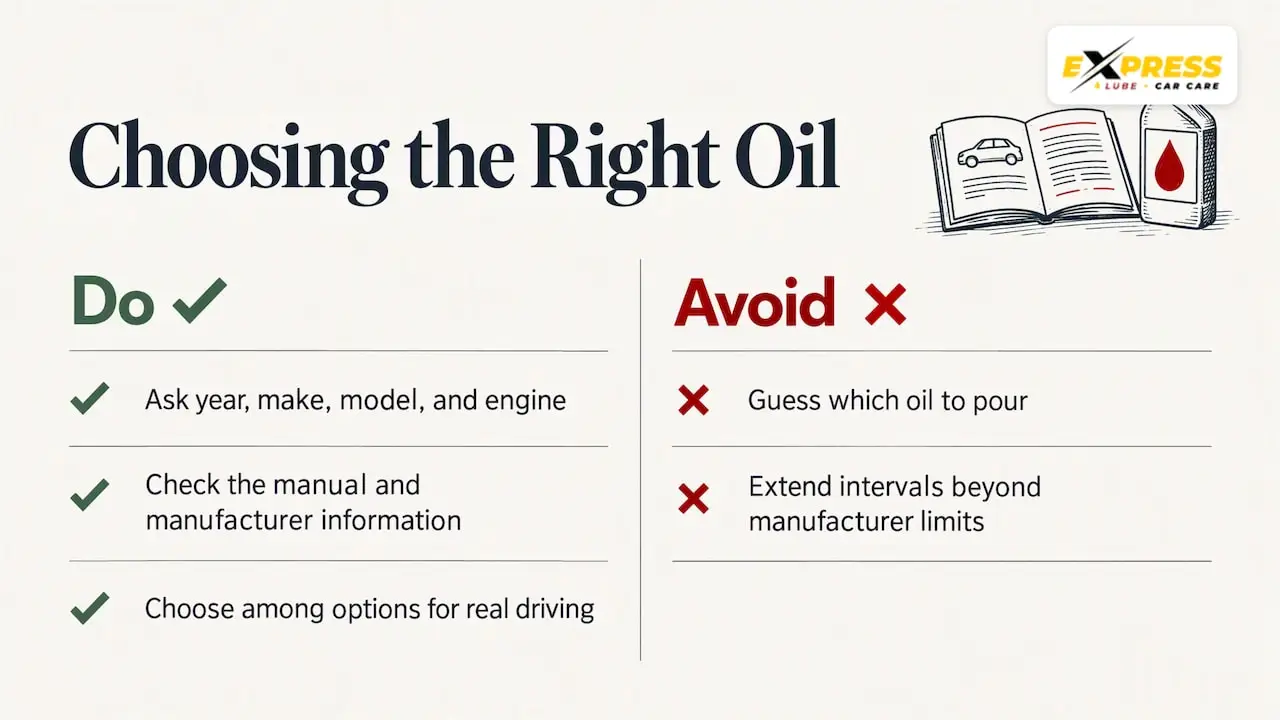
We’re a full-service repair shop with ASE-certified technicians, not just an oil change counter, and that shapes how we handle this question. When someone pulls in and asks for 5W-30 or 5W-20, we’d rather ask a few questions than just pour. What’s the year, make and model? Which engine? What does the manual say? If there’s any doubt, we check the manufacturer’s information.
We do that because oil is the cheapest part of a long-lasting engine, and the wrong choice can be quiet for a long time before it shows up. We also see the other side: engines that arrive with a check-engine light or noise, where we have to confirm what’s in the crankcase before we diagnose anything. Knowing which oil was used and when is part of an accurate diagnosis, and we’d rather not guess.
So our advice is simple. Follow the manual. If it gives you options, pick on your real driving, not a rumor. And don’t let a label talk you into a longer interval than the manufacturer allows.
— Express Lube & Car Care
Getting it done in Richland Hills
If you’d rather not decode the manual yourself, we’ll do it with you. We take walk-ins as well as appointments, and our oil change and preventive maintenance work covers the oil, filter and a look over the rest of the vehicle. You can see everything we do on our services page, or start from our home page. We serve drivers in Richland Hills, North Richland Hills, Hurst, Bedford and the surrounding Northeast Tarrant County area from one shop at 7932 Glenview Drive, Richland Hills, TX 76180. Call us at (817) 284-8478 and we’ll talk through your vehicle, no pressure.
FAQ
Can I use 5W-30 instead of 5W-20 in my Honda Pilot or other SUV?
Only if the manual for your year and engine allows it. Many vehicles list one grade, and some list more than one, so there’s no universal yes or no. Tell us the year and engine and we’ll check the manufacturer’s specification before we service it.
Is 5W-20 thinner than 5W-30?
Yes, once the engine is at operating temperature. Both share the same 5W cold rating, so the difference shows up when the oil is hot. The second number refers to viscosity at 100°C (212°F), and 30 is the thicker grade.
Does 5W-20 really get better gas mileage?
It can, in some engines, because thinner oil can reduce friction. But the benefit depends on the engine and the oil formulation, and published figures come from specific tests rather than every driver’s results. Don’t switch grades for mileage unless your manufacturer permits it.
Is 5W-30 or 5W-20 better for Texas summers?
The heat doesn’t change the rule. Use what your manual specifies, and if it lists more than one grade, discuss towing or stop-and-go use with your technician. A quality oil that meets the spec and a timely change usually matter more than moving up one grade.
Sources
- API Motor Oil Guide
- Ford: What is the recommended engine oil for my vehicle?
- Ford 2021 F-150 Technical Specs
- API Latest Oil Categories
- API Engine Oil Licensing and Certification System
- SAE: Effect of Engine Oil Viscosity on Low Temperature Cranking, Starting and Fuel Economy
- SAE: Cold-temperature oil study (2000-01-2052)
- Toyota Customer Service: oil substitution guidance
- Ford Owner Manuals
- AAA Oil Quality Fact Sheet
- AAA Research Report: Synthetic vs. Conventional