

You’re probably here because you opened the hood, checked the oil cap, or stood in front of a shelf full of bottles that all look almost the same. 5W-20, 5W-30, full synthetic, high mileage, GF-6. It’s easy to feel like you need a translator just to buy motor oil.
I see that confusion all the time with local drivers. A lot of people are not ignoring maintenance. They’re trying to do the right thing and getting hit with too many choices, too many labels, and too much generic advice that doesn’t match how they drive in Richland Hills.
That matters because oil is not just “something slippery” that goes in the engine. The right oil helps the engine start cleanly, protect moving parts, handle heat, and stay cleaner between changes. The wrong oil can leave parts underprotected, especially on startup when oil needs to move fast.
For oil recommendations for my car, the best answer is never “whatever is on sale.” It’s the oil that matches your engine design, your mileage, and the way you drive around Northeast Tarrant County. Texas heat, short errands, school drop-offs, stop-and-go traffic, and older family vehicles all change what works best.
Why Choosing the Right Engine Oil Matters
A driver walks into an auto parts store needing oil for a midsize sedan. The shelf has conventional, synthetic blend, full synthetic, and high-mileage bottles in three different viscosities. The natural question is, “How different can they really be?”
The answer is. Very.
Engine oil has to do two jobs at once. It needs to move quickly when the engine is cold, and it needs to keep a protective film on parts after the engine gets hot. If the oil is too thick for a cold start, it can take too long to reach tight engine clearances. If it is too thin for the design and conditions, protection can suffer once the engine is fully warmed up.
That’s why oil choice is not a cosmetic decision. It affects startup protection, oil consumption, deposit control, and how well the engine handles everyday stress.
What this looks like in real life
In Richland Hills, a lot of vehicles live hard but don’t look like they do. They may only drive a few miles to work, school, or the store. Then they sit. Then they do it again in traffic and heat.
That pattern is rough on oil. The engine may not stay hot long enough to fully burn off moisture and contaminants. Over time, that can make the oil work harder than the mileage alone would suggest.
On the other hand, a driver who spends more time on the highway may put more miles on the car, but the engine often reaches stable operating temperature and stays there. Same city. Same model. Different oil stress.
Tip: If you want the shortest version possible, start with your manual, match the viscosity and service rating, then adjust the oil type to fit your mileage and driving habits.
Good oil choice prevents expensive guesswork
Many engine problems begin subtly. No dramatic warning. Just increased wear, heavier deposits, noisy starts, or oil loss that gets worse month by month.
That’s why I tell people to treat engine oil the same way they’d treat the right blood type in a medical setting. Close enough is not the standard. Correct is the standard.
Your Owner's Manual Is the Ultimate Guide
If you remember one thing from this article, remember this. Your owner’s manual comes first. Not the bottle front. Not the advice from a friend with a different vehicle. Not whatever worked in an older truck twenty years ago.

The process starts with the manufacturer’s recommended viscosity grade and the required API or ILSAC rating. That is the baseline the engine was designed around. A published guide on choosing engine oil notes that AAA benchmarks show synthetics outperform conventionals by 47% in key tests, but it also says that deviating from manual specs risks voiding the warranty and causing premature wear, which occurs in over 35% of vehicles where owners guess the oil type (how to choose engine oil in 3 steps).
Where to look in the manual
Most manuals list oil requirements in one of these places:
- Maintenance section: This location often provides the easiest access to oil change guidance and approved oil specs.
- Specifications pages: Many manufacturers list viscosity and service requirements in a chart.
- Cap and underhood labels: The oil cap can help with viscosity, but it may not show the full service rating you need.
If the paper manual is missing, check the manufacturer’s digital manual for your exact year, make, model, and engine. That matters because the same model line can use different engines with different oil requirements.
What to write down before you buy
Don’t rely on memory when you’re standing in the aisle. Write down these items:
Viscosity grade
Something like 0W-20, 5W-20, or 5W-30.Required service standard
This may be an API category, an ILSAC requirement, or both.Whether synthetic is required or recommended
Some vehicles allow options. Some really do best on a specific type.Any severe service note
If your manual lists extra-short-trip driving, repeated hot weather driving, or stop-and-go use as severe service, pay attention.
Why the manual beats generic advice
A lot of quick online answers sound simple because they skip important details. They may say “most sedans use 5W-30” or “synthetic is always better.” That can point you in the general direction, but your engine doesn’t run on general direction.
Manufacturers choose oil specs based on bearing clearances, valve timing systems, turbocharger needs, emissions hardware, and cold-start behavior. If the engine calls for a certain viscosity and service standard, that is not a suggestion tossed in for fun.
Key takeaway: Start every oil decision with the exact spec from the manual. Everything else comes after that.
How to Decode the Labels on an Oil Bottle
Once you know what your manual calls for, the next problem is decoding the bottle. People often feel like they’re reading license plate numbers instead of useful information.

The good news is that most of the important stuff comes down to two things. Viscosity and service rating.
A Castrol guide explains that the SAE viscosity grading system is the global standard, that 5W-30 is one of the most common grades, and that the “W” means winter performance, with lower numbers flowing better in cold temperatures. It also notes that using the wrong viscosity can starve engine parts of lubrication on startup, and that ILSAC GF-6 standards introduced in 2020 are required for many new vehicles to help protect against issues like low-speed pre-ignition in turbocharged engines (what kind of oil does my car need).
What 5W-30 means
Think of 5W-30 as a two-temperature label.
The first number with the W: This is about cold-weather flow. Lower numbers move more easily when the engine is cold.
The second number: This tells you how the oil behaves at operating temperature.
Even in Texas, cold-start flow still matters. You may not be starting in deep winter every morning, but every engine starts cold relative to its fully warmed condition. Oil that reaches moving parts quickly helps reduce startup wear.
Why 0W-20 and 5W-30 are not interchangeable by default
A lot of drivers assume those numbers are close enough. They are not automatically interchangeable.
A newer engine built around a lighter oil may depend on fast flow through narrow passages and precision-controlled systems. An older engine may tolerate a different grade better. The bottle size may look the same, but the job the oil is doing inside the engine can be very different.
The symbols that matter on the front and back
When you pick up a bottle, don’t stop at the big print on the front label.
Look for:
API service information
This tells you whether the oil meets the service category your engine requires.ILSAC approval
This is especially important for many gasoline vehicles that call for modern fuel-economy and protection standards.Synthetic, blend, or high-mileage wording
That describes the oil type, not whether it matches your engine’s required spec.
Here’s a quick visual explainer before we go further.
A simple bottle-reading checklist
| What you see | What it tells you | What to do |
|---|---|---|
| 0W-20, 5W-30, 5W-20 | Viscosity grade | Match your manual first |
| API / ILSAC markings | Service standard | Confirm it meets or exceeds what your vehicle requires |
| Full synthetic / blend / high mileage | Oil formulation type | Choose based on mileage, climate, and driving style after matching specs |
Shop-floor advice: The front label sells the oil. The back label confirms whether it fits the engine.
Conventional Synthetic or High-Mileage Oil
Once the viscosity and service rating are correct, the next decision is the oil type. Here, budget, mileage, and driving conditions start to matter.
A lot of drivers frame this as “What’s the best oil?” That is the wrong question. The better question is, what works best for this vehicle, this mileage, and this driving pattern?
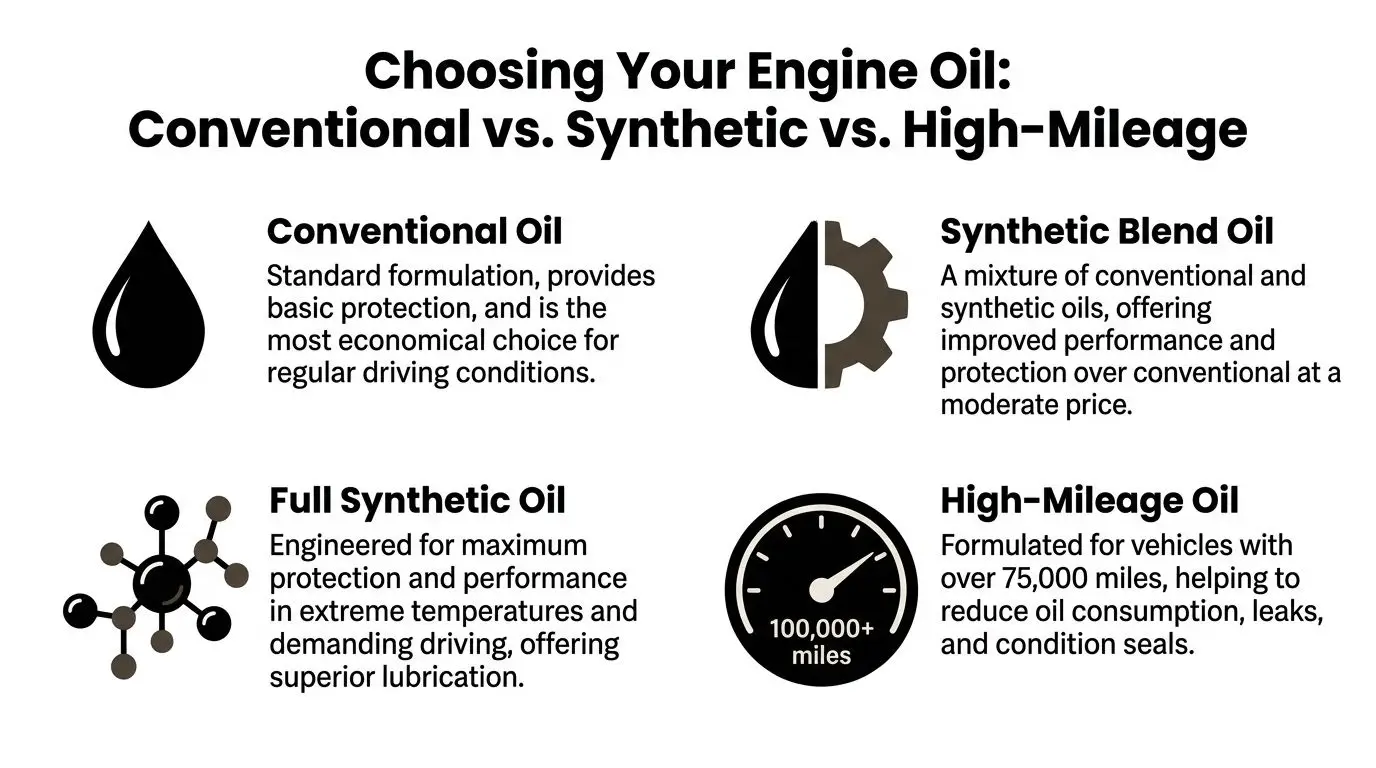
Conventional oil
Conventional oil is the basic, budget-friendly option. In the right vehicle, it can do the job. This usually makes more sense in older engines with simpler demands and for drivers who keep up with routine service.
Where conventional starts to lose ground is heat resistance, deposit control, and consistency over longer service life. If the car sees heavy traffic, hard summer use, or repeated short trips, conventional oil often gives you less margin for error.
Synthetic blend
Synthetic blend sits in the middle. It gives you some of the added stability and protection of synthetic while keeping cost lower than full synthetic.
For many everyday drivers, this is a practical compromise. It often fits family vehicles that are used for errands, school runs, and local commuting, especially if the engine is not unusually demanding but still sees Texas heat.
Full synthetic
Full synthetic is usually the strongest choice for modern engines, especially if the vehicle is turbocharged, runs hot, or sees severe driving conditions. It handles temperature swings better and generally offers stronger resistance to sludge and oxidation.
That doesn’t mean every car needs it all the time. But if you drive in stop-and-go traffic, make repeated short trips, or want more protection margin in summer, full synthetic is often money well spent.
A practical comparison of conventional or synthetic oil can help if you’re deciding between those two for a daily driver.
High-mileage oil
High-mileage oil is not a magic fix, but it has a real place. It is designed for vehicles with over 75,000 miles and can help address the kind of issues older engines start to show, like seepage, mild consumption, and seal aging.
This type makes the most sense when the engine is still mechanically sound but is showing the usual signs of age. It is a maintenance choice, not a substitute for repair.
Side-by-side trade-offs
| Oil type | Best fit | Strengths | Watch-outs |
|---|---|---|---|
| Conventional | Older, simpler engines on a tighter budget | Lower upfront cost | Less protection margin in heat and severe use |
| Synthetic blend | Daily drivers with mixed use | Balanced cost and performance | Less durable than full synthetic |
| Full synthetic | Modern engines, heavy traffic, hotter operation, demanding use | Strong overall protection and stability | Higher upfront cost |
| High-mileage | Vehicles over 75,000 miles | Helps older engines manage age-related oil issues | Must still match viscosity and service requirements |
What works and what does not
What works:
- Matching the oil type to the vehicle’s age and use
- Paying more for synthetic when the driving pattern justifies it
- Using high-mileage oil when an older engine shows normal age-related behavior
- Sticking to the required viscosity and service standard first
What does not work:
- Assuming expensive automatically means correct
- Jumping to thicker oil because the car is older
- Choosing by brand color, bottle design, or marketing language
- Treating all “synthetic” bottles as interchangeable
Practical rule: Pick the correct spec first. Then choose the oil type that fits your budget and the way the car lives.
Adjusting for Richland Hills Climate and Your Driving Style
The manual gives you the baseline. Local driving tells you how hard that oil has to work.
That’s the part generic advice usually misses. A car in Richland Hills that spends its life on short trips and summer pavement does not experience oil the same way as the same model cruising long highway stretches in milder conditions.
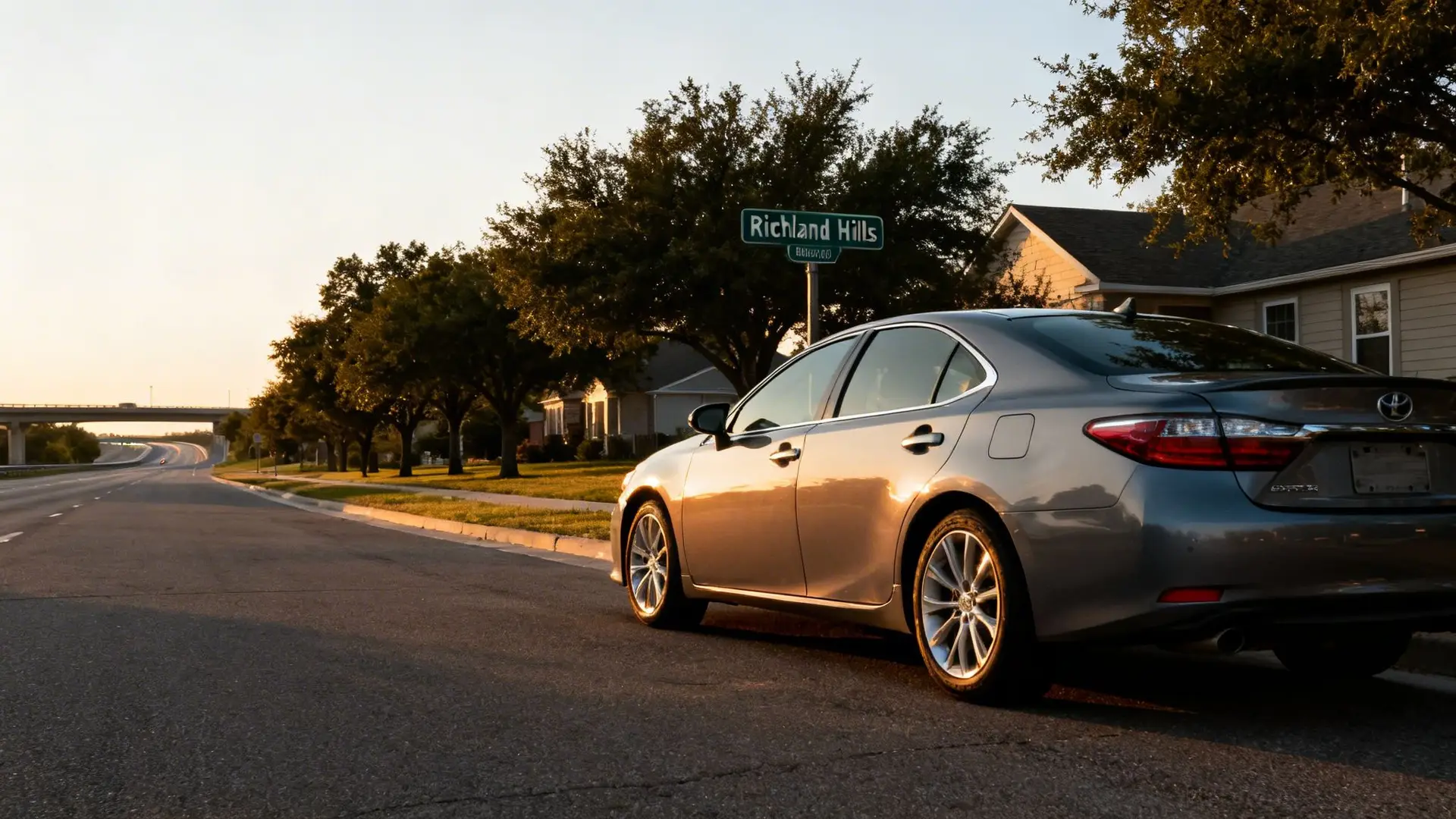
A DFW-focused guide notes that short trips under 10 miles are common and can keep engines from reaching optimal temperature, which can worsen leaks and contaminant buildup in vehicles with over 75,000 miles. It also states that high-mileage synthetic blends with seal conditioners can reduce oil burn-off by up to 50% in manufacturer testing, making them a strong fit for hot Texas conditions (how to know which oil type is right for your vehicle).
Why short-trip driving is harder than it looks
A lot of local driving is made up of:
- School drop-offs
- Grocery runs
- Short commutes
- Stop-and-go traffic
- Weekend errands
That doesn’t sound severe. But it can be.
When the engine runs briefly and shuts off again, oil may not stay hot long enough to deal with moisture and contaminants as effectively as it does during a longer drive. In older engines, that pattern can also make small leaks or oil consumption issues more noticeable.
Texas heat changes the value equation
Heat stresses oil. That doesn’t mean you should guess and go thicker than the manual says. It means the quality of the oil type matters more.
For many Richland Hills drivers, especially families with one vehicle doing everything, synthetic or a strong synthetic blend often makes more practical sense than the cheapest acceptable option. The upfront cost is higher, but it can buy better heat resistance and cleaner operation in daily use.
If your vehicle already has some miles on it, a guide on mileage on synthetic oil can help you think through how oil type and mileage work together.
A few common Richland Hills examples
A newer crossover doing school runs and city driving all week often benefits from sticking closely to the factory spec and leaning toward synthetic.
An older family sedan with over 75,000 miles, mild seepage, and mostly short local trips may do well with a high-mileage synthetic blend if the manual allows it.
A commuter who spends most of the week on longer highway drives may have less contamination stress than the short-trip driver, even if the odometer climbs faster.
Local takeaway: In Richland Hills, the heat matters. The short-trip pattern matters even more than many drivers realize.
When to Trust the Pros at Express Lube & Car Care
Some oil decisions are simple. The manual is clear, the vehicle is stock, and the driving pattern is straightforward.
Others are not.
Professional advice saves people from expensive trial and error. If you’re comparing viscosities, wondering whether your older engine should move to high-mileage oil, or trying to set the right interval for synthetic, it helps to have someone look at the whole picture instead of one bottle label.
When DIY is enough
You can usually handle the choice confidently if:
- The owner’s manual is available and clear
- The engine is stock and running normally
- You know your driving pattern
- You’re choosing the correct oil type within the required spec
That’s a normal, manageable situation for a lot of drivers.
When expert input is smarter
It makes sense to get help if:
- You have an older vehicle with leaks, consumption, or startup noise
- You bought a used car and don’t know what was used before
- Your driving is mostly short trips, towing, or heavy stop-and-go use
- You want to extend intervals safely instead of guessing
- You manage multiple vehicles and need consistency
A data-driven approach is especially useful for fleets and detail-oriented owners. Professional used oil analysis can help optimize intervals and, according to a technical discussion of oil analysis, can reduce long-term downtime by 30-50%. That same source notes that synthetics can often extend to 10,000-15,000 miles in many cases, while analysis helps avoid costly guesswork and potential engine damage worth over $1,500 in repairs (data-driven oil change insights with an expert).
Why a shop visit adds value
A proper oil service is not just pouring in fresh oil.
A good technician also looks at:
- Filter condition and correct filter selection
- Oil level and signs of consumption
- Leaks around common gasket and seal areas
- Service interval habits versus actual driving conditions
- Whether the chosen oil still makes sense for the vehicle’s age and use
That matters because many oil problems don’t start with the oil itself. They start with a mismatch between the vehicle, the driving pattern, and the maintenance routine.
What a busy driver really needs
Many drivers don’t want a chemistry lecture. They want a clear recommendation that fits the vehicle and the way they drive.
That usually comes down to a few plain answers:
- Use the exact viscosity the engine was designed for.
- Make sure the bottle meets the required service standard.
- Choose conventional, blend, synthetic, or high-mileage based on mileage and real driving conditions.
- Recheck the plan if your usage changes.
For simple maintenance and a professional recommendation based on your vehicle and driving habits, oil and filter change service is often the easiest way to keep things accurate and stress-free.
If you want straightforward oil recommendations for my car without guessing in the parts aisle, visit Express Lube & Car Care. The team provides walk-in service, ASE-certified guidance, and honest recommendations suited to your vehicle, mileage, and Richland Hills driving conditions.