

Full synthetic oil protects better than conventional oil in heat, cold and hard use, and it usually lasts longer between changes. Conventional oil still does the job in many engines that are driven gently and serviced on time. The right choice is the one your owner’s manual specifies, adjusted for how you actually drive. A synthetic blend sits in the middle on both price and performance.
That is the short version. Below, we walk through what each oil is, where the differences show up, what the higher price buys, and how to decide for a daily commute on Loop 820, a truck that tows, or a car that sits in Northeast Tarrant County traffic all summer.
TL;DR
- Conventional oil is refined petroleum. It is the lowest-cost option and meets many manufacturers’ requirements when changes are made on schedule.
- Full synthetic oil is engineered at the molecular level. It handles extreme heat and cold better, resists breakdown longer, and is required by some engines.
- Synthetic blend mixes the two. It adds some high-temperature and load protection for a smaller price step.
- Your owner’s manual decides. Match the viscosity grade and performance standard it lists, then shorten the interval if your driving is hard on oil.
- Longer intervals can offset the price. Consumer Reports puts synthetic at about 30% more per change, but it may need changing about half as often.
Table of Contents
- What is the difference between conventional, blend and full synthetic oil?
- How do they compare on engine protection?
- Is synthetic oil worth the extra cost?
- Does every engine need synthetic oil?
- How do you choose the right oil for your vehicle?
- How often should you change each type?
- Our perspective at Express Lube & Car Care
- Which oil makes sense for different drivers?
- Get an oil change from technicians who look at the whole car
- Common mistakes when choosing oil
- FAQ
- Sources
What is the difference between conventional, blend and full synthetic oil?
All three start as crude oil or a close relative of it. What changes is how refined and engineered the base oil is, and what additives go into the bottle.
Conventional oil is refined petroleum. Synthetic oil is chemically modified petroleum made in a factory, and a synthetic blend combines the two, according to Consumer Reports. Think of conventional oil as a mix of molecules of many different sizes, and synthetic as a mix built to be far more uniform.
The line between “full synthetic” and “blend” is blurrier than most people expect. Mobil’s own guide notes that there are no firm industry definitions separating the two. Full synthetics typically start with the highest-quality base oils, while blends typically mix higher- and lower-quality conventional base oils or use only the higher-quality ones. In practice, that means two bottles marked “blend” can perform differently, and so can two marked “synthetic.”
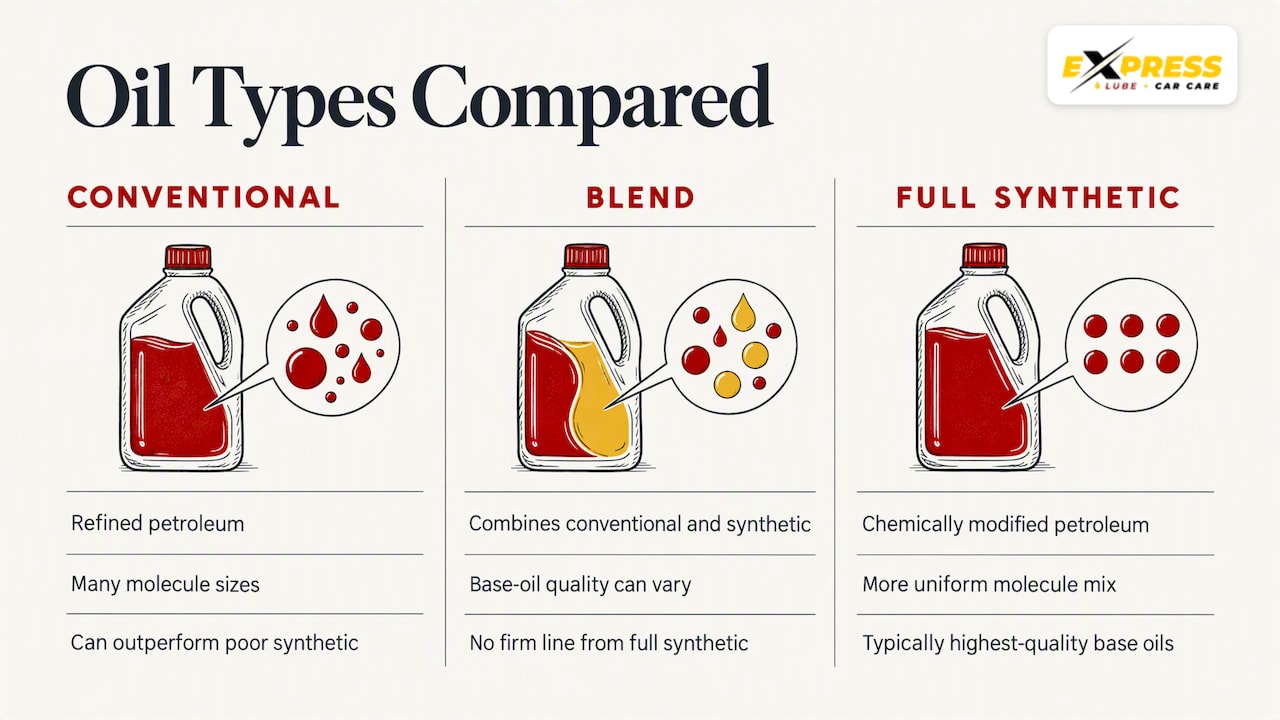
Additives matter too. Purdue Extension explains that additives enhance the base oil’s properties, suppress some of them and add new ones. A well-additized conventional oil can outperform a poorly made synthetic. That is why the performance standard on the label matters more than the marketing word on the front.
Quick comparison
| Conventional | Synthetic blend | Full synthetic | |
|---|---|---|---|
| What it is | Refined petroleum | Conventional plus synthetic base oils | Engineered base oils |
| Cold-start flow | Adequate | Better than conventional | Best of the three |
| High-heat stability | Breaks down faster | Moderate gain | Strongest |
| Typical interval range* | 3,000 to 5,000 miles | About 7,500 miles | 10,000 to 25,000 miles |
| Upfront cost | Lowest | Middle | Highest |
| Good fit | Simple engines, gentle driving, short intervals | Pickups and SUVs, mixed driving, budget step-up | Turbocharged and high-tech engines, towing, extreme temperatures |
*These are the general ranges Castrol publishes, and they come with the same advice we give: follow the interval in your owner’s manual.
How do they compare on engine protection?
Engine oil has a long job list. According to Purdue Extension, crankcase oil reduces friction and wear, controls sludge and deposits, carries contaminants to the filter, transfers heat, protects against rust and keeps its viscosity at hot and cold temperatures. Synthetic and conventional both do all of that. The difference is how well and for how long.
Heat, cold and breakdown
Consumer Reports says conventional oil holds on to more impurities and breaks down faster, while synthetic performs better at both high and low temperature extremes. Popular Mechanics adds that full synthetics flow better in the cold and hold their viscosity when hot.
Cold flow matters at startup, when most engine wear happens, because oil has to reach the top of the engine quickly. Heat stability matters when oil sits in a hot engine for hours. Texas summers, stop-and-go traffic on Rufe Snow Drive or Airport Freeway, and an A/C running nonstop all push oil temperature up.
What about the claim that synthetic prevents more wear?
Here the evidence is more modest than the advertising. Purdue Extension summarizes a Consumers Union taxi study in which vehicles ran 100,000 miles with routine oil changes. Engine wear showed no difference between conventional and synthetic oil, and Purdue concludes that under normal maintenance and operation the differences may be small.
That result is useful for a very specific reason. Those engines got regular oil changes. The real advantage of synthetic shows up when conditions are tough or intervals are stretched, because a more stable oil has more margin. If you change oil on time and drive gently, conventional can be perfectly adequate. If you tow, idle a lot, make short trips or push intervals, the margin is worth paying for.
Where blends fit
Popular Mechanics says blends are formulated for somewhat heavier loads and higher temperatures than conventional oil. They are often less volatile too, which can mean less evaporation and oil loss, and the publication notes they are popular in pickups and SUVs that haul. If you want a step up without paying full synthetic prices, a blend is a legitimate middle option, as long as it meets your engine’s specification.
We go deeper on blend schedules in our guide to the oil change interval with synthetic blend.

Is synthetic oil worth the extra cost?
Often yes, but not always. Consumer Reports says synthetic can last up to 10,000 miles or more between changes, costs about 30% more than conventional, and may need replacing about half as often. Its reasoning is that the longer interval can offset the higher price per change. It also says the owner’s manual, not a generic mileage number, should control how often you change oil.
That last point is where many drivers get burned. Here is how the math works in general terms, using no prices because they vary by vehicle and oil capacity:
- Find the interval your manual gives for your oil type and driving conditions.
- Ask for the price of each oil type for your specific vehicle.
- Divide each price by the miles it will realistically stay in the engine.
- Add the value of fewer trips to the shop, which for busy people can be the biggest saving.
Synthetic is most likely to be worth it when your manual requires it, when you tow or haul, when you drive in extreme heat or cold, or when you want fewer visits. Conventional is most likely to make sense when the manual allows it, the engine is simple, you drive moderate distances and you are happy to change oil on a shorter schedule.
Our own data-focused write-up, Is Synthetic Oil Better?, goes through the comparison from the engine’s point of view, and how long synthetic oil lasts covers the interval question in more detail.
Does every engine need synthetic oil?
No. Popular Mechanics says full synthetic costs more and not every engine needs it. It is made for high-tech engines and heavy-duty uses, but an older or simpler engine may run fine on something less expensive. The reverse is also true: some engines require synthetic, and using conventional in them can undermine the warranty or the engine.
Two groups come up often in Richland Hills:
- European vehicles. Many call for a specific manufacturer approval, not just a viscosity grade. The right oil is the one that carries the approval your manual lists.
- Turbocharged and direct-injection engines. These run hot and put oil under stress, and many manufacturers specify synthetic for them. Check your manual rather than assuming.
What about switching from conventional to synthetic?
Switching is generally fine as long as the new oil meets the specification in your manual. If your engine is old, has high mileage or has a known leak, mention it at the shop so the technician can look at seals and gaskets and talk through the options. We do not promise that a switch will fix or cause a leak, because we have not seen your engine yet. We look at the actual condition first.

How do you choose the right oil for your vehicle?
The label on the bottle should match your manual in three places. The API’s motor oil guide says to follow the manufacturer’s recommendations, including the SAE viscosity grade and the ILSAC or API performance standard.
- Viscosity grade, such as 5W-30 or 5W-20. The numbers describe how the oil flows cold and hot. Using the wrong one can affect protection and efficiency. Our comparison of 5W-30 vs. 5W-20 explains the difference.
- Performance standard, the API or ILSAC rating printed on the bottle.
- Any manufacturer approval your manual calls out, common with European makes and some diesels.
Oil type (conventional, blend, synthetic) is a fourth decision made inside those limits. If your manual lists only synthetic, that settles it. If it allows several, your driving decides.
How often should you change each type?
There is no single mileage number that is right for everyone. Consumer Reports says the owner’s manual is the best source for the exact interval and that manufacturers may list separate normal, severe and extreme-use schedules, with towing calling for more frequent changes.
What counts as severe use is often broader than drivers expect. Common items in manuals include:
- Frequent short trips where the engine never fully warms up
- Stop-and-go traffic and long idling
- Towing or hauling heavy loads
- Very hot or very cold weather
- Dusty roads
If you drive for a rideshare or delivery service, your engine may log far more hours and stop-and-go miles than the average car. Our guides to delivery driver oil change frequency and quick oil changes between rideshare shifts are written for those schedules. For a general overview, see why oil change intervals matter.
Our perspective at Express Lube & Car Care
We are a full-service repair shop, not only an oil change counter, so we see what happens to engines after years of different oil choices. Our view is simple.
First, we do not push one oil on everyone. We start with your manual and what you tell us about how you drive. A commuter who drives gently and changes oil on time has different needs from a contractor who tows a trailer in July.
Second, price should be clear before the work starts. Asking “which oil is in my engine and why” is a fair question, and you should get a plain answer.
Third, oil changes are the best moment for a quick look at everything else. Our ASE-certified technicians can use a digital vehicle inspection with photos so you can see what we see, such as a seep near a gasket, worn belts or low fluids, and decide what to do with the facts in front of you.
Finally, we would rather you change oil a little early with the right product than stretch an interval on a hot Texas summer. That advice comes from the manual, not from us wanting to sell more oil.
— Express Lube & Car Care
Which oil makes sense for different drivers?
These are starting points, not rules. Your manual always comes first.
| Driver | Often a good fit | Why |
|---|---|---|
| Gentle commuter, simple engine, manual allows it | Conventional or blend | Meets the spec at the lowest cost if you change on time |
| Pickup or SUV that hauls or tows | Blend or full synthetic | Heavier loads and heat put more stress on the oil |
| Turbocharged or European vehicle | Full synthetic with the right approval | Often required, and heat stress is higher |
| High-mileage rideshare or delivery vehicle | Full synthetic, interval per manual’s severe schedule | Fewer stops, more heat and idling |
| Weekend or low-mileage car | Whatever the manual lists, changed by time as well as miles | Oil ages even when the odometer barely moves |
For more on shopping for a synthetic service, see our article on finding a full synthetic oil change. If you want a second angle on the choice, conventional or synthetic oil for your car covers it too.
Get an oil change from technicians who look at the whole car
At Express Lube & Car Care we offer oil changes and preventive maintenance with no appointment needed, or you can schedule ahead if you prefer. Along with the oil service, you can ask for a digital inspection with photos so you know the condition of your brakes, belts, hoses and fluids before deciding on anything else. If something needs repair, qualifying repairs are covered by our 24-month/24,000-mile warranty.
You can see what we offer on our services page, and current offers are listed on our oil change and service specials page. We serve drivers from Richland Hills, North Richland Hills, Hurst, Bedford and the rest of Northeast Tarrant County from one location at 7932 Glenview Drive, Richland Hills, TX 76180. Call us at (817) 284-8478 with questions about your vehicle’s oil.
Common mistakes when choosing oil
- Going by mileage stickers alone. Windshield stickers are generic. The manual is specific to your engine.
- Choosing by brand or word on the bottle. Check the viscosity and performance standard instead.
- Assuming synthetic means never change it. Synthetic lasts longer, but it is not permanent, and severe conditions shorten the schedule.
- Ignoring time. Oil degrades with age and short trips even if you drive little.
- Skipping level checks. Between changes, check the dipstick regularly. Low oil harms any engine, regardless of type.
For a broader schedule, our guide on how often to change oil walks through it in modern-car terms.
FAQ
Is synthetic oil better than conventional oil?
In most measurable ways, yes. Synthetic resists breakdown, handles temperature extremes better and tends to last longer. That said, Purdue Extension’s summary of a 100,000-mile taxi study found no difference in wear with routine oil changes, so conventional can be enough if your manual allows it and you change it on time.
What is the difference between full synthetic and a synthetic blend?
A blend mixes synthetic and conventional base oils, while full synthetic is built from engineered base oils. The two terms have no firm industry definition, according to Mobil, so the performance standard on the label tells you more than the name does. Blends cost less and give some added protection under load and heat.
Can I mix synthetic and conventional oil?
Mixing is not harmful in the sense that a blend is already a mixture of both, and topping off a low engine is better than running it low. Still, mixing dilutes the benefits of the better oil, so use matching oil when you can and tell your technician what is in the engine at the next service.
Can I go back to conventional after using synthetic?
If your manual allows conventional, you can. If it requires synthetic, do not switch back, because the engine was designed around it. Ask us if you are unsure which category your vehicle falls into.
Does Express Lube offer financing for larger repairs found during an oil change?
Eligible customers may explore financing through third-party providers such as Koalafi, Snap Finance, American First Finance and Synchrony, subject to provider approval and terms. Approval is not guaranteed, and these are not in-house payment plans. Ask us about your options at (817) 284-8478.
Sources
- Should You Use Synthetic Oil in Your Car? Consumer Reports
- Synthetic oil vs. conventional oil, Mobil
- Engine Oils and Their Filters, Purdue Extension
- How To Pick The Right Engine Oil For Your Vehicle, Popular Mechanics
- API Motor Oil Guide
- What kind of oil does my car take? Castrol USA