

P0171 means your engine is running too lean on Bank 1. The powertrain control module has detected too much oxygen (or not enough fuel) in the exhaust stream and logged the code in response. You can usually drive short distances to a shop, but don’t put it off: a persistent lean condition can cook a catalytic converter and sap performance over time. The leading suspects are intake or vacuum leaks, a dirty MAF sensor, fuel delivery trouble, or an exhaust leak confusing the upstream oxygen sensor.
TL;DR:
- Intake or vacuum leaks are the most common causes and should be the first issue checked during diagnosis.
- Dirty or failing MAF sensors frequently contribute to P0171 and may require cleaning or replacement to resolve the code.
- Fuel delivery problems, such as a weak pump or clogged injectors, can cause the lean condition and need testing with live fuel trim data.
- Exhaust leaks or oxygen sensor faults also create false lean signals, and smoke testing helps locate these hidden leaks.
- Ignoring the code can risk damaging the catalytic converter, so timely professional diagnosis and repair are crucial for avoiding long-term engine issues.
Table of Contents
- What Is the P0171 Code and What Symptoms Show Up?
- What Causes P0171 Most Often?
- How Do Technicians Diagnose a P0171 Code?
- What Can You Check Yourself Before Visiting a Shop?
- When Should You Get Professional Diagnostics for P0171?
- Our Take on Diagnosing P0171 the Right Way
- How Express Lube & Car Care Handles P0171 Diagnostics
- Sources
- FAQ
What Is the P0171 Code and What Symptoms Show Up?
Your engine’s computer, the PCM, constantly adjusts the fuel mixture based on feedback from sensors, including the upstream oxygen sensor near the exhaust manifold. When that sensor reports more oxygen than expected, the PCM assumes the air/fuel mix is lean, meaning too much air relative to fuel. It compensates by adding fuel through short-term and long-term fuel trim adjustments (STFT and LTFT). When those corrections max out and the system still can’t get the mixture back in range, the PCM flags P0171.
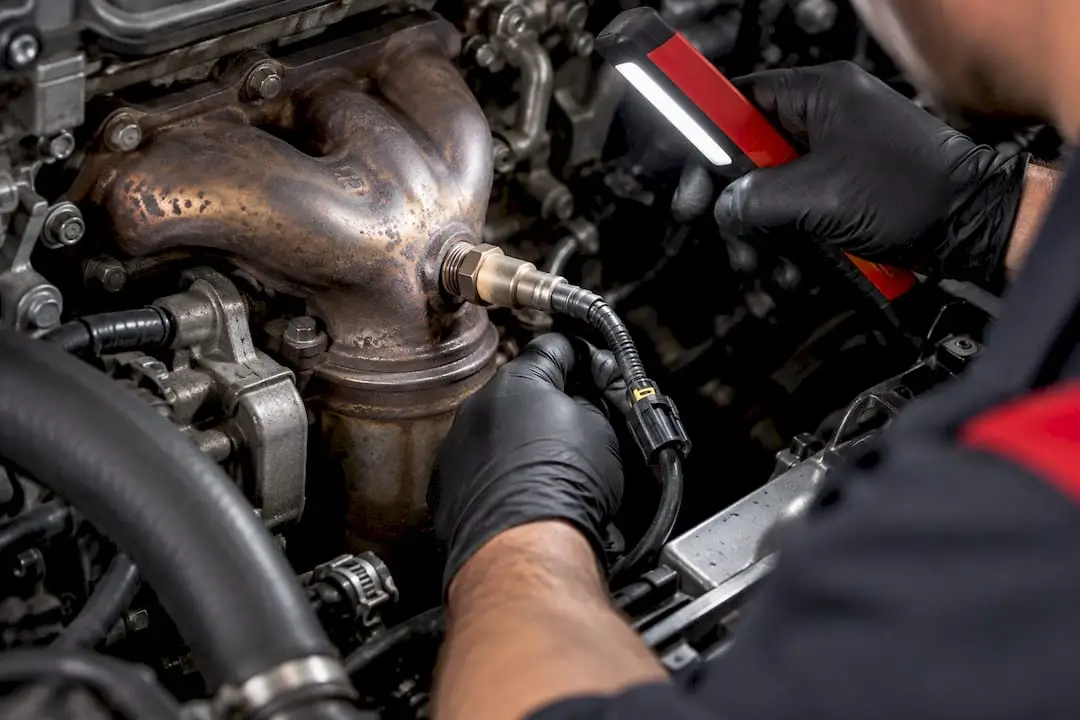
“Bank 1” refers to the cylinder bank containing cylinder number one. On inline four and six cylinder engines, that’s usually the whole engine since there’s only one bank. On V6 and V8 engines, Bank 1 and Bank 2 are separate sides, each with its own oxygen sensor. If you see P0174 alongside P0171, both banks are running lean, which usually points to something shared, like the MAF sensor or a intake leak affecting the whole engine rather than one side.
Watch for these signs:
- Check engine light illuminated, sometimes flashing under load
- Rough or fluctuating idle
- Hesitation or stumbling during acceleration
- Noticeably reduced power
- Stalling, especially at idle or in stop-and-go traffic
- A hissing sound near the intake, a telltale sign of a vacuum leak
- Worse fuel economy than usual
If you notice severe power loss, unusual knocking, overheating, or repeated stalling in traffic, don’t keep driving. Get the car to a shop or have it towed instead of pushing through it.
What Causes P0171 Most Often?
Technicians don’t chase every possible cause with equal attention, and neither should you. Some problems show up far more often than others, so the smart move is working through the list in order of likelihood.
- Intake and vacuum leaks downstream of the MAF sensor. Cracked intake boots, loose clamps, and brittle vacuum hoses let unmetered air into the engine after the mass airflow sensor has already measured it, throwing off the whole calculation. This is the single most frequent cause of a lean code.
- Dirty or failing MAF sensor. Oil residue from an aftermarket air filter, road grime, or a failing sensor element can make the MAF underreport incoming air, and the troubleshooting data on P0171 consistently ranks it alongside intake leaks as the top culprit.
- Fuel delivery problems. A weakening fuel pump, a clogged fuel filter, low fuel pressure, or partially clogged injectors can starve the engine of fuel even when airflow is normal.
- Upstream oxygen sensor faults or exhaust leaks before the sensor. A leak in the exhaust manifold ahead of the sensor lets outside air in, tricking the sensor into reporting a lean condition that isn’t really happening in the combustion chamber.
- PCV, EVAP, or EGR faults. A stuck-open PCV valve or a leaking EVAP purge valve can introduce unmetered air in smaller, sneakier amounts.
- PCM issues. Rare, but worth mentioning: a software glitch or wiring fault at the control module can occasionally produce a false lean reading with no mechanical cause at all.
Notice the order. Intake leaks and MAF contamination cause the overwhelming majority of P0171 cases, which is exactly why a competent diagnosis starts there instead of jumping straight to sensor replacement.
How Do Technicians Diagnose a P0171 Code?
A proper diagnosis follows a sequence, not a guess. Here’s the process an ASE-certified technician typically runs through:
- Scan for codes and pull freeze-frame data. This shows what the engine was doing the moment the code set, plus whether related codes like a MAF fault, misfire, or P0174 are riding along.
- Read live fuel trims at idle and around 2,500 RPM. This is the step most DIY repairs skip, and it’s the one that actually tells you what’s wrong.
- Inspect intake boots, clamps, and visible vacuum hoses. Cracks, loose connections, and perished rubber are common enough that a visual check catches many cases outright.
- Run a smoke test when the visual inspection comes up empty. Pressurizing the intake with smoke and watching where it escapes finds leaks a visual check alone will miss.
- Test and clean the MAF sensor, then verify fuel pressure and pump output; check injectors if fuel delivery looks weak.
- Check for exhaust leaks ahead of the upstream O2 sensor, clear the code, and confirm the fix with a fresh fuel-trim reading and a road test.
The fuel trim numbers do a lot of the heavy lifting here. Pro Tip: If your long-term fuel trim is high at idle but drops back toward normal as RPM climbs, that pattern points strongly toward a vacuum leak. If the trim stays elevated across the entire RPM range, you’re more likely looking at a fuel delivery or MAF calibration problem rather than a leak. That single distinction, drawn from live fuel-trim analysis, can save hours of chasing the wrong part.
What Can You Check Yourself Before Visiting a Shop?
Before you touch anything, know your limits. If the car is stalling repeatedly, losing significant power, or making noises you can’t explain, skip the DIY step and get it looked at, or towed if it feels unsafe to drive.
If the symptoms are mild, here’s a reasonable sequence to try:
- Check the air filter. A filthy filter restricts airflow and can throw off MAF readings; replacing a clogged air filter is cheap and takes minutes.
- Inspect intake boot clamps. Look for loose or corroded clamps at the connections between the air box, MAF housing, and throttle body.
- Look over visible vacuum and PCV hoses. Cracked, soft, or disconnected hoses are common on higher mileage vehicles.
- Make sure the MAF connector is fully seated. A loose electrical connector can mimic a failed sensor.
- Clean the MAF sensor if it looks dirty. Use a dedicated MAF cleaner spray and never touch the sensing element directly with a rag or your finger, since a damaged sensor coating will read incorrectly no matter how clean it looks.
Pro Tip: Don’t swap sensors on a guess. Replacing the oxygen sensor or MAF without reading fuel trim data first is the most common way owners spend money without fixing anything. Before your appointment, jot down when the light came on, what symptoms you’ve noticed, and any steps you’ve already tried. That context speeds up diagnosis considerably.
When Should You Get Professional Diagnostics for P0171?
If the DIY checks don’t clear the code or the symptoms are more than mild, it’s time for a shop visit. A live-data diagnosis and smoke test almost always cost less in the long run than guessing your way through part replacements, since fuel trim readings point directly at the system that’s actually failing.
A typical diagnostic visit runs one to two hours for the scan, fuel trim review, and inspection. Repair time varies a lot depending on what’s found:
- A loose clamp or a torn intake boot might be fixed same-day
- MAF cleaning or replacement is usually a quick turnaround
- Fuel pump or injector work takes longer and involves more labor
Exact costs depend on your vehicle and what the inspection turns up, so it’s worth asking your shop for a quote after diagnosis rather than assuming a number in advance. What isn’t worth guessing on is the risk of waiting. A lean condition that runs unresolved for weeks or months can overheat and damage the catalytic converter, cause ongoing misfires, and put extra wear on the engine. If your fuel pump is the underlying issue, catching failure symptoms early also helps avoid a roadside breakdown. Bring any freeze-frame notes or symptom timing you’ve recorded. The more detail you hand over, the faster your technician connects the dots.
Our Take on Diagnosing P0171 the Right Way
We see a pattern in a lot of P0171 cases that never had to become expensive: someone replaces the oxygen sensor, the code comes back within days, and now they’ve spent money without touching the actual problem. The fix almost always starts with fuel trims and a smoke test, not a parts cannon. Technicians who read the data first, rather than guessing based on mileage or a hunch, consistently land on the right repair faster and with less wasted expense. That’s not a knock on DIY effort. It’s a reminder that some steps genuinely need a scan tool talking to live data, not a shot in the dark.
— Express Lube & Car Care
How Express Lube & Car Care Handles P0171 Diagnostics
A code reader will tell you P0171 is set. It won’t tell you whether the culprit is a cracked intake boot or a failing fuel pump, and that gap is where money gets wasted. Technicians typically run live-data fuel trim analysis and smoke testing to find the actual source before recommending a repair, and jobs often include digital inspections, complete with photos, so you can see exactly what was found.
Whether it turns out to be an intake leak, a fuel system issue, or something with your MAF sensor, qualifying repairs are often backed with a warranty. Walk-ins are welcome, and same-day service is often available. Bring your symptoms, when the light came on, and anything you’ve already checked. Browse our full service list or schedule a diagnostic appointment now by calling (817) 284-8478. If you’re near Richland Hills and that check engine light won’t turn off, let’s find out what it’s actually trying to tell you.
Sources
- P0171 & P0174 Trouble Codes – Diagnosis, Causes, Symptoms & How to Fix It- AutoZone
- Troublecodes
- P0171 diagnostic guide – Autocodes
- Is it safe to drive a car with a P0171 code? | Ryan’s Auto Care
FAQ
How Do I Fix a P0171 Code?
Start by identifying the actual cause through fuel trim data and a visual inspection, since P0171 is a symptom code, not a specific part failure. Most cases trace back to an intake leak or dirty MAF sensor, which get fixed by repairing the leak or cleaning or replacing the sensor. If those checks come up clean, the next step is testing fuel pressure and injector performance.
Can You Drive Your Car With a P0171 Code?
You can often drive a short distance safely, but you shouldn’t ignore it for long. A persistent lean condition can damage the catalytic converter and lead to stalling or reduced power the longer it goes unaddressed. If you notice severe symptoms like repeated stalling or major power loss, get it looked at right away instead of continuing to drive.
What Is the Most Common Cause of a P0171 Code?
Intake and vacuum leaks downstream of the MAF sensor, along with a dirty or failing MAF sensor itself, cause the large majority of P0171 cases. Fuel delivery problems and exhaust leaks near the upstream oxygen sensor are less common but still worth ruling out.
How Much Does It Cost to Fix a P0171 Code?
Cost depends on the specific cause of the lean condition, with simpler repairs like replacing a clamp generally costing less than more complex issues such as fuel pump replacement. Express Lube & Car Care offers exact pricing after diagnostic inspection to identify the problem; call (817) 284-8478 or visit our services page for current details.
Is P0171 the Same as P0174?
No. P0171 signals a lean condition on Bank 1, while P0174 signals the same problem on Bank 2 of a V6 or V8 engine. If both codes appear together, the issue is likely shared across both banks, such as a MAF sensor or intake manifold leak, rather than two separate bank-specific failures.