

Mechanics diagnose car problems through a structured process that combines the driver’s description of the symptoms, visual inspection, vehicle computer data, service information, and targeted testing.
A professional diagnosis is more than connecting a scanner and reading a trouble code. The technician gathers evidence, identifies which system may be responsible, performs tests to confirm or eliminate possible causes, and verifies the repair afterward.
Understanding this process can also help you describe your vehicle’s symptoms more clearly and understand why certain diagnostic tests may be necessary.
How Do Mechanics Diagnose Car Problems?
Although the exact procedure depends on the vehicle and symptom, professional diagnosis generally follows a logical sequence.
- Verify the complaint. The technician confirms the symptom whenever possible through direct observation, a test drive, or other appropriate method.
- Gather information. Details about when the problem occurs, how often it happens, recent repairs, warning lights, noises, smells, vibrations, and other symptoms help determine where to begin.
- Perform a visual inspection. The technician looks for obvious problems such as fluid leaks, damaged wiring, loose connections, deteriorated hoses, damaged components, or other visible clues.
- Scan the vehicle when appropriate. Diagnostic trouble codes and module information can identify systems that require further investigation.
- Review applicable service information. Wiring diagrams, specifications, diagnostic procedures, and Technical Service Bulletins can provide vehicle-specific direction.
- Analyze diagnostic data. Depending on the problem, this may include freeze-frame information, live sensor data, fuel trims, misfire information, module communication, or other vehicle data.
- Form and test a diagnostic hypothesis. Rather than replacing parts based on assumptions, the technician performs targeted tests to confirm or eliminate possible causes.
- Recommend the appropriate repair. Once sufficient evidence identifies the cause, the technician can explain what was found and what repair is recommended.
- Verify the repair. After repairs are completed, the original symptom should be rechecked to confirm that the problem has been corrected.
Helpful tip: Before bringing your vehicle in, write down exactly when the problem happens. “The vehicle vibrates between 55 and 65 mph after about 20 minutes of driving” provides much more useful information than “it shakes sometimes.”
Why Does a Mechanic Start by Asking Questions?
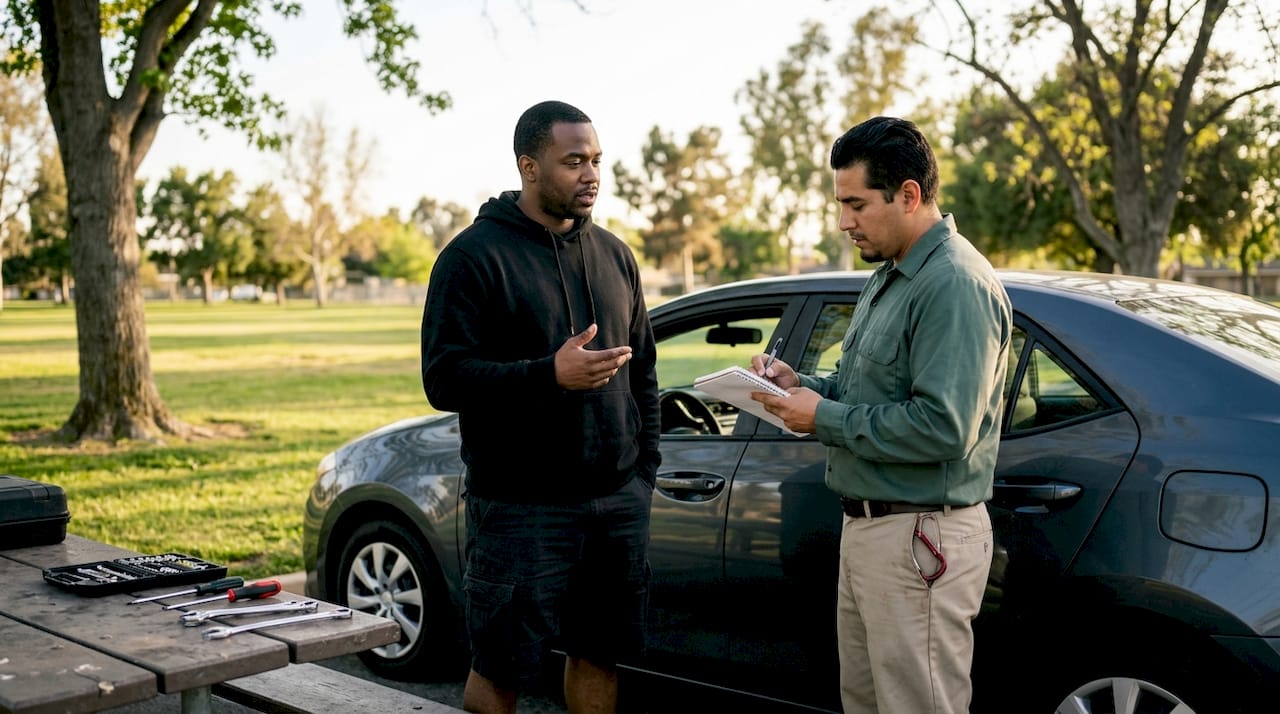
Your description of the problem is an important part of the diagnostic process because some symptoms occur only under specific conditions.
A technician may ask:
- When did the problem begin?
- Does it happen every time or only occasionally?
- Does it happen when the vehicle is cold or after it warms up?
- Does it occur at idle, during acceleration, while braking, while turning, or at highway speed?
- Are any warning lights illuminated?
- Do you hear any unusual noises?
- Have you noticed unusual smells, smoke, leaks, or vibrations?
- Does anything make the problem better or worse?
- Was any maintenance or repair performed recently?
- Did anything happen shortly before the symptom appeared, such as hitting a pothole or curb?
Intermittent problems are especially dependent on good symptom information because the vehicle may behave normally by the time it reaches the repair shop.
If you’re trying to organize the symptoms before your visit, our guide to diagnosing car problems by noises, smells and warning signs can help.
What Does a Mechanic Look for During the Visual Inspection?
Before advanced testing begins, a visual inspection may reveal the problem or provide important clues.
Depending on the complaint, a technician may inspect:
- Fluid levels and visible leaks
- Electrical wiring and connectors
- Battery terminals and grounds
- Vacuum and intake hoses
- Cooling-system hoses
- Belts and tensioners
- Damaged or disconnected components
- Tire condition
- Brake components
- Steering and suspension components
- Exhaust components
- Evidence of overheating, impact damage, or previous repairs
A scan tool cannot identify every physical problem. A disconnected hose, damaged wire, leaking component, or worn mechanical part may be discovered through inspection before more advanced testing is necessary.
How Do Mechanics Use Diagnostic Scan Tools?
When the problem involves a system monitored by the vehicle’s computers, a professional scan tool can provide valuable information.
Depending on the vehicle and equipment, technicians may be able to access multiple control modules, including:
- Engine or powertrain control module
- Transmission control module
- Anti-lock braking system
- Body control module
- Airbag or restraint systems
- Steering or suspension modules
- Other vehicle-specific electronic systems
The diagnostic information available can include:
- Stored trouble codes
- Pending codes
- Permanent codes
- Freeze-frame information
- Live sensor data
- Module communication faults
- Vehicle-specific data and test functions
A Trouble Code Is a Starting Point, Not a Diagnosis
This is one of the most important principles in automotive diagnosis.
A diagnostic trouble code tells the technician what condition the vehicle’s computer detected. It does not necessarily identify which component should be replaced.
For example, a code involving an oxygen-sensor reading could result from:
- A faulty sensor
- Damaged wiring
- An exhaust leak
- A vacuum leak
- A fuel-delivery problem
- An engine misfire
- Another condition affecting the sensor’s reading
Testing determines which possibility is actually responsible.
For a detailed explanation of retrieving and interpreting check-engine codes, see our How to Diagnose a Check Engine Light guide.
How Do Mechanics Use Freeze-Frame and Live Data?
Computer data becomes more useful when it is evaluated in the context of the vehicle’s symptoms.
Freeze-Frame Data
Freeze-frame data records certain operating conditions when a diagnostic fault is detected.
Depending on the vehicle, this may include:
- Engine RPM
- Vehicle speed
- Engine load
- Coolant temperature
- Fuel trims
- Throttle position
- Other sensor information
This can help a technician understand whether the fault occurred during startup, idle, acceleration, highway driving, or another operating condition.
Live Data
Live data allows technicians to observe certain sensor and system values while the vehicle is operating.
Rather than simply looking for a number that appears abnormal, technicians compare related data and evaluate whether the readings make sense under the current operating conditions.
A sensor may report an unusual value because the sensor has failed—or because it is correctly reporting a problem elsewhere.
What Are Technical Service Bulletins?
A Technical Service Bulletin (TSB) is information published by a vehicle manufacturer to assist technicians with known conditions, diagnostic procedures, updated parts, software changes, or repair procedures.
Reviewing applicable service information can help determine whether the manufacturer has documented a condition similar to the one being diagnosed.
A TSB is not automatically proof that a particular vehicle has the documented problem. The vehicle still needs to be evaluated to determine whether the bulletin applies.
How Do Mechanics Test a Suspected Problem?
Once the available evidence points toward a particular system, targeted testing begins.
The exact tests depend on the symptom and vehicle.
Electrical Testing
Electrical diagnosis may involve:
- Voltage measurements
- Voltage-drop testing
- Ground testing
- Continuity or resistance testing when appropriate
- Circuit-load testing
- Connector and wiring inspection
- Waveform analysis for certain sensors or circuits
Mechanical Testing
Mechanical tests can include:
- Compression testing
- Cylinder leak-down testing
- Fuel-pressure testing
- Cooling-system pressure testing
- Oil-pressure testing
- Vacuum testing
- Smoke testing
- Exhaust restriction testing
- Other vehicle-specific procedures
For a deeper explanation of mechanical engine tests, see our Engine Diagnosis: How Mechanics Find Engine Problems guide.
How Do Mechanics Avoid Guessing?
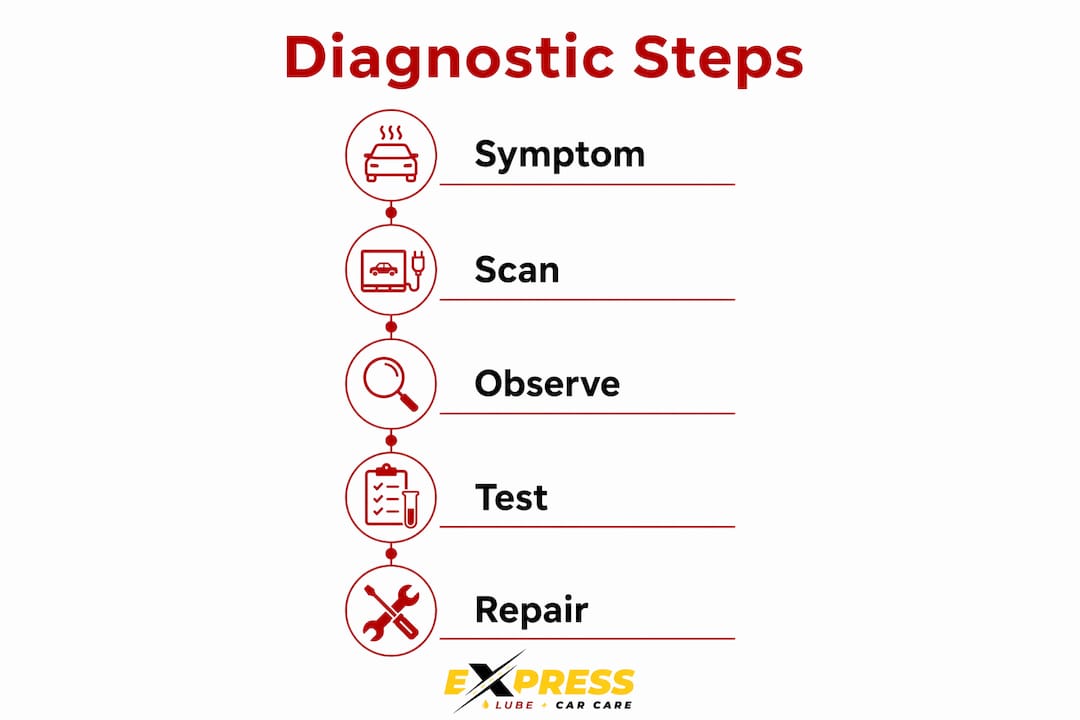
Accurate diagnosis follows evidence rather than assumptions.
A simplified diagnostic path looks like this:
Symptom → System → Possible Causes → Testing → Confirmed Cause → Repair → Verification
Each test should help confirm or eliminate a possible cause.
| Approach | What Happens |
|---|---|
| Guessing | Parts are replaced because they seem related to the symptom or trouble code. |
| Systematic Diagnosis | Evidence is gathered and components or circuits are tested before replacement. |
| Repair Verification | The original symptom is rechecked after repair to confirm the problem has been corrected. |
This is why replacing the component named in a trouble-code description without testing can lead to unnecessary repairs.
Why Manufacturer Service Information Matters
Modern vehicles have different specifications, wiring configurations, control strategies, test procedures, and known issues.
Professional diagnosis may require manufacturer-specific information such as:
- Wiring diagrams
- Connector information
- Diagnostic flowcharts
- Component specifications
- Technical Service Bulletins
- Software information
- Testing procedures
General online information can help explain how a system works, but vehicle-specific service information is often necessary when confirming a fault.
How Your Description Helps the Mechanic
The information you provide can help a technician reproduce an intermittent symptom and choose the appropriate diagnostic path.
Before bringing your vehicle in, consider writing down:
- Exactly what the vehicle does
- When the symptom occurs
- How often it occurs
- Whether the engine is hot or cold
- Approximate vehicle speed
- Whether you are accelerating, braking, turning, or idling
- Any warning lights
- Any noises, smells, vibrations, smoke, or leaks
- Recent repairs or maintenance
- Anything that happened shortly before the problem began
Specific observations give the technician a better starting point than a general description.
What Happens After the Problem Is Found?
Once testing identifies the cause, the technician can explain:
- What was found
- Which tests confirmed the problem
- What repair is recommended
- Whether other related problems were discovered
- What should be verified after the repair
After repairs are completed, the diagnostic process should include confirming that the original symptom has been corrected.
Depending on the repair, verification might involve:
- A test drive
- Rescanning the vehicle
- Reviewing live data
- Repeating the original test
- Confirming there are no leaks
- Verifying proper system operation
Frequently Asked Questions About Professional Car Diagnosis
What does a mechanic do first when diagnosing a car problem?
A mechanic generally begins by gathering information and verifying the reported symptom when possible. Understanding exactly what the vehicle is doing helps determine which systems should be inspected or tested.
Can a fault code tell a mechanic exactly what is broken?
No. A fault code identifies a condition detected by the vehicle’s computer. Additional inspection and testing are often required to determine the actual cause.
How long does a car diagnostic take?
Diagnostic time depends on the problem. Some faults can be identified relatively quickly, while intermittent electrical problems, multiple related faults, or symptoms that occur only under specific conditions may require additional testing. There is no single diagnostic time that applies to every vehicle or problem.
Why does my mechanic ask so many questions?
Details about when, where, and how the problem occurs can help a technician reproduce the symptom and choose the correct diagnostic path. This is particularly important for intermittent problems.
What is a Technical Service Bulletin?
A Technical Service Bulletin is manufacturer-issued service information that can describe known conditions, updated diagnostic procedures, revised parts, software changes, or repair information. A technician still needs to determine whether the bulletin applies to the specific vehicle being diagnosed.
Why doesn’t a mechanic just replace the part named in the code?
Because several different problems can cause the same diagnostic trouble code. Testing helps determine whether the issue is actually the component itself, its wiring, another system affecting it, or a different underlying condition.
What is the difference between a code scan and a diagnostic test?
A code scan retrieves information stored by the vehicle’s computers. Diagnosis goes further by interpreting that information, inspecting the vehicle, performing appropriate tests, and identifying the root cause of the symptom.
Professional Vehicle Diagnostics in Richland Hills
If your vehicle has a warning light, unusual noise, vibration, drivability problem, electrical issue, or another symptom that needs investigation, a structured diagnostic process can help identify the cause before repairs are recommended.
Express Lube & Car Care in Richland Hills uses vehicle information, visual inspection, diagnostic data, and appropriate testing to investigate automotive problems and explain the findings.
If your concern specifically involves an illuminated check engine light, visit our Check Engine Light & Diagnostics service page.