

If your engine cranks fine but won’t fire, whines from the tank, or loses power under load, you’re likely looking at fuel pump failure. The three clearest red flags are a no-start with a normal crank, a whining or humming noise from the fuel tank, and power loss climbing hills or accelerating. Before anything else, turn the key to ON and listen for a two-second prime hum from the tank, and check the fuel pump fuse and relay. If those symptoms match, get a professional fuel pressure test before you spend money on parts.
TL;DR:
- Most fuel pump failures show early signs such as hard starts, sputtering under acceleration, and whining noises from the tank, especially when under load.
- Common causes include contaminated fuel, running the tank low frequently, restricted filters, electrical faults, and general wear, with contaminated fuel being a leading reason for premature failure.
- Diagnostic steps involve pressure and volume testing, electrical checks, and inspecting filters, with proper diagnosis preventing unnecessary pump replacements.
- Driving with a suspected bad fuel pump is risky, as it can cause engine stalls and other failures, so testing should be performed promptly.
- Using OEM pumps or high-quality aftermarket parts, along with regular maintenance such as filter replacement, extends the lifespan beyond 100,000 miles and prevents costly failures.
Table of Contents
- What Are the Symptoms of Fuel Pump Failure?
- What Causes Fuel Pump Failure?
- How Do Mechanics Diagnose a Bad Fuel Pump?
- Can You Drive With a Bad Fuel Pump?
- How Can You Prevent Fuel Pump Failure?
- How Does Express Lube & Car Care Handle Fuel Pump Diagnosis?
- How Does a Failing Fuel Pump Affect Other Vehicle Components?
- Do All Fuel Pumps Fail the Same Way?
- What Does Fuel Pump Repair or Replacement Cost?
- Should You Choose OEM or Aftermarket for a Replacement Pump?
- Why Testing Beats Guessing on a Fuel Pump
- Schedule Fuel Pump Diagnostics in Richland Hills
- Sources
- FAQ
What Are the Symptoms of Fuel Pump Failure?
A struggling fuel pump rarely fails all at once. It usually gives you warning signs for days or weeks before it leaves you stranded, and those signs tend to get worse under load, like climbing a hill or towing a trailer, because that’s when the engine demands the most fuel volume.
Watch for these patterns:
- Hard starts or extended cranking even though the starter sounds normal and the battery is healthy.
- Sputtering or surging at highway speed, especially under acceleration or while towing.
- Intermittent stalling that seems to happen randomly, or a sudden no-start with no warning.
- Whining, humming, or grinding noise coming from the fuel tank area, often louder when the tank is low.
- Check engine light with codes tied to fuel pressure, fuel trim, or a lean-running condition.
- Dropping gas mileage, a fuel smell, or an erratic fuel gauge reading.
Here’s the part a lot of drivers miss: symptoms like these often worsen under load, which is exactly why a car can idle fine in your driveway and then sputter on the highway ten minutes later. If you’re only testing at idle, you can miss the problem entirely.
What Causes Fuel Pump Failure?
Most fuel pump problems trace back to something that could have been prevented, which is good news if you catch it early and bad news if you’ve been ignoring it.
- Contaminated or water-damaged fuel clogs the pump’s pickup screen and accelerates wear on internal moving parts.
- Running the tank low on a regular basis. In-tank electric pumps depend on surrounding gasoline for cooling and lubrication, so repeatedly driving on fumes cooks the pump from the inside.
- A restricted fuel filter or inlet strainer forces the pump to work harder than it was designed to, straining the motor.
- Electrical faults, including a failing relay, a blown fuse, corroded ground connections, or low supply voltage reaching the pump.
- Plain old age and wear, sometimes made worse by a low-quality replacement part installed during a previous repair.
Contaminated fuel and clogged inlet filters are one of the leading causes of premature pump failure, and in some cases the damage to the pump itself is irreversible once debris gets past the strainer.
How Do Mechanics Diagnose a Bad Fuel Pump?
Diagnosing fuel pump problems is a process of elimination, not a guessing game. A thorough diagnosis before replacement matters because a clogged filter, a tired relay, or a corroded ground wire can mimic pump failure almost perfectly, and none of those cost anywhere near what a pump replacement does.
Here’s the sequence a technician typically works through:
- Relieve fuel system pressure first. Fuel system work involves flammable vapors, so pressure gets relieved and ignition sources get cleared before any line gets disconnected.
- Listen for the prime. Turn the key to ON without starting the engine. A healthy pump hums for about two seconds as it primes the system; silence or a weak whine is a red flag.
- Run a fuel pressure test. A gauge on the fuel rail checks pressure against the manufacturer’s spec. A pressure-hold test is the most direct way to confirm pump problems: low idle pressure that drops further under load usually points to the pump, while normal pressure points elsewhere.
- Check volume, not just pressure. A pump can hold pressure but still fail to deliver enough fuel volume under load, which is why some tests measure output over time.
- Test the electrical side. That means checking the fuse, bench-testing or swapping the relay, and verifying voltage at the pump connector under load, plus checking ground resistance.
- Inspect the filter and strainer for contamination or debris that could be starving the pump.
- Compare results before condemning the pump. If pressure and volume come back normal, the real problem is often the injectors, the pressure regulator, or a sensor.
Pro Tip: Rapid pressure loss during a hold test often points to a leaking check valve or a bad pressure regulator, not the pump itself. That’s an easy way for a shop to save you from paying for a part you didn’t need.
Can You Drive With a Bad Fuel Pump?
Technically, sometimes, but it’s a risk we don’t recommend taking longer than necessary. A failing pump can stall your engine in traffic, on a highway on ramp, or anywhere else that turns an inconvenience into a real safety hazard.
- Avoid long trips or highway driving until the pump has been tested.
- Don’t tow anything. Towing puts extra demand on a pump that’s already struggling.
- Minimize driving overall until a shop can confirm what’s actually wrong.
- Note when the failure happens. Symptoms that show up only when the engine is hot, or only when it’s cold, help a technician narrow things down fast.
- Call for a tow if the engine won’t start at all or stalls repeatedly. Intermittent failures tend to get worse over time, and waiting usually means a breakdown at the worst possible moment, not a convenient one.
How Can You Prevent Fuel Pump Failure?
A little discipline at the pump goes a long way toward keeping your fuel pump alive well past 100,000 miles.
- Keep the tank above one-quarter full. Running near empty regularly starves the pump of the fuel it needs for cooling and lubrication.
- Replace the fuel filter on your manufacturer’s schedule, and always replace it whenever a fuel pump gets replaced.
- Buy fuel from stations you trust, and never use a questionable or unsealed fuel container.
- Address electrical corrosion or weak ground connections as soon as you notice flickering gauges or slow cranking.
- Ask about periodic fuel-system service, including injector cleaning and strainer inspection, especially if your vehicle sees a lot of stop-and-go driving.
Pro Tip: A cheap fuel pump can fail in a fraction of the time a quality one lasts. If you’re replacing a pump, that’s the moment to also budget for a filter change, since skipping it just sets up the new pump to fail the same way.
How Does Express Lube & Car Care Handle Fuel Pump Diagnosis?
We test before we replace. That means a fuel pressure and pressure-hold test, electrical checks at the fuse, relay, and pump connector, and a look at the fuel filter and tank for contamination, all before anyone recommends a new pump. Our ASE-certified technicians walk you through the results with digital inspection photos, so you can see exactly what’s failing and why.
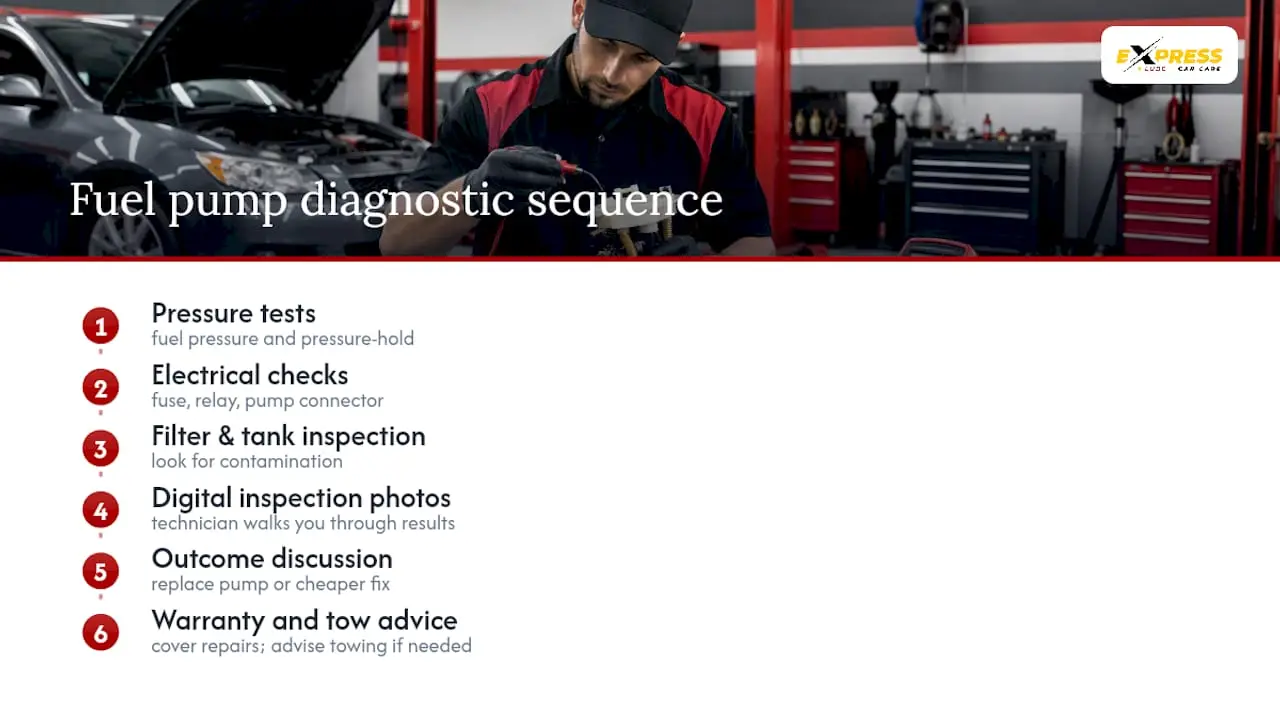
If testing points to the pump, we’ll talk through replacement. If it points somewhere cheaper, like the filter or a relay, we’ll tell you that instead. Certain repairs come with a warranty covering parts and labor for a limited period. If your symptoms suggest a total no-start, we’ll advise whether a tow makes more sense than driving in.
How Does a Failing Fuel Pump Affect Other Vehicle Components?
A struggling fuel pump doesn’t fail in isolation. When it can’t deliver steady pressure and volume, everything downstream has to compensate, and that compensation has a cost.
Fuel injectors are the first to feel it. Low or fluctuating pressure forces injectors to spray less fuel than the engine’s computer intended, which creates a lean-running condition. That shows up as misfires, rough idle, and check engine codes that look like an injector problem even though the injector itself is fine. Run that condition long enough and injector deposits can build up faster, since the spray pattern isn’t behaving the way it was designed to.
Engine performance takes a broader hit too. A lean fuel mixture runs hotter, which stresses components like the catalytic converter over time. Acceleration feels sluggish, fuel economy drops, and in more severe cases the engine can hesitate or stall under load. None of this means the injectors or the catalytic converter are bad. It means they’re being asked to work around a fuel delivery problem they can’t fix on their own, which is exactly why a fuel pressure test matters before anyone starts replacing downstream parts.
Do All Fuel Pumps Fail the Same Way?
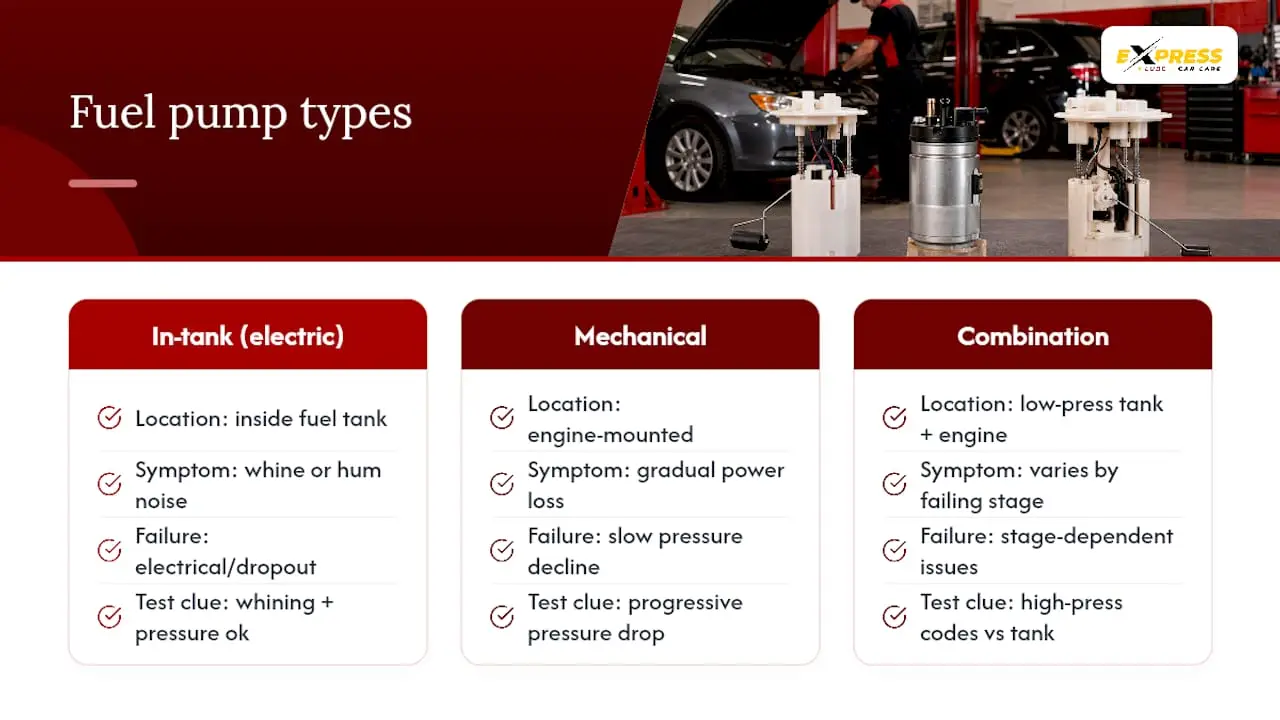
Not quite, and knowing which type your vehicle has helps explain the symptoms you’re seeing. Most vehicles built in the last few decades use an electric in-tank pump, submerged in the fuel for cooling and noise reduction. These are the pumps most prone to the whining or humming noise readers report, since that sound travels easily through the tank and floor.
Older vehicles, along with some diesel and performance applications, use a mechanical fuel pump mounted on the engine, driven by a camshaft lobe or a separate electric motor outside the tank. Mechanical pumps tend to fail with a slow decline in pressure rather than a sudden electrical dropout, so symptoms often look more like gradual power loss than an abrupt stall.
Many modern fuel-injected engines also use a combination setup, with a lower-pressure in-tank pump feeding a higher-pressure pump near the engine for direct injection systems. In these setups, a failure can look different depending on which stage is struggling. A weak in-tank pump might starve the system under high demand, while a failing high-pressure pump often triggers specific fuel-pressure fault codes even when the in-tank pump sounds and tests fine at idle. That’s one more reason a pressure test, not guesswork, is what actually tells you which pump is at fault.
What Does Fuel Pump Repair or Replacement Cost?
We can’t quote you a number here, because fuel pump repair costs swing widely based on your vehicle’s make, model, and pump type, and we don’t publish blanket pricing for a repair that varies this much from car to car. What we can tell you is what drives that cost up or down.
In-tank electric pumps generally cost more to replace than mechanical pumps, mainly because of labor. On many vehicles, reaching the pump means dropping the fuel tank, which takes more time than a mechanical pump bolted to the engine block. Parts pricing also varies a lot between OEM and aftermarket options, and a combination high-pressure/low-pressure setup can cost more simply because there are two pumps to evaluate instead of one.
The good news is that a proper diagnosis often lowers your final bill rather than raising it. Since restricted filters, bad relays, or wiring issues frequently get misdiagnosed as pump failure, a shop that tests first before replacing the pump can save you from paying for a part your car never needed. That’s exactly the sequence worth asking about before you approve any fuel pump repair estimate.
Should You Choose OEM or Aftermarket for a Replacement Pump?
Here’s where a lot of drivers get talked into the wrong decision. OEM pumps are built to your vehicle manufacturer’s exact specifications, which means predictable fit, predictable pressure output, and a track record that matches what your engine was designed around. Aftermarket pumps vary enormously in quality, from parts that perform just as well as OEM at a lower price, to cheap units that fail again within months.
A quality fuel pump should last well past 100,000 miles with proper maintenance, but that lifespan assumes the part itself was built well in the first place. A bargain-bin aftermarket pump can cut that expectation dramatically short, turning a one-time repair into two repairs a year apart.
When you’re choosing a replacement, ask your technician which brand they’re installing and why. A shop that stands behind its parts with a real warranty, not just a sales pitch, has a reason to pick a pump that lasts. That’s a fair question to ask before any repair gets approved, regardless of where you take your vehicle.
Why Testing Beats Guessing on a Fuel Pump
Replacing a fuel pump without testing it first is one of the most expensive guesses you can make on a repair bill, and it’s a guess that goes wrong more often than most drivers realize. We’ve seen how often the real culprit turns out to be a $15 relay or a corroded ground wire instead of a pump that costs many times more to replace, and once a pump gets swapped for no reason, the original problem is still sitting there waiting to cause the same symptoms again.
That’s why we test power, ground, and pressure before we ever recommend a replacement, and why we walk you through those results with honest pricing instead of a vague estimate. Before your visit, jot down when the symptoms happen: cold starts, highway speeds, hot weather, towing. That detail speeds up the diagnosis and helps us find the actual cause faster.
— Express Lube & Car Care
Schedule Fuel Pump Diagnostics in Richland Hills
There are service providers that perform pressure tests, electrical checks, and filter inspections before recommending fuel pump replacements, and they may provide digital inspection photos to explain the findings.
If your vehicle is showing any of the red flags covered here, hard starts, a whining tank, or power loss under load, don’t wait for a full breakdown on the highway. Our fuel system and injection service covers diagnostics, injector cleaning, and fuel pump replacement, all backed by our 24 month/24,000 mile warranty on qualifying repairs. Walk-ins are welcome, or you can schedule ahead through our full services page. To book directly or ask a question about your symptoms, call us at (817) 284-8478 or use our online appointment page to pick a time that works for your schedule.
Sources
- Bad Fuel Pump Symptoms — Signs, Testing, and …
- Fuel pump and assembly: what you should know before replacement – Haynes
- Fuel pump diagnose – AA1Car
- Motorservice — Electric fuel pumps: models, damages, reasons (PDF)
- Bad fuel pump signs and fixes — Jalopnik
FAQ
What Are the Symptoms of Fuel Pump Failure?
The most common signs are hard starting, sputtering at highway speed, sudden stalling, and a whining or humming noise from the fuel tank. Symptoms often get worse under load, like climbing a hill or towing.
What Is the Average Cost to Replace a Fuel Pump?
Fuel pump replacement costs vary too much by vehicle make, model, and pump type for us to quote a single figure here, and current pricing depends on your specific diagnosis. Ask us for an estimate once testing confirms the pump is actually the problem, since a proper diagnosis sometimes reveals a cheaper fix instead.
Can You Still Drive if Your Fuel Pump Is Bad?
You can sometimes drive short distances, but it’s risky since a failing pump can stall your engine without warning, including in traffic. Avoid highway trips and towing, and get it tested as soon as possible rather than waiting for a full breakdown.
How Do You Fix Fuel Pump Failure?
The fix depends on what testing actually finds. If a fuel pressure test and electrical check confirm the pump itself is bad, replacement is the answer, but if the real cause is a clogged filter, a bad relay, or a wiring issue, fixing that is often cheaper and solves the same symptoms.
Do I Need a Professional to Diagnose a Fuel Pump Problem?
You can safely check the fuse and listen for the pump’s prime sound yourself, but confirming failure requires a fuel pressure test with proper gauges and safety procedures. A shop with ASE-certified technicians can run that test accurately and rule out lookalike causes before recommending a repair.