

Texas heat is hard on engine oil. Sustained hot conditions accelerate oil thinning, oxidation, and additive breakdown, leaving your engine with less protection exactly when it needs more. The single best thing you can do right now: pull the dipstick, check your oil level and color, and if you’re overdue or running conventional oil through a Texas summer, talk to an ASE-certified technician about switching to a heat-resistant full synthetic.
- Check your oil today if you haven’t in the last month, especially before a heat wave.
- Switch to severe-service intervals (more on those below) if you drive stop-and-go, tow, or idle frequently in the heat.
- Watch for warning signs: burning smell, oil-pressure light, ticking noises, or blue exhaust are all signals your oil is struggling.
AAA Texas reports a seasonal rise in heat-related breakdowns every summer and recommends a pre-heatwave service to reduce the risk of being stranded in 100°F-plus conditions. Express Lube & Car Care sees the same pattern locally, which is exactly why understanding what heat does to your oil matters before the temperature climbs.
Table of Contents
- How engine oil actually works, and why heat changes everything
- What Texas heat actually does to your oil at a chemical level
- Warning signs your oil is struggling in the heat
- Choosing the right oil for Texas summers
- How to adjust your oil-change schedule for extreme heat
- Practical steps you can take right now to protect your engine
- When to bring your car to Express Lube & Car Care
- Key Takeaways
- A mechanic’s honest take on Texas heat and engine oil
- Express Lube & Car Care is ready for your next Texas summer service
- Useful sources
- FAQ
How engine oil actually works, and why heat changes everything
Engine oil does three jobs at once: it lubricates moving metal parts, carries heat away from the combustion area, and suspends contaminants until the filter can trap them. Its ability to do all three depends almost entirely on viscosity, which is simply how thick or thin the oil flows at a given temperature.
Viscosity index (VI) measures how much viscosity changes as temperature rises. A high-VI oil stays closer to its rated thickness across a wide temperature range. That matters in Texas because your engine oil routinely reaches high temperatures at operating temperature, and on a hot summer day with stop-and-go traffic, it can reach even higher temperatures.
“Multi-viscosity oils like 5W-20 are engineered to flow easily at cold starts and maintain protective film strength at high operating temperatures — but that protection depends on the additive package staying intact.”
— Fort Worth Star-Telegram, reporting on Texas summer oil advice
The two numbers on your oil label tell you a lot. In 5W-20, the “5W” describes cold-weather flow, and the “20” describes viscosity at 212°F. The higher that second number, the thicker the oil stays when hot. Beyond viscosity, the additive package carries the real workload: detergents clean deposits, anti-oxidants slow chemical breakdown, and anti-wear agents coat metal surfaces. When those additives deplete, the oil’s protection drops fast, regardless of how much oil is still in the pan. Always check your owner’s manual and the API/ILSAC label on the bottle before changing oil type, since your manufacturer’s spec is the authoritative baseline.
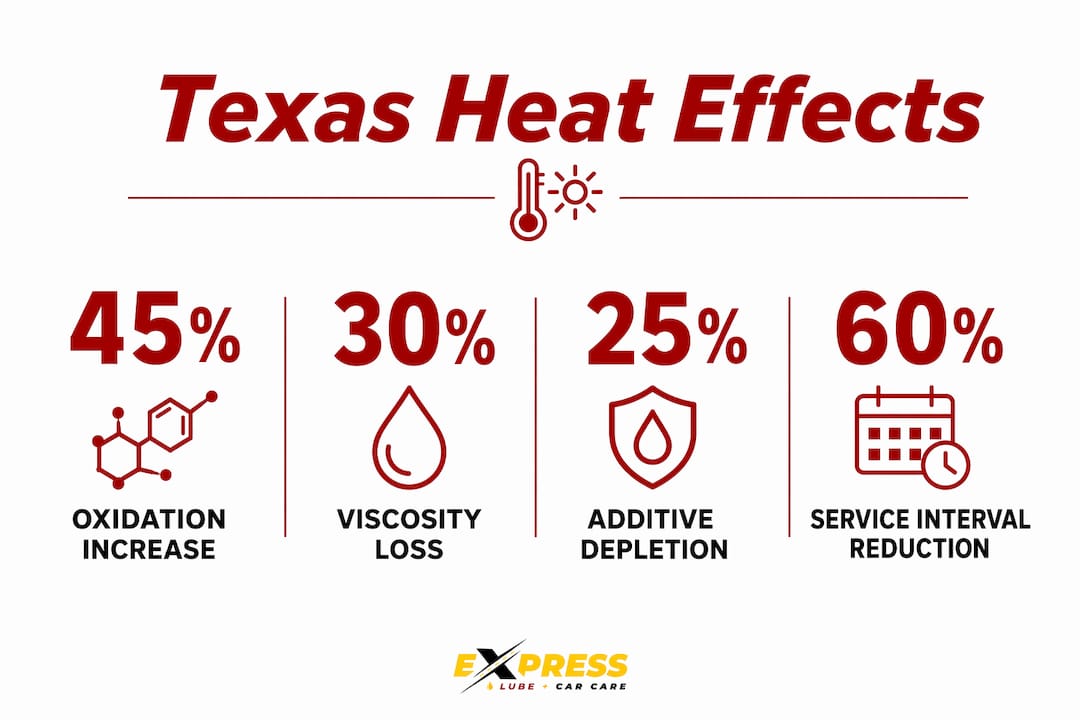
What Texas heat actually does to your oil at a chemical level
Heat doesn’t just thin oil. It triggers a chain of chemical reactions that permanently degrade it. Here’s what’s happening inside your engine on a 105°F Texas afternoon:
- Thermal thinning: As oil temperature rises, viscosity drops. Thinner oil forms a weaker film between metal surfaces, increasing metal-to-metal contact and accelerating wear on bearings, camshafts, and cylinder walls.
- Oxidation: Oxygen and heat break down oil molecules, producing oxidized and polymerized compounds that thicken the oil over time and form sludge or varnish on engine surfaces. Research confirms that total polar compounds rise nonlinearly with both temperature and time.
- Additive depletion: Anti-oxidants and detergents are consumed fighting the heat. Once they’re gone, oxidation accelerates and deposits begin forming in oil passages and on piston rings.
- Sludge and varnish buildup: Polymerized oil residue coats internal surfaces, restricts oil flow, and can clog the oil pickup screen, starving the engine of lubrication.
- Seal and gasket damage: Sustained heat dries out rubber seals, hoses, and gaskets, causing them to harden and crack. A dried valve-cover gasket becomes an oil leak waiting to happen.
Higher temperatures drive markedly more oxidation products than moderate ones, and the relationship isn’t linear. Even moderate increases in oil temperature can significantly accelerate the rate of oxidative degradation, which is why Texas summers are so punishing compared to milder climates.
Certain driving patterns make all of this worse. Stop-and-go city traffic keeps the engine idling without enough airflow to cool the oil, and towing or hauling heavy loads raises combustion temperatures. Short trips that never fully warm the engine allow moisture and fuel to contaminate the oil without burning off. Any of these patterns, common for Texas commuters and delivery drivers, push your oil toward the “severe service” category faster than highway miles alone would.
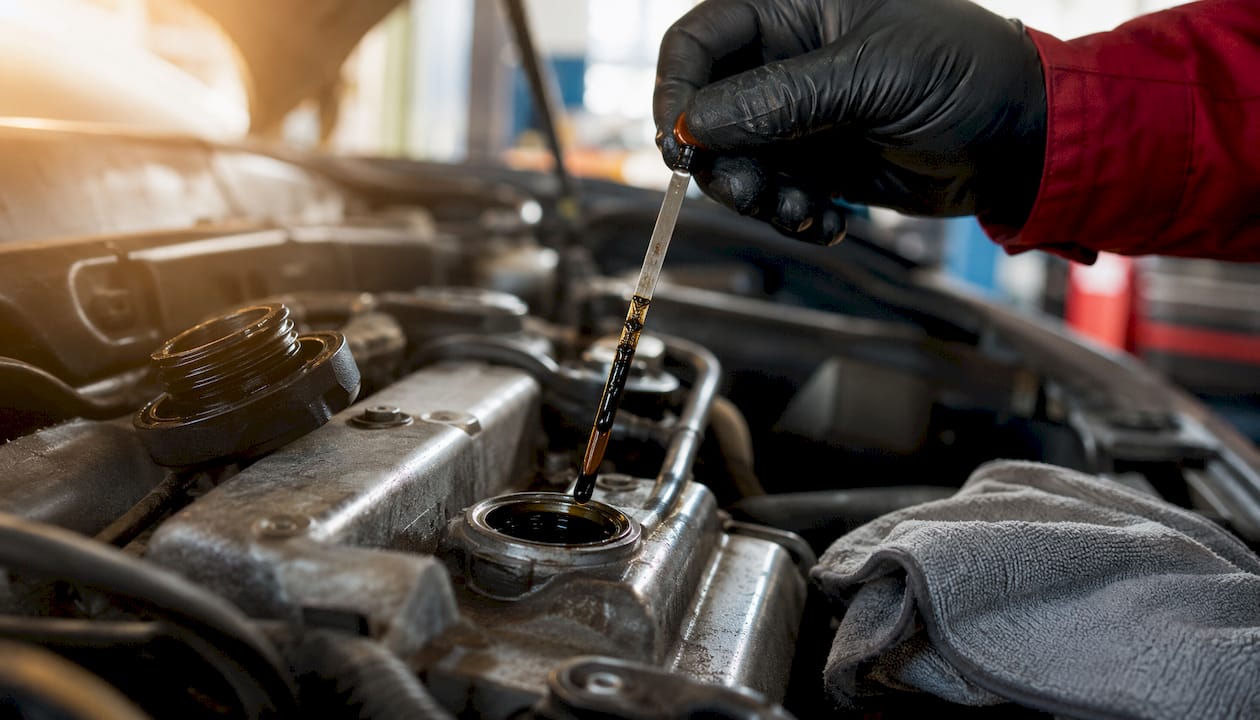
Pro Tip: If you regularly tow, haul, or sit in Dallas-Fort Worth traffic for more than 30 minutes a day, your driving likely qualifies as severe service under most manufacturer definitions, regardless of mileage.
Warning signs your oil is struggling in the heat
Catching a heat-related oil problem early is the difference between a $60 oil change and a $3,000 engine repair. These are the signals worth knowing:
- Burning smell from the engine bay: Hot oil leaking onto exhaust components has a sharp, acrid smell. Don’t ignore it.
- Blue or gray exhaust smoke: Oil burning in the combustion chamber produces bluish smoke, often a sign of worn seals or rings worsened by heat.
- Ticking or knocking noises: Low oil pressure means metal parts aren’t getting adequate lubrication. A ticking lifter or knocking rod bearing is a serious warning.
- Oil-pressure warning light: If this comes on while driving, pull over safely as soon as possible. Continuing to drive with low oil pressure can destroy an engine in minutes.
- Engine temperature gauge climbing: Overheating and oil degradation often go hand in hand. If the temp gauge is creeping up, your oil may already be compromised.
Dipstick checks are your best at-home diagnostic tool. Pull the dipstick when the engine is cool, wipe it clean, reinsert fully, and pull again. Healthy oil is amber to light brown and slightly translucent. Dark brown or black oil that smells burnt has oxidized. Milky or foamy oil suggests coolant contamination. Gritty texture means metal particles are present. Any of those last three conditions means you need a shop visit before your next long drive. For a full list of overdue oil change symptoms, it’s worth a quick read before summer hits.
If the oil-pressure light comes on AND you hear knocking, don’t drive it. Have it towed.
Choosing the right oil for Texas summers
Not all oils handle heat the same way, and the difference matters more here than in most states.
Conventional oil is refined from crude and contains a basic additive package. It works fine in moderate climates with regular changes, but its thermal stability is lower than synthetic options. In sustained Texas heat, conventional oil oxidizes faster and depletes additives sooner.
Synthetic blend oil mixes conventional base stock with synthetic molecules, offering better heat resistance and oxidation stability than straight conventional at a moderate price increase. A reasonable middle ground for drivers who don’t tow or idle heavily.
Full synthetic oil is engineered at the molecular level for consistent viscosity across a wide temperature range. It resists oxidation longer, maintains film strength at higher temperatures, and keeps additives working further into the oil’s service life. For Texas summer driving, full synthetic is the strongest choice, particularly for high-mileage vehicles, trucks that tow, or anyone logging heavy stop-and-go miles.
- Follow your owner’s manual first. If it specifies 5W-20, don’t switch to 10W-30 without consulting a technician. Using the wrong grade can void warranty coverage and cause its own problems.
- Consider a higher hot-viscosity grade (e.g., 5W-30 instead of 5W-20) only when your manufacturer allows it and your driving conditions are severe. An ASE-certified tech can help you make that call.
- API and ILSAC labels on the bottle confirm the oil meets your manufacturer’s minimum spec. Look for the API donut and the starburst symbol.
Pro Tip: Full synthetic is especially worth it for delivery drivers, rideshare drivers, and anyone towing in Texas heat. The longer additive life and better thermal stability can extend your service interval safely, which offsets the higher per-quart cost.
How to adjust your oil-change schedule for extreme heat
Texas heat pushes most vehicles into the “severe service” category, a designation most manufacturers define in the owner’s manual that calls for shorter oil-change intervals. Severe service typically includes: frequent short trips under 5 miles, sustained stop-and-go driving, towing or hauling, extended idling, and operating in extreme temperatures.
| Driving Profile | Standard Interval | Severe-Service Interval |
|---|---|---|
| Highway, light load, mild climate | 7,500 mi (full synthetic) | N/A |
| City driving, Texas summer heat | 7,500 mi | 3,000–5,000 mi |
| Towing, hauling, or heavy loads | 5,000–7,500 mi | 3,000–5,000 mi |
| Delivery / rideshare, stop-and-go | 5,000 mi | 3,000–5,000 mi |
These ranges are illustrative. Your owner’s manual is the authoritative baseline, and an ASE-certified technician can help you decide where your specific vehicle and driving pattern fall. The cost of an extra oil change per year, typically $50–$100 for a synthetic service, is a fraction of what a sludge-related engine repair runs. Oil change intervals matter more in Texas than most drivers realize.
Regular dipstick checks between services are the simplest way to catch degrading oil before it causes damage. If the oil looks dark and smells burnt well before your next scheduled change, don’t wait.
Practical steps you can take right now to protect your engine
You don’t need a shop visit to start protecting your oil today. Here’s a straightforward routine that makes a real difference through a Texas summer:
- Check your oil level weekly during heat waves. Low oil means less film coverage and faster temperature spikes. Takes 90 seconds.
- Check coolant level at the same time. Your cooling system and oil work together to manage engine temperature. A low coolant level stresses both. Cooling system health directly affects how hard your oil has to work.
- Park in shade whenever possible. A car sitting in direct Texas sun can reach interior temperatures well above 130°F. That pre-heats everything, including the oil, before you even start the engine.
- Avoid heavy loads and towing during peak heat hours (typically 2–6 PM in Texas summers). If you must tow, do it in the morning.
- Schedule a pre-summer service before June if you haven’t already. A summer car care check covers oil, coolant, belts, and hoses in one visit.
- Request a digital vehicle inspection when you bring your car in. Photos of your oil condition, filter, and engine bay give you a documented baseline to compare against at your next visit.
- Keep a quart of your manufacturer-specified oil in the trunk if you drive long distances or delivery routes. Running even a quart low in Texas heat accelerates wear significantly.
Pro Tip: Delivery and rideshare drivers should carry both the quart of oil and a copy of their owner’s manual oil spec. If you need to top off on the road, you’ll know exactly what grade to buy without guessing.
When to bring your car to Express Lube & Car Care
Some situations call for a professional set of eyes, not just a dipstick check. Bring your vehicle in when you notice any of the following:
| Symptom | What It May Indicate |
|---|---|
| Oil-pressure light on while driving | Critically low oil pressure; stop driving immediately |
| Persistent overheating | Cooling system failure or oil no longer managing heat |
| Oil that looks milky or foamy on dipstick | Coolant contamination, possible head gasket issue |
| Rapidly dropping oil level between checks | Active oil leak or oil burning in combustion |
| Burning smell with no visible leak | Oil on hot exhaust components; seal or gasket failure |
| Ticking or knocking at startup | Low oil pressure or worn bearings |
At Express Lube & Car Care, an ASE-certified technician will check your oil condition and level, inspect the oil filter, review your owner’s manual spec, and run a digital vehicle inspection with photos documenting every finding. That inspection report travels with your vehicle’s service history and supports the shop’s 24-month/24,000-mile warranty on covered repairs. You’ll leave knowing exactly what was found, what was done, and what to watch for next.
Walk-ins are welcome, or you can schedule ahead if you prefer. Either way, you won’t be guessing about your engine’s condition when the next heat wave rolls through.
Key Takeaways
Texas heat degrades engine oil through oxidation, thermal thinning, and additive depletion, making shorter service intervals and full synthetic oil the most practical defenses for most Texas drivers.
| Point | Details |
|---|---|
| Heat accelerates oil breakdown | Oxidation and thinning begin at sustained operating temperatures, worsening with stop-and-go driving and heavy loads. |
| Severe-service intervals often apply to Texas drivers due to heat and driving conditions | Shorten oil changes for city driving and towing or delivery routes according to severe service guidelines in the owner’s manual. |
| Full synthetic resists heat best | Synthetic oil generally maintains viscosity and additive life longer than conventional oils in sustained high-heat conditions. |
| Watch for five key warning signs | Burning smell, blue exhaust, ticking noises, oil-pressure light, and rising temp gauge all signal oil trouble. |
| Express Lube & Car Care offers documented inspections | ASE-certified technicians provide digital inspections with photos and a 24-month/24,000-mile warranty on covered work. |
A mechanic’s honest take on Texas heat and engine oil
Every summer, we see the same pattern at the shop: drivers come in after the first real heat wave with oil that looks like dark syrup and smells like it’s been cooking for months. Sometimes the oil-pressure light has been on for a week. Sometimes the engine is already ticking. The frustrating part is that most of those situations were preventable with a $60 oil change and a five-minute dipstick check.
What people underestimate is how quickly Texas heat compounds the problem. It’s not just the temperature on the thermometer. It’s the combination of 105°F ambient heat, stop-and-go traffic that keeps the engine working without airflow, and oil that was already three months past due. Each factor multiplies the others. By the time a warning light comes on, the oil has often been degraded for weeks.
The most practical habit we can recommend: check your oil every time you fill up with gas during summer. It takes less time than cleaning your windshield. If it’s dark, low, or smells off, don’t wait for your scheduled interval. Synthetic oil and a shorter service window cost far less than the alternative.
Express Lube & Car Care is ready for your next Texas summer service
Texas drivers deal with conditions that push engines harder than most manufacturer schedules account for. Express Lube & Car Care offers oil changes with full synthetic options, digital vehicle inspections with photos, cooling-system checks, and warranty-backed repairs, all performed by ASE-certified technicians in Richland Hills.
No appointment needed for most services, though you’re welcome to schedule ahead. The shop’s oil change specials include synthetic upgrade options, and every qualifying repair is backed by the 24-month/24,000-mile warranty. If a heat-related inspection turns up something bigger, financing options are available so you’re not caught off guard by an unexpected repair bill. Stop in before the next heat wave, or book online today.
Useful sources
| Source | What It Covers |
|---|---|
| AAA Texas: Heat Wave Prep | Seasonal breakdown risk and pre-summer service recommendations |
| Fort Worth Star-Telegram: Texas Heat and Oil | Local reporting on oil thinning and multi-viscosity oil guidance |
| Express Lube: Summer Car Care Guide | Pre-summer fluid, belt, hose, and oil-change checklist |
| Express Lube: Overdue Oil Change Symptoms | Warning signs specific to hot-weather driving |
| Express Lube: Digital Vehicle Inspections | How photo-documented inspections support service and warranty |
| PMC: Oxidation and Polymerization of Triacylglycerols | Scientific basis for oxidation and sludge formation under heat |
| Your vehicle’s owner’s manual | Manufacturer-specified oil grade, API/ILSAC requirements, and service intervals |
FAQ
Can hot weather really affect engine oil performance?
Yes. Texas heat causes oil to thin at operating temperature, reducing its film strength and leaving engine parts more vulnerable to wear. Sustained high ambient temperatures also accelerate oxidation, depleting the additive package faster than in milder climates.
At what temperature does engine oil start to degrade?
Engine oil begins oxidizing meaningfully above roughly 200°F, which is within normal operating range for many engines. In Texas summer conditions with stop-and-go driving or towing, oil temperatures can climb well above that, speeding up chemical degradation significantly.
Is 230°F too hot for engine oil?
High operating temperatures at or above normal ranges accelerate oxidation and additive depletion, especially in conventional oil. Full synthetic handles heat better and maintains its protective properties longer.
How often should I change my oil during a Texas summer?
Most Texas drivers qualify for severe-service intervals. If you’re using full synthetic and driving mostly highway miles, 3,000–5,000 miles is a reasonable target. Stop-and-go city driving, towing, or delivery routes should also follow 3,000–5,000 mile intervals. Always confirm with your owner’s manual and an ASE-certified technician at Express Lube & Car Care.
What are the first signs my oil is failing in the heat?
A burning smell from the engine bay, dark or gritty oil on the dipstick, a ticking noise at startup, or the oil-pressure warning light are the most common early signals. Catching any of these early, as outlined in the warning signs guide, can prevent a minor oil issue from becoming a major engine repair.