

Flickering headlights almost always point to an electrical supply problem: a weak battery, a charging system that isn’t keeping up, a loose or corroded connection, or a fault in the headlight circuit itself. If both lights pulse together, start by suspecting the battery, the alternator or a bad ground. If only one light flickers, the bulb, its connector or its own wiring is the more likely culprit. Either way, the flicker is your car telling you something, and it’s worth testing before it turns into a dead battery on the side of Loop 820.
TL;DR
- Both headlights flickering or dimming together usually means a battery, alternator, belt or ground-connection problem. One light flickering usually means a bulb, connector or wiring issue.
- Lights that dim at idle and brighten when you rev the engine are a classic sign of undercharging.
- You can safely look for loose battery clamps and white or blue crusty corrosion with the engine off. Don’t guess beyond that.
- Get the car tested soon if the flicker comes with a battery light, slow cranking, stumbling or dashboard glitches. Stop driving if power fails.
- A proper battery, starter and alternator test costs far less than replacing parts by guesswork. We can run it at our Richland Hills shop, walk-ins welcome.
Table of Contents
- What makes headlights flicker?
- Why do headlights flicker while driving?
- Why do headlights flicker at idle?
- Why is only one headlight flickering?
- What can you safely check yourself?
- When is flickering unsafe?
- How do you get headlights to stop flickering?
- Electrical trouble rarely travels alone
- Keeping the electrical system healthy
- Perspective: why we test before we replace
- Get your headlights and charging system checked in Richland Hills
- FAQ
- Sources
What makes headlights flicker?
Headlights are one of the biggest steady electrical loads on your car, so they are often the first place a power problem shows. Think of the electrical system as a three-part team: the battery stores power, the alternator makes power while the engine runs, and the cables, grounds and fuses carry it where it needs to go. When any one of them falters, the lights are what you notice.
How the problem starts tells you something. Based on diagnostic guidance for flickering headlights, a gradual worsening can trace to corrosion or lost battery capacity, while a sudden onset can point to a connector, bulb, ballast or low battery. That’s a useful clue to bring to a technician: “it crept up over weeks” and “it started yesterday” send the diagnosis in different directions.
Here’s how the common causes line up with what you see.
| What you notice | Most likely area | Why it happens |
|---|---|---|
| Both lights dim at idle, brighten when you rev | Alternator, belt or alternator wiring | The charging system isn’t keeping up at low engine speed |
| Flicker plus slow cranking or a clicking start | Battery or battery terminals | Low capacity or a poor connection at the clamps |
| Flicker when you hit bumps | Loose connector, ground or battery clamp | The connection breaks and remakes as the car moves |
| One headlight flickers, the other is steady | Bulb, socket, connector or that side’s wiring | The fault is on one branch of the circuit |
| Flicker when you switch on the A/C, fan or wipers | Weak charging or a marginal ground | Extra load exposes a system that’s already near its limit |
| Flicker with new aftermarket LED or HID bulbs | Bulb or ballast compatibility | The new lights react differently to the car’s power control |
Why do headlights flicker while driving?
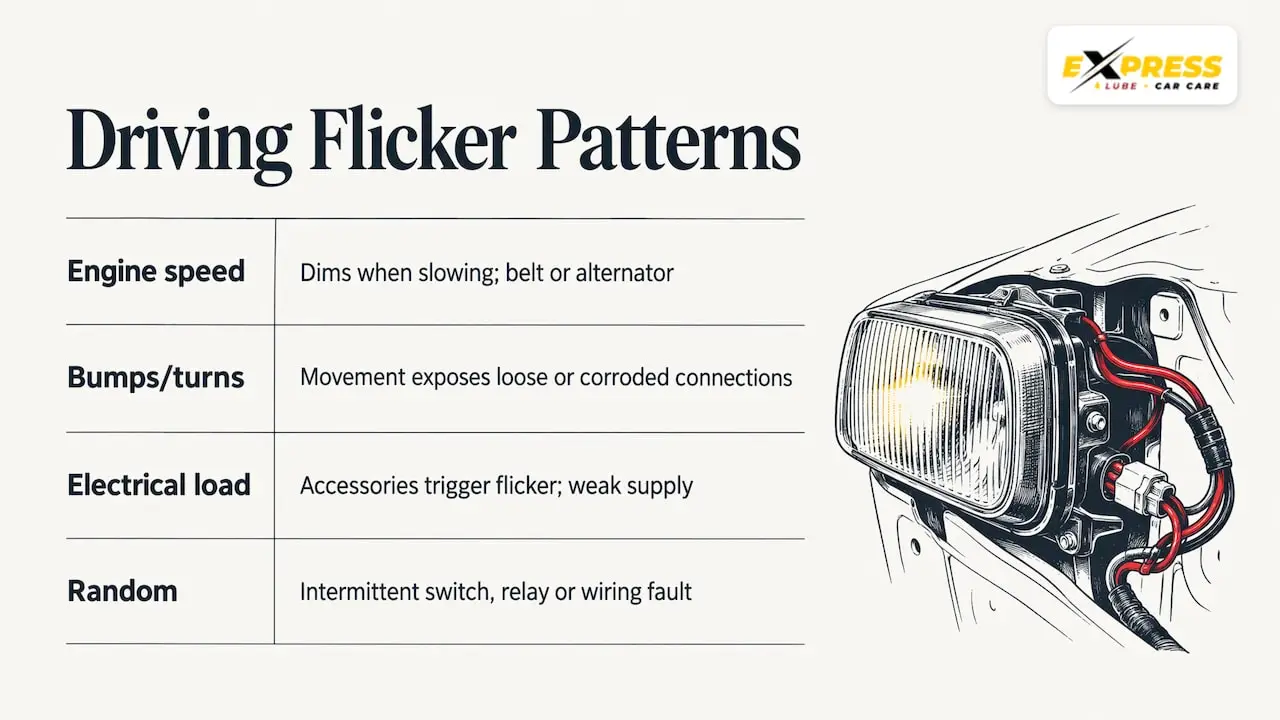
When the flicker shows up on the road, it usually follows engine speed or electrical load. That’s useful, because it narrows things down.
Flicker that follows engine speed. If the lights dim as you slow down and recover as you accelerate, the alternator may not be producing enough at lower RPM. A slipping drive belt, a worn tensioner or a failing alternator can all do this.
Flicker that follows bumps and turns. A connection that’s loose or corroded can open and close as the car moves. Battery clamps, ground straps where the engine or body connects to the frame, and the headlight connector itself are the usual suspects.
Flicker that follows load. If the lights pulse when the blower motor, rear defroster or seat heaters kick in, the system is struggling to supply the extra demand. In stop-and-go traffic on Rufe Snow Drive or Grapevine Highway, with the A/C running and little engine speed, you’ll see it sooner.
Flicker that comes and goes at random. This is the hardest kind. It can be a switch, a relay or a wiring fault that only misbehaves sometimes. That’s where a shop’s scan tool, voltage testing and a patient wiring check earn their keep, because guessing means replacing parts that aren’t broken.
Why do headlights flicker at idle?
At idle the engine turns the alternator slowly, so it has the least to give. A healthy charging system still holds steady voltage here. A weak one doesn’t, and the headlights pulse or dim until you press the gas.
According to a charging-system troubleshooting guide from a repair-manual publisher, undercharging can make lights dim at idle and brighten with revs, and the causes include a slipping belt, bad alternator connections, internal winding shorts or failed diodes. Fleet lighting specialists describe the same pattern, and there are practical LED dimming checks on fleets that apply to any vehicle with a weak supply.
A few things make idle flicker more noticeable:
- Low battery reserve. A tired battery can’t cushion the dips, so the lights follow every change in alternator output.
- High accessory load. A/C, rear defrost, a phone charger, a dash camera and a stereo amp all draw from the same supply.
- A glazed or loose belt. You may hear a squeal on startup or when the A/C cycles.
- Corroded connections. Resistance at a terminal wastes voltage before it ever reaches the lights.
If you drive for Uber, Lyft or delivery work, you spend a lot of time at idle with the A/C on and the phone charging. That is exactly the situation that exposes a marginal charging system, so treat idle flicker as a prompt to get tested before it costs you a shift.
Why is only one headlight flickering?
When both headlights share a problem, the cause is usually upstream: battery, alternator, a main ground or a shared switch or relay. When only one flickers while the other stays steady, the fault is on that side’s branch. Look at these in order:
- The bulb. A worn filament or a failing LED or HID can flicker, then fail altogether.
- The socket and connector. Heat, vibration and moisture can loosen pins or corrode the contacts. A flicker when you tap the headlight housing or hit a bump points here.
- That side’s ground. Each side has its own return path, and a rusty ground point can make one light pulse.
- A ballast or control module on HID and some LED setups.
- Wiring damage where a harness rubs or has been exposed to water.
What to avoid: don’t pull the connector repeatedly or poke at it with the lights on. If you want to check, turn everything off first. A shop can swap a known-good bulb and test voltage right at the connector, which settles it quickly.
What can you safely check yourself?
A few simple looks can save you time, and none of them need tools beyond a flashlight. Do them with the engine off and the key out, parked on level ground.
- Look at the battery terminals and clamps. A fundamental first step is a visual check of terminals and ground points for white or blue powdery corrosion or loose clamps. If you see crusty buildup, our guide on preventing car battery corrosion explains what causes it and how to keep it from returning.
- Check that the clamps don’t wiggle. Don’t force anything. If a clamp moves by hand, tell a technician.
- Look at the drive belt. Cracks, shiny glazing or fraying are worth mentioning. A squeal at startup is a clue too.
- Notice the pattern. Write down whether it happens at idle, over bumps, with the A/C on, or only at night. That note is worth more than you’d think.
- Watch the dash. A battery light, a dim dash or a power steering warning alongside the flicker points to charging.
What we’d skip: swapping bulbs, relays or the battery on a hunch. Parts that look like the answer are often the symptom, not the cause. A new battery on a car with a failing alternator will be drained again soon. Our posts on signs of a failing alternator and signs of a bad car battery help you tell the two apart before you visit.
When is flickering unsafe?
A brief, mild flicker is a reason to schedule a test. Some situations are more serious. Based on guidance on dimming headlights, flickering becomes unsafe when the headlights go very dim or pulse heavily, and you should stop and get help if the battery light comes on, electrical power is lost, or the engine stumbles and threatens to stall.
Put plainly:
- Pull over safely and call for help if the lights go very dim, the dash goes dark, the power steering feels heavy, or the engine starts to stall. A car that loses electrical power can lose lighting and power assist in traffic.
- Don’t drive at night on a flickering system if you can avoid it. You depend on those lights to see and be seen.
- Book a diagnosis promptly if the flicker is paired with a battery warning light. We cover that scenario in what to do when the battery light is on.
If the car won’t start after sitting, a related problem may be a parasitic drain. See what causes a battery to drain overnight.
How do you get headlights to stop flickering?
The fix depends on the cause, which is why the order of diagnosis matters more than the parts list.
Start with testing, not replacing
A technician measures battery condition, then checks charging voltage at idle and with the engine raised above idle, with and without a load. They also check voltage drop across the main cables and grounds, which can expose a connection that looks fine but isn’t. That sequence separates a battery problem from an alternator problem from a wiring problem.
Typical repairs once the cause is known
- Cleaning and tightening battery terminals and ground connections.
- Replacing a weak battery that fails a load test.
- Replacing a drive belt or tensioner that’s slipping.
- Repairing or replacing an alternator with a failed internal component.
- Replacing a headlight bulb, socket or connector on one side.
- Replacing a relay, switch or ballast that fails under testing.
- Repairing damaged wiring where a harness has chafed or corroded.
We don’t quote timelines or repair costs for a flicker in general, because a loose clamp and a failed alternator are very different jobs. What we can tell you is that you’ll see the finding before you approve the work. Our digital vehicle inspections include photos, so you can see the corroded clamp or the cracked belt yourself.
What about aftermarket LED or HID bulbs?
If the flicker began after you installed new bulbs, compatibility is a prime suspect. Some vehicles monitor the headlight circuit and react to a different electrical load than the factory bulb. Adapters or compatible bulbs may be needed, and a loose or poorly routed driver can cause flicker on its own. Mention the upgrade when you come in. It saves us from chasing the charging system when the answer is the bulbs.
Electrical trouble rarely travels alone
Headlight flicker is often the first visible sign of something wider. If your vehicle is also showing other symptoms, they may share a root cause.
- A check engine light can appear when low voltage upsets sensors and modules. A scan helps separate the two. Our engine light service article explains what a scan tells you, and our check engine light diagnostics page describes how we approach it.
- Starting trouble points to the battery, starter or alternator, all of which we service.
- A squealing belt may also affect the cooling pump and power steering on some engines, so a belt check can matter beyond the lights.
- European vehicles often have more complex electrical networks with control modules. If you drive a Mercedes, our Mercedes diagnostic guide explains how warning lights relate to testing.
Because diagnosis comes before repair at our shop, you only hear a recommendation after we’ve measured something. That applies to the electrical system and to everything else we service, from brakes and steering to cooling, fuel injection and exhaust.
Keeping the electrical system healthy
Preventive care costs less than a roadside breakdown, and it doesn’t have to follow a universal mileage rule. The right schedule comes from your owner’s manual and from how you actually drive.
- Follow the manufacturer’s maintenance schedule for belts, hoses and fluids, then adjust for your conditions. Short trips, heavy stop-and-go, towing and long idling in summer heat all load the battery and charging system harder than steady highway driving.
- Have the battery tested when the vehicle gets older or when starting feels slower. Our battery, alternator and starter service covers testing and replacement.
- Keep terminals clean and tight. Corrosion adds resistance quietly.
- Look at the belt during oil changes. It’s an easy visual check while the hood is up.
- Add accessories thoughtfully. Extra lighting, amplifiers and chargers add load. Have them installed properly with correct fusing.
- Take care of the basics around it: oil and filter changes, fluid exchanges, tire condition and pressure, and seasonal checks before summer heat and winter cold.
A preventive inspection is a good time to ask us to look over the battery, belt and lights at the same time, so small items get caught before they turn into a flicker.
Perspective: why we test before we replace
Flickering headlights are one of the most misdiagnosed complaints that come through our door. Drivers arrive having replaced a bulb, then a battery, and the lights still pulse because the real issue was a slipping belt or a rusty ground.
We approach it as a measurement problem. Our ASE-certified technicians test the battery, check charging output, and look at the connections, and we document what we find with photos in a digital inspection. That way you decide with the evidence in front of you, not on a hunch.
We also think a shop should be a full repair center, not only a quick oil change stop. A flicker may start in the electrical system, but it can lead to the engine, the cooling system or the fuel system. Having technicians who handle all of that under one roof means one diagnosis, not a run-around.
Qualifying repairs we perform carry our 24-month/24,000-mile warranty, so the work you approve is backed.
Express Lube & Car Care
Get your headlights and charging system checked in Richland Hills
If your headlights flicker, bring the car in and we’ll find out why. We serve drivers across Richland Hills, North Richland Hills, Hurst, Bedford and the rest of Northeast Tarrant County, with no-appointment walk-ins or scheduled visits. Our technicians test the battery, charging system and connections, then explain what they find before any repair.

We can also help with the rest of your vehicle, from brakes and suspension to cooling and engine repair, and you can see the full list on our services page. If a repair is bigger than expected, eligible customers may be able to explore financing through third-party providers such as Koalafi, Snap Finance, American First Finance and Synchrony, subject to provider approval and terms. Details are on our easy financing page.
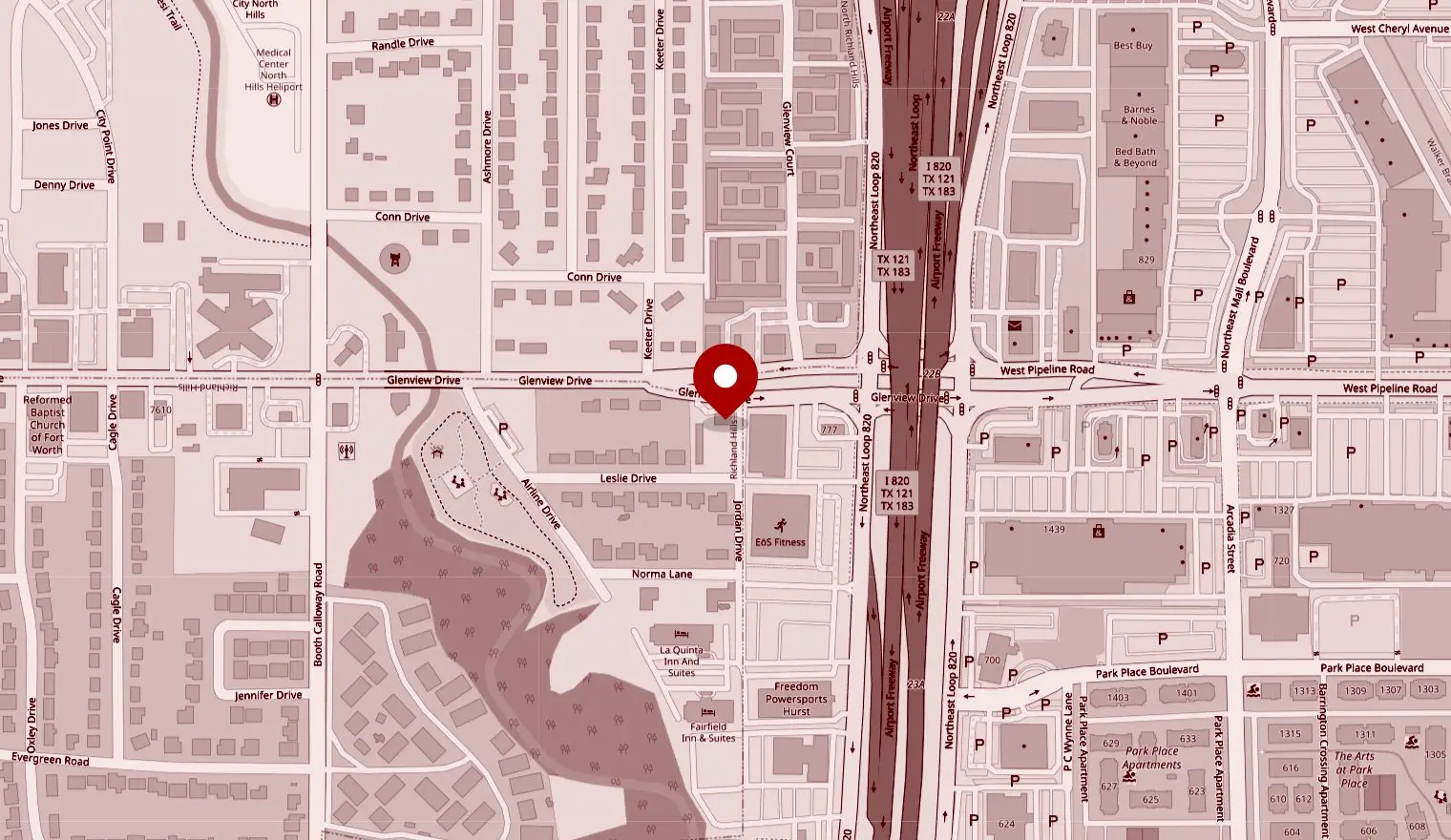
Visit us at 7932 Glenview Drive, Richland Hills, TX 76180, call (817) 284-8478, or contact us here to request service.
FAQ
Does a bad alternator cause headlights to flicker?
Yes, it can. An alternator that isn’t producing steady output makes the lights dim and brighten, often most visibly at idle. A slipping belt or a poor connection at the alternator can cause the same thing, so testing the whole charging circuit is the reliable way to know.
Can a bad battery make headlights flicker?
It can. A battery with reduced capacity can’t smooth out the dips in electrical supply, and loose or corroded terminals can interrupt the connection. Slow cranking, a battery warning light or visible corrosion alongside the flicker all point toward the battery side.
Is it safe to drive with flickering headlights?
A brief, mild flicker is a reason to get tested soon, but it isn’t one to ignore. If the lights go very dim, the battery light appears, or the engine stumbles, pull over safely and get help. Avoid night driving until the cause is found.
Why do my headlights flicker only at idle?
At idle the alternator spins slowly, so a weak charging system or tired battery shows up first. The lights usually brighten when you press the gas. Heavy loads such as A/C and defrost make it more obvious, and a belt or connection check is a good starting point.
Do I need an appointment to have it checked?
No. We accept walk-ins, and you can also schedule a visit through our contact page if you prefer a set time. Same-day service is available when possible.
Sources
- Headlights Dimming While Driving: Causes and Fixes, CarReformer
- Troubleshooting: Common Charging System Issues and Causes, Haynes