

You’re driving home, traffic is moving fine, and then a light comes on in the cluster. Maybe it’s the check engine light. Maybe it’s ABS, battery, or an airbag warning. The car still runs, but your confidence drops fast.
That reaction is normal, especially in a Mercedes. These cars monitor a lot, and they don’t throw warnings just to be dramatic. A warning light is the vehicle telling you something changed, something stopped reporting correctly, or something needs to be checked before a small issue becomes a larger one.
A proper mercedes benz diagnostic isn’t just about plugging in a scanner and reading a code. It’s about figuring out why that code appeared, whether the fault is current or stored history, and which system is responsible. For owners, that difference matters because it’s what separates a real fix from repeated parts replacement and the same light coming back a week later.
That Unsettling Light on Your Mercedes Dashboard
You head out for a normal drive, the car feels fine, and then a warning light shows up in the cluster. The Mercedes still starts, still moves, and still sounds mostly normal. What changes is your confidence. Every shift, idle fluctuation, or small vibration suddenly feels like a bigger problem.
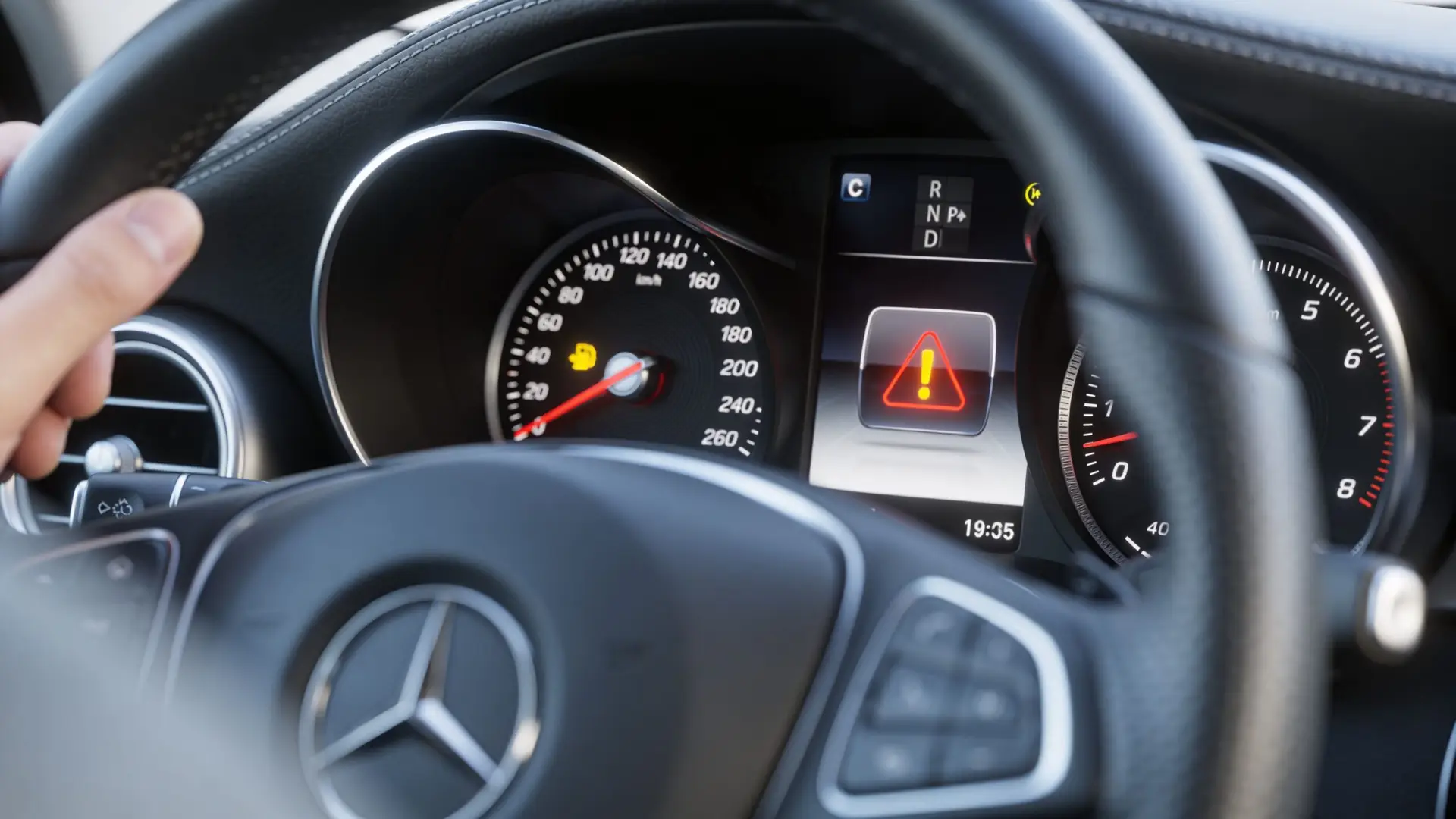
The first reaction is usually simple. Check the fuel cap. Shut the car off and restart it. See whether the light was a one-time event. A common reaction after that is to stop at a parts store for a quick code read, hear a part name, and assume the repair is straightforward.
On a Mercedes, that shortcut often leads to wasted money.
These cars use layered electronic systems, so one fault can trigger warnings in places that look unrelated. A check engine light may trace back to a failed sensor, but it can also come from low system voltage, damaged wiring, poor module communication, or a signal that does not make sense compared with what other modules are seeing. The code points you toward a circuit or condition. It does not automatically identify the failed part.
Why the light matters even if the car still drives
Mercedes builds vehicles to watch themselves closely. That is good for safety and drivability, but it also means the car will flag a problem before it turns into a breakdown in many cases. I tell owners to treat a warning light like a smoke alarm. It does not tell you exactly which wire overheated, but it does tell you something needs attention.
A dashboard light is a starting point, not a diagnosis.
That distinction matters if you are trying to avoid dealer-level cost and delay without guessing at repairs. The practical goal is to find out three things quickly. Which system reported the fault, whether the problem is active right now, and whether the car is safe to keep driving until service. Good diagnostic work answers those questions before anyone recommends parts.
That approach saves time, cuts down on repeat visits, and gives you a clear reason for the repair instead of a vague printout and a shrug.
Understanding Your Car’s Nervous System
Mercedes diagnostics make more sense when you stop thinking of the car as one machine and start thinking of it as a connected system. The easiest analogy is the human body. The vehicle has a brain, nerves, and muscles. If one part sends bad information, another part may react even though it isn’t the actual problem.
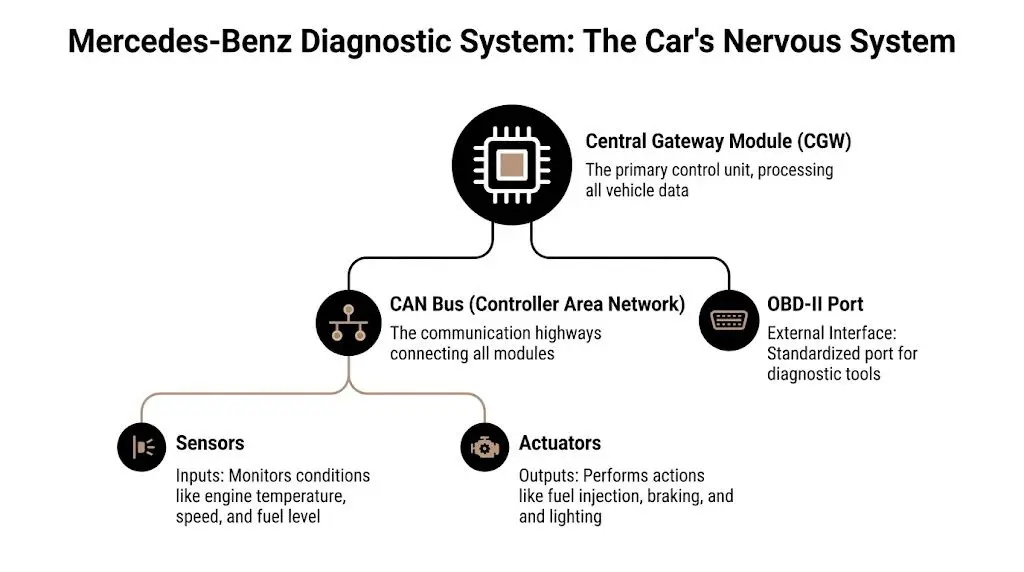
The brain, nerves, and muscles
The control modules act like brains. The engine control unit watches fuel delivery, ignition, airflow, and emissions inputs. Other modules handle transmission operation, braking, stability control, airbags, locking systems, and body electronics.
The sensors are the nerves. They report temperature, wheel speed, throttle position, oxygen readings, steering angle, voltage, and much more. The actuators are the muscles. They carry out commands, whether that means adjusting fuel injection, activating a pump, applying brake logic, or switching on a cooling fan.
When the system is healthy, those parts communicate constantly and fast. The car starts cleanly, shifts properly, brakes smoothly, and keeps warning lights off because each module is receiving believable information.
Where CAN bus fits in
Mercedes-Benz incorporated CAN wiring starting in 1992, using a two-wire diagnostic communication system that changed how modern vehicles share information internally, as described in this Mercedes CAN diagnostics breakdown. In plain language, CAN bus is the communication highway that lets multiple control modules talk at the same time.
That sophistication is part of why a Mercedes feels so coordinated on the road. But there’s a trade-off. The network is digitally sensitive, so even a small interruption can create false signals or fault codes. A weak connection, wiring issue, or unstable communication path can make one module look bad when the actual problem is upstream.
Practical rule: A stored code tells you where the complaint showed up. It does not automatically tell you which part failed.
Why cheap scanners hit a wall
A basic code reader can often pull a generic fault from the engine computer through the OBD-II port. That’s useful, but limited. It may not reach every module, and it usually won’t guide the technician through follow-up testing.
Mercedes-specific tools go further. They can identify the vehicle’s exact build information, access control modules beyond the powertrain, and run functional tests that show whether a sensor is reporting correctly or an actuator is responding.
That difference matters because many faults aren’t obvious from the code alone. A warning for ABS, traction control, or charging issues may require looking at live values, communication status, and system relationships, not just reading one stored message.
What owners should take from this
If your Mercedes shows one warning light and then another, don’t assume the car is falling apart. Often, one fault is creating side effects.
Think of diagnostics like tracing a symptom through the nervous system:
- The light is the symptom. It tells you where the car noticed trouble.
- The code is the clue. It points toward a circuit, module, or operating condition.
- The testing finds the cause. That’s the step that separates accurate repair from guesswork.
Once you understand that, the process feels much less mysterious.
Decoding the Most Common Mercedes Warning Lights
Not every warning light means “stop now,” but every warning light means “pay attention.” The key is knowing which system is involved and how much risk comes with waiting.
What the common lights usually point to
The check engine light is tied to emissions and engine monitoring. It can come on for something minor, but it can also reflect misfires, sensor faults, or communication problems affecting engine control. It’s one of the most misunderstood warnings because the light itself doesn’t tell you whether the issue is simple or layered.
ABS or ESP warnings point to braking or stability control concerns. These systems depend on accurate inputs, especially speed-related and movement-related data. When the car loses trust in those inputs, it may disable part of the safety system and turn the light on.
An SRS or airbag warning means the restraint system has detected a fault. Even when the vehicle drives normally, that light needs proper diagnosis because it concerns crash protection logic, not drivability.
A battery or charging light may indicate the battery, alternator output, poor connections, or an electrical problem affecting the charging system. On a Mercedes, low or unstable voltage can trigger strange secondary complaints because so many modules depend on clean electrical supply.
Common Mercedes Warning Lights and Next Steps
| Warning Light | Common Causes | DIY Check? | Severity / Action |
|---|---|---|---|
| Check Engine Light | Loose fuel cap, sensor issue, emissions fault, wiring or communication problem | Yes. Check and tighten the fuel cap, note any drivability change | Moderate to high. If it’s steady, schedule diagnosis soon. If drivability is poor, don’t wait |
| ABS / ESP | Wheel speed sensor issue, wiring problem, sensor alignment issue, related module fault | Limited. Check tire condition and obvious damage around wheels | High. Braking remains possible, but safety assist functions may be reduced |
| SRS / Airbag | Seat or restraint circuit fault, module communication issue, post-repair fault requiring reset | No meaningful DIY beyond checking if something under a seat was disturbed | High. Have it professionally scanned |
| Battery / Charging | Weak battery, terminal corrosion, charging issue, unstable system voltage | Yes. Inspect battery terminals for corrosion or looseness | High. If lights dim or starting is weak, address it promptly |
| Brake Warning | Low brake fluid, worn brake components, parking brake issue, electronic brake system fault | Yes. Check brake fluid level if you know how to do it safely | High. If braking feel changes, don’t continue driving |
| Tire Pressure | Low tire pressure, temperature-related pressure change, damaged tire | Yes. Check pressures and inspect tires | Moderate. Correct pressure and recheck warning status |
The hidden problems basic scans miss
One issue that gets overlooked too often is water ingress under the passenger floor mat, which can corrode electrical modules and create recurring warning lights or hard-to-explain electrical behavior. That risk has been noted in Mercedes-Benz diagnostic options coverage for independent shops and owners. A basic scan may show the complaints without revealing the moisture damage behind them.
That’s why recurring lights deserve more respect than they are often given. If a shop clears the warning but doesn’t find the source, the car usually tells on itself again.
For a closer look at how fault codes and warning behavior are interpreted, this guide on how to diagnose a check engine light gives a useful owner-level overview.
Some Mercedes faults are electronic chain reactions. The first visible warning may not be the first failed component.
Simple Checks to Perform Before Calling a Pro
Before you schedule a diagnostic visit, there are a few safe checks worth doing at home. They won’t replace proper testing, but they can rule out simple causes and give you better information when you talk to a technician.

Start with the easy items
First, check the fuel cap. If it was loose after a fill-up, tighten it until it clicks properly. That won’t solve every check engine light, but it’s an easy thing to eliminate.
Next, inspect the battery terminals. Look for corrosion, looseness, or obvious damage. Mercedes vehicles are sensitive to electrical quality, so poor terminal contact can trigger strange warning behavior.
Then do a quick walk-around:
- Tires. Look for one that appears low, uneven wear, or visible damage.
- Brake feel. If the pedal feels different, don’t keep driving just because the car still moves.
- Fluid levels. If you know how to check them safely, verify basics like engine oil and brake fluid.
- Obvious wiring damage. Rodent damage or loose connectors in visible areas can matter.
Pay attention to how the car behaves
The warning light matters. The symptom pattern matters just as much.
Ask yourself a few practical questions:
- Did the light come on right after fuel service or a repair?
- Is the car running rough, shifting strangely, or cranking slowly?
- Did multiple warnings appear at once?
- Has the light come and gone before?
Those details help narrow the path. A steady check engine light with normal driving behavior is different from a warning that shows up with hesitation, poor idle, or reduced power.
A quick explainer can help if you want to see a basic scanner workflow and warning light context before booking service:
Know when to stop
DIY checks are useful up to a point. Stop and call a professional if:
- The check engine light is flashing
- The car is misfiring, shaking, or stalling
- You have an SRS, ABS, or brake warning with a drivability change
- The battery light appears with weak starting or dim electrical behavior
- A warning returns after being cleared
That line matters. Good owners don’t prove anything by pushing a car past a warning. They catch problems before they spread.
What Happens During a Professional Diagnostic Service
A real diagnostic visit should feel organized, not mysterious. The process starts before any scanner gets connected.
The conversation and visual inspection
A technician should first ask what you noticed. Was the light intermittent or constant? Did it appear after rain, a battery replacement, a tire repair, or another service? Did the car lose power, change idle quality, or show multiple warnings?
Then comes the visual side. On Mercedes vehicles, that can reveal a lot. Wiring condition, fluid contamination, weak battery connections, damaged wheel sensor wiring, and signs of moisture intrusion can all shape the rest of the testing path.
Reading codes isn’t the same as diagnosing
The next step is connecting a scan tool and checking for stored, current, and history faults. Many people often think the job is done at this point. It isn’t.
A generic scanner may show only part of the story. The official XENTRY Diagnosis System can do much more. It can identify detailed vehicle build data, access broad system information, and run guided tests. According to this XENTRY diagnostic system overview, it can reduce diagnostic time by up to 30% compared with generic scanners because it goes beyond code reading and helps pinpoint failures in systems like the engine, transmission, and ABS.
That matters because a code such as a wheel speed signal problem might come from the sensor itself, wiring damage, contamination, a connector fault, or a related issue affecting the module’s interpretation. Without guided testing and live data, replacing the sensor can be a guess.
Live data and functional tests
A strong Mercedes diagnostic process usually includes:
- Live data review. The technician compares actual sensor values instead of relying only on stored faults.
- Actuation tests. The tool commands parts or systems to operate so the technician can verify response.
- Module communication checks. This helps identify whether the problem is the component, the circuit, or the network path.
- Verification after repair. The system is rechecked to confirm the warning condition is gone for the right reason.
The code names the complaint. The testing proves the cause.
That’s also why owners sometimes hear two very different estimates from two shops. One shop may be pricing a part from a code description. Another may be pricing diagnostic labor to verify the failure first. The second approach is usually what prevents repeat visits.
Why the tool and technician both matter
Even with strong equipment, experience still matters. Mercedes faults often require pattern recognition. A technician has to know when one warning is a symptom of low system voltage, when a communication code likely points to wiring, and when a module adaptation or system reset is part of the repair.
If you want to understand what qualified Mercedes-specific service should look like, this page on a certified Mercedes mechanic is a useful comparison point. The best shops don’t just read codes. They explain findings in plain language and show why the recommended repair fits the evidence.
Your Trusted Local Alternative to the Dealership
Your Mercedes throws a warning light on Tuesday morning. The dealer’s next opening is a week out, the estimate starts with a diagnostic fee that may or may not lead to the actual fix, and you still need the car for work. That is usually the moment owners start looking for a better option.
A good independent shop fills the gap between dealer pricing and generic service. The goal is not fancy amenities. It is accurate testing, a clear explanation, and a repair plan that fits the car you drive now, not the car it was when it left the showroom.
What local owners actually need
Mercedes systems are more interconnected than many owners realize. One fault can affect several symptoms, and one warning light can point to a power supply issue, a sensor problem, or a communication fault between modules. That is why the right local shop matters. You want someone who can explain what failed, why it failed, and what needs to happen before parts get ordered.
For daily drivers, the practical concerns are usually the same. How soon can someone look at it. Will they confirm the cause before replacing parts. Will they tell you which repairs are urgent and which can wait.
Why independent capability matters
A capable local shop often gives owners what they are paying for:
- Clear answers in plain language
- Mercedes-capable scan tools and testing procedures
- Scheduling that works for commuters and families
- Pricing approval before repair costs start climbing
That combination matters more than the sign on the building for many warning light concerns, drivability complaints, and electrical faults.
If you are comparing options, this guide to Mercedes repair service shows what a solid independent experience should include.
Some owners also need help before the vehicle ever reaches a shop. If a car or work truck is stuck off-site, examples of on-site diagnostic services from a mobile mechanic can help you understand how field diagnosis is typically handled.
When the dealership still makes sense
Dealers still have a place. Factory programming, certain software updates, and a small group of highly specialized repairs may still belong there.
But many Mercedes problems do not require a dealership visit. They require disciplined diagnosis, the right equipment, and a technician who knows how these systems behave in practical scenarios. That is where owners usually save time, avoid unnecessary parts replacement, and get a repair they can trust the first time.
Your Mercedes Diagnostic Questions Answered
Can a cheap OBD-II scanner diagnose my Mercedes fully
No. It can be useful for basic engine-related code access, but it usually won’t reach every module or run the guided tests needed to isolate the actual failure. On Mercedes vehicles, that gap matters because many faults involve communication, voltage quality, or system interaction rather than one obvious bad part.
Why would a warning light come back after another shop cleared it
Because clearing the code isn’t the same as fixing the fault. A recurring warning often points to an unresolved root cause. Mercedes-Benz position statements also call for post-repair scans after many common services, since repairs such as radiator or brake work can trigger related faults in systems like SRS or park assist that may need proper resets, as discussed in I-CAR’s collision repair news on Mercedes-Benz scanning procedures.
If the light comes back, treat that as new information, not bad luck.
Is a flashing check engine light serious
Yes. A flashing check engine light is different from a steady one. It signals a condition that needs immediate attention. Don’t keep driving and hope it sorts itself out.
What does a diagnostic charge usually include
The honest answer is that it depends on the complaint and how deep the testing needs to go. A proper diagnostic charge should cover time to verify the concern, scan the relevant systems, inspect likely causes, review live data where needed, and explain what failed versus what only looked suspicious.
Do electric and hybrid Mercedes models change the diagnostic picture
They can. The core principle is the same, but the systems involved are broader and often more integrated. If you’re curious how Mercedes approaches the electric side of the lineup, the Mercedes EQC 400 is a helpful example of how much technology is packed into newer models, and why diagnostic clarity matters even more as vehicles become more software-driven.
If your Mercedes has a warning light, drivability issue, or electrical problem you want diagnosed clearly and accurately, Express Lube & Car Care offers ASE-certified service, modern diagnostic equipment, transparent recommendations, and walk-in convenience for drivers in Richland Hills and Northeast Tarrant County.