

If your car consistently pulls right, the cause is almost always one of three things: unequal tire pressure or wear, a dragging brake, or worn suspension and alignment components. Start with the free checks: look for a visibly low tire, then check all four tires cold against the door-placard pressure. Most pulls are fixable without major repair, but a sudden, severe pull after hitting a curb or pothole deserves immediate attention.
TL;DR:
- A car pulling right is often caused by uneven tire pressure or wear, which can create a 2 to 5 psi difference affecting steering and handling.
- Misalignment, worn suspension parts, and brake caliper drag are common mechanical causes that can be diagnosed through simple tests like tire swapping or brake checks.
- Road crown and surface conditions can induce a pull that disappears when driving in opposite directions or on level surfaces, making environmental factors important to consider.
- Overloading the vehicle or uneven weight distribution significantly worsens existing pulls, especially when hauling heavy or uneven loads regularly.
- Severe pulls, vibrations, or noises after hitting obstacles require immediate inspection, and any persistent or sudden pull should be diagnosed promptly by a professional.
Table of Contents
- Why Does My Car Pull to the Right? Common Causes
- How Do You Test a Car That Pulls to One Side?
- What Does a Mechanic Check for a Car That Pulls Right?
- When Should You Stop Driving a Car That Pulls Right?
- What Express Lube & Car Care Checks for a Pulling Car
- Does a Heavy Load Make a Car Pull to One Side?
- Can Road Conditions Cause a Car to Drift Right?
- How Much Does Uneven Tire Pressure Really Affect Pulling?
- Could Power Steering Problems Be Causing the Pull?
- Does Weather Affect Tire Pressure and Cause a Pull?
- A Mechanic’s Take on Misdiagnosed Pulls
- Schedule a Pull Diagnosis at Express Lube & Car Care
- Sources
- FAQ
Why Does My Car Pull to the Right? Common Causes
A rightward pull almost never has just one cause, but a handful of culprits show up again and again. Getting the direction and the driving condition right (does it happen all the time, only when braking, or only after a tire rotation) narrows the list fast.
Alignment and suspension geometry. Camber and caster angles steer each wheel slightly. When one side sits out of spec, the car naturally leans toward that wheel’s direction. This is the classic cause everyone assumes first, and it’s often the correct one, but Michelin’s own guidance notes that tire pressure, uneven wear, sticking calipers, and tire conicity are just as common and should get ruled out before you pay for an alignment.
Tire pressure and wear. Even a small imbalance matters. A pressure gap of just 2 to 5 psi between the left and right front tires can create a noticeable pull toward the softer side, because the underinflated tire has more rolling resistance.
Tire conicity. This one surprises a lot of drivers. Conicity is a manufacturing quirk in the tire itself, not the car, and it often shows up right after installing new tires or rotating the old ones.
Brake drag. A caliper that won’t fully release, a collapsed flex hose, or an emergency brake that’s slightly engaged will create drag on one wheel and pull the car toward that side, especially under braking.
Worn steering and suspension parts. A loose tie rod, a failing ball joint, or slop in the steering rack changes how each wheel tracks. Some front-wheel-drive vehicles also show torque steer, a pull that appears only under hard acceleration.
Here’s the quick rundown of what to look for:
- Alignment: pull happens constantly, in a straight line, regardless of speed
- Tire pressure/wear: pull is mild and may shift after rotating or replacing tires
- Brake drag: pull worsens or only appears when you brake
- Suspension wear: pull comes with vibration, looseness, or uneven handling over bumps
How Do You Test a Car That Pulls to One Side?
Before booking anything, you can rule out most of the easy stuff yourself in about 20 minutes. Run these in order. Each one eliminates a suspect.
- Check cold tire pressure on all four corners. Set every tire to the pressure listed on your door placard, not the number on the tire’s sidewall. Do this before driving, since heat from the road raises psi and hides the real numbers.
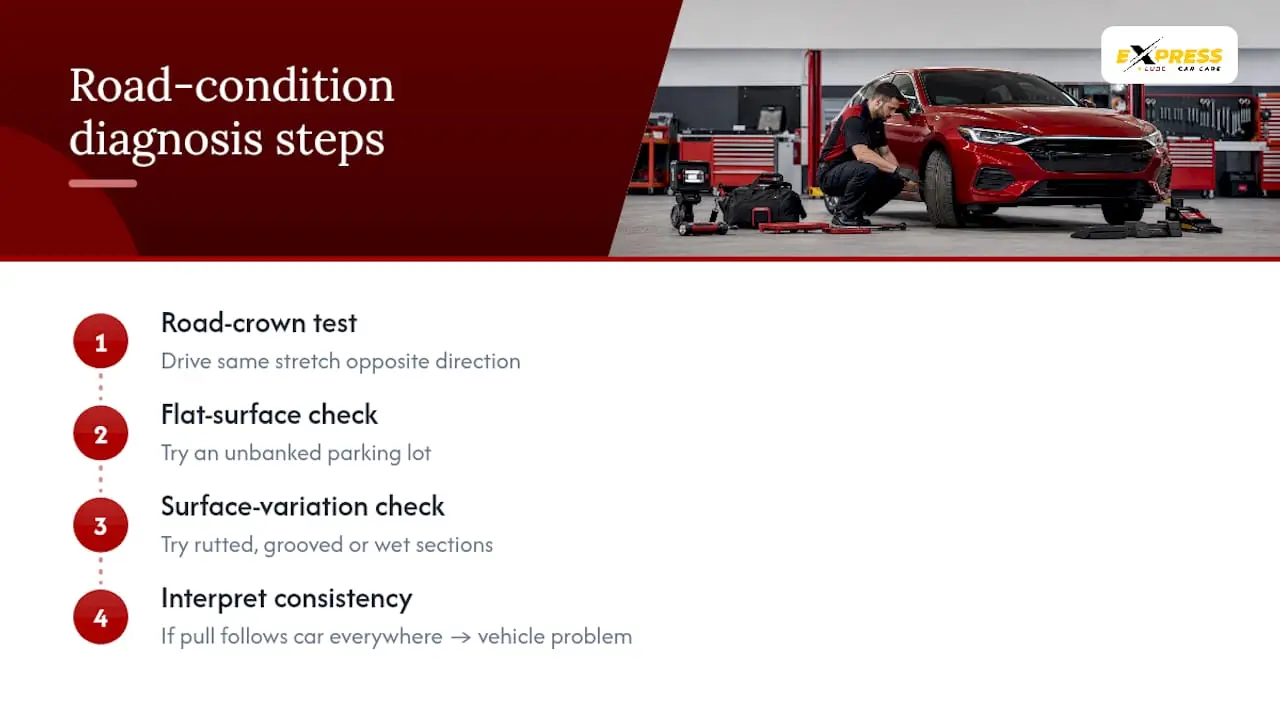
- Run the road-crown test. Most roads slope slightly toward the shoulder for drainage, and that camber alone can cause a mild drift. Drive the same stretch of road in both directions, or find a flat, empty parking lot. If the pull disappears or reverses, it’s the road, not your car.
- Cross-swap the front tires. Swap the left and right front tires and drive the same test again. If the pull switches sides, the tire caused it, likely conicity or uneven wear. If the pull stays on the same side, the problem is in the vehicle.
- Try a brake-only test. On an empty, straight road at low speed, apply the brakes gently without turning the wheel. If the car lurches right only when braking, suspect a dragging caliper or uneven pad wear rather than alignment.
- Spin-test the wheels if you can safely lift the car. A wheel that resists turning by hand points to brake drag, not steering geometry.
Pro Tip: Write down exactly what you find at each step, and snap a photo of anything odd, like a tire with feathered wear on one edge. Handing that to your technician saves diagnostic time and often saves you money.
What Does a Mechanic Check for a Car That Pulls Right?
A trained technician doesn’t guess. NHTSA’s own diagnostic bulletin for OEM shops defines a real pull condition very specifically, and that definition matters because it keeps techs from chasing a problem that’s actually just road crown.
The industry benchmark: a vehicle is considered to have a genuine pull if it drifts across a lane in less than 7 seconds without steering correction at 60 MPH on a road with less than 1.5 degrees of crown. Anything milder than that, on a normal crowned road, is often just the road itself.
From there, shops generally follow a set sequence rather than jumping straight to alignment:
- Rule out tire irregularities first. Pressure check, visual inspection, and a cross-swap test to isolate a bad tire before touching anything else.
- Inspect the brake system. Look for a dragging wheel, check caliper piston movement, inspect the flex hoses for internal collapse, and confirm the parking brake fully releases.
- Check suspension and steering play. Tie rod ends, ball joints, and rack bushings all get checked for looseness that could bias the vehicle’s tracking.
- Move to alignment corrections only after tires and brakes are cleared. The NHTSA flow treats alignment as the last step, not the first, because correcting alignment on a car with a bad tire or a dragging caliper just masks the real issue.
That sequence exists for a good reason: if a shop aligns a car with an underlying tire problem, the pull often comes right back after the next rotation.
When Should You Stop Driving a Car That Pulls Right?
Most pulls are annoying, not dangerous, and you can drive carefully to a shop. But a few signs mean you should stop immediately and call for service or a tow instead of driving further.
Pull over right away if you notice a sudden, severe pull right after hitting a curb, pothole, or debris, especially if it’s paired with a vibration or a knocking noise. Smoke, a burning smell, or a grinding sound from one wheel also means stop, since that can point to a seized caliper overheating a wheel bearing. Very uneven or weak braking alongside the pull is a safety issue, not a maintenance inconvenience.
If the pull is mild and steady, it’s generally fine to drive at low speed with both hands ready on the wheel. Note when the pull started, what triggers it (braking, acceleration, bumps), and bring that detail with you when you call for an appointment.
What Express Lube & Car Care Checks for a Pulling Car
When you bring a pulling vehicle to Express Lube & Car Care in Richland Hills, our ASE-certified technicians run through the same evidence-based sequence outlined above instead of jumping straight to an alignment quote.
A typical inspection covers:
- Visible tire and sidewall condition, plus cold pressure verification on all four corners
- A wheel spin and drag check to catch a sticking caliper early
- Full brake caliper, pad, and hose inspection
- Suspension and steering component checks for play in tie rods, ball joints, and the rack
Every finding gets documented in a digital vehicle inspection with photos, so you see exactly what we saw, not just a verbal summary. If a repair like a brake caliper or pad service turns out to be the fix, it’s backed by our 24 month/24,000-mile warranty on qualifying repairs. We offer same-day service and walk-ins, so you’re not stuck waiting days for an appointment while your car keeps pulling.
Does a Heavy Load Make a Car Pull to One Side?
Weight distribution changes how a vehicle handles more than most drivers expect. A trunk loaded unevenly, a toolbox always riding on one side of the bed, or passengers concentrated on one side of the cabin shifts weight off one wheel and onto another. That imbalance changes tire contact patch and can make an existing mild pull noticeably worse.
Overloading the vehicle beyond its rated capacity compounds the problem. Excess weight compresses the suspension unevenly if it’s not centered, which alters camber angles temporarily and can mimic an alignment issue that isn’t actually there. If your pull seems to appear only when the trunk is full or you’re hauling a trailer, try the same test empty. If the pull disappears, the fix isn’t mechanical at all. It’s how you’re loading the car.
This also explains why some pulls come and go. A rideshare or delivery driver carrying inconsistent cargo weight from day to day may notice the pull some days and not others, which throws off a simple diagnosis unless load is part of the conversation. If you’re consistently hauling heavy gear, mention that explicitly when you describe the symptom to a technician. It changes where they look first.
Can Road Conditions Cause a Car to Drift Right?
Not every pull comes from the car. Road geometry plays a bigger role than most drivers realize. Most paved roads are built with a slight crown, a gentle slope from the center line toward the shoulder, so rainwater drains off instead of pooling. That built-in slope naturally nudges a vehicle toward the lower edge of the road, which in the United States is usually the right shoulder.
That’s exactly why the road-crown test matters so much in diagnosis. Drive the same stretch of road in the opposite direction, or find a flat, unbanked parking lot, and see if the pull follows the road or stays fixed to one side of the car regardless of direction.
Rutted highways, freshly repaved sections with an uneven surface, and roads with heavy grooving from truck traffic can also tug at a vehicle unpredictably. Wet roads and standing water add another variable, since one side of the car can lose traction slightly before the other, creating a pull that feels mechanical but is really about surface grip. If your pull only shows up on certain roads and vanishes on others, road condition, not your car, is the more likely explanation. Consistency is the key clue: a true vehicle-caused pull follows the car everywhere, on every surface, in every direction.
How Much Does Uneven Tire Pressure Really Affect Pulling?
The cold-pressure check catches the obvious cases, but inflation problems go deeper than a single number on a gauge. Tire pressure affects the size and shape of the contact patch touching the road. An underinflated tire flexes more, builds more rolling resistance, and effectively “drags” compared to its properly inflated neighbor on the other side, and that drag is what steers the car toward it.
Always set pressure to the number on your vehicle’s door placard, not the maximum psi molded into the tire’s sidewall. Those two numbers are frequently different, and using the tire’s max-pressure figure instead of the manufacturer’s recommended figure is a common mistake that throws off handling. A gap as small as 2 to 5 psi side-to-side can produce a noticeable pull, which is a smaller margin than a lot of drivers assume matters.
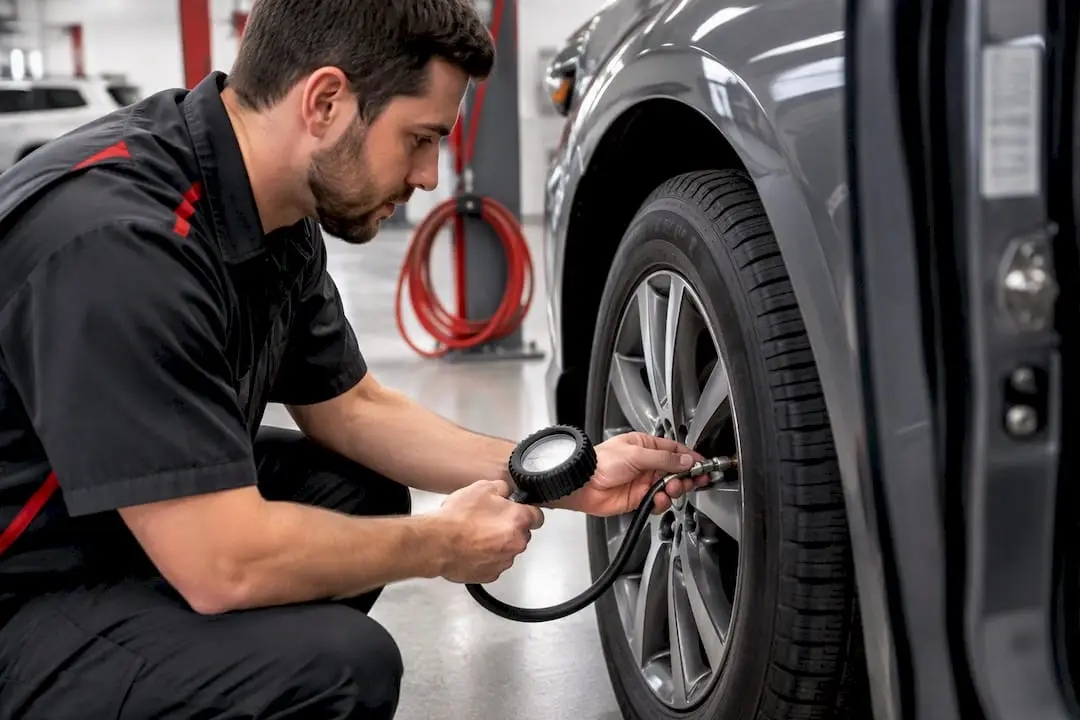
Uneven wear compounds the pressure problem. A tire that’s been chronically underinflated wears faster on its outer edges, and that wear pattern changes the tire’s effective diameter and rolling characteristics permanently, even after you correct the pressure. That’s part of why regular rotation matters: it evens out wear before one corner develops a personality of its own. If you’ve corrected pressure and the pull persists, uneven wear from a past inflation problem, not the current psi reading, may be the real cause.
Could Power Steering Problems Be Causing the Pull?
Low or degraded power steering fluid rarely causes a directional pull by itself, but it can make an existing pull feel far more dramatic. Power steering assists your effort at the wheel; it doesn’t independently decide which way the car goes. If the assist is uneven or the pump is failing, though, a mild mechanical pull from tires or brakes can feel like a much stronger tug because you’re fighting it with less power assistance backing you up.
Watch for these related symptoms alongside the pull: a whining noise from the steering pump, stiffer steering at low speeds, or the wheel feeling noticeably heavier in one direction than the other. A power steering fluid leak often shows up as a small reddish or amber puddle under the front of the car, and low fluid can eventually starve the pump and cause steering effort to spike unevenly side to side.
If your steering feels heavy, inconsistent, or noisy in addition to the pull, that’s worth flagging separately from the pull itself. Fixing a power steering fluid leak or a failing pump won’t correct a genuine alignment or brake-drag problem, but it will make whatever pull remains far easier to control and far less alarming behind the wheel.
Does Weather Affect Tire Pressure and Cause a Pull?
Temperature swings change tire pressure more than most drivers track. As a rule of thumb, tire pressure drops roughly 1 psi for every 10 degree Fahrenheit drop in outside temperature. That means a tire set correctly at 75 degrees in September can read several psi lower by the time a cold front rolls through in January, and if one tire started slightly higher than the others, that gap often widens as temperatures fall.
This is exactly why a car that never pulled in summer sometimes develops a mild pull as the seasons change. It’s rarely a coincidence. Cold mornings are the classic trigger, since overnight temperature drops hit tire pressure hardest right before your morning drive, when you’re least likely to have checked it.
The fix is simple but easy to forget: recheck cold pressure on all four tires every time there’s a significant swing in outside temperature, not just once at the start of the season. Set them to the door-placard number, not the sidewall maximum, and recheck again after the first hard freeze or the first real heat wave. A five-minute check at the pump can quietly prevent a pull that would otherwise send you looking for a mechanical cause that isn’t there.
A Mechanic’s Take on Misdiagnosed Pulls
Shops sometimes push straight to an alignment because it’s the easiest sale, not because it’s the correct fix. Ask for the cross-swap and brake-drag checks first. Some techs also dial in a deliberate alignment offset to mask a tire pull, a shortcut that tends to backfire after the next rotation.
— Express Lube & Car Care
Schedule a Pull Diagnosis at Express Lube & Car Care
A pull that won’t quit is exactly the kind of problem worth having looked at properly instead of guessed at. Express Lube & Car Care runs the same tire, brake, and suspension checks outlined above before ever recommending corrective work, so you’re not paying for a fix you didn’t need.
Our ASE-certified technicians document every check with a digital vehicle inspection complete with photos, so you can see the caliper, the tie rod, or the tire wear pattern yourself before approving anything. Qualifying repairs, whether it’s a caliper, a suspension component, or a brake job, are backed by our 24 month/24,000 mile warranty. Same-day service and walk-ins mean you don’t have to keep driving on a pull for a week waiting for a slot. Browse our full list of services, including brake repair, suspension work, and diagnostics, or call us directly at (817) 284-8478 to get on the schedule today. If you’re dealing with brake dust buildup while you’re at it, safe brake dust removal is worth a look too.
Sources
- DIAGNOSIS OF VEHICLE PULL (DRIFT) AND/OR STEERING WHEEL OFF-CENTER (NHTSA OEM bulletin)
- Handling problems : Symptom pulling to one side | Michelin
- Why Does My Car Pull to One Side? Tires, Alignment, or Brakes | PerformancePlus Tire
- Car pulls to the right or left: How to diagnose and fix yourself | 1A Auto
FAQ
How Do I Fix a Car That Pulls to the Right?
Start with the free checks: verify cold tire pressure matches the door placard, then run the road-crown and cross-swap tests to isolate whether a tire, a brake, or the vehicle itself is causing it. Once you know which system is responsible, the actual fix ranges from a simple pressure adjustment to a caliper repair or suspension work, which is why diagnosis always comes before repair.
What Does It Mean If Your Car Pulls to the Right?
It usually means one side of the car has more rolling resistance or drag than the other, most often from uneven tire pressure or wear, a dragging brake caliper, or worn suspension and steering components. NHTSA’s own bulletin defines a true pull as drifting across a lane in under 7 seconds at 60 MPH on a road with less than 1.5 degrees of crown, which rules out ordinary road camber as the cause.
What Would Cause a Hard, Sudden Pull to the Right?
A sudden, severe pull usually points to physical damage, like a curb strike that bent a wheel or damaged suspension, a tire that’s rapidly losing air, or a caliper that’s seized completely. This warrants stopping driving and getting the vehicle inspected right away rather than continuing to your destination.
Why Does My Car Pull to the Right When I Accelerate?
A pull that only shows up under hard acceleration, particularly on front-wheel-drive vehicles, is often torque steer, caused by uneven power delivery to each front wheel. If the pull happens at every speed and every driving condition, though, suspect tires, brakes, or suspension instead of an acceleration-specific cause.
When Should I Get a Pulling Car Professionally Inspected?
Get it inspected promptly if the pull is constant, worsens under braking, or appeared suddenly after hitting a curb or pothole. Express Lube & Car Care offers same-day service and walk-in appointments with ASE-certified technicians who run a full diagnostic check backed by a digital vehicle inspection, so call (817) 284-8478 to get on the schedule.