

That humming, growling, or grinding sound that gets louder as you speed up is almost always a wheel bearing wearing out, especially if it shifts pitch when you turn. Treat it as urgent: limit driving to short, low-speed trips and get the vehicle inspected soon, since a severely worn bearing can seize or let a wheel wobble. An ASE-certified technician can confirm it fast with a road test and a few hands-on checks.
TL;DR:
- A bad wheel bearing often produces humming, growling, squealing, or clicking sounds that change with speed and steering direction.
- Diagnosing the issue requires a combination of road testing, wheel play checks, spinning tests, and listening with a stethoscope to confirm the exact source.
- Contamination from water or grit, impact damage, larger wheels, low-profile tires, and poor installation are common causes of premature bearing failure.
- Driving on a confirmed bad bearing is risky; it should be limited to low-speed trips or avoided altogether to prevent wheel seizure or separation.
- Repairs involve replacing the entire hub assembly or serviceable bearing, with costs depending on vehicle design, parts quality, and labor, and include warranties up to 24 months or 24,000 miles.
Table of Contents
- What Does a Bad Wheel Bearing Sound Like?
- How to Check Wheel Bearings: A Step-by-Step Diagnostic
- What Causes Wheel Bearings to Fail?
- How Long Can You Safely Drive on a Bad Wheel Bearing?
- Wheel Bearing Replacement: What It Involves and What It Costs
- How a Professional Shop Diagnoses a Wheel Bearing Problem
- Our Take on What to Insist On
- Get Your Wheel Bearing Checked at Express Lube & Car Care
- Sources
- FAQ
What Does a Bad Wheel Bearing Sound Like?
A failing wheel bearing rarely stays quiet for long. It tends to announce itself with one of a few distinct noises, and the pattern tells you almost as much as the sound itself.
- Humming or droning that starts subtle at low speed and builds into a steady drone as you accelerate, similar to driving with a window cracked on the highway.
- Growling or rumbling, deeper and rougher than a hum, often described as sounding like driving on a graveled shoulder even on smooth pavement.
- Squealing or chirping, higher pitched, sometimes mistaken for a belt noise but tied to wheel speed rather than engine RPM.
- Clicking or clunking, usually a sign the bearing has progressed to physical damage inside the hub, sometimes paired with a CV joint issue.
The single biggest clue that separates wheel bearing noise from anything else under the car is how it behaves relative to speed and steering. It gets louder as your speed increases, and it changes when you turn. Wheel bearing noise typically gets louder when you steer away from the bad side and quieter when you steer toward it, because turning shifts weight onto or off the damaged bearing.
Compare that to other common culprits. Tire noise usually stays flat regardless of steering input and often points to uneven wear, which is worth checking against our car safety inspection checklist. Brake noise tends to show up only when you apply the brakes, not constantly while driving. A failing CV joint clicks specifically during turns at low speed, rather than humming at highway speed. If the noise pulses or changes with brake pedal pressure, read up on how the ABS braking system works before assuming it’s the bearing.
How to Check Wheel Bearings: A Step-by-Step Diagnostic
Confirming a bad wheel bearing takes more than just listening. It takes a short sequence of hands-on checks that isolate exactly which wheel is the problem and rule out tires, brakes, or CV joints along the way.
- Drive it and listen on both sides of the road. A brief road test with steering weighted left, then right, reveals which side is loaded when the noise gets louder. This left/right load test is one of the most reliable low-cost diagnostic signals a driver can report to a technician.
- Check for play at 12 and 6 o’clock. With the wheel safely off the ground, grab it at the top and bottom and rock it. Excess play (not to be confused with normal tie rod movement checked at 3 and 9 o’clock) points to a worn bearing.
- Spin the wheel by hand. Roughness, grinding, or resistance while spinning freely usually means bearing damage, not just noise from wind or road texture.
- Localize with a stethoscope or a long screwdriver. Touching the tool to the hub area and listening at the other end pinpoints exactly where the noise originates, separating bearing hum from a brake caliper drag or exhaust rattle.
- Watch for ABS warning lights. Some wheel speed sensors sit inside the hub assembly, so a damaged bearing can trigger erratic sensor readings and an ABS light alongside the noise.
A thorough diagnosis leans on this same combination: road test, visual inspection, and hands-on checks, precisely because tires, brakes, and CV joints can all mimic bearing symptoms. Skipping steps is how good parts get replaced for no reason.
Pro Tip: Note exactly when the noise changes, on acceleration, at a specific speed, or only when turning one direction, and describe that timing to your technician. It cuts diagnostic time significantly and helps confirm findings against digital inspection photos.
What Causes Wheel Bearings to Fail?
Bearings are sealed, but seals fail, and once they do, the clock starts ticking fast. A few conditions consistently show up in bearings that die early.
- Contamination. Water, road salt, and grit that work past a damaged seal wash out lubricant and pit the bearing races, and this is the most common cause behind premature failure.
- Impact damage. A hard pothole strike or curb hit can dent the races or dislodge internal components even when the wheel and tire look fine afterward.
- Larger wheels and low-profile tires. Bigger, wider wheels change leverage and load on the hub, and stiffer, low-profile tires transmit more shock straight into the bearing instead of absorbing it.
- Heavy, consistent loads. Frequent towing or hauling near a vehicle’s limit accelerates wear on bearings not built for that duty cycle.
- Poor installation or low-quality parts. A bearing pressed in without proper alignment, or a budget aftermarket unit with looser tolerances, can fail in a fraction of the expected mileage.
Routine attention to seals and suspension components, and prompt fixes for anything that causes uneven tire wear, go a long way toward keeping bearings on their expected service life.
How Long Can You Safely Drive on a Bad Wheel Bearing?
Not long, and not fast. A wheel bearing holds the wheel onto the vehicle while letting it spin freely, so when it fails completely, the risk isn’t just noise. It’s the bearing seizing or the wheel developing dangerous play that can lead to separation.
Technicians generally advise against highway driving once a bearing is confirmed bad, and recommend limiting travel to a few low-speed miles only if reaching a shop requires it. Sustained speed generates heat and stress that a failing bearing can’t handle for long.
Pull over and arrange a tow instead of continuing to drive if you notice any of the following:
- A grinding noise that’s suddenly gotten louder or rougher.
- Visible wobble in the wheel when viewed from outside the vehicle.
- Vibration through the steering wheel or floor that intensifies with speed.
- A burning smell near a wheel, which can indicate a bearing overheating.
If the noise is mild, steady, and hasn’t changed, a short trip to a shop at moderate speed is usually reasonable. If it’s gotten worse in the last day or two, don’t gamble on it.
Wheel Bearing Replacement: What It Involves and What It Costs
Repair paths split into two categories. Some vehicles use a serviceable bearing that a technician presses out of the hub and replaces on its own. Many newer vehicles use a sealed hub assembly, where the bearing, hub, and sometimes the ABS sensor come as one unit that gets replaced together.
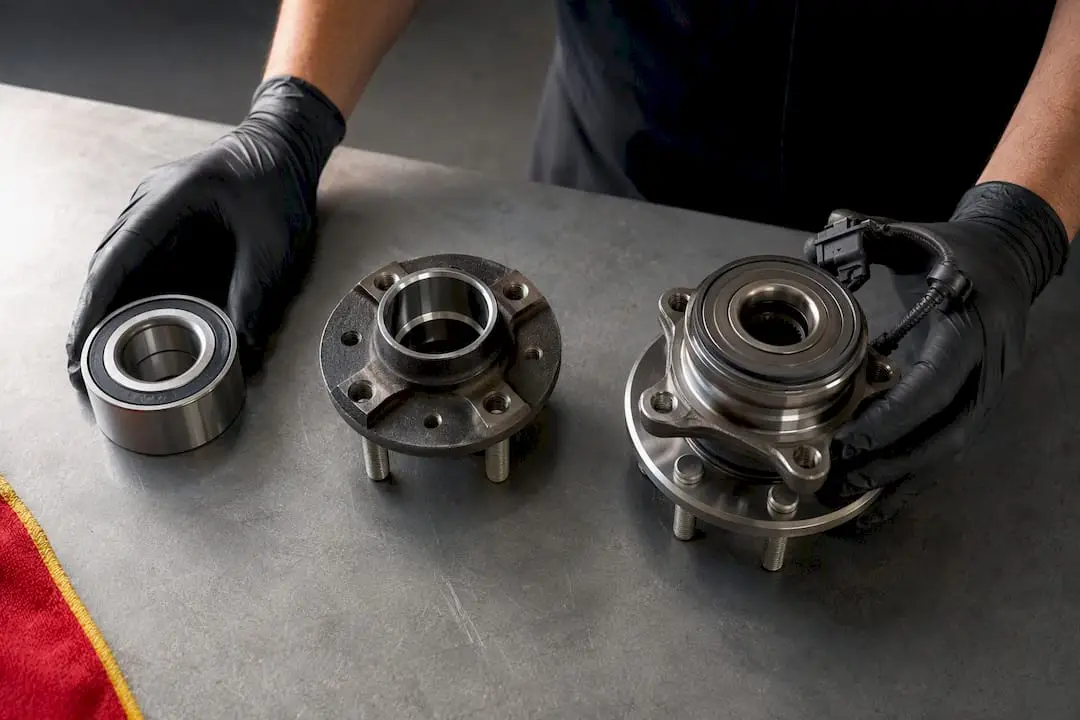
Either way, a competent repair looks past just the bearing itself. Technicians typically inspect seals, axle mating surfaces, and sometimes the rotor and studs, since reusing a damaged seal or a pitted mating surface is a common reason bearings fail again within months of a “fix.”
Several factors move the price up or down:
- Front versus rear, since front hub assemblies on many vehicles carry more complexity and labor time.
- OEM versus aftermarket parts, with OEM generally costing more upfront but often carrying tighter tolerances.
- Labor time, which varies by vehicle design; some hubs come out in under an hour, others require more disassembly.
- Whether adjacent parts need replacement, like a corroded stud or a damaged sensor ring.
Express Lube & Car Care doesn’t publish blanket pricing here because it genuinely depends on your vehicle and what the inspection turns up, but every repair comes backed by a 24-month/24,000-mile warranty, and financing is available for larger jobs through easy financing options.
How a Professional Shop Diagnoses a Wheel Bearing Problem
A proper diagnosis follows a sequence, not a guess. It starts with listening to your description of the noise, then moves into hands-on verification before anyone touches a wrench.
- Customer interview, pinning down when the noise happens and whether it changes with speed or turning.
- Road test, including the left-right steering load test that isolates the affected side.
- Visual inspection and wheel play check, done with the vehicle safely raised.
- Spin test and stethoscope localization, confirming the exact source before recommending a repair.
- Digital inspection with photos, so you see what the technician sees rather than taking a verdict on faith.
This is the same test-drive-and-inspection process that separates a real bearing failure from a misdiagnosed tire or CV joint. Combined with ASE-certified technicians and a 24-month/24,000-mile warranty on the repair, it’s built to get the diagnosis right the first time.
Our Take on What to Insist On
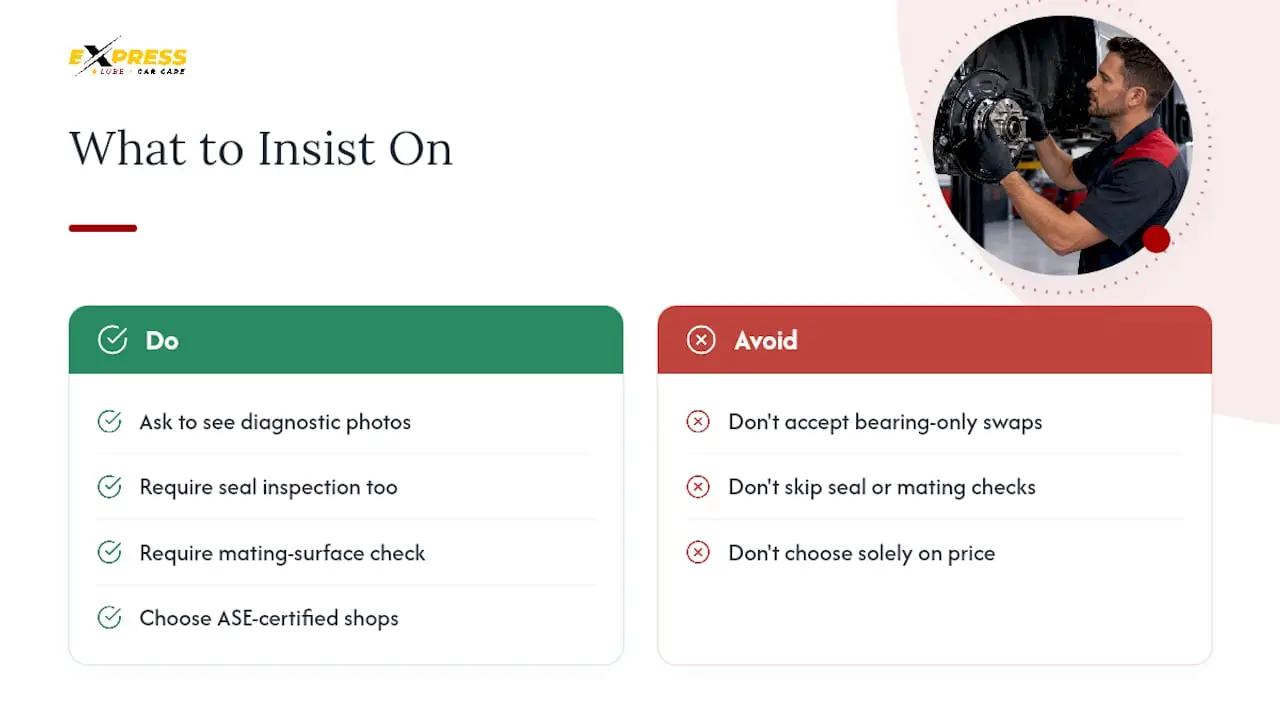
Ask for the photos, not just the verdict. Any shop worth your money should be able to show you the worn race, the failed seal, or the play in the hub, not just tell you it’s bad. Push back if a technician wants to swap the bearing but skip the seal or the mating surface. That shortcut is exactly how bearings fail again within a year. Weigh warranty coverage and ASE certification as heavily as price when you’re choosing who touches your hub assembly.
Get Your Wheel Bearing Checked at Express Lube & Car Care
Express Lube & Car Care skips the guesswork and the waiting list. Walk in without an appointment, and our ASE-certified technicians run the same road test, wheel play check, and stethoscope localization outlined above, backed by a digital inspection with photos so you see exactly what’s worn before any work starts.
Every wheel bearing repair carries our 24-month/24,000-mile warranty, and if the job is larger than expected, financing options can spread out the cost. Richland Hills drivers dealing with a hum that won’t quit don’t have to book weeks out or diagnose it themselves in a driveway. Schedule an inspection online through our appointment page or call (817) 284-8478 to get on the schedule today.
Sources
- BCA Bearings | What’s Causing That Noise? Isolating Wheel Bearing Noise from Tires, Brakes and Other Components
- Identifix blog — 8 symptoms of a bad wheel bearing
- How Long Can You Drive on a Bad Wheel Bearing? (Maxi Auto Repair)
- Kelley Blue Book — How do I know if I need new wheel bearings?
FAQ
What does a wheel bearing sound like when it’s failing?
Most drivers hear a humming, growling, or rumbling noise that grows louder with speed and often changes pitch when steering left or right.
Is it safe to drive with wheel bearing noise?
Short, low-speed trips are usually tolerable, but sustained highway driving on a confirmed bad bearing risks seizure or wheel separation, so prompt inspection matters.
How much does it cost to replace a wheel bearing?
Cost depends on whether your vehicle uses a serviceable bearing or a full sealed hub assembly, plus labor time and whether adjacent parts like seals or sensors need replacement; a technician can give you an accurate estimate after inspection.
How can I tell if it’s a wheel bearing or just a tire noise?
Tire noise usually stays constant regardless of steering input, while bearing noise shifts in volume when you turn, getting louder when you steer away from the affected side.
Can a bad wheel bearing cause an ABS warning light?
Yes, since some wheel speed sensors sit inside the hub assembly, a damaged bearing can send erratic signals that trigger an ABS light alongside the noise.