

When your car’s blower motor isn’t working, the cause is usually one of four things: a blown fuse, a bad relay, a failed blower motor resistor, or the motor itself. If you smell burning or see melted plastic near the connectors, stop using the blower entirely and have an ASE-certified technician diagnose it before you risk an electrical fire or a bigger repair bill.
TL;DR:
- A blower motor failing on all speeds is often caused by a blown fuse, failed relay, or damaged wiring, not necessarily the motor itself.
- If only the highest speed works, the likely cause is a faulty resistor or control module, which is cheaper and easier to replace than the motor.
- A burning smell or melted plastic indicates an electrical overload, requiring immediate stop and professional diagnosis to prevent fire risks.
- Weak airflow at all speeds could stem from a clogged cabin air filter rather than a failing motor, making initial checks and filter replacement inexpensive.
- Diagnosing the issue precisely involves testing voltage, ground, and the motor directly with a multimeter or jumper, mostly performed by ASE-certified technicians.
Table of Contents
- Blower Motor Not Working: Symptoms That Point to the Cause
- How to Do Basic Blower Motor Troubleshooting Yourself
- What Happens During a Shop Diagnostic
- Blower Motor Repair Options and What to Expect
- Preventing Repeat Blower Motor Problems
- A Shop’s-Eye View on Blower Motor Diagnosis
- Get Your Blower Motor Diagnosed the Right Way
- Sources
- FAQ
Blower Motor Not Working: Symptoms That Point to the Cause
Your fan’s behavior is basically a diagnostic clue, and figuring out which pattern you’re seeing narrows the problem before you touch a single wire.
- No airflow at any speed. Suspect a blown fuse, failed relay, damaged wiring, or a dead motor.
- Only the highest speed works. This is the classic sign of a failed blower motor resistor or control module, since lower speeds route through that component while high speed often bypasses it.
- Weak airflow at every speed. Could mean worn motor bearings, a clogged cabin air filter, or a blocked evaporator or heater box.
- Intermittent operation, especially after hitting a bump. Usually worn motor brushes or a loose connector.
- Grinding or squealing noise. Often bearing wear or debris caught in the blower wheel.
- Burning smell or melted plastic near the vents. This is an electrical overload warning. Stop using the blower immediately.
Pro Tip: If your fan only works on high, don’t buy a new blower motor yet. That pattern almost always points to the resistor or control module, not the motor, and that part is usually far cheaper to replace.
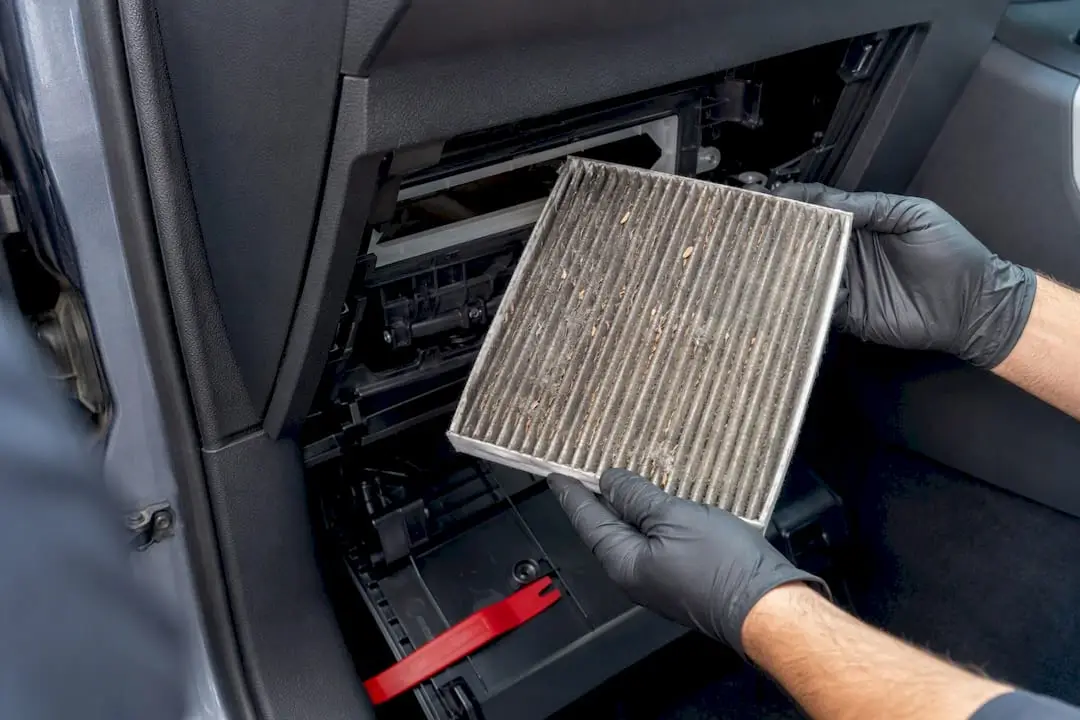
Weak airflow across all speeds gets blamed on the motor more than it should. A clogged cabin air filter can choke off airflow enough to feel like a dying fan, and it’s one of the cheapest things in your car to check.
How to Do Basic Blower Motor Troubleshooting Yourself
Before you assume the worst, run through these checks. They cost you nothing but a few minutes, and they’ll tell you a lot about where the fault actually lives.
- Turn the key to RUN and cycle through every fan speed. Note exactly which speeds work and which don’t. This pattern is the single most useful piece of information you can hand a technician.
- Check the cabin air filter first. A filter packed with dirt and debris can mimic a weak or dying blower motor, and swapping it is inexpensive.
- Locate the blower motor fuse and relay (check your owner’s manual for the fuse box diagram). Look for a blown fuse or a relay that isn’t clicking when you turn on the fan.
- Swap in a known-good relay of the same type if you’re comfortable doing so and have one on hand. If the fan starts working, you’ve found your culprit.
- If you own a multimeter and know how to use it safely, check fuse continuity. Otherwise, leave voltage and ground testing to a shop. Poking around a live HVAC circuit without the right tools risks a bigger repair.
Stop right there if you notice a burning odor, discolored wiring, or a melted connector at any point during this process. That’s not a DIY situation. Continuing to run the blower with heat damage present can turn a $20 part into a full harness repair.
If you want a broader rundown of related HVAC symptoms before you dig in, our guide to diagnosing car AC problems walks through the same testing logic technicians use on the cooling side.
What Happens During a Shop Diagnostic
An ASE-certified technician doesn’t guess. There’s a sequence, and it exists because it isolates the fault fast instead of throwing parts at the problem.
- Listen for the relay click and check fuse integrity. A silent relay or a blown fuse gets replaced immediately, and the fan is retested before anything else happens.
- Measure voltage and ground at the blower motor connector with a multimeter. Technicians prioritize this step because power present with no motor spin points squarely at a bad motor, while missing power on certain speeds points to the resistor or control side.
- Run a fused direct-power test on the motor. Applying battery power directly to the motor confirms whether it spins. If it runs fine on direct power, the fault is upstream in the resistor, control module, or wiring, not the motor.
- Inspect the resistor pack or blower control module, depending on how your specific vehicle’s HVAC system is built.
- Check the wiring harness and connectors for heat damage, and confirm the cabin air filter and vent path aren’t restricting airflow.
Here’s how the diagnostic priorities generally break down:
| Diagnostic Step | What It Rules In or Out |
|---|---|
| Relay click and fuse check | Blown fuse, dead relay |
| Voltage and ground at motor connector | Wiring fault vs. motor fault |
| Direct-power (jumper) test on motor | Confirms motor health independently |
| Resistor pack or control module inspection | Speed-specific failures |
| Harness and connector inspection | Heat damage, overload history |
Some vehicles complicate this further. Older cars typically run a resistor pack with a mechanical multi-speed switch, while newer vehicles use an electronic blower control module instead. Getting that distinction wrong leads to ordering the wrong part. On vehicles with automatic climate control, a scan tool or oscilloscope may be needed to read the pulse-width-modulated signal that commands blower speed, since a basic multimeter won’t tell you if that signal is present.
Blower Motor Repair Options and What to Expect
Once the diagnostic points to a specific part, the repair path is usually straightforward, though not always cheap in the way you’d hope.
- Resistor pack replacement solves many single-speed complaints. But if the connector at the resistor is melted or discolored, that’s often a sign of excessive current draw from a struggling motor, and replacing just the resistor without addressing the underlying overload risks a repeat failure within weeks.
- Blower motor replacement becomes necessary when bearings fail, the motor seizes, or it fails the direct-power test.
- Blower control module replacement applies to variable-speed systems instead of a simple resistor swap. Confirming which system your vehicle uses before ordering parts saves you a second trip.
- Harness or connector repair is required whenever heat damage shows up, regardless of which other part also gets replaced.
Pro Tip: Ask for photos of the damaged connector or resistor before you approve the repair. A shop that documents the failure with a digital inspection is showing you the actual problem, not just telling you about it.
Blower motor diagnostics are handled by ASE-certified technicians and qualifying repairs may be backed by a warranty. Expect a written estimate after the diagnostic step, and don’t hesitate to ask for the digital inspection photos before you sign off on anything.
Preventing Repeat Blower Motor Problems
A little routine attention goes a long way toward keeping your blower running quietly for years instead of months.
- Replace your cabin air filter on schedule, or sooner if you drive in dusty or high-pollen conditions. A clogged filter strains the motor and mimics failure symptoms on its own.
- Check the intake grills and under-hood air inlet seasonally. Leaves, debris, and even rodent nests can block airflow or damage wiring.
- Don’t ignore odd noises or single-speed behavior. A grinding sound or a fan that only works on high is often cheap to fix early and expensive to ignore, since a struggling motor can eventually cook the connector feeding it.
- Ask your shop to inspect connectors for heat damage and replace pigtails whenever discoloration shows up, even if the part itself still technically works.
A Shop’s-Eye View on Blower Motor Diagnosis
Most blower motor complaints we see start the same way: a customer assumes the whole motor is dead when the real problem is a $30 resistor, or they assume it’s “just the filter” when a connector is quietly overheating behind the dash. That gap between what a symptom looks like and what it actually means is exactly why guessing costs more than diagnosing.
We document every blower motor inspection digitally, with photos, so you can see the failed part and understand why it failed before you approve anything. Safety comes first. If there’s any sign of burning or heat damage, we’ll tell you to stop using that blower immediately, and we’ll fix the root cause rather than just swapping the part that quit. Walk-ins are welcome, and we handle same-day repairs when parts and shop workload allow it.
— Express Lube & Car Care
Get Your Blower Motor Diagnosed the Right Way
A blower motor problem rarely fixes itself, and guessing at parts online usually means paying twice. This shop provides a transparent diagnostic process with ASE-certified technicians who document findings with photos through digital inspections and offer warranties on qualifying repairs.

No appointment necessary. Walk in with a dead fan, weak airflow, or a burning smell you’re worried about, and we’ll get it on a lift. If you’d rather see everything the shop handles beyond HVAC work, browse our full auto A/C and heating repair services or the complete services list. Ready to get it looked at? Call (817) 284-8478 or schedule your visit online today.
Sources
- Blower Motor vs Resistor: Which HVAC Part Failed? — VehicleRuns
- Blower motor symptoms and diagnostics — Sontian Motor
- How to test a blower motor like a pro — Rick’s Free Auto Repair Advice
- Blower motor not working on any speed — GarageSee
FAQ
Why Is My Car’s Blower Motor Not Working At All?
No airflow at any speed usually means a blown fuse, a failed relay, damaged wiring, or a dead motor. Checking the fuse and relay first costs nothing and rules out the two cheapest possibilities before you consider a motor replacement.
Why Does My Blower Only Work on High Speed?
This almost always points to a failed blower motor resistor or control module, since lower fan speeds rely on that component while high speed typically bypasses it. It’s rarely the motor itself in this scenario.
How Much Does Blower Motor Replacement Cost?
Cost depends on your vehicle, whether the resistor, motor, or control module needs replacing, and labor to access the part. Express Lube & Car Care provides a written estimate after diagnosis, so check the services page or call ahead for current details.
Can I Diagnose a Blower Motor Problem Myself?
You can safely check the fuse, relay, and cabin air filter, and note which fan speeds work. Anything involving voltage testing at the connector or a direct-power test is best left to a shop, especially if you smell burning or see melted plastic.
Is It Safe to Keep Driving With a Blower Motor That Smells Like Burning?
No. A burning smell or melted connector signals an electrical overload, and continuing to run the blower risks further wiring damage or fire. Stop using the fan and have an ASE-certified technician inspect it as soon as possible.