

When your car's AC starts acting up, it's often a sign of a simple, fixable issue. Before you jump to conclusions about a massive repair bill, a little detective work can go a long way. Things like weak airflow, weird noises, or even a funky smell are common clues that often point to low-cost fixes like a refrigerant recharge or a new cabin air filter.
Knowing what to look for can save you a ton of time and money.
Diagnosing Your Car AC Problem Like a Pro
Nothing's worse than your AC blowing lukewarm air on a sweltering Texas afternoon. But don't panic. Your car usually gives you hints about what’s wrong long before you start sweating. By taking a systematic approach, you can figure out if you're dealing with a simple maintenance task or something that needs a professional eye.
Let's move past the obvious "it's blowing warm" and get into the specifics. What are you hearing? New and unusual noises are a huge clue.
- A rattling or buzzing sound? This could mean debris is stuck in the blower motor or that the compressor clutch is starting to fail.
- Hear a squeal when you start the car? That often points directly to a worn-out serpentine belt, which is crucial for powering the AC compressor.
- A distinct clicking noise? Some clicking is normal as the AC cycles on and off. But if it's rapid-fire and constant, your system is likely low on refrigerant.
A Quick Car AC Symptom Checker
To make things easier, here’s a quick table to match what you’re experiencing with the most likely culprit. It'll help you decide if this is something you can tackle in your driveway.
| Symptom | Likely Cause | Potential DIY Fix Level |
|---|---|---|
| Weak Airflow | Clogged cabin air filter | Easy (often a 10-minute job) |
| Warm or Lukewarm Air | Low refrigerant | Moderate (recharge kits available) |
| Musty or Moldy Smell | Mold/mildew in evaporator or filter | Easy to Moderate (replace filter, use cleaner) |
| Squealing Noise | Worn serpentine belt | Moderate (requires specific tools) |
| Rattling/Buzzing Noise | Debris in blower motor / failing clutch | Advanced / Pro (can be complex) |
| Water on Floor Mats | Clogged evaporator drain line | Moderate (can be cleared with air/wire) |
This isn't an exhaustive list, of course, but it covers the most common problems we see every day.
Trust Your Senses
It’s not just about what you hear. A persistent musty smell blowing from the vents is a classic sign of mold and mildew buildup on the evaporator core. This is usually caused by a clogged cabin air filter or a blocked drain hose that isn't letting condensation escape properly.
Another dead giveaway is finding water inside your car, usually on the passenger-side floor. That's a telltale sign that the evaporator drain is clogged, causing water to back up into the cabin instead of dripping out underneath the vehicle where it belongs. For more general troubleshooting tips, our guide to help diagnose common car problems has some great pointers.
Your car’s air conditioning is a sealed system. If the refrigerant is low, it means there’s a leak somewhere. Unlike gasoline, it doesn't just get "used up" over time.
By paying attention to these signs, you can build a much clearer picture of what's going on. This initial diagnostic checklist helps you separate a straightforward fix you can handle yourself from a more complex problem that needs professional tools, giving you the confidence to know exactly where to start.
Your First-Line DIY Car AC Fixes
Alright, now that you have a hunch about what's going on, it’s time to get your hands dirty. The good news is that many common car AC problems don't mean an automatic, expensive trip to the shop.
With a little guidance, you can tackle some of the most frequent culprits right in your own driveway. These are the go-to checks that address the usual suspects behind a weak or warm AC system, and they're the perfect place for any DIYer to start.
This simple diagnostic process can help you zero in on the issue before you even pick up a tool.
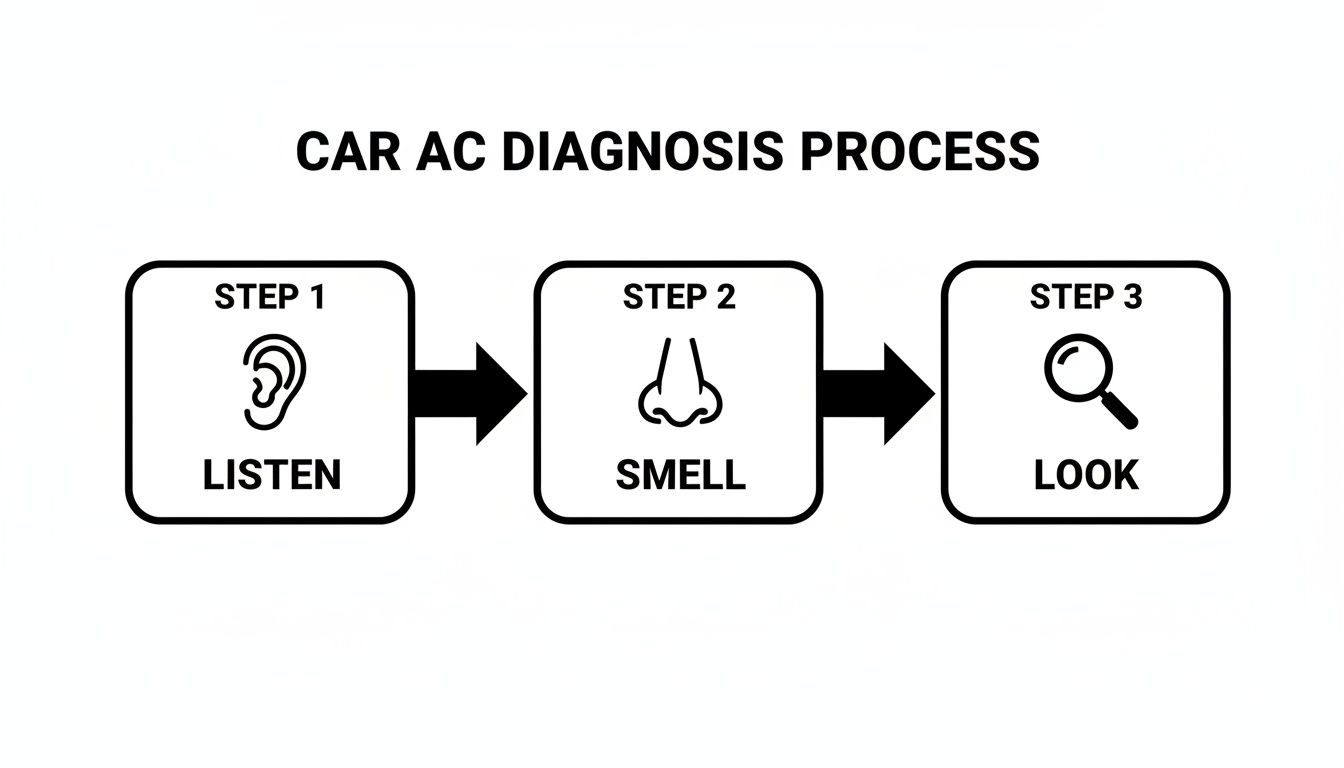
This chart just breaks down what we do instinctively: listen for weird noises, sniff for strange smells, and look for anything that’s obviously wrong.
Safely Recharge Your AC Refrigerant
One of the most common reasons an AC system blows warm is simply low refrigerant. Your car’s AC is a sealed system, so if it's low, there's a leak somewhere. A pro should definitely handle a major leak, but for a minor, slow one, you can often top it off yourself.
You’ve probably seen the DIY AC recharge kits at the auto parts store. They come with a can of refrigerant (usually R-134a for cars made after 1994) and a built-in pressure gauge. First thing's first: put on safety glasses and gloves. Refrigerant is no joke and can cause serious injury if it hits your skin or eyes.
Here's the quick rundown on how to do it:
- Find the Low-Pressure Port: With the engine off, look for the larger-diameter aluminum AC line. The port you need will have a plastic cap, often marked with an "L." The kit's coupler is designed to only fit this specific port, so you can't accidentally connect it to the high-pressure side.
- Connect the Gauge: Attach the recharge hose to the port. You'll feel it click securely into place.
- Check the Pressure: Now, start the car and crank the AC to its max setting with the fan on high. The gauge will give you a pressure reading. Look at the color-coded dial—it'll tell you if the pressure is low, normal, or dangerously high.
Crucial Tip: Whatever you do, do not overcharge the system. Too much refrigerant creates massive pressure that can wreck your AC compressor—a repair that costs hundreds, if not thousands, of dollars. Follow the gauge carefully.
If the gauge is in the "low" zone, you're clear to add refrigerant. Shake the can well and squeeze the trigger in short bursts of 5-10 seconds each. After every burst, let go and watch the gauge to see your progress.
Once the needle climbs into the "filled" or green zone on the gauge, stop. You're done. A successful recharge often gives you instantly colder air blowing from the vents. It’s a pretty satisfying fix.
Replace the Cabin Air Filter
Is the air from your vents weak, or does it have a funky, musty smell? The number one suspect is a clogged cabin air filter. This little filter is responsible for cleaning all the air that comes into your car, trapping dust, pollen, and leaves. When it gets choked with gunk, it kills your airflow and makes the AC's blower motor work way too hard.
Swapping it out is one of the easiest and cheapest fixes you can do. Most are tucked away behind the glove box, but some hide under the hood or dash. Your owner's manual will point you to the right spot. For a deeper dive, you can learn more about where to find your car's air filter in our guide.
The process is usually simple: empty the glove box, squeeze the sides to release its stoppers, and let it hang down. You’ll see a small rectangular door. Unclip it, slide out the gross old filter, and pop the new one in. Just make sure the little airflow arrows on the new filter are pointing in the correct direction.
Inspect the Compressor and Serpentine Belt
A quick visual check can tell you a lot about the health of your AC system's core parts. The AC compressor is the heart of the whole operation, and it gets its power from the engine's serpentine belt.
Pop the hood, start the car, and turn on the AC. Now, look at the front of the compressor pulley. The center part, called the clutch, should kick on and start spinning along with the rest of the pulley.
- If that clutch doesn't engage at all, you're likely looking at an electrical problem (like a fuse) or a failed compressor.
- If it engages but you hear a horrible grinding or squealing sound, the compressor's internal bearings are probably shot.
Next, turn the engine off and take a look at the serpentine belt itself. You're looking for obvious signs of wear and tear:
- Cracks or fraying
- Glazed, shiny spots on the surface
- Chunks of rubber missing from the ribbed side
A worn-out belt can slip and won't be able to turn the compressor effectively. While replacing a belt can be a more involved job, just inspecting it is a quick and vital diagnostic step.
Check Fuses and Relays
Sometimes the fix is ridiculously simple. If your AC system is completely dead—no lights, no fan, nothing—it could just be a blown fuse or a bad relay.
Your car has at least two fuse boxes. One is usually inside the cabin (check near the driver's side footwell), and the other is under the hood. Your owner's manual or the diagram on the fuse box cover will tell you which fuse or relay belongs to the A/C.
Use a fuse puller or small pliers to pull the A/C fuse out and hold it up to a light. If you see a break in the thin metal strip inside, it's blown. Grab a new fuse with the exact same amperage rating, pop it in, and you might be back in business.
If the new fuse blows right away, you've got a short circuit somewhere that needs a professional to track down. For a relay, you can try a quick test by swapping the A/C relay with an identical one from a less critical system, like the horn. If the AC suddenly works, you've found your culprit: a failed relay.
Understanding Your Car's AC System
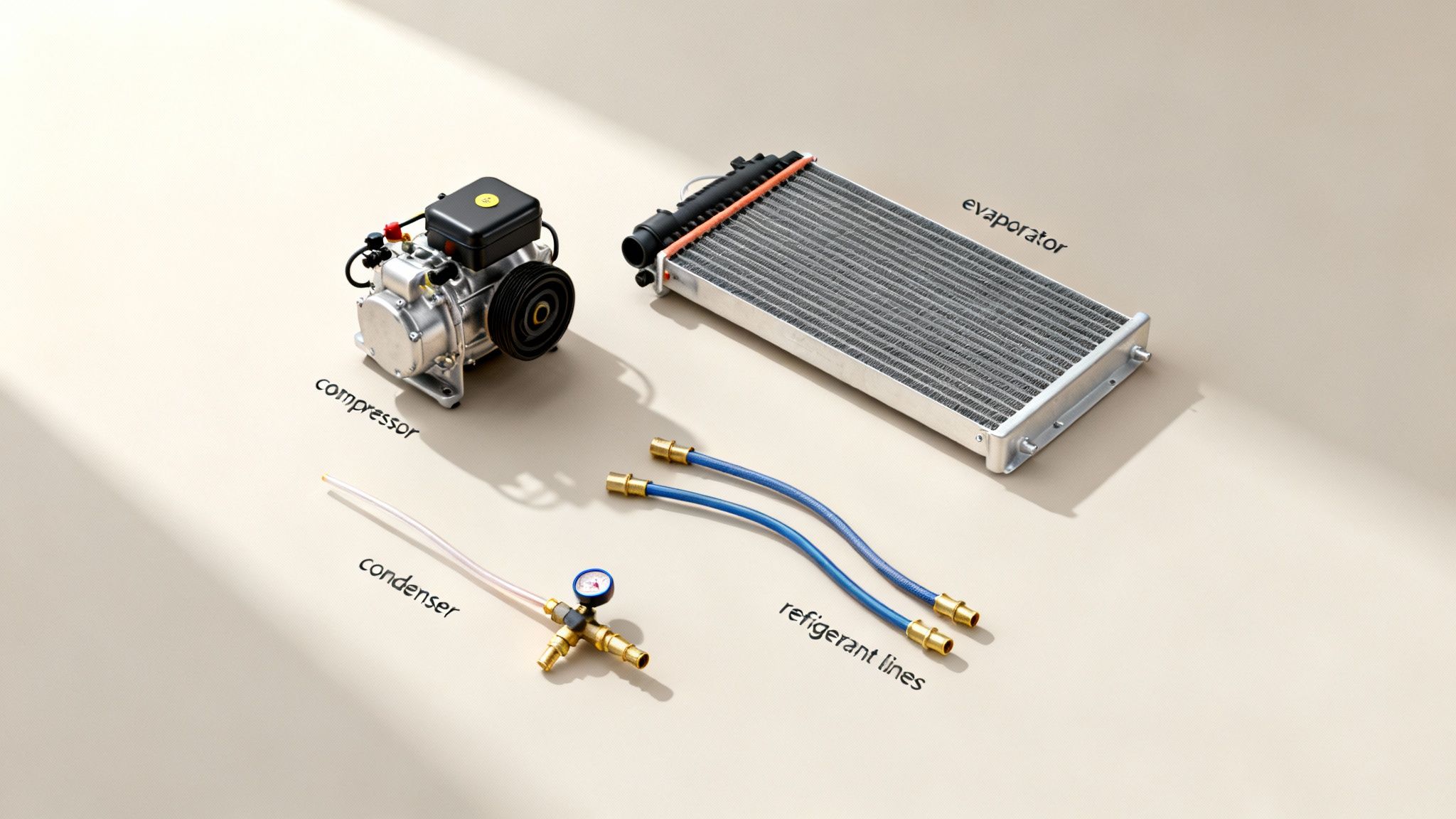
Before you can tackle a car AC fix, it really helps to know what you’re up against. Your car’s air conditioning isn’t some black magic—it’s actually a clever system that works a lot like the refrigerator in your kitchen, just squeezed to fit under the hood.
At its core, the AC is a sealed loop that moves heat from inside your car to the air outside. It does this by constantly changing a special substance called refrigerant from a liquid to a gas and back again. This cycle is what creates that blissful cooling effect on a hot day.
Knowing the key players makes diagnosing problems way easier and helps you speak the same language as a technician if you end up needing professional help.
The Major Components and Their Roles
Think of your AC system as a team of four critical parts, each with a specific job. If one of them drops the ball, the whole team suffers, leaving you with nothing but warm air.
Let's break down who does what.
The Compressor
Often called the heart of the system, the compressor is a pump driven by your engine's serpentine belt. Its job is to take low-pressure refrigerant gas and squeeze it into a high-pressure, hot gas. This is the first and most important step in the whole cooling process.
A failing compressor is usually a major repair. You might hear ugly grinding or squealing noises when the AC is on, or notice the clutch on the front of it won't engage at all.
The Condenser
Look right in front of your car's radiator, and you'll see the condenser. It looks like a smaller, thinner version of the radiator, and its job is to cool that hot, high-pressure gas from the compressor until it turns back into a liquid. Air flowing through its fins as you drive is what gets rid of the heat.
Because it's right up front, the condenser is a magnet for road debris. A stray rock can easily cause a leak.
The Evaporator
This is where the real magic happens, but it’s tucked deep inside your dashboard. The high-pressure liquid refrigerant flows into the evaporator and gets forced through a tiny valve, causing a massive pressure drop. This makes the refrigerant instantly expand back into a gas, which absorbs a huge amount of heat from the surrounding air.
Your blower motor then pushes cabin air across the now-frosty evaporator, and—voilà—cold air comes out of your vents. A common problem here is mold and mildew buildup, which causes that classic musty AC smell.
Common Failure Points to Watch For
The entire system relies on being perfectly sealed. The number one enemy of any car's AC is a leak. Over the years, rubber O-rings and seals dry out and crack, and hoses can get brittle, letting that precious refrigerant escape. Without enough refrigerant, the system can't build pressure, and the cooling cycle grinds to a halt.
Your car's AC doesn’t "use up" refrigerant like it uses gas. If the system is low, it means there’s a leak somewhere that needs to be found and fixed. Otherwise, you’re just throwing money away on recharges.
Another common weak spot is the electrical system. Fuses blow, relays go bad, and pressure switches can fail. Any of these can prevent the compressor's clutch from engaging, even if the rest of the system is mechanically sound. These are often simple fixes but can be a real headache to diagnose without the right tools.
This need for reliable AC is bigger than ever. The global automotive air conditioning market is projected to grow from USD 2.301 billion in 2026 to USD 2.881 billion by 2035. For shops like Express Lube & Car Care, this trend shows why AC service has become a standard maintenance item, not just a luxury repair. You can learn more about the growth of the automotive HVAC market and its impact on drivers and shops.
Gathering Your Tools and Getting Ready for a Safe Repair
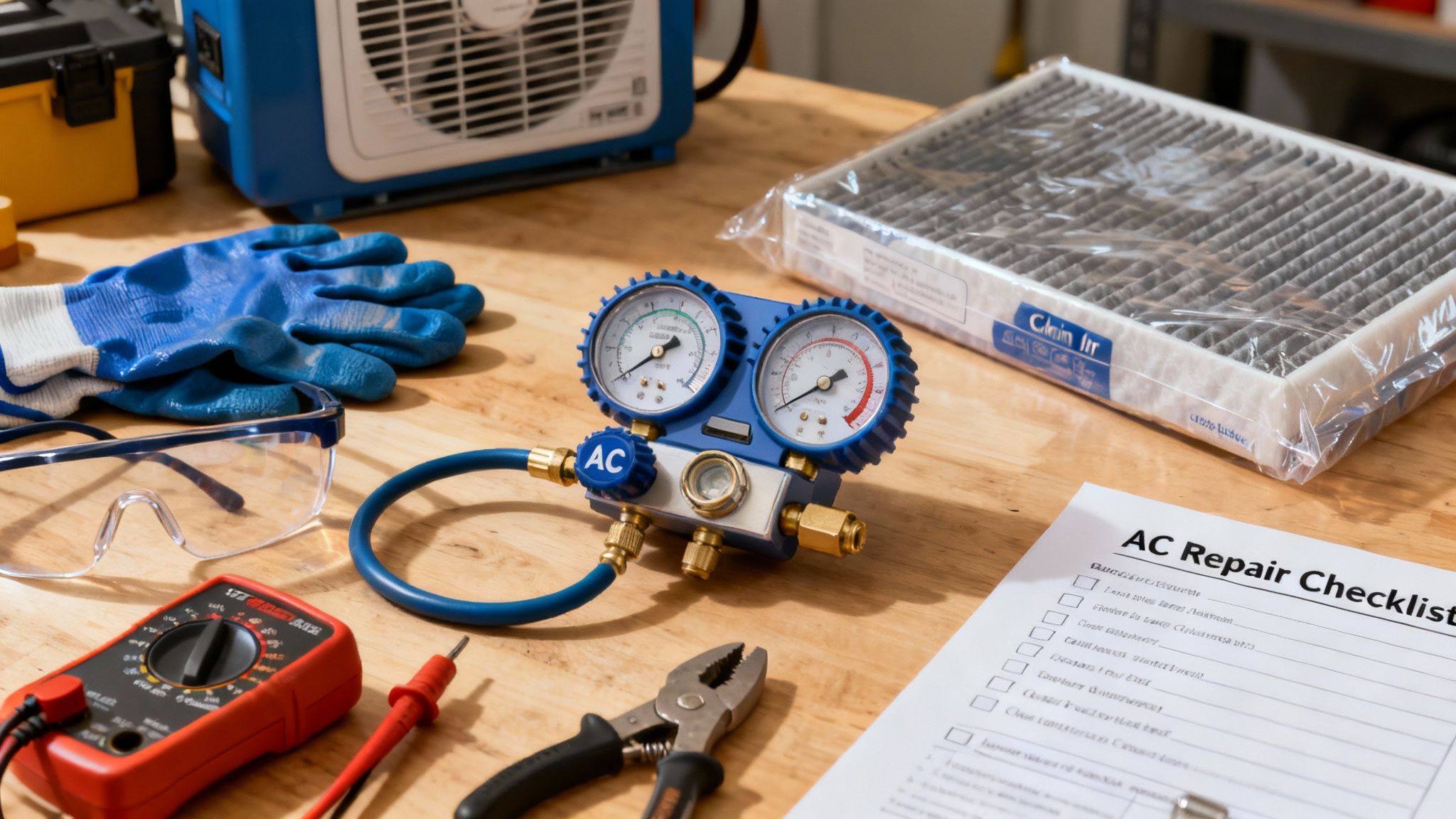
Before you even think about popping the hood, a little prep work can be the difference between a quick, satisfying fix and a day of frustration. Just like any good project, grabbing the right tools and knowing the safety rules isn't optional. It’s about doing the job right and protecting both yourself and your car's delicate AC system.
A successful DIY repair starts with a solid toolkit. You don't need a pro-level garage, but a few basics are non-negotiable for the most common fixes we've covered.
Your Essential DIY Toolkit
Getting your gear ready beforehand means no scrambling around mid-repair. For most basic AC jobs, you’ll want these on hand.
- AC Refrigerant Recharge Kit: This is your main tool for a refrigerant top-off. Get one with a built-in pressure gauge—it's absolutely critical for not overcharging the system.
- Safety Glasses and Gloves: This is mandatory. Seriously. Refrigerant can cause instant frostbite and permanent eye damage if it makes contact.
- Basic Hand Tools: A good socket set, a few screwdrivers, and some pliers will handle most tasks, like getting to the cabin air filter or checking on other parts.
- Flashlight or Headlamp: The low-pressure port and cabin filter are often tucked away in dark corners. A good light source makes the job ten times easier and safer.
- Shop Rags or Towels: Always handy for wiping up small messes and keeping parts clean while you work.
Laying all this out first lets you focus on the task without any unnecessary interruptions.
Putting Safety First During Your Repair
Working on your car’s AC system demands a bit of caution, especially when you’re dealing with refrigerant. It's under high pressure and needs to be respected.
Always work in a well-ventilated area, like your driveway or an open garage—never a closed room. This keeps any fumes from building up. And, of course, make sure the engine is completely off and cool before you start poking around near belts or other moving parts.
Safety First: The refrigerant in your car's AC system can cause severe frostbite on your skin and can lead to blindness if it gets in your eyes. Always wear your protective glasses and gloves from start to finish.
Don't rush this part. Taking that one extra moment to put on your safety gear is the single most important step of any DIY car AC repair.
DIY vs. Professional: A Quick Cost Breakdown
Let’s be honest, a big reason we DIY is to save cash. But is it always the smartest financial move? Knowing the potential costs helps you decide when to roll up your sleeves and when to hand over the keys.
For instance, a DIY refrigerant recharge kit will run you about $40-$60. A new cabin air filter is usually just $15-$30. These are easy wins where you can save a good chunk of change on labor. The flip side is that a professional service comes with diagnostic tools that can find the real problem, like the hidden source of a slow leak.
To give you a clearer picture, here’s how the numbers often shake out.
DIY vs Professional Car AC Fix Cost Comparison
Here’s a look at the estimated costs, time, and complexity for common AC repairs to help you decide if a DIY project is the right call for you.
| AC Repair Task | Estimated DIY Cost | Estimated Professional Cost | Complexity Level |
|---|---|---|---|
| Refrigerant Recharge | $40 – $60 | $150 – $250+ | Moderate |
| Cabin Air Filter Replacement | $15 – $30 | $50 – $100 | Easy |
| Fuse or Relay Replacement | $5 – $20 | $75 – $150 (includes diagnosis) | Easy |
| AC Compressor Replacement | N/A (Pro recommended) | $800 – $1,500+ | Professional Only |
The table makes it pretty clear: for the simple stuff, the savings are huge. But if you’re looking at something complex like a bad compressor or a stubborn leak, the cost of specialized equipment and the risk of getting it wrong often mean a pro is the better long-term investment.
With this prep work and cost analysis done, you can confidently decide whether to tackle that AC fix yourself or let a trusted technician handle it.
When to Call a Professional Technician
Knowing your limits is the mark of a smart DIYer. While recharging your AC or swapping a cabin air filter is satisfying, some car AC problems can quickly turn into catastrophic failures if you push too far. Recognizing the red flags is key to avoiding a much bigger, more expensive headache.
Maybe you recharged the system yourself and enjoyed a few weeks of cold air, only to find you're right back where you started. That's a classic sign of a refrigerant leak that a simple DIY can won't fix for good.
This is where a pro comes in. Technicians use specialized tools like fluorescent dye injectors and electronic leak detectors—we call them "sniffers"—to find the exact source of the leak. It could be a tiny crack in an O-ring or a pinhole in a hose. Just adding more refrigerant is a temporary band-aid that ignores the real problem.
When Electrical Gremlins Appear
Modern AC systems are way more complex than they used to be. They're tied directly into your car's main computer, relying on a whole network of sensors and modules to work right. If the AC compressor clutch won't engage or the system is just acting weird, you’re almost certainly looking at an electrical fault.
This is where DIY troubleshooting hits a hard wall. Without the right diagnostic scanners and wiring diagrams, you risk causing short circuits, frying control modules, or even damaging your car’s main computer.
Here are some clear signs you need an expert:
- The compressor clutch won't engage. You've already checked the fuse and relay, so the problem is deeper—likely a bad pressure switch or control module.
- The AC blows cold, then warm, then cold again. This kind of intermittent problem usually points to a sensor feeding bad data to the computer.
- A new fuse blows instantly. This means there's a dead short somewhere in the AC circuit, and that needs to be traced professionally to be fixed safely.
These aren't just simple mechanical fixes; they're complex diagnostic challenges. If you need help finding the right shop, our guide on how to find a good mechanic you can trust has some great tips.
The Rise of Complex Climate Control
Vehicle climate systems have come a long way from a simple on/off switch. Today, things like dual-zone and even tri-zone automatic climate control are common. In fact, around 70% of car buyers now look for these kinds of advanced features, turning basic AC into a sophisticated amenity everyone expects.
The growing complexity of modern AC systems—with their blend doors, multiple sensors, and computer integration—means that ASE-certified technicians are more valuable than ever. They have the specialized training and equipment needed to diagnose these intricate systems correctly the first time.
When you're facing a problem that goes beyond the basics, calling a professional isn't admitting defeat—it's just being smart. For the really tough issues, the team at Express Lube & Car Care in Richland Hills has the expertise and diagnostic tools to handle any car AC fix and get the job done right.
Your Car AC Questions, Answered
Even after trying a few fixes, you probably still have some questions floating around. It's completely normal. Getting clear on the facts versus the myths can save you a ton of money and keep your AC from quitting on you during a Texas heatwave.
Here are the straight-up answers to the questions we hear all the time from drivers.
How Often Should I Get My AC Checked?
Think of it like a check-up. You should have a pro look at your AC system every one to two years, even if it’s blowing cold. These preventative inspections are designed to catch the small stuff—tiny leaks, slightly low refrigerant, or early signs of a worn-out part—before they turn into a catastrophic failure.
This is especially true here in Texas, where our air conditioners are pushed to their limits for months on end. A quick look-over is always cheaper than a new compressor that burned out because the system was low on refrigerant.
Are Those AC Leak Sealer Cans a Good Idea?
Honestly, using an off-the-shelf AC leak sealer is a huge gamble. They promise a quick, cheap fix, but they often create much bigger, more expensive problems.
The chemicals in those cans are notorious for gumming up the works. They can easily clog delicate parts like the expansion valve, the receiver/drier, and even the compressor itself. What started as a small leak can suddenly become a full system replacement.
The only real way to fix a leak for good is to have a certified tech find the source, repair it properly, and then recharge the system to the manufacturer’s exact specs.
Why Does My Car AC Smell Like Old Socks?
That musty, sour smell is almost always from mold and bacteria having a party on your evaporator core, which is hidden deep in the dashboard. Moisture collects on the evaporator as part of the normal cooling process, creating the perfect dark, damp place for mildew to grow.
The first thing to try is replacing your cabin air filter. A clogged filter can make the problem worse. If that doesn't fix it, you'll need a professional evaporator cleaning service to get rid of the gunk and get your car smelling fresh again.
Can't I Just Top It Off With More Refrigerant?
Your car’s AC is a sealed system. That means if the refrigerant is low, you have a leak—period. Unlike gas, refrigerant doesn't get used up or evaporate over time. Just adding more from a DIY can is like putting a band-aid on a leaky pipe; the new refrigerant is just going to leak right back out.
To fix it the right way, a technician has to find and repair that leak. Then, they use a special vacuum pump to suck out all the air and moisture before recharging the system with the precise weight of refrigerant it needs. It's the only way to guarantee a lasting repair and ice-cold air.
When the DIY approach doesn't cut it, trust the ASE-certified technicians at Express Lube & Car Care to get your AC blowing cold again. We offer walk-in service with no appointment necessary, so you can get a fast, reliable, and honest repair. Stop by today for a professional AC inspection! https://www.expressluberichlandhills.com