

You turn the key, crank the A/C to full cold, and expect relief. Instead, you get warm air, weak airflow, or that stale smell that makes you shut it right back off. That moment usually sends drivers straight to one conclusion: “Great, this is going to be expensive.”
Sometimes it is. A lot of times, it isn’t.
When people ask me about how to diagnose car ac problems, I always start with the same advice. Don’t guess, and don’t jump straight to refrigerant. The fastest way to get pointed in the right direction is to separate the problem into three buckets: airflow, basic under-hood function, and the exact symptom pattern. That simple process rules out a surprising amount before any advanced testing starts.
When Your Car A/C Blows Hot Air
The first hot stretch of the season is when this usually shows up. The A/C seemed fine last year, maybe a little weak, but nothing alarming. Then one afternoon the cabin turns into an oven, and now the vents are blowing air that feels about as useful as an open window in traffic.
That’s when people tend to make two common mistakes. First, they assume the compressor has failed. Second, they buy a recharge can before they know what the system is doing. Both can waste time and money.

A car A/C system isn’t mysterious once you break it down. Air has to move through the cabin properly. The compressor has to engage. Heat has to leave through the condenser. The refrigerant circuit has to stay sealed and balanced. If one part of that chain is off, you’ll feel it at the vents.
Practical rule: Start with the checks that require no tools and no parts. A clogged cabin filter, blocked airflow, or obvious compressor behavior can tell you more than guessing ever will.
Here’s the good news. Not every A/C complaint means major repair work. Some problems come from restricted airflow in the cabin, debris packed into the condenser area, or a clutch that never engages because of a fault elsewhere in the system. You can learn a lot just by paying attention to what the system does when you switch it on.
Before you think about leak sealer, recharge kits, or replacing expensive components, start simple. The first question isn’t “How much refrigerant is in it?” The first question is “Am I dealing with weak airflow, or air that blows strongly but never gets cold?”
Is It an Airflow Problem or a Cooling Problem
Most drivers describe both problems the same way. They say, “My A/C isn’t working.” That’s understandable, but it hides the most important clue.
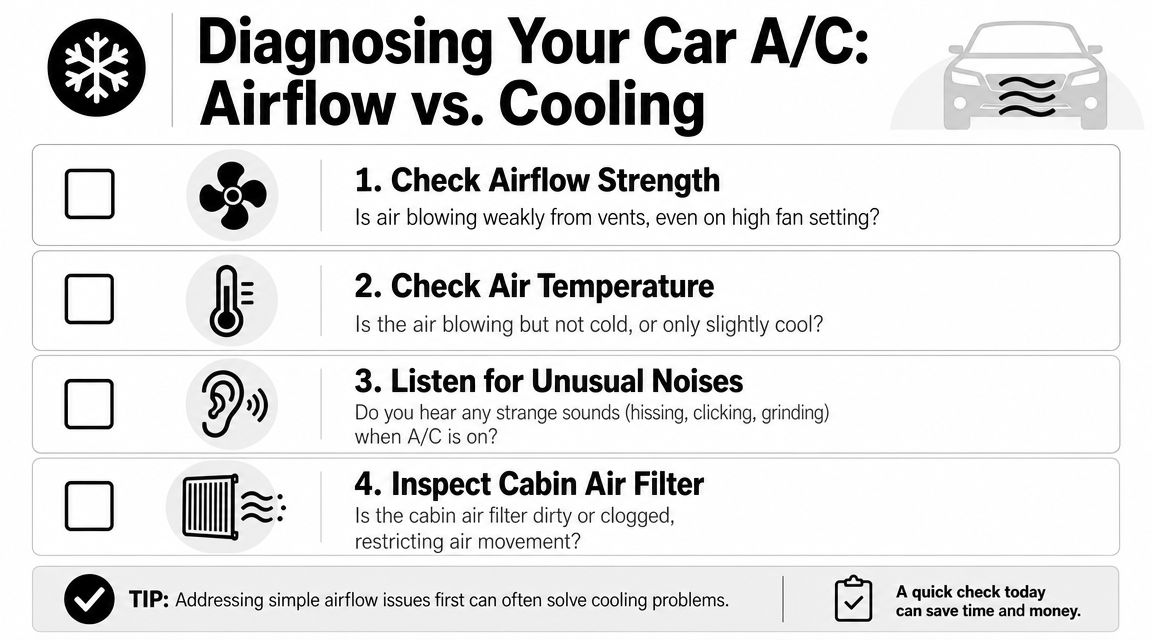
If the air coming from the vents is weak, you may be dealing with an airflow issue inside the vehicle. If the air is strong but warm, the cooling side of the system becomes more likely. AAA notes that weak or inconsistent airflow can point to blower motor issues, fan-speed problems, or duct obstructions, and recommends checking that air flows from all vents plus cleaning or replacing the cabin air filter first in its guide on signs your car’s A/C needs repair.
Check the fan before anything else
Sit in the car with the engine running and the A/C turned on. Then work through the fan speeds.
- Low to high fan test: If the blower changes speed smoothly, that’s useful. If it only works on one setting, especially high, that points more toward a blower circuit or resistor issue than a refrigerant problem.
- Vent comparison: Put your hand over multiple vents. If one vent is strong and another is barely moving air, you may have a duct or mode-door issue rather than a cooling issue.
- Recirculate setting: Switch between fresh air and recirculate. If airflow changes sharply, pay attention. That can help narrow down whether the issue is inside the HVAC box or related to intake restriction.
Check the cabin air filter
A dirty cabin air filter is one of the easiest things to inspect, and it causes more confusion than it should. It won’t make refrigerant disappear, but it can absolutely make the A/C feel weak and disappointing.
On many vehicles, the filter is behind the glove box. On some, it’s under a dash panel or cowl cover. If you’re not sure where yours is, this local guide on how to check your car’s air filter is a solid place to start.
Weak airflow and warm airflow are not the same problem. Treating them like they are is how people end up recharging a system that really needed a filter or blower repair.
Pull the filter and inspect it in good light. If it’s packed with dirt, leaves, or debris, replace it. If airflow improves after that, you’ve already learned something important. If airflow is still strong but the air isn’t cold, move on to the next stage.
What to Look and Listen For Under the Hood
Once you know the cabin side is moving air properly, go under the hood. There, a simple visual check can save a lot of guesswork.
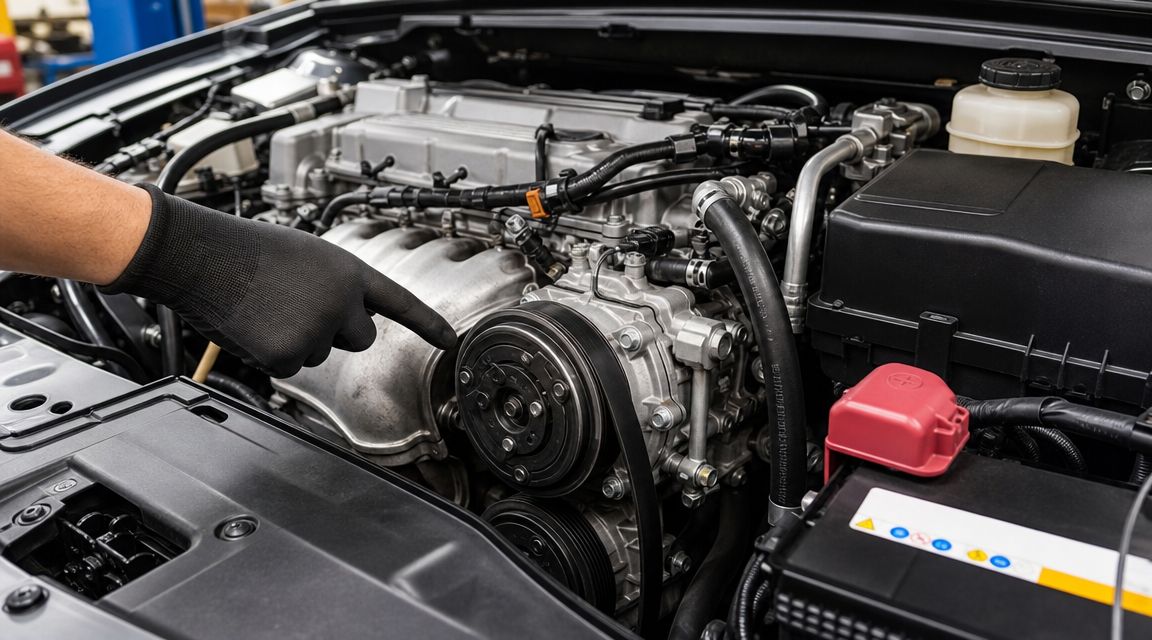
With the engine running and the A/C set to max cool and high fan, the first thing to watch is the compressor clutch. Practical troubleshooting guidance recommends verifying compressor engagement first, because a system with no refrigerant or an electrical fault may never engage the clutch at all. If the clutch doesn’t engage, the next step is to confirm refrigerant charge and then check electrical supply, grounding, and connector integrity, as explained in this compressor clutch troubleshooting video.
Watch the compressor clutch safely
The compressor is belt-driven, and the outer pulley usually spins whenever the engine is running. The center portion is the clutch. When the A/C is commanded on, that center section should engage and begin spinning with the pulley.
Use your eyes and ears. Keep hands, clothing, jewelry, and tools clear of moving parts.
Look for these patterns:
-
Clutch engages and stays on steadily
That usually means the system is at least trying to cool normally. If the vent air still isn’t cold, more detailed diagnosis is needed. -
Clutch never engages
That can point to low refrigerant, an electrical problem, connector issues, fuse or wiring faults, or a failed clutch. -
Clutch clicks on and off rapidly
AutoZone’s A/C diagnostic guidance notes that a clutch cycling on and off every few seconds is a classic sign of low refrigerant because the low-side pressure drops too far when the clutch engages and then rises again when it disengages, as outlined in its article on diagnosing car A/C problems.
Check condenser airflow
The condenser sits in front of the radiator on most vehicles. Its job is to shed heat. If airflow across it is poor, cooling performance suffers even if other parts of the system are working.
Look for:
- Packed debris: Leaves, bugs, dirt, and road grime can block airflow.
- Bent or damaged fins: Severe damage reduces heat transfer.
- Cooling fan problems: If the fans don’t run when they should, the A/C may cool poorly at idle or in traffic.
A quick visual inspection matters here. A mechanically healthy compressor still won’t cool well if the condenser can’t get rid of heat.
Here’s a simple visual walkthrough that can help you identify what you’re seeing under the hood:
Listen for clues, but don’t over-interpret them
Clicks, squeals, and grinding noises matter, but they aren’t a final diagnosis by themselves. A click can be clutch engagement. Repeated clicking can suggest cycling. Grinding or harsh noise can mean internal compressor or pulley trouble.
What doesn’t work is replacing parts based on sound alone. Use sound as a clue, then match it to airflow, vent behavior, and clutch action.
Matching Symptoms to Common AC Problems
Once you’ve checked airflow in the cabin and watched the system under the hood, the symptoms usually start to line up. At this point, drivers stop chasing random fixes and start thinking like a technician.
If you want a broader process for narrowing down vehicle issues, this guide to car problem diagnostic basics follows the same logic: identify the symptom clearly, then match it to the most likely systems before replacing anything.
Common Car A/C Symptoms and What They Mean
| Symptom | What It Feels/Sounds Like | Most Likely Cause(s) |
|---|---|---|
| Weak airflow from vents | Fan is on, but air barely reaches you | Dirty cabin air filter, blower issue, duct obstruction, fan-speed control problem |
| Strong airflow but air stays warm | Plenty of air movement, little to no cooling | Refrigerant issue, compressor not engaging, condenser airflow problem, mechanical fault |
| A/C starts cool, then fades warm | Feels fine at first, then loses cooling | System may be cycling abnormally, airflow restriction, charge-related issue |
| A/C cools better while driving than while stopped | Better on the road, worse at idle | Condenser airflow problem, cooling fan issue |
| Clicking every few seconds under the hood | Repeated clutch click and release | Low refrigerant is a strong possibility when cycling is rapid |
| No change when A/C button is pressed | Cabin blower may work, but no cooling response | Compressor clutch not engaging, electrical fault, low charge |
| Airflow strong on one vent but weak on another | Uneven cabin delivery | Duct issue, mode-door problem, internal HVAC airflow fault |
| Musty smell from vents | Damp, stale odor when system runs | Dirty cabin air filter, moisture or contamination in the HVAC box |
| Water inside the cabin | Damp carpet or dripping passenger-side interior | Evaporator drain problem, not usually a refrigerant diagnosis by itself |
| Grinding or squealing with A/C on | Harsh mechanical noise near engine | Pulley, clutch, belt, or compressor-related mechanical issue |
What owners usually get wrong
The biggest mistake is assuming all warm-air complaints come from low refrigerant. The second biggest mistake is ignoring weak airflow because “the A/C still comes on.”
A clean symptom description beats a vague one every time. “Strong air but not cold” is useful. “A/C doesn’t work” usually isn’t.
Another common miss is confusing an air delivery problem with a cooling capacity problem. If the system can make cold air but the cabin can’t move it effectively, the A/C will still feel bad. That’s why the airflow-first approach saves so much time.
Quick Fixes and Knowing When to Call for Backup
Some A/C checks and fixes are absolutely fair game for a car owner. Others are not.
The safest DIY work is the simple stuff that doesn’t open the refrigerant system. Once refrigerant handling enters the picture, it’s time for professional equipment and proper procedures.

Reasonable first fixes at home
These are the jobs that make sense for many drivers:
- Replace the cabin air filter: If it’s dirty, swap it out and recheck airflow.
- Clean visible debris carefully: Leaves and dirt around the condenser area can restrict airflow. Use care so you don’t bend fins.
- Confirm vent operation: Make sure all modes and fan speeds respond normally.
- Watch for obvious wiring or connector issues: Only with the engine off if you’re inspecting closely around components.
What needs a shop
The moment you suspect a refrigerant leak, clutch electrical fault, or internal compressor issue, the job changes.
Professional diagnosis usually includes a full visual inspection for oil residue, corrosion, damage, or loose connections, followed by active leak detection with UV dye or tracer methods. For performance validation, one source recommends checking vent temperature after a few minutes of operation, and on a properly functioning passenger vehicle system, vent air should typically stabilize around 35 to 40°F (2 to 4°C) in favorable conditions, as described in this overview of professional car A/C diagnosis.
Why recharge cans often create more confusion
A/C systems are pressure-sensitive. Too little refrigerant causes problems. So can the wrong amount. So can contamination, trapped air, or adding refrigerant to a system that has an airflow or electrical fault instead.
That’s why the better approach is diagnosis first, charge correction second. Shops use manifold gauges, vent temperature checks, and leak detection tools to find out why the system isn’t cooling. At a local repair facility such as Express Lube & Car Care, that means inspecting the system before recommending recharge, parts replacement, or leak repair.
If the system leaked once, it can leak again. Adding refrigerant without finding the reason is a short-term guess, not a repair.
Your Next Step for a Cool Drive in Richland Hills
The cleanest way to approach how to diagnose car ac problems is to narrow it down in order. Check airflow first. Then do the safe visual and listening checks under the hood. Then match the exact symptom pattern to the most likely cause.
That process helps you avoid the two biggest wastes of time: replacing parts too early and adding refrigerant before you know whether the problem is airflow, electrical, or mechanical. If you want to compare how local shops present service quality and customer trust, these Reviews To The Top ranking strategies are worth a look because they show what drivers often pay attention to when choosing an auto service provider.
If your A/C still isn’t right after the basic checks, the next smart move is a real diagnostic visit. For local help, this page on auto air conditioning repair near Richland Hills explains what professional A/C service typically involves and when it makes sense to bring the car in.
If your car’s A/C is blowing warm, weak, or inconsistent air, Express Lube & Car Care can help you pin down the problem and repair it correctly. Our ASE-certified technicians handle walk-in diagnostics and A/C service for drivers in Richland Hills who want clear answers, practical recommendations, and a comfortable ride again.