

Your engine is overheating because the cooling system can’t move or shed heat fast enough. Pull over safely, shut the engine off, and let it cool completely before doing anything else. Do not open the radiator cap while the engine is hot.
The cooling system works as a loop: coolant absorbs heat from the engine block, carries it to the radiator, and the radiator releases that heat into the air. When any part of that loop fails — low coolant from a leak, a thermostat stuck shut, a water pump that’s stopped circulating fluid, a clogged radiator, or a fan that won’t spin — heat builds up faster than it can escape, and the temperature gauge climbs.
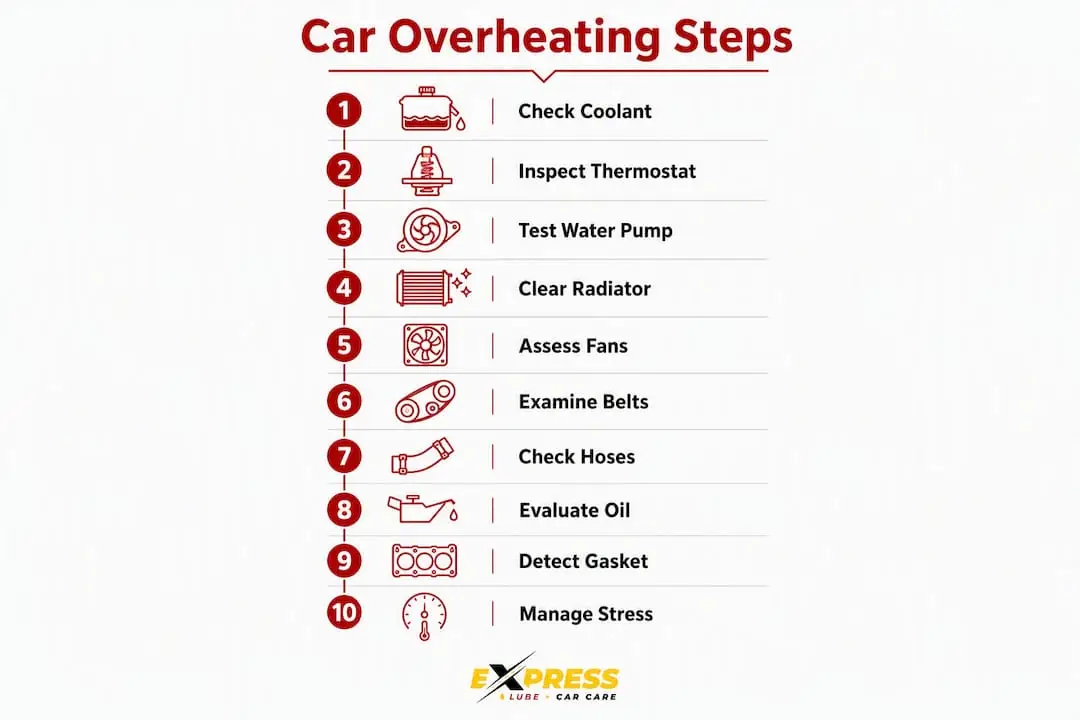
The most common causes at a glance:
- Low coolant or a coolant leak (the most frequent culprit)
- Thermostat stuck in the closed position
- Failed or weak water pump
- Clogged or leaking radiator
- Radiator fan or fan clutch failure
- Broken or slipping serpentine belt
- Low engine oil
- Blown head gasket
Critical warning: driving an overheating vehicle risks permanent engine damage — a blown head gasket or a warped cylinder head can turn a $300 repair into a $3,000+ rebuild. Stop the car, not the clock.
Table of Contents
- Why car overheating happens: the most common causes
- What to do right now if your temperature gauge spikes
- Safe checks you can do after the engine cools
- When you can — and can’t — keep driving, plus what damage costs
- Routine maintenance that prevents overheating
- Why your car overheats but doesn’t lose coolant
- How a professional shop diagnoses overheating
- Key Takeaways
- What we see every week at the shop
- Fast, reliable overheating diagnosis in Richland Hills
- Authoritative sources and further reading
- FAQ
Why car overheating happens: the most common causes
Engines run best within a normal operating temperature range. Anything that prevents the cooling loop from absorbing, moving, or releasing heat pushes that number higher. Here are the causes you’re most likely dealing with, along with the symptoms each one tends to produce.
1. Low coolant or a coolant leak
Low coolant is the leading cause of overheating, and it almost always traces back to a leak somewhere in the system. You might notice a sweet smell near the engine, a puddle of green, orange, or pink fluid under the car, or a temperature gauge that creeps up on longer drives. The coolant reservoir will be below the MIN line.
2. Thermostat stuck closed
The thermostat is a small valve that opens once the engine reaches operating temperature, allowing coolant to flow through the radiator. When it sticks shut, coolant can’t circulate, and heat builds fast. The gauge spikes quickly after startup, often with no visible leaks and a full reservoir — which confuses a lot of drivers.
3. Malfunctioning water pump
The water pump is the heart of the cooling system. It pushes coolant through every passage in the engine and radiator. A worn impeller, a failed bearing, or a leaking seal can all reduce or stop flow. Water pumps typically need regular inspection and eventual replacement as part of routine maintenance. Symptoms include a whining noise from the front of the engine, coolant leaking from the pump weep hole, or overheating that worsens at idle.
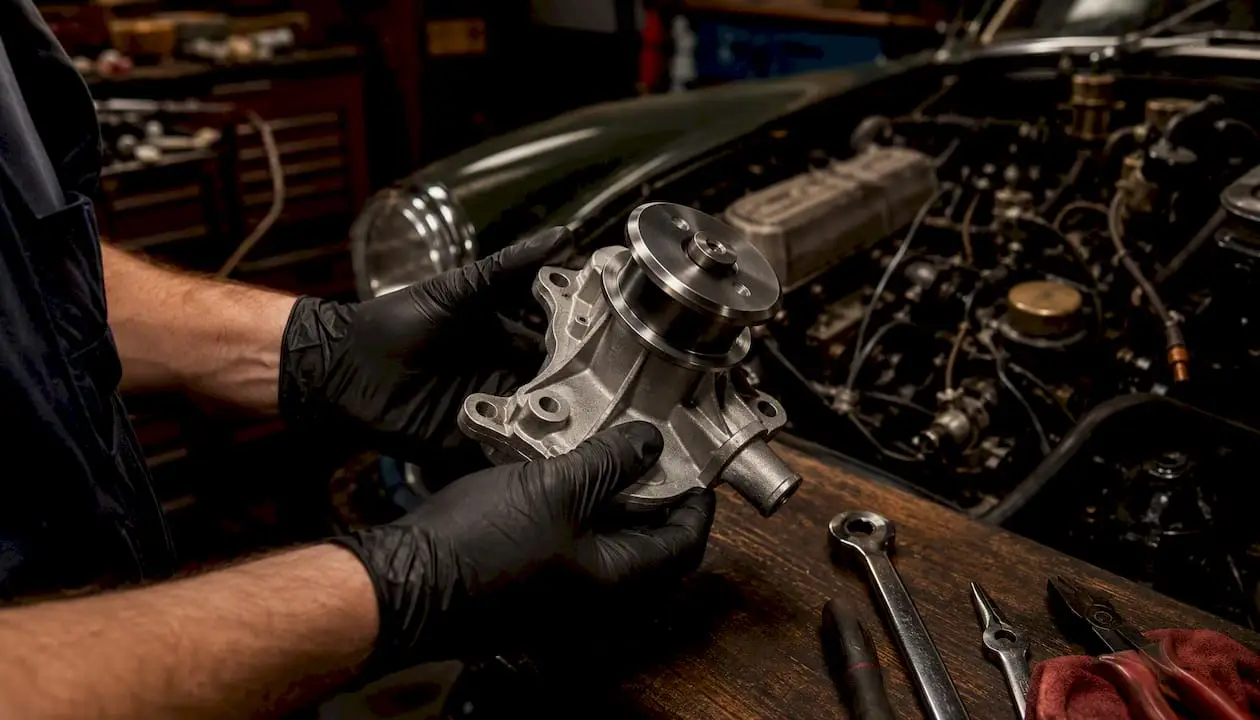
One thing worth knowing: using the wrong aftermarket water pump — wrong impeller design or rotation direction — can cause persistent overheating even after a fresh install. This is a real trap for DIY replacements.
4. Radiator problems (clogs, leaks, cap failure)
A radiator packed with bugs, road debris, or internal sediment can’t shed heat efficiently. Infrared scans can reveal cold spots across the radiator surface that point to blocked internal passages — something you can’t see from the outside. A failing radiator cap is easy to overlook: if it can’t hold the system’s pressure, coolant boils at a lower temperature and the system loses fluid through the overflow.

5. Radiator fan or fan clutch failure
At highway speeds, airflow through the radiator is usually enough to keep temperatures in check. At idle or in stop-and-go traffic, the radiator fan does that job. Fan clutches lose efficiency over time and should be regularly checked and are often missed during routine inspections. Electric fans can fail outright. The tell: the car runs fine on the highway but overheats sitting in traffic.
6. Broken or slipping serpentine belt
On many vehicles, the serpentine belt drives the water pump. A cracked, glazed, or snapped belt means the pump stops turning, and coolant stops moving. You’ll often hear a squeal before the belt fails completely. Check the belt’s condition visually — cracks, fraying, or glazing are all warning signs.
7. Clogged hoses or collapsed lower radiator hose
Hoses can harden, crack, or swell over time. The lower radiator hose has a less obvious failure mode: many contain an internal metal spring to prevent the hose from collapsing under suction. If that spring corrodes or breaks, the hose can pinch shut and block coolant flow while looking perfectly normal from the outside.
Pro Tip: Squeeze the lower radiator hose when the engine is cold. It should feel firm but pliable. A hose that collapses easily under light pressure likely has a broken internal spring and needs replacement.
8. Low engine oil
Oil doesn’t just lubricate — it carries heat away from parts the coolant can’t reach directly. Low oil increases friction and raises engine temperature, especially under load. Check the dipstick. If the oil looks milky or foamy, that’s coolant mixing with oil — a sign of head gasket failure, not just low oil.
9. Blown head gasket
A head gasket seals the combustion chamber from the coolant passages. When it fails, combustion gases enter the cooling system, building pressure and heat faster than the system can handle. White smoke from the exhaust, a sweet smell, a fluctuating temperature gauge, and milky oil are all classic signs. This is a serious repair — not a wait-and-see situation.
10. External stress factors
Stop-and-go traffic on a 100°F day, towing a heavy trailer, or running the A/C hard while climbing a grade all push the cooling system harder than normal. These conditions don’t cause overheating on their own in a healthy car, but they expose weaknesses that might otherwise go unnoticed. Drivers who tow regularly or do a lot of city driving in hot climates should treat cooling-system inspections as a higher priority. For a full seasonal breakdown, the summer car care guide covers what to check before temperatures climb.
What to do right now if your temperature gauge spikes
Stay calm. The steps below protect both you and your engine.
Step-by-step:
- Turn on your hazard lights immediately.
- Pull over to a safe location as soon as possible — a parking lot, a wide shoulder, anywhere off the main road.
- Turn the engine off. Do not idle it hoping it cools down faster.
- Stay in the car with hazards on if you’re on a busy road. Warn other drivers if it’s safe to exit.
- Wait at least 30 minutes before touching anything under the hood.
- Never open the radiator cap while the engine is hot. Pressurized coolant can spray and cause serious burns.
- Once the engine is fully cool, check the coolant reservoir level. If it’s low and you have coolant or water available, top it off carefully.
- Call for help if you see steam, smell burning coolant, or the gauge returns to red after restarting.
Short-term tactic: Turning the heater on full blast draws heat away from the engine and into the cabin. It’s uncomfortable, but it can buy you enough margin to reach the nearest shop — only if temperatures drop back to normal and you see no steam or leaks.
Tow immediately if you notice any of these:
- The temperature gauge stays in the red after the engine has had time to cool
- White steam or smoke coming from the exhaust pipe (not just the hood)
- A visible coolant puddle forming under the car
- The oil dipstick shows milky or foamy oil
- Loss of oil pressure warning light alongside the temperature warning
Safe checks you can do after the engine cools
Once the engine is completely cold (give it at least an hour), these checks take 15–30 minutes and give you useful information before you call a shop.
- Coolant reservoir level and color. The reservoir is a translucent plastic tank near the radiator. The level should sit between MIN and MAX. Coolant should be bright (green, orange, or pink depending on type) and clear. Brown, rusty, or oily coolant signals contamination.
- Look for external leaks. Check under the car and around hoses, the water pump, and the radiator for wet spots, staining, or dried coolant residue.
- Belt condition. Inspect the serpentine belt for cracks, glazing, fraying, or missing chunks. A belt that looks shiny instead of matte has been slipping.
- Hose condition. Squeeze each hose. They should feel firm but flexible. Hard, brittle hoses or soft, mushy ones both need replacing.
- Oil level and appearance. Pull the dipstick. Low oil is a problem on its own. Milky or foamy oil means coolant is mixing with oil — stop driving and call a shop.
- Radiator cap (cold only). Remove the cap and inspect the rubber seal. A cracked or compressed seal can’t hold system pressure and lets coolant escape.
- Radiator fan. Start the engine cold and let it idle. Within a few minutes, the fan should kick on. If it doesn’t, you’ve found a likely cause. Turn the engine off before reaching near the fan.
- Heater output. With the engine at operating temperature, turn the heater to max. Weak or cold output from a warm engine often points to low coolant flow or a stuck thermostat.
What your results likely mean:
- Low coolant + puddle under car: external leak (hose, radiator, water pump seal)
- Full coolant + no leaks + gauge spikes: thermostat, fan, or water pump impeller
- Milky oil: head gasket failure — do not drive
- Fan not running at idle: fan motor, relay, or fan clutch failure
When you can — and can’t — keep driving, plus what damage costs
Stop driving and call a tow if:
- The temperature gauge is in the red and won’t come down
- You see white steam from the exhaust
- There’s a visible coolant leak that doesn’t stop
- The oil looks milky on the dipstick
- You hear knocking or grinding from the engine
If temperatures return to normal, there’s no steam, no visible leak, and the heater blows warm, you may be able to drive cautiously to the nearest shop — but treat it as a one-shot trip, not business as usual.
What overheating can damage and what repairs typically cost:
| Damage | Typical Repair Cost Range | Notes |
|---|---|---|
| Thermostat replacement is a common and straightforward cooling system repair | Common, straightforward repair | |
| Water pump replacement is a common cooling system repair often done during related service | Often done with timing belt service | |
| Radiator replacement costs vary by vehicle make and model | Varies by vehicle make and model | |
| Head gasket repair is labor-intensive and can be costly | Labor-intensive; can approach engine replacement cost | |
| Warped cylinder head repair may require resurfacing or full replacement | May require full head replacement | |
| Repairing a seized or cracked engine block can be very expensive, often leading to totals on older vehicles | Often totals older vehicles |
Every mile you drive on an overheating engine multiplies the repair scope. A thermostat that costs $200 to fix today can warp a cylinder head by tomorrow, adding $1,000 or more to the bill. The math strongly favors stopping early.
If a major repair is on the table, financing options can help spread the cost without delaying necessary work.
Routine maintenance that prevents overheating
Prevention is straightforward, and most of it fits into a regular service schedule. Here’s what to stay on top of:
Maintenance checklist:
- Coolant flush: — Follow your manufacturer’s interval. Many vehicles require coolant flushes at regular manufacturer-recommended intervals to maintain cooling efficiency. Manufacturer-recommended flush intervals help prevent sediment and corrosion buildup that silently reduce cooling efficiency.
- Oil changes: Regular oil change service keeps oil at the right level and viscosity, reducing heat from friction.
For a complete maintenance schedule, the car maintenance checklist covers all the key intervals in one place.
Pro Tip: Before a summer road trip or towing job, ask your shop for a cooling-system pressure test. It takes about 20 minutes and catches leaks that won’t show up until you’re under load on a hot day.
Internal blockages from rust, scale, or debris are just as common as external leaks — and topping off the coolant reservoir does nothing to fix them. A professional coolant flush clears those passages in a way that simply adding fluid can’t.
Why your car overheats but doesn’t lose coolant
This is one of the most confusing scenarios: the reservoir is full, there’s no puddle under the car, but the gauge still climbs. When coolant level appears normal, the likely causes are mechanical, not a simple fluid loss.
- Thermostat stuck closed. Coolant sits in the engine but can’t reach the radiator. The gauge spikes fast, often within the first 10 minutes of driving. The heater may blow warm initially, then drop off as the engine gets dangerously hot.
- Failed electric fan or worn fan clutch. The car runs fine at highway speeds but overheats in traffic. The fan isn’t doing its job at low speeds when airflow through the radiator is minimal.
- Collapsed lower radiator hose. Externally, the hose looks fine. Internally, a broken spring lets it pinch shut under suction. Coolant can’t flow through, and the engine overheats despite a full reservoir.
- Eroded water pump impeller. The pump spins, but the impeller blades are worn down or corroded and can’t generate enough flow. This is hard to diagnose without removing the pump or doing a flow test.
- Head gasket failure (internal leak). Combustion gases enter the coolant passages, building pressure and heat. The coolant level may stay stable because the leak is internal. White exhaust smoke, a sweet smell from the tailpipe, and a fluctuating gauge are the key signs. A block-checker test (combustion gas in coolant) confirms this quickly.
How to tell them apart:
- Gauge spikes fast after startup, heater works initially: thermostat
- Overheats only in traffic, fine on highway: fan or fan clutch
- Gauge fluctuates, white exhaust smoke: head gasket
- No obvious symptoms except rising temp: water pump impeller or internal blockage
A professional pressure test or combustion-gas-in-coolant test is often the fastest way to rule out head gasket failure when everything else looks normal. For more on performance-related overheating patterns, the team at Performance Tuning NI covers some useful technical angles.
How a professional shop diagnoses overheating
When you bring an overheating car to a shop, a good technician doesn’t just guess — they follow a systematic process to find the actual root cause, not just the most obvious one.
Typical diagnostic workflow:
- Digital vehicle inspection: A tech photographs the cooling system components — hoses, belts, radiator, reservoir — so you can see exactly what they see. Express Lube & Car Care’s digital vehicle inspection process sends those photos directly to you.
- Cooling system pressure test: The system is pressurized to its rated cap pressure. Any drop in pressure points to a leak — internal or external.
- Infrared radiator scan: An infrared thermometer scanned across the radiator surface reveals cold spots that indicate internal blockages or clogged passages. This is far more precise than visual inspection alone.
- Compression or leak-down test: Checks whether combustion gases are entering the cooling system (head gasket failure indicator).
- Block checker / combustion gas test: A chemical test that detects exhaust gases in the coolant — the fastest confirmation of a blown head gasket.
- Belt, hose, fan, and clutch inspection: Physical checks for wear, tension, and operation.
- Coolant analysis: Checks pH, freeze point, and contamination level.
Tools and what they tell you:
| Tool | What It Finds |
|---|---|
| Pressure tester | Leaks in hoses, radiator, water pump, head gasket |
| Infrared thermometer | Cold spots in radiator (internal blockage) |
| Block checker | Combustion gases in coolant (head gasket) |
| Compression tester | Cylinder pressure loss (head or gasket damage) |
| OBD scanner | Engine codes, coolant temp sensor data |
Most shops separate a diagnostic fee from the repair estimate. Expect a diagnosis to take 1–3 hours for a straightforward cooling-system issue; head gasket confirmation can take longer. ASE-certified technicians follow a documented process and can explain exactly what they found and why the repair is necessary.
Key Takeaways
Engine overheating is almost always a cooling-system failure — catching it early and stopping immediately is the single most effective way to prevent a minor repair from becoming a major one.
| Point | Details |
|---|---|
| Stop immediately | Pull over and shut off the engine the moment the gauge enters the red or you see steam. |
| Top three causes to check | Low coolant, thermostat failure, and fan problems account for most overheating cases. |
| Never drive on a red gauge | Continuing to drive risks warped heads or a blown head gasket, turning a $300 fix into $3,000+. |
| Flush and inspect on schedule | Coolant flushes, hose checks, and belt inspections prevent the majority of overheating events. |
| Express Lube & Car Care | Walk-in or book a digital vehicle inspection with photos — ASE-certified techs diagnose the root cause, backed by a 24-month/24,000-mile warranty. |
What we see every week at the shop
Most overheating calls we get follow the same pattern: a driver noticed the gauge creeping up days earlier, figured it would sort itself out, and kept driving. By the time the car arrives at the shop, what started as a $150 thermostat job has become a head gasket repair. The early warning signs — a slightly high gauge, a faint sweet smell, a small puddle in the driveway — are easy to dismiss. They shouldn’t be.
The other thing we see regularly is confusion about “full coolant, still overheating.” Drivers assume a full reservoir means the cooling system is fine. It doesn’t. A stuck thermostat, a worn fan clutch, or a collapsed lower hose can all cause serious overheating with a perfectly full reservoir. That’s exactly why a systematic diagnostic matters more than a quick visual check.
Our approach at Express Lube & Car Care is simple: we photograph what we find, explain it in plain language, and give you a clear repair recommendation with no pressure. ASE-certified technicians handle every diagnosis, and every repair comes with a 24-month/24,000-mile warranty. If you’re not sure whether your car has an overheating problem or just a quirky gauge, come in and let us take a look. Better to know now than on the side of the highway.
Fast, reliable overheating diagnosis in Richland Hills
When your temperature gauge has been misbehaving or you’ve already had one close call, the smartest next step is a proper cooling-system inspection — not another week of hoping for the best.
Express Lube & Car Care offers same-day, walk-in cooling-system diagnostics performed by ASE-certified technicians. Every inspection includes digital photos of what we find, so you see the problem before you approve any repair. Services cover the full cooling-system picture: coolant flush, radiator inspection and repair, water pump and thermostat replacement, belt and hose checks, and pressure testing. All repairs are backed by our 24-month/24,000-mile warranty — no fine print, no surprises. If a bigger repair is needed, financing options are available to keep you moving without the wait. Stop by the shop at 2840 or book an appointment online — same-day service is available for most cooling-system concerns.
Authoritative sources and further reading
These resources back the guidance in this article and are worth bookmarking if you want deeper technical detail:
- Car Overheating: 8 Causes and Solutions — AAA Automotive’s breakdown of the most common causes, with service interval guidance.
- Causes of Engine Overheating — AA1Car’s technical deep dive, including infrared diagnostics and water pump failure modes.
- Engine Overheating Solutions: Quick Fixes & Safety Advice — GEICO’s practical overview of symptoms and short-term tactics.
- Why Is My Car Overheating? — Express Lube & Car Care’s own quick-reference guide to causes and fixes.
- Coolant Flush Service Guide — What a coolant flush involves and why it matters for long-term engine health.
FAQ
Can I drive if my car is overheating?
No. Driving on an overheating engine risks a blown head gasket or warped cylinder head — pull over, shut the engine off, and call for help or a tow.
Why is my car overheating but not losing coolant?
A full coolant reservoir doesn’t rule out overheating. A thermostat stuck closed, a failed fan or fan clutch, a collapsed lower radiator hose, or a worn water pump impeller can all cause overheating with no visible fluid loss.
How do you fix a car that overheats?
The fix depends on the cause. Common repairs include thermostat replacement, water pump replacement, radiator repair or replacement, and head gasket repair, which can be labor-intensive with costs that vary widely. A proper diagnosis is the first step.
Is it expensive to fix an overheating engine?
It depends on how long the engine ran hot. A thermostat or fan repair is relatively affordable. A blown head gasket or warped cylinder head can be labor-intensive and costly. Stopping early almost always keeps the repair bill lower. Express Lube & Car Care offers financing for larger repairs to help manage the cost.