

The most common coolant leak symptoms are a sweet smell after driving, a green, orange, pink or blue-green puddle under the car, a coolant level that keeps dropping, and a temperature gauge that climbs higher than normal. Any one of these is enough reason to have the cooling system checked soon. If the gauge is in the red or you see steam, pull over and shut the engine off.
We see this a lot with Richland Hills drivers. A Texas summer in stop-and-go traffic on Loop 820 or Highway 26 asks a lot of a cooling system, and a small seep that went unnoticed in March can become a roadside breakdown in July. This guide walks through what the symptoms look like, how to tell coolant from other fluids, what usually causes the leak, what you can safely check yourself, and when it is time for a professional pressure test.
TL;DR
- Watch for a sweet smell, colored puddles, a low coolant level, steam, and a temperature gauge that runs hot.
- Coolant feels like water, smells sweet, and is usually green, yellow, orange, pink or blue-green. Clear water under the car is often just A/C condensation.
- Hoses, the radiator, the water pump, the radiator cap, the thermostat housing and the heater core are the usual suspects.
- Never open the radiator or reservoir cap on a hot engine. If the engine is overheating, stop driving.
- If coolant keeps disappearing and you cannot see a leak, a pressure test is the right next step.
Table of Contents
- What are the signs of a coolant leak?
- Is that puddle coolant, water, or something else?
- What causes a coolant leak?
- Does a coolant leak mean a blown head gasket?
- External vs. internal leaks: how to tell
- How to check for a coolant leak safely
- How a shop finds a leak you cannot see
- Can you drive with a coolant leak?
- What does it take to fix a coolant leak?
- How to keep coolant leaks from starting
- Get a coolant leak checked in Richland Hills
- FAQ
- Sources
What are the signs of a coolant leak?
Coolant leaks announce themselves in several ways, and they rarely all show up at once. Here are the ones worth taking seriously.
A sweet smell after driving
Antifreeze has a distinctly sweet odor. When a small amount drips onto a hot engine or exhaust, it burns off and you may smell it at a stoplight or after you park, even if there is no puddle. Car and Driver lists a sweet smell after driving among the common signs, along with colored puddles and an engine that runs hot.
A stronger smell inside the cabin points somewhere else. The same source notes that a leaking heater core can cause a stronger coolant smell inside the car, damp carpet, or windows that fog up easily. If your passenger-side floor feels wet and the windshield films over when you turn on the heat, mention that to your technician right away.
Smells can be confusing, since a musty A/C, spilled drinks and burning oil all have their own character. If you want a general approach to diagnosing the source of car odors, the principle is the same: find where it is coming from before you treat it.
Colored puddles or stains under the car
A spot on your driveway or parking space is the classic clue. Coolant is often green, yellow or orange, though other colors are possible, and it feels like water but smells sweet, according to AutoZone’s guide to leaking fluids. Look for damp or crusty residue around hoses, the radiator and the water pump as well. Dried coolant often leaves a chalky white, green or pink crust at the leak point.
A coolant level that keeps dropping
Coolant does not get used up like fuel. In a sealed system, the level in the recovery tank should stay fairly steady between the minimum and maximum marks. If you keep topping it off, the coolant is going somewhere. AutoZone lists persistent low coolant and a low-coolant warning light among the main warning signs.
A temperature gauge that climbs or swings
Less coolant means less ability to carry heat away from the engine. Watch for a gauge that reads higher than usual, one that creeps up in traffic, or one that swings up and down. Steam from under the hood is the final warning. Our guide to why a car overheats goes deeper on the causes and the safe steps to take when it happens.
Warning lights and heater that blows cool
A low-coolant message or temperature warning light is the car telling you the same thing. Another subtle sign is a cabin heater that turns lukewarm in cold weather, because the heater uses hot coolant too. That is less of a Texas problem in August, but a cold morning in January can reveal it.
Is that puddle coolant, water, or something else?
Before you worry, identify the fluid. Slide a white paper towel or a piece of cardboard under the drip and check color, feel and smell.
| Fluid | Color | Feel and smell | Usual source |
|---|---|---|---|
| Coolant (antifreeze) | Green, yellow, orange, pink or blue-green | Thin like water, sweet smell | Cooling system |
| Water | Clear | No smell | A/C condensation or normal drip |
| Engine oil | Dark brown or black | Slick, oily | Engine |
| Transmission fluid | Reddish | Viscous, pungent | Transmission |
The descriptions of oil, transmission fluid and water come from AutoZone’s fluid-leak guide. Car and Driver makes the same point about A/C: condensation is clear, while antifreeze forms a colored puddle. On a hot, humid day, a small clear puddle under the passenger side of the front of the car after running the A/C is normal. If the drip is colored or sweet, it is not.
Power steering fluid and brake fluid can also leave spots, so if the color does not match, take a photo and bring it in. Our article on power steering fluid leak symptoms can help you rule that one in or out.
What causes a coolant leak?
The cooling system is a loop of hoses, metal passages and seals under pressure, and heat and age work against all of it. Sources such as How a Car Works list cracked or flexed hoses, overtightened clips, radiator seams, water pump bearings or gaskets, thermostat housings or gaskets, and core plugs as typical leak points. Core plugs can loosen from pressure, corrosion or vibration. HowStuffWorks names six common causes: damaged hoses, leaking heater cores, worn water pumps, faulty radiator caps, corroded radiators and blown head gaskets.
Here is how that looks in the shop.
- Hoses and clamps. Rubber hardens and cracks with heat cycles. A hose that feels crunchy or swollen, or a clamp with crusty residue, is a common find.
- Radiator. Corrosion, damaged seams and impact damage cause seepage. If you suspect this one, our radiator leak repair cost guide explains what shapes the repair decision.
- Water pump. A weeping seal or a failing bearing can leak from the pump’s small vent hole, often with a whining or grinding sound.
- Radiator cap. A cap that no longer holds pressure can let coolant escape as steam or overflow. It is a small part, but it matters.
- Thermostat housing. Gaskets and plastic housings can crack or seep over time. A thermostat can also fail in other ways, as in this case of a thermostat stuck open.
- Heater core. It sits behind the dash, so symptoms show up inside: damp carpet, a sweet smell in the cabin, and fogged windows.
- Head gasket. This is the one drivers fear most, and it is covered below.
Does a coolant leak mean a blown head gasket?
No. Most coolant leaks come from hoses, the radiator, the water pump or connections, and are far less involved than a head gasket repair. A head gasket is only one possible source.
That said, certain combinations point toward an internal leak. AutoZone notes that bubbles in the reservoir can signal combustion gases entering the cooling system, possibly from a head gasket leak. Other signs commonly associated with a failing head gasket include white exhaust smoke, milky or foamy engine oil, and an engine that overheats repeatedly with no visible external leak. No single sign proves it. That takes a proper test, such as a cooling system pressure test or a combustion-gas check, performed by a technician.
If a head gasket turns out to be the problem, you will want to understand the scale of the repair before deciding. For general background on blown head gasket repair cost and the choices owners face, that is a useful starting point, though your own vehicle and the diagnosis will decide the actual path. We never guess at a head gasket. We confirm it first.

External vs. internal leaks: how to tell
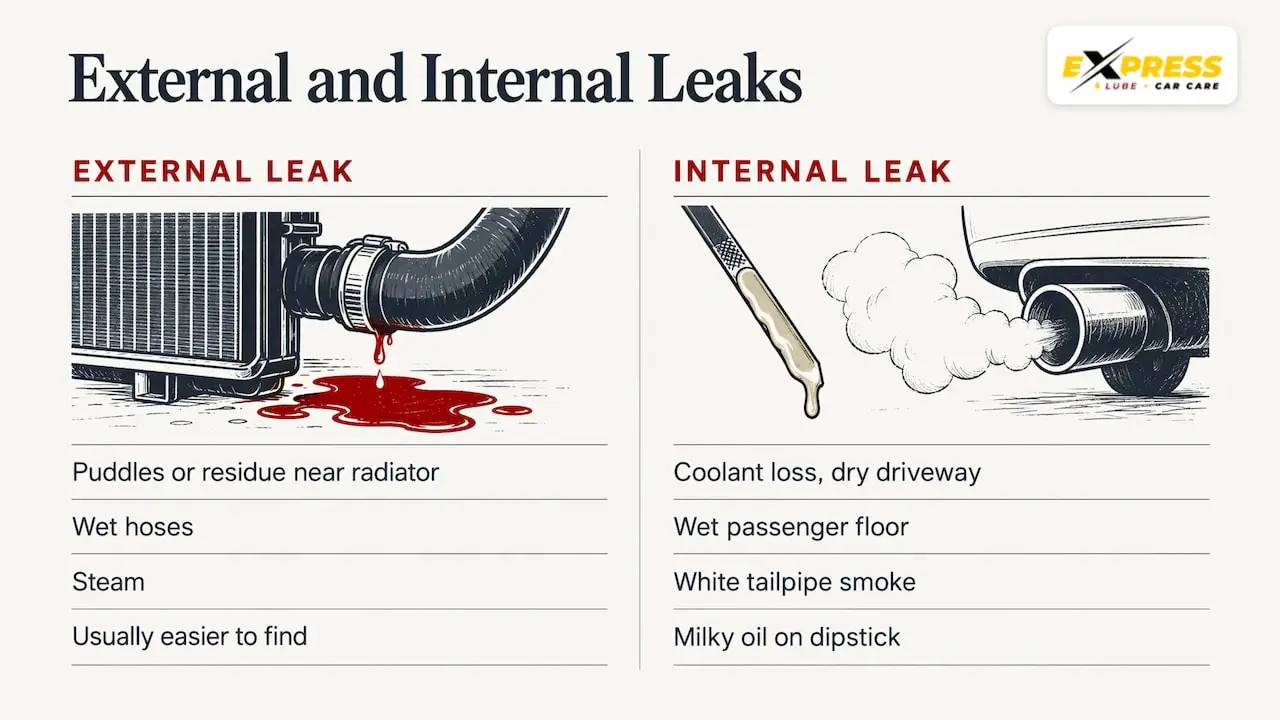
An external leak leaves evidence: puddles, wet hoses, crusty residue, steam. These are usually easier to find. An internal leak sends coolant somewhere you cannot see, such as into a cylinder or into the heater core’s housing.
Car and Driver’s guidance is consistent here. External leaks may leave colored puddles or residue around the radiator cap, hoses or radiator, and if the coolant is low but no leak is visible, a technician should pressure test the system. Internal clues include coolant loss with a dry driveway, a wet passenger floor, white smoke from the tailpipe, or milky oil on the dipstick or under the oil fill cap.
How to check for a coolant leak safely
You can do a basic inspection at home in about 15 minutes of hands-on time, as long as the engine is cold. Here is the order we would follow.
- Let the engine cool completely. Never remove a radiator or reservoir cap on a hot engine. Pressurized coolant can spray out and cause serious burns, and Car and Driver specifically warns against opening a cap before the engine has adequately cooled.
- Park on clean, dry pavement. Check for a fresh puddle after about 15 minutes, which is the timeframe Car and Driver suggests. A clean sheet of cardboard under the engine makes drips easier to read.
- Check the recovery tank. The level should sit between the marks when cold. Note it, then recheck in a few days.
- Look at the hoses and clamps. Look for wet spots, crust, swelling or cracks at the ends where hoses connect.
- Inspect the radiator and cap area. Look for stains, bent fins or residue along the seams.
- Look under the car. Trails of dried coolant often run downward from the source, so trace residue upward.
- Check inside. Feel the passenger-side carpet, and notice any sweet smell or fogging when the heat or defrost runs.
If you find a wet hose or crusty fitting, you have likely found the leak. If you find nothing but the level still drops, that is where a professional comes in.
How a shop finds a leak you cannot see
Small leaks often only show up when the system is hot and under pressure, then dry up as the car cools. That is why a thorough shop does not rely on a quick glance.
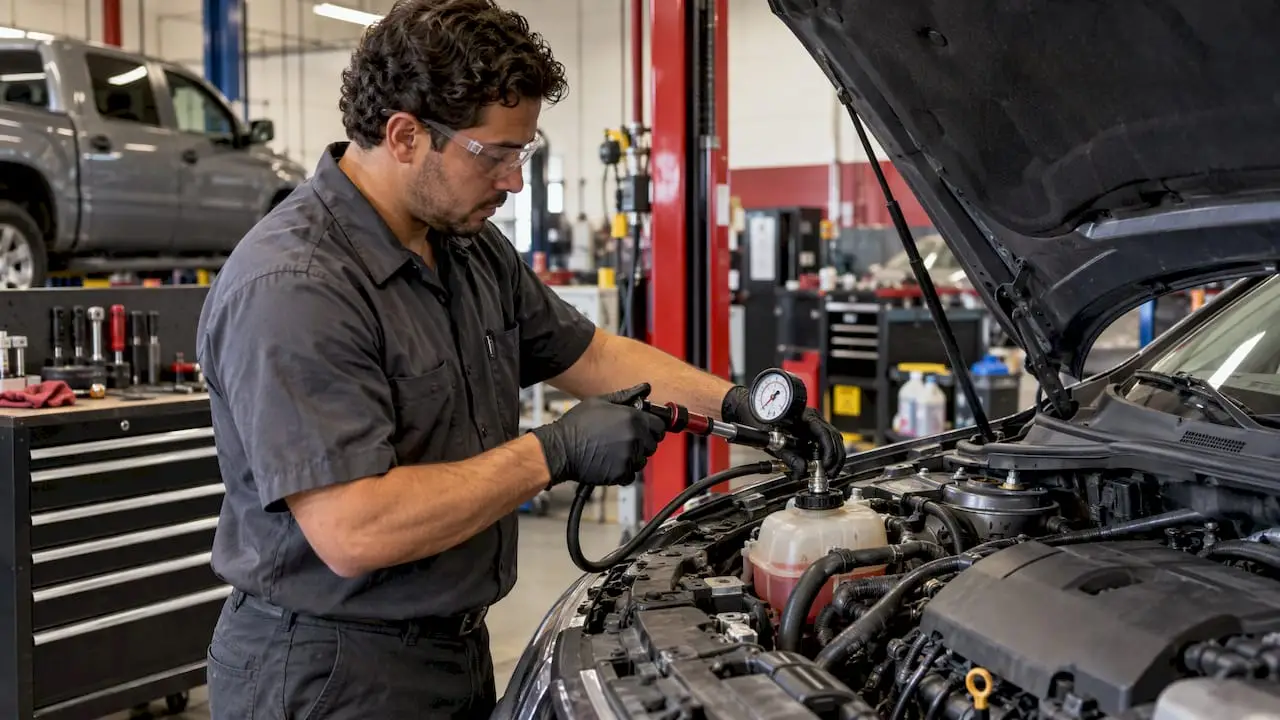
The professional approach is documented. A June 2024 service bulletin hosted by NHTSA for a suspected engine coolant leak directs technicians to inspect the entire cooling system under pressure, use ultraviolet light, and trace residue upward to its source. That kind of method helps especially when residue has migrated to lower areas of the engine compartment, which can send you to the wrong part if you guess.
In practice, diagnosis usually includes:
- A visual inspection of hoses, clamps, radiator, water pump, thermostat housing and heater hoses.
- A cooling system pressure test to reproduce the leak.
- UV dye and a UV light when the leak is slow or hidden.
- A radiator cap test.
- A check for combustion gases in the coolant when a head gasket is in question.
At our shop, ASE-certified technicians do the diagnosis first, and our digital vehicle inspections include photos, so you can see what we see before you approve any work. We do not recommend a repair until we know what is actually failing.
Can you drive with a coolant leak?
For a very small seep, a short, careful drive to a shop may be reasonable if the gauge stays normal and the coolant level is topped off. It is not a plan for the week. If the temperature gauge rises, the warning light comes on, or you see steam, stop driving.
The reason is simple: an engine without enough coolant overheats. HowStuffWorks warns that overheating from a coolant shortage can warp cylinder heads, contaminate engine oil and leave you stranded. Those are the kinds of failures that turn a modest hose repair into engine work.
If the engine overheats while you are driving:
- Turn off the A/C and turn the heater on high to pull some heat from the engine, if you can do so safely.
- Pull over as soon as it is safe and shut the engine off.
- Wait for the engine to cool fully before touching any cap.
- Call for a tow if the level is very low or the leak is active. Adding water to the tank can get you a short distance, but the system then needs to be properly refilled and checked.
Do not keep going to “make it home.” Our overheating guide lays out the safe steps in more detail.
What does it take to fix a coolant leak?
The repair depends entirely on the source, which is why we do not quote a number before diagnosis. A loose clamp, a worn hose, a radiator cap, a water pump, a radiator, a heater core and a head gasket are very different jobs in parts, labor and access. Prices vary by vehicle, and we will not guess at them in an article.
What we can tell you is how to think about the decision:
- Fix the cause, not the symptom. Stop-leak additives may seem tempting, but they can clog small passages and do not replace a proper repair. Find the leak and fix it.
- Replace related wear items together when it makes sense. If a hose is cracked, the ones next to it are the same age. Your technician can show you their condition in photos.
- Refill and bleed correctly. Air trapped in the system can cause overheating even after the leak is fixed.
- Use the right coolant. Different vehicles call for different coolant types, and mixing the wrong ones can cause problems. Check your owner’s manual, and see our guide on what engine coolant is and how to choose it.
Eligible customers can also explore financing through third-party providers such as Koalafi, Snap Finance, American First Finance and Synchrony, subject to provider approval and terms. It is not an in-house payment plan, and approval is never guaranteed.
How to keep coolant leaks from starting
Prevention is cheap compared with a breakdown. Base it on your owner’s manual and how you drive, not on a one-size mileage rule.
- Check the level when the engine is cold. Make it a habit once a month, and before long trips.
- Follow the manufacturer’s coolant service guidance. Coolant additives wear out, and old coolant can corrode internal parts. Intervals differ by vehicle, so check your manual. Our coolant flush service guide explains what a service involves.
- Have hoses and belts inspected at routine service. Heat, short trips and stop-and-go traffic age rubber faster than many people expect.
- Watch the gauge. If it moves from its normal position, take it seriously.
- Keep the radiator face clean. Bugs, leaves and debris can reduce airflow.
- Act on small signs early. A faint sweet smell is cheaper to fix than an overheated engine.
Heavy use matters too. Towing, hauling, rideshare and delivery driving, and fleet work all put more heat cycles on a cooling system than a light commute. If that is you, ask for a cooling system check at every service.
Our perspective: diagnose first, then repair
Most coolant problems we see started small. A drip, a smell, a level that needed a top-off every few weeks. By the time the temperature gauge climbs, the cheap fix has often become an expensive one.
That is why we put diagnosis ahead of the parts counter. Our ASE-certified technicians pressure test the system, trace the leak to its actual source, and show you photos through our digital vehicle inspection, so you can see the worn hose or the weeping pump for yourself. We think you should be able to understand a repair before you approve it.
We also serve more than commuters. European vehicles, SUVs and trucks, rideshare and delivery drivers, and fleets all lean on their cooling systems harder, and they cannot afford to lose a day. We take walk-ins, offer same-day service when possible, and back qualifying repairs with a 24-month/24,000-mile warranty.
Express Lube & Car Care
Get a coolant leak checked in Richland Hills
If you have noticed a sweet smell, a colored puddle, or a coolant level that will not stay put, we can find the source and walk you through your options. Our full list of services includes cooling system and radiator repair, engine diagnostics, belts and hoses, and fluid exchanges, all handled by ASE-certified technicians.

Walk-ins are welcome, and you can also schedule ahead. We are at 7932 Glenview Drive, Richland Hills, TX 76180, and we regularly help drivers from North Richland Hills, Hurst, Bedford and the rest of Northeast Tarrant County. Call us at (817) 284-8478 or visit Express Lube & Car Care to request service. A warranty applies to qualifying repairs only.
FAQ
Where is the most common place for coolant to leak?
Hoses and their connections are among the most frequent sources, followed by the radiator, water pump and thermostat housing. These parts live under heat and pressure, and rubber and gaskets age. A pressure test and a close look at clamps and fittings usually pinpoint the spot.
Is a coolant leak expensive to fix?
It depends on the source. A hose or cap is a very different job from a water pump, radiator, heater core or head gasket, and costs vary by vehicle. Catching the leak early keeps the repair smaller, since overheating can cause far more damage. We confirm the cause first and explain the options before any work begins.
Why is my coolant low but I see no puddle?
Small leaks can burn off on a hot engine, evaporate before reaching the ground, or leak only under pressure. Coolant can also be lost internally, for example through a heater core or a head gasket. When the level drops with no visible leak, a pressure test is the sensible next step.
Can I just add water or stop-leak?
Water can get you to safety in an emergency, but it dilutes the coolant’s freeze and boil protection and corrosion inhibitors, so the system should be properly serviced afterward. Stop-leak products can clog small passages and do not fix the cause. A proper diagnosis and repair is the safer route.
How long can I drive with a coolant leak?
There is no safe number of miles. A tiny seep might allow a short trip to a shop with the level topped off and the gauge normal. If the gauge climbs, a warning light appears or you see steam, stop and shut the engine off. Overheating can cause serious engine damage.
Sources
- How to Recognize and Locate an Antifreeze Leak, Car and Driver
- How To Find and Fix Coolant Leaks, AutoZone
- Why is Water Leaking from My Car? AutoZone
- Checking for coolant leaks, How a Car Works
- How to Identify and Fix a Coolant Leak, HowStuffWorks
- Suspected Engine Coolant Leak service bulletin, NHTSA
- Diagnosing the source of car odors
- Blown head gasket repair cost