

A thermostat stuck open means coolant keeps circulating constantly instead of warming up and closing on schedule, so your engine runs cooler than it should. This usually is not an emergency the way overheating is, but it chips away at fuel economy, heater output, and long-term engine health. If your heat feels weak or your temp gauge barely moves, check your hoses or get an ASE-certified diagnosis soon.
TL;DR:
- A stuck-open thermostat causes engine under-heating, leading to reduced fuel efficiency, slower oil warm-up, and weaker cabin heat.
- Signs include a low or slowly rising temperature gauge, cool heater output, and a low coolant temperature code like P0128.
- Diagnosing involves feeling radiator hoses, using an infrared thermometer, and checking for related codes before considering thermostat removal and testing.
- Short trips are generally safe with a steady gauge, but driving should halt immediately if overheating signs or a flashing check engine light occur.
- Replacing a thermostat is straightforward but costs vary based on vehicle design, with additional checks on coolant condition, water pump, and sensor recommended during service.
Table of Contents
- Signs and Symptoms of a Thermostat Stuck Open
- Risks and Harms of a Stuck Open Thermostat
- How to Diagnose a Stuck Open Thermostat
- Can You Drive With a Thermostat Stuck Open?
- Repair Options and Typical Costs
- Preventing Thermostat Failure and Cooling System Problems
- What an ASE-Certified Technician Checks for a Stuck Thermostat
- Our Take: Don’t Overreact, But Don’t Ignore It Either
- Get Your Cooling System Checked the Easy Way
- FAQ
- Sources
Signs and Symptoms of a Thermostat Stuck Open
The first clue is usually the temperature gauge. If it stays low or rises unusually slowly, even after extended driving, the thermostat is a prime suspect. Weak cabin heat and a defroster that takes forever to clear the windshield point the same direction, since your heater core depends on hot coolant to do its job.
One reliable field test: feel the lower radiator hose shortly after a cold start. On a healthy thermostat, that hose should stay cool until the engine warms up. If the lower radiator hose warms up almost immediately, the valve is likely stuck open and letting coolant flow before the engine needs it.
Watch for these patterns together:
- Temperature gauge stays near cold or rises unusually slowly
- Heater blows lukewarm or cool air, especially on short trips
- Defroster takes longer than normal to clear fog or frost
- Check engine light appears with a low-temperature related code
A thermostat issue commonly triggers OBD-II code P0128, which flags the coolant temperature staying below the thermostat’s regulating point. That code alone does not confirm a stuck-open thermostat, but paired with weak heat and a slow-climbing gauge, it is a strong signal.
Risks and Harms of a Stuck Open Thermostat
An engine that never reaches proper operating temperature burns fuel less efficiently, since the computer compensates by running a richer mixture. That translates into more fuel used per mile and higher tailpipe emissions than a properly regulated engine produces.
There is also wear to consider. Cold-running oil stays thicker longer and circulates less effectively, and condensation inside the engine can build up when temperatures stay low, which over time contributes to sludge and corrosion. Lost cabin heat is more than a comfort issue too: a weak defroster in freezing weather reduces visibility and makes driving genuinely riskier.
- Reduced fuel economy from a cold-running engine
- Slower oil warm-up and possible condensation buildup
- Weak heater and defroster performance in cold weather
- Increased long-term wear versus a properly regulated engine
It helps to separate this from a true overheating emergency. A stuck-open thermostat typically causes under-heating, not overheating, which is a different and usually less urgent problem than a rising temp gauge or boiling coolant.
Pro Tip: If your heater struggles the same week your fuel economy drops, check the thermostat before assuming it’s just “cold weather” dragging down your mileage.
How to Diagnose a Stuck Open Thermostat
A handful of checks, done in order, usually confirm what is going on before you commit to a repair.
- Feel both radiator hoses after a cold start. The top hose should stay cool until the engine nears operating temperature; the bottom hose warming up right away suggests the valve never closed.
- Use an infrared thermometer for a more precise read. Pointing it at the lower hose over several minutes shows whether temperature climbs gradually, as it should, or spikes early.
- Pull OBD-II codes with a scan tool designed for exhaust valve motor testing. A P0128 code supports the diagnosis, especially alongside a slow-warming gauge and weak heat.
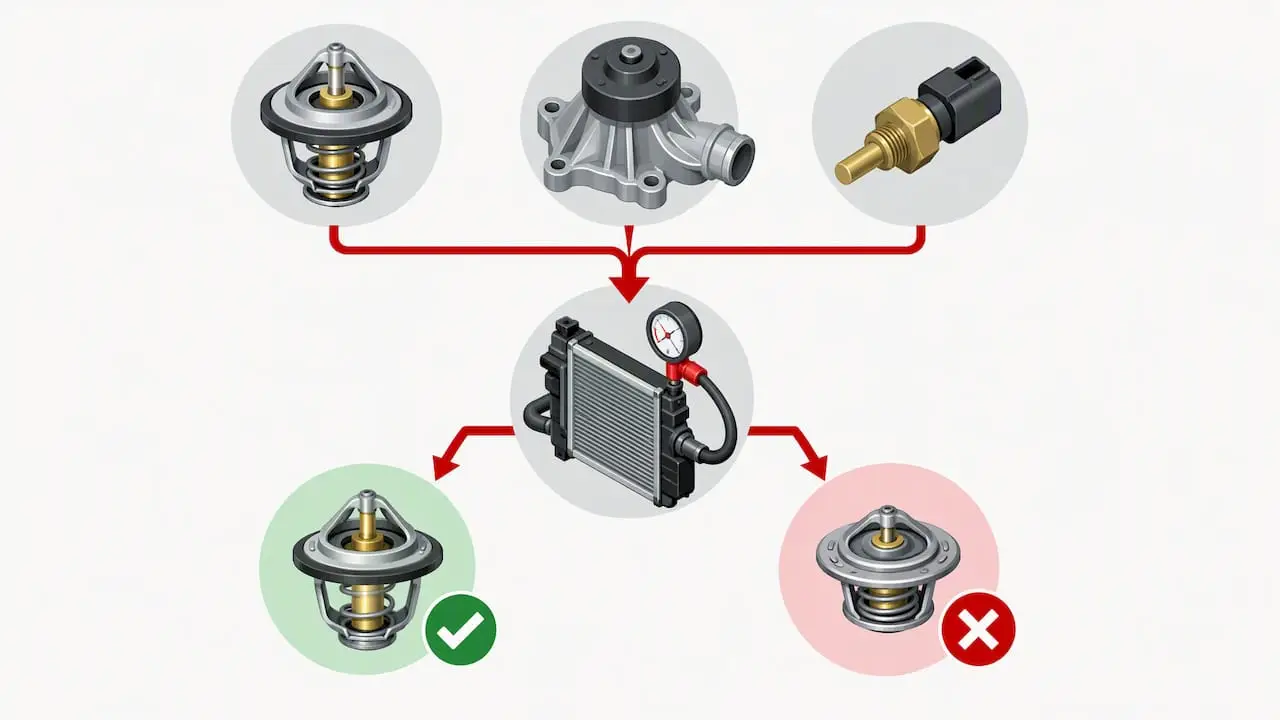
- Bench test the thermostat if you’re comfortable with coolant handling. Removing the thermostat and heating it in water shows the exact temperature it opens at, which should open close to the stamped rating.
Removing a thermostat and bench testing it gives a definitive answer, but it means draining coolant and handling a part that can be awkward to access on some engines. For most owners, this step is better left to a shop with the right tools and a lift.
If a test reveals something off beyond the thermostat itself, like a sluggish water pump or a faulty coolant temperature sensor, a shop will usually check those related parts, since symptoms can overlap and a misdiagnosis means paying for a part that was never the problem.
Can You Drive With a Thermostat Stuck Open?
Short trips to a shop are usually fine if your gauge stays steady, there is no steam or burning smell, and the heater still produces at least some warmth. Keep speeds moderate and skip towing or hauling anything heavy until the thermostat gets checked.
Stop driving immediately if you see steam from under the hood, the temperature gauge climbs toward the red, you smell coolant or something burning, or the check engine light starts flashing rather than staying steady. A flashing check engine light signals an active, urgent issue that needs attention right away, not a drive-it-and-see approach.
- Keep an eye on the gauge for the whole trip, not just at startup
- Note when symptoms started and any codes pulled, and pass that along to the shop
- If towing, mention the symptoms so the operator knows it’s not an overheating emergency
Pro Tip: Jot down what your gauge is doing and when the heater weakens. That detail saves diagnostic time once your car is on a lift.
Repair Options and Typical Costs
A straightforward thermostat replacement restores proper coolant flow and is one of the quicker cooling-system repairs most shops handle, though housing design and access vary a lot by vehicle. The job typically involves draining coolant, removing the housing, swapping the thermostat and gasket, then refilling and bleeding air from the system.
While a technician is in there, it is common to recommend a few related checks:
- Coolant condition and age, since old antifreeze loses its protective properties
- Hose and clamp condition near the thermostat housing
- Water pump function, since a failing pump can mimic some thermostat symptoms
- Coolant temperature sensor accuracy, which affects both the gauge and the OBD-II codes
Cost depends heavily on your specific vehicle: labor rates, how accessible the thermostat housing is, and whether a coolant flush or additional parts get added to the job. A simple front-mounted housing on a common sedan is a different job than a thermostat buried under intake components on some European models. We recommend asking for a coolant flush alongside thermostat work when your coolant is overdue, since you are already draining the system anyway.
Most thermostat jobs are same-day work once diagnosed, though a vehicle that reveals a secondary issue, like a worn water pump, may need an extra day for parts.
Preventing Thermostat Failure and Cooling System Problems
A little scheduled maintenance goes a long way toward avoiding this problem altogether.
- Flush and replace coolant on schedule. The Car Care Council recommends flushing and refilling your cooling system roughly every two years as a general rule, since old coolant loses its corrosion protection.
- Inspect hoses, belts, and clamps regularly. Brittle, soft, or cracked hoses are a common precursor to cooling-system trouble and are worth catching early, especially before winter driving season.
- Use the coolant type your vehicle calls for. Mixing types or using the wrong concentration can affect how well the system protects against freezing and corrosion.
- Keep maintenance records and ask for digital inspections. A documented history with photos makes it easier to track what has and hasn’t been checked.
- Test your heater and defroster before cold weather arrives. Catching weak output in October beats discovering it during the first freeze.
What an ASE-Certified Technician Checks for a Stuck Thermostat
When a vehicle comes in with these symptoms, our ASE-certified technicians run through a consistent checklist rather than guessing: hose temperatures at both the top and bottom radiator connections, a scan for OBD-II codes like P0128, visual inspection of coolant condition and level, and an assessment of how accessible the thermostat housing is on that specific engine.
- We document findings with digital inspections and photos before any repair work is approved
- We check related components, like the water pump and coolant sensor, when symptoms suggest more than a simple thermostat failure
- Some repairs may come with a warranty for peace of mind
- Walk-ins are welcome, and many thermostat diagnoses and repairs can be handled same day
Our Take: Don’t Overreact, But Don’t Ignore It Either
The biggest mistake we see owners make with a stuck-open thermostat is either ignoring it completely because “the car still runs fine” or panicking like it is a blown head gasket waiting to happen. Neither reaction fits the actual risk. A stuck-open thermostat is a slow, quiet drain on fuel economy and comfort, not a ticking time bomb, and treating it with overheating-level urgency leads to unnecessary worry and sometimes unnecessary towing.
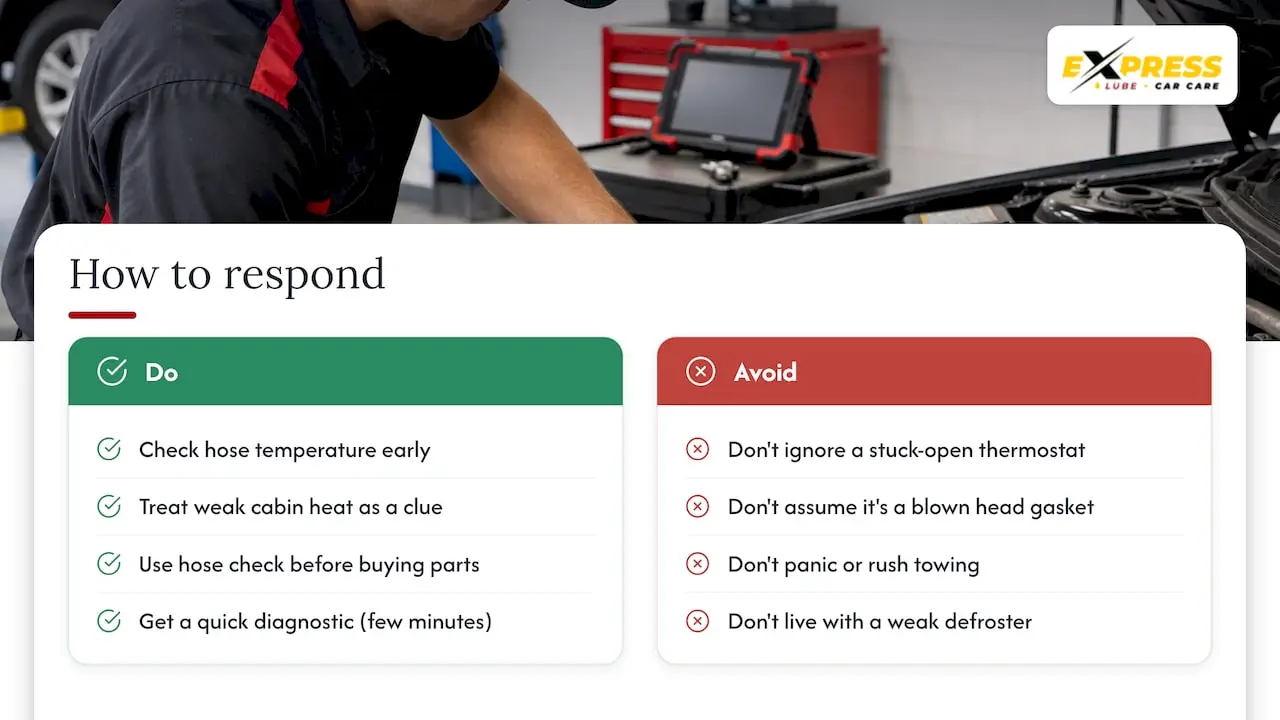
What gets underrated is the heater connection. Most people associate thermostat problems with temperature gauges and warning lights, but a weak defroster in January is just as often the first real sign something is off. We think the smartest move is to treat persistent weak cabin heat as a diagnostic clue worth checking, not just a seasonal annoyance to live with.
If there’s one thing worth prioritizing, it’s getting the hose-temperature check done early, before you spend money guessing at parts. It costs nothing, takes a few minutes, and points you toward the right next step almost every time.
— Express Lube & Car Care
Get Your Cooling System Checked the Easy Way
Weak heat, a sluggish gauge, or a stubborn check engine light are worth a proper look rather than a guess, and that is exactly what our ASE-certified technicians handle every day. We run hose-temperature and OBD-II checks, document findings with digital inspection photos, and back qualifying repairs with a warranty.
- Walk in without an appointment or schedule online for same-day service when possible
- Get a transparent, photo-backed diagnosis before any repair work begins
- Ask about coolant flush and related radiator and cooling system service in the same visit
Browse our full list of services or call us at (817) 284-8478 to get your cooling system looked at this week.
FAQ
Will a stuck open thermostat cause AC not to work?
A stuck-open thermostat affects engine coolant temperature and heater output, not the air conditioning refrigerant circuit, so it typically does not cause your AC to stop cooling. If your AC and heat both seem off, you likely have two separate issues worth diagnosing individually.
How long can I drive with a thermostat stuck open?
Short trips to a shop are usually fine as long as your temperature gauge stays steady and there is no steam, burning smell, or flashing check engine light. Avoid long highway drives or towing until a technician confirms what’s going on.
How do you fix a thermostat stuck closed?
A thermostat stuck closed, unlike one stuck open, blocks coolant flow and can cause rapid overheating, so it needs prompt replacement rather than a quick fix. The repair itself involves draining coolant, swapping the thermostat and gasket, then refilling and bleeding the system, a job most shops complete the same day.
How much does it cost to fix a stuck open thermostat?
Cost varies by vehicle since labor time depends heavily on how accessible the thermostat housing is and whether a coolant flush or additional parts are needed. Estimates are provided after digital inspection so you know the full picture before approving any repair.