

Clunking or knocking over bumps, a steering wheel that wanders or feels loose, uneven tire wear, and vibration at highway speeds are the four clearest signs of a failing control arm. If you’re noticing more than one of these, it’s time to get the suspension looked at with a proper inspection rather than waiting for things to get worse. Slow down, avoid rough roads, and get it checked soon.
TL;DR:
- Control arms often fail due to impact damage, corrosion, or wear of bushings and ball joints, especially in rough driving conditions or climates with road salt.
- Symptoms such as clunking sounds, loose steering, uneven tire wear, and highway vibration typically develop gradually over months, indicating the need for inspection.
- Regular inspections every 30,000 to 50,000 miles can catch early signs, with replacement usually needed between 80,000 and 150,000 miles depending on driving habits.
- A full control arm assembly replacement is generally more practical than individual part repairs, and proper wheel alignment is essential after replacement to prevent uneven tire wear.
- Driving with worsening symptoms is unsafe, as it can lead to loss of steering control or wheel separation, requiring immediate inspection or towing.
Table of Contents
- What a control arm actually does for your suspension
- Common symptoms of a failing control arm
- What causes control arms to fail and when to inspect them
- How to check your control arms before heading to a shop
- What to expect once you’re at the shop
- Is it safe to keep driving with these symptoms?
- How Express Lube & Car Care diagnoses control arm issues
- Schedule a control arm inspection with Express Lube & Car Care
- Sources
- FAQ
What a control arm actually does for your suspension
Think of the control arm as the hinge that connects your wheel to the vehicle’s frame. It lets the wheel move up and down over bumps while keeping it pointed in the right direction, which is exactly why a worn one throws off your handling and your tire wear at the same time.
Most vehicles have upper and lower control arms, and each one relies on bushings and ball joints to allow that controlled movement. On most cars, those rubber or polyurethane bushings and the ball joints wear out long before the metal arm itself fails. That’s actually good news: the softer parts usually give you a warning before anything catastrophic happens. But because control arms help set your suspension geometry, worn bushings or joints throw off alignment and change how your tires meet the road.
Common symptoms of a failing control arm
Some symptoms show up early and quietly. Others show up all at once and demand attention. Here’s how to read them.
A knocking or clunking sound over bumps, potholes, or during braking and acceleration is often the first thing owners notice, and it usually points to a worn ball joint or a control arm that’s developed play in its mounts. According to MOOG’s technical guidance, this kind of noise, along with a steering wheel that feels loose or requires constant correction, uneven tire wear, and vibration at highway speeds, make up the core symptom set for a failing control arm.
- Clunking or metallic knocks over bumps or during braking often signal a loose or worn ball joint.
- Steering wander or looseness happens when worn bushings let the control arm move more than it should, throwing off alignment geometry.
- Uneven tire wear, especially along the inner or outer edge, shows up when a bad control arm changes how the tire meets the road.
- Vibration at highway speeds and a generally rougher ride point to worn joints or bushings that can no longer absorb road input smoothly.
A control arm problem rarely arrives out of nowhere. MOOG’s data notes these symptoms generally worsen over months, moving from an occasional light clunk to a constant, louder noise as wear progresses. If you caught it early, that’s a good thing: it means you likely have time to schedule a repair instead of scrambling for an emergency one.
If vibration is your main symptom, our guide to steering wheel vibration walks through the other common causes worth ruling out. And if the noise you’re hearing is more of a bounce than a knock, our signs you need new shocks piece can help you tell the difference.
What causes control arms to fail and when to inspect them
Three things typically wear out a control arm: physical impact from a pothole or curb strike, corrosion from road salt and moisture eating away at metal components, and the slow, everyday wear that bushings and ball joints experience just from driving, so understanding road salt protection for cars can help extend your suspension components’ life.
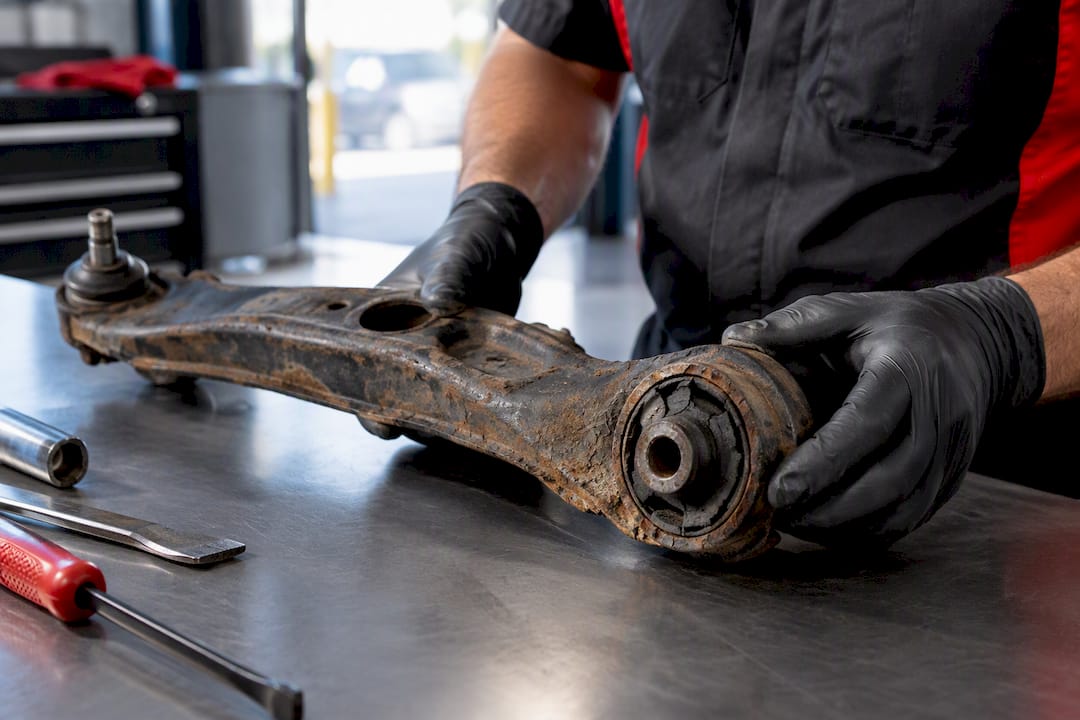
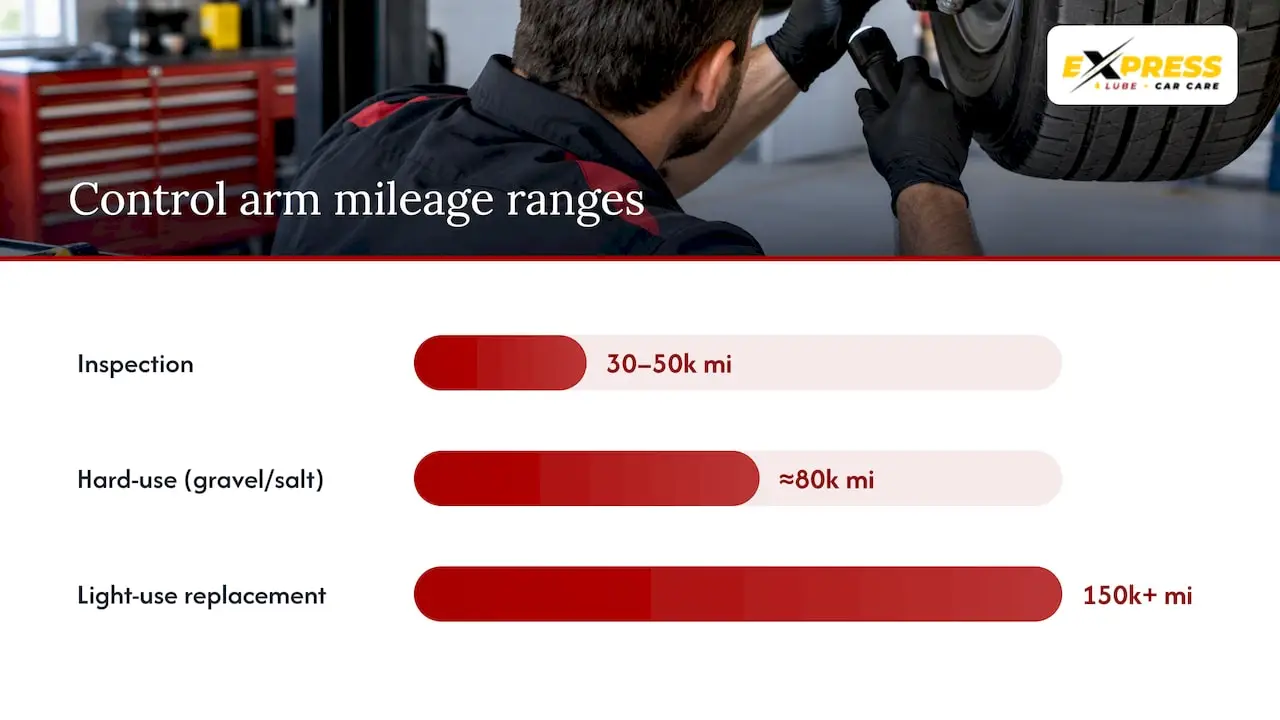
There’s no single mileage where a control arm is guaranteed to fail, but Detroit Axle recommends inspecting them every 30,000 to 50,000 miles as part of routine maintenance. Replacement commonly falls somewhere between 80,000 miles for vehicles driven hard or on rough roads and 150,000 or more miles for vehicles used more lightly. If you regularly haul heavy loads, drive on gravel or poorly maintained roads, or live somewhere that salts the roads in winter, your control arms are working harder and wearing faster than average.
How to check your control arms before heading to a shop
You don’t need a lift or a full toolbox to catch early warning signs. A few minutes with a flashlight and a short test drive can tell you a lot.
- Look underneath from the curb. Check for a torn rubber boot, visible rust-through on the arm itself, a bent or misshapen arm, or grease leaking from a ball joint.
- Reproduce the noise at low speed. Drive slowly over a speed bump or rough patch and listen for the clunk; note whether it happens during braking, turning, or acceleration.
- Check for steering wander on a straight, empty road. If you have to keep correcting to hold a lane, that’s worth mentioning to your technician.
- Test at different speeds and loads. Symptoms that only show up at highway speed or with a full trunk are still worth reporting, even if they seem minor.
Pro Tip: Before your visit, take a few close-up photos of your tire tread edges along with a wider shot of the whole tire. That helps a technician tell alignment-related wear apart from suspension-component wear at a glance.
If your wheel feels loose or the vehicle pulls hard to one side, don’t try to jack it up yourself or keep driving on it. Call for a tow instead. Bring notes on speed, road type, and when the noise happens: it speeds up diagnosis considerably.
What to expect once you’re at the shop
Many modern vehicles use control arms with the bushings and ball joints built into a single assembly rather than as separate replaceable parts. Detroit Axle notes that replacing the whole assembly is often more practical than trying to service individual components, since it cuts down on labor time and avoids reusing worn mating surfaces.
A typical shop visit for a suspected control arm issue includes:
- A full inspection of the suspension, often documented with photos so you can see exactly what’s worn.
- A clear estimate that lays out part options, since some replacement bushings are designed to resist the kind of premature failure that affects certain OE-style bushings in as little as 30,000 miles on some models.
- A recommended wheel alignment, since AAA’s guide to suspension and alignment confirms that alignment keeps tires making proper contact with the road and prevents the accelerated wear that follows any suspension repair.
Cost depends on labor time, the type of part used, and how complex your particular vehicle’s suspension is, so it’s worth asking for a written estimate before any work begins. For more on why alignment matters after this kind of repair, our signs your car needs alignment article covers the details.
Is it safe to keep driving with these symptoms?
A faint, occasional clunk might be safe to drive on for a short trip to a nearby shop. But a clunk that’s getting louder, steering that wanders more than usual, or vibration strong enough to affect your control over the vehicle means it’s time to stop.
Slow down, avoid potholes and curbs, turn on your hazard lights, and get the vehicle inspected or towed rather than pushing on. In severe cases, a failed suspension connection can lead to a loss of steering control or, rarely, wheel separation. That’s not a risk worth taking to save a trip to the shop.
How Express Lube & Car Care diagnoses control arm issues
We start every suspension complaint with a digital vehicle inspection, complete with photos, so you can actually see the worn bushing, the bent arm, or the uneven tire wear we’re talking about instead of just taking our word for it. Our ASE-certified technicians handle the inspection and will recommend an alignment whenever a control arm is replaced, since skipping it undoes the benefit of the repair. We offer both walk-in and appointment options with same-day service when the schedule allows.
Schedule a control arm inspection with Express Lube & Car Care
If any of these symptoms sound familiar, don’t wait for the clunk to get louder. Our digital inspections show you exactly what’s happening under your vehicle, and our technicians back qualifying repairs with a warranty.

- Walk in or book online for a full suspension inspection with photo documentation.
- Ask about our steering and suspension repair services when you schedule.
- Prefer to talk it through first? Call us at (817) 284-8478.
Visit our services page to see everything we offer, or head to our appointment page to get on the schedule.
Sources
- Signs & Symptoms of a Failing Control Arm
- How long do lower control arms last?
- Guide to vehicle wheel alignment and suspension
FAQ
Can I still drive with a bad control arm?
Mild, occasional noise may be safe for a short trip to a shop, but you should stop driving if you notice worsening clunks, strong steering wander, or vibration affecting your control. A compromised suspension connection can lead to loss of steering control, so when in doubt, arrange a tow rather than continue driving.
Is it expensive to fix a control arm?
Cost depends on labor time, whether the shop replaces the full assembly or individual parts, and your vehicle’s complexity, so it’s best to get a written estimate. Since alignment is a standard part of the repair, factor that into your expectations as well.
How often do control arms need to be replaced?
There’s no fixed mileage, but Detroit Axle recommends inspecting control arms every 30,000 to 50,000 miles, with replacement commonly falling between roughly 80,000 miles for hard-driven vehicles and 150,000 or more miles for lightly used ones. Driving conditions and load play a big role in where your vehicle falls in that range.
What causes control arms to fail?
Control arms typically fail from pothole or curb impacts, corrosion from road salt and moisture, or the gradual wear of bushings and ball joints over time. Vehicles used for towing, frequent rough-road driving, or in climates with heavy winter salting tend to wear out control arm components faster.
— Express Lube & Car Care