

A basic oil change or wiper swap takes minutes to a couple hours. A brake job or A/C repair usually runs same-day to a couple days. Engine, transmission, or collision work can stretch into weeks depending on parts and damage. The single biggest lever you control? Fast, clear authorization. When you answer the shop’s call quickly and describe symptoms in detail up front, you keep your car moving through the shop instead of sitting on a lift waiting for a decision.
One thing worth knowing before you drop off your keys: the “estimated time” a shop quotes usually comes from a labor guide like Mitchell 1 or MOTOR. That number is a guideline based on average conditions, not a promise.
- Quick maintenance: minutes to a few hours
- Moderate repairs (brakes, A/C, windshield): same-day to a few days
- Major repairs (engine, transmission, collision): days to several weeks
Pro Tip: Answer your phone during the diagnostic window. A two-hour delay in giving the green light can bump your car from “done today” to “done tomorrow” even when every part is already on the shelf.
Key Takeaways
Repair turnaround time depends more on parts logistics and owner responsiveness than on any single shop’s speed, and clear communication remains the fastest fix available to drivers.
| Point | Details |
|---|---|
| Know your repair bracket | Quick services finish in hours; brakes and A/C run same-day to a few days; collision or engine work can take weeks. |
| Book time is a guide, not a guarantee | Mitchell 1 and MOTOR estimates assume ideal conditions and don’t account for disassembly surprises or parts delays. |
| Authorize fast | Answering the shop’s call within the hour can keep your job on the same-day schedule. |
| Ask about parts location | Local stock means hours; warehouse shipping can add 24 to 48 hours or more. |
| Choose a shop with documentation | Express Lube & Car Care uses digital inspections, ASE-certified technicians, and a 24-month warranty to reduce delays and disputes. |
Table of Contents
- Typical Car Service Duration by Repair Type
- What Determines Turnaround Time in a Repair Shop?
- How to Shorten Your Repair Turnaround Time
- What Does “Book Time” From Labor Guides Actually Mean?
- Common Delay Scenarios and What a Good Shop Should Do
- Why Express Lube & Car Care’s Process Cuts Down Wait Times
- What This Article’s Research Actually Supports
- Get Faster, Reliable Repairs Without the Guesswork
- Sources
- FAQ
Typical Car Service Duration by Repair Type
Every repair job falls into a rough time bracket, and knowing which bracket yours belongs to helps you plan the rest of your day, week, or rental car budget.
- Same-day quick services. Oil changes, wiper blade swaps, battery replacements, and simple sensor fixes (like a loose gas cap triggering a check-engine light) typically wrap up in under an hour to a few hours. These jobs rarely require special parts ordering.
- Brake jobs. Pad and rotor replacement generally takes two to four hours if parts are in stock. Add a day if your shop needs to source specialty rotors for a less common vehicle.
- Tire service. Mounting, balancing, and rotation usually finish in under an hour. A full set replacement with alignment can take half a day.
- A/C repair. Recharges and simple leak fixes often finish same-day. Compressor replacements or evaporator work can take one to three days because of disassembly and parts sourcing.
- Windshield replacement. Most auto glass jobs finish within a few hours, though adhesive cure time may require the car to sit before it’s driven.
- Minor bodywork. Small dent and scratch repairs commonly take one to three days.
- Collision, engine, and transmission repairs. These extend the furthest, from several days to multiple weeks. Complex collision jobs with multiple damaged components can stretch into months, especially when insurance claims, part backorders, and structural repairs are involved.
If you’re unsure which bucket your issue falls into, our guide on types of nearby vehicle repair services breaks down what typically qualifies as quick versus complex.
What Determines Turnaround Time in a Repair Shop?
Four forces control how fast your car moves through a shop, and understanding them helps you ask better questions at drop-off.
- Labor complexity and hidden disassembly. A “three-hour” job on paper might involve removing several adjacent parts just to reach the failing component. Technicians call this “getting to it,” and it’s a major reason elapsed time runs longer than the quoted estimate.
- Parts sourcing. If your part sits on a local shelf, you’re looking at hours. If it has to ship from a regional or central warehouse, add 24 to 48 hours or more to your timeline, sometimes longer if a weekend or carrier cutoff gets in the way.
- Diagnostic time. Intermittent electrical faults and modern software updates or module coding can eat hours before a wrench ever touches the car, especially if the vehicle needs a stable connection to an OEM server to complete a reflash.
- Shop workload and equipment. A shop juggling a full bay schedule with limited lift space moves slower than one with open capacity and experienced technicians who’ve seen your specific issue before.
Pro Tip: Ask directly whether your delay is a parts issue, a diagnostic issue, or a scheduling issue. Each has a different fix, and a shop that can answer clearly is one you can trust to keep you updated.
How to Shorten Your Repair Turnaround Time
You have more control over your car fix turnaround than you might think. A few habits before and during drop-off consistently shave hours or days off the total wait.
- Describe symptoms precisely. “Grinding noise when braking at low speed, started three days ago” gives a technician a head start over “brakes sound weird.”
- Pre-authorize likely follow-ups. If you already suspect you’ll need brake pads plus rotors, say so at drop-off instead of waiting for a callback.
- Ask about parts availability up front. Find out if your part is on-site or needs ordering, and ask about expedited shipping if it’s a rare part.
- Book non-emergency work on a weekday, mid-week. Mondays and Fridays tend to carry the heaviest shop backlog.
- Make the car easy to work on. Clear the trunk if a jack needs access, and remove anything blocking the engine bay or interior panels.
Pro Tip: Save your service history in your phone. Repair techs move faster when they know what was replaced last time instead of starting the diagnostic from zero.
Our checklist for choosing a shop covers more ways to set realistic expectations before you ever hand over your keys.
What Does “Book Time” From Labor Guides Actually Mean?
Every professional shop leans on an auto repair time estimate from an industry labor guide, and the two biggest names are Mitchell 1 and MOTOR. Neither company invented these numbers out of thin air.
- Mitchell 1 builds its Estimated Labor Times from OEM repair procedures, refined by experienced labor editors, and expressed in hours and tenths. The company’s own FAQ documentation is explicit that these numbers assume an average technician working with factory tools in the correct sequence.
- MOTOR publishes Estimated Work Times that integrate with parts and procedure databases, letting shops quote and schedule against a standardized reference.
- Both guides assume ideal conditions: no rust, no stripped bolts, no surprise corrosion. Real cars rarely cooperate that perfectly, which is why elapsed time frequently runs past book time.
- Shops that pair labor-time data with parts systems tend to schedule more accurately, cutting down the idle hours a technician spends waiting on a shipment.
Book time is a planning tool, not a countdown clock. Our post on why auto repair estimates vary digs deeper into the gap between quoted and actual hours.
Common Delay Scenarios and What a Good Shop Should Do
Not every delay is a red flag. Here’s how to tell a normal wait from a communication failure.
- Parts backorder vs. same-day delivery. A shop should tell you clearly whether your part ships same-day from a local distributor or takes 24 to 48 hours from a warehouse.
- Authorization delays. A shop should call you the moment it finds something beyond the original estimate, not wait until end of day. Every hour you delay a callback can push your job to tomorrow’s schedule.
- Documentation. Ask for photos or notes on any additional repair found mid-job. A shop using digital vehicle inspections should be able to send these within minutes.
- Update cadence. A reasonable shop gives you a status check at least once if the job runs past the original estimate, not radio silence until pickup day.
Why Express Lube & Car Care’s Process Cuts Down Wait Times
Turnaround delays usually trace back to one of three things: wrong diagnosis, slow communication, or unresolved disputes after the fact. Express Lube & Car Care’s shop workflow is built to close all three gaps.
- ASE-certified technicians diagnose correctly the first time, which cuts the rework that turns a same-day fix into a three-day ordeal.
- Walk-in, no-appointment service means quick jobs like oil changes, wiper blades, and battery swaps often finish the same visit without a scheduling wait.
- Digital vehicle inspections with photos give you documented proof of what’s wrong, so you’re not left guessing why a repair takes longer than expected.
- A 24-month/24,000-mile warranty means a follow-up issue gets resolved without reopening a billing dispute, which is one of the quieter reasons repairs drag out at less transparent shops.
Shops that skip photo documentation and rely on verbal-only updates tend to generate more callback disputes, which stretches out total resolution time even after the wrench work is done, as detailed in Car Wrap Time: Realistic Timelines for Owners and Fleets | NJ Vinyl Wrapz.
What This Article’s Research Actually Supports
Most advice about repair timing focuses on picking “the fastest shop.” That’s the wrong target. The research here points somewhere more useful: turnaround time is mostly a function of communication speed, not shop speed. A technician can’t work faster than a customer responds to a phone call, and a part can’t arrive faster than a warehouse ships it.
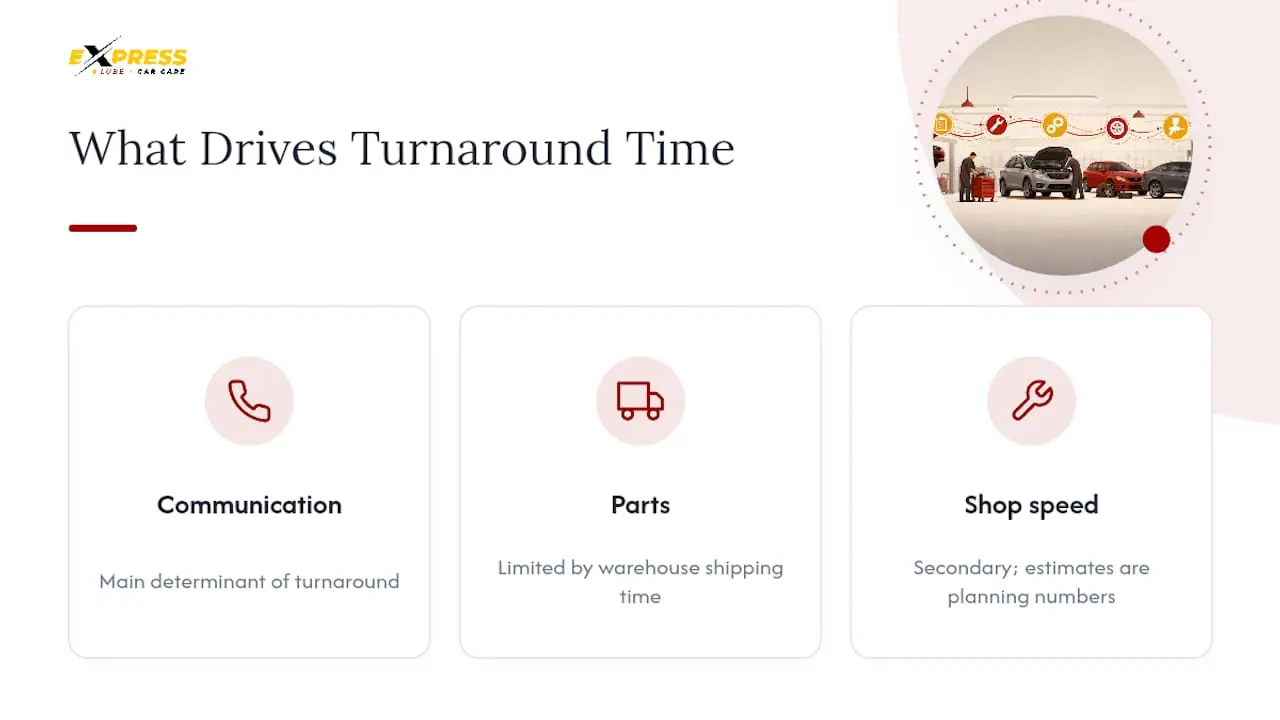
Conventional wisdom oversells labor guides as a reliability metric, treating a Mitchell 1 or MOTOR estimate like a delivery promise. It isn’t. It’s a planning number built on ideal conditions, and the gap between that number and your actual pickup time usually comes down to disassembly surprises, parts logistics, or how quickly you picked up the phone.
If you want a shorter wait, prioritize this first: give a specific symptom description at drop-off, and stay reachable during the diagnostic window. That single habit does more to shrink your repair timeline than shopping around for a shop that promises to be fast.
Get Faster, Reliable Repairs Without the Guesswork
Express Lube & Car Care is built around the exact problem this article covers: unpredictable wait times caused by poor communication and slow authorization loops. Walk in without an appointment for quick services like oil changes and wiper replacements, and get diagnostic answers backed by ASE-certified technicians who catch the right issue the first time instead of the third.
Every repair comes with digital photo documentation so you see exactly what’s being fixed and why, plus a 24-month warranty that protects you if something resurfaces. Need help authorizing a bigger repair fast? Easy financing means budget doesn’t have to slow down your decision. Check our ASE and RepairPal certifications to see why local drivers trust us with same-day work, then book your visit or stop by for a walk-in appointment today.
Sources
- Labor Times – Mitchell1
- Estimated Work Times | MOTOR
- 2026 repair shop challenges – Automotive Research
- Understanding car repair types and timelines – Caliber
FAQ
How Long Does a Typical Car Repair Take?
Quick maintenance like oil changes takes minutes to a few hours, while brake jobs and A/C repairs typically run same-day to a few days. Engine, transmission, or collision work can extend to several weeks.
What Is “Book Time” in Auto Repair?
Book time is the estimated labor hours published by guides like Mitchell 1 or MOTOR, built from OEM procedures under average shop conditions. It’s a planning estimate, not a guaranteed completion time.
Why Is My Car Repair Taking Longer Than Quoted?
The most common causes are hidden disassembly work, parts that must ship from a regional warehouse, and delays in customer authorization for additional findings.
Does Express Lube & Car Care Offer Same-Day Repairs?
Yes. Express Lube & Car Care accepts walk-ins with no appointment needed, and many quick services like oil changes, wiper replacements, and battery swaps are completed the same visit.
How Can I Speed Up My Car’s Repair Time?
Give the shop a detailed symptom description at drop-off, stay reachable for authorization calls, and ask upfront whether parts are on-site or need ordering.