
Types of nearby vehicle repair services are the distinct categories of local automotive providers you can choose from, ranging from quick oil change centers to full-service independent shops, dealership service departments, tire and alignment centers, and specialty diagnostic shops. Knowing which category fits your situation saves you time, money, and frustration. Each type has a specific scope of work, a typical cost range, and a set of technician qualifications. Match your car’s problem to the right shop type, and you get a faster fix at a fairer price.
1. what are quick lube and oil change providers?
Quick lube services are the fastest local auto repair option for routine maintenance. They focus on a narrow menu of services you can get done in under an hour, often without an appointment.
Typical services at a quick lube include:
- Engine oil and filter changes
- Fluid top-ups (coolant, transmission, brake, power steering)
- Air filter and cabin filter replacements
- Wiper blade swaps
- Basic tire pressure checks
Quick lube turnarounds are measured in minutes to hours for standard maintenance, which is the main reason busy drivers rely on them. That speed comes with a trade-off: these shops are not set up for complex diagnostics, brake jobs, or electrical repairs.
Quick lube providers are the right call when your oil life monitor is flashing and you need to get back on the road fast. They are not the right call when your check engine light is on or your brakes are grinding.
Pro Tip: Always ask for a printed service menu before you pull in. Some quick lube locations charge separately for items like tire rotation or fluid top-ups that other shops bundle into the oil change price.
2. how do full-service independent repair shops differ?
Full-service independent shops are the most versatile of all local auto repair options. They handle the full range of mechanical and electronic work that quick lube centers and tire shops cannot touch.
A quality independent shop covers:
- Brake inspection, repair, and replacement
- Engine diagnostics and repair
- Transmission service and rebuild
- A/C recharge and repair
- Electrical system diagnostics
- Hybrid and EV high-voltage system service
Independent shops position themselves explicitly as “not a quick-lube, not a tire shop,” which tells you exactly what they are built for. That broad capability is backed by ASE-certified technicians who have passed standardized exams and logged real hands-on experience.
The advantage over a dealership is cost and flexibility. Independent shops typically charge lower labor rates and are not locked into one manufacturer’s parts catalog. The advantage over a quick lube is obvious: they can actually fix the problem, not just maintain the fluids.
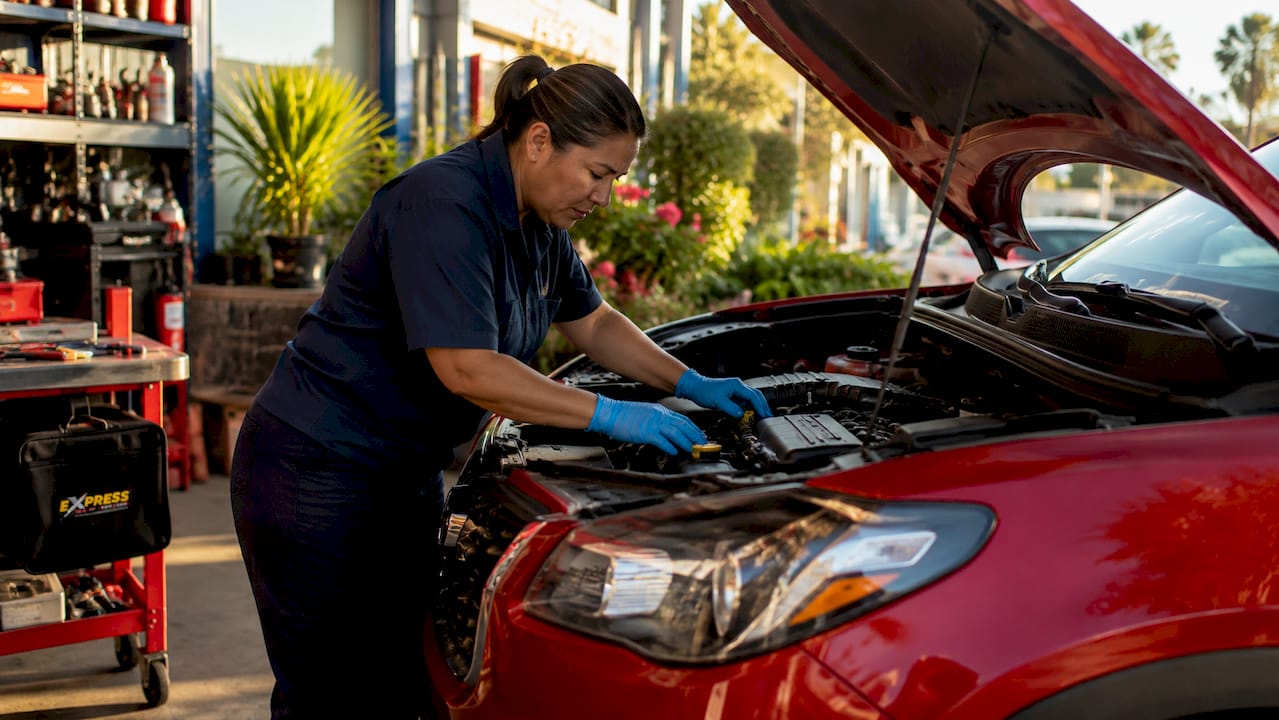
Choosing between shop types comes down to your vehicle’s warranty status and the complexity of the repair needed. For most out-of-warranty cars, a certified independent shop is the best combination of quality and value.
Pro Tip: Before you hand over your keys, ask two questions: Are your technicians ASE certified, and what warranty do you offer on parts and labor? A shop that answers both questions clearly is worth your trust.
3. when are dealership service departments the best option?
Dealership service departments are the right choice in specific, well-defined situations. Outside of those situations, they are often slower and more expensive than independent shops without delivering better results.
Use a dealership service department when:
- Your vehicle is under the manufacturer’s original warranty
- A safety recall needs to be addressed
- Your car requires brand-specific software updates or OEM programming
- You drive a luxury or late-model vehicle with proprietary systems
Dealerships handle warranty work and safety recalls that independent shops legally cannot perform under the manufacturer’s terms. That is a hard rule, not a preference. If your car has an open recall, the dealership is your only covered option.
The trade-offs are real. Dealership labor rates run higher than independent shops, appointment wait times are often longer, and service advisors work on commission structures that can push unnecessary add-ons. Go in knowing exactly what you need, and get a written estimate before authorizing any work.
For routine maintenance on a vehicle that is out of warranty, a dealership service department rarely offers a compelling reason to choose it over a well-reviewed independent shop nearby.
4. what do tire, alignment, and diagnostic centers provide?
Tire and alignment centers are specialized shops that focus on a specific cluster of services. They do those services exceptionally well, but they are not built for engine or transmission work.
Core offerings at tire and alignment centers include:
- Tire sales, mounting, and balancing
- Tire rotation and replacement
- Wheel alignment and suspension checks
- Shocks and struts service
- Exhaust system maintenance
Monro Auto Service and Tire Centers is a national example of this model, with locations highlighting tires, wheel alignments, shocks and struts, and exhaust systems as their primary focus. That specialization means the technicians working on your alignment have done it hundreds of times, which matters for precision work.
Diagnostic centers take a different angle. They invest in factory-level scan tools and ADAS calibration equipment that most general shops do not carry. Specialty shops handling ADAS calibration and hybrid or EV maintenance require certified technicians and specialized equipment that reflects the growing complexity of modern vehicles. If your car has a lane-keeping assist system that is misbehaving after a windshield replacement, a diagnostic specialist is the only shop equipped to recalibrate it correctly.
The practical rule: go to a tire center for anything wheel and suspension related, and go to a diagnostic specialist when your car’s electronics or driver-assistance systems are the source of the problem.
5. comparing all nearby vehicle repair service types
The table below puts all four major shop categories side by side so you can make a fast, informed decision.
| Shop Type | Typical Services | Turnaround | Relative Cost | Technician Standard |
|---|---|---|---|---|
| Quick Lube | Oil changes, fluid top-ups, filters | 30–60 minutes | Low | Varies |
| Full-Service Independent | Brakes, engine, transmission, A/C, electrical | Same day to 2 days | Moderate | ASE certified recommended |
| Dealership Service | Warranty, recalls, OEM software, brand-specific repairs | 1–3 days | High | Factory trained |
| Tire and Alignment Center | Tires, balancing, alignment, suspension, exhaust | Same day | Low to moderate | Specialized |
| Diagnostic and Specialty Shop | ADAS calibration, hybrid/EV, complex electrical | 1–2 days | Moderate to high | ASE and OEM certified |
ASE certification requires about two years of hands-on work plus passing standardized tests. That standard is your clearest signal that a technician knows what they are doing regardless of shop type.
A quick checklist before you choose:
- Is your car under warranty? Go to the dealership for covered work.
- Is this routine maintenance? A quick lube or full-service independent handles it.
- Are tires, alignment, or suspension the issue? A tire center is your best bet.
- Is the problem electrical, ADAS-related, or hybrid-specific? Find a diagnostic specialist.
- Is the repair complex and out of warranty? A certified independent shop gives you the best value.
Complex diagnostics and drivability issues almost always require full-service or specialized shops equipped for engine management and electrical systems. A quick lube simply does not have the tools or training for that work.
Key takeaways
Matching your repair need to the right shop type is the single most effective way to get quality car repair services near you at a fair price.
| Point | Details |
|---|---|
| Quick lube for routine maintenance | Use quick lube centers for oil changes and fluid top-ups when speed matters most. |
| Independent shops for most repairs | ASE-certified independent shops offer the best value for out-of-warranty mechanical work. |
| Dealerships for warranty and recalls | Go to a dealership only when manufacturer warranty, recalls, or OEM software are involved. |
| Tire centers for wheel and suspension work | Specialized tire and alignment shops deliver better precision on suspension and wheel services. |
| Diagnostic specialists for electronics | ADAS calibration and hybrid systems require shops with factory-level scan tools and certified technicians. |
What we’ve learned from watching drivers choose the wrong shop
Here is something I see regularly at Express Lube & Car Care: a driver comes in frustrated because they paid a quick lube to “check” a check engine light, got a vague answer, and wasted both time and money. Quick lube centers are genuinely excellent at what they do. The problem is that drivers sometimes expect them to do things outside their scope.
My honest observation after years in this business is that most car owners do not need to choose between cheap and good. They need to choose the right shop for the right job. A transparent repair estimate with clear line items and warranty terms is the first sign you are dealing with a shop that respects your time and your wallet. If a shop cannot give you that before you authorize work, walk away.
I also think the obsession with dealerships for routine maintenance is mostly habit. Once your warranty expires, a certified independent shop with ASE-qualified technicians gives you the same quality at a lower price. Build a relationship with a shop you trust, ask questions, and read local reviews before your car has a problem. That way, when something does go wrong, you already know exactly where to go.
— Express Lube & Car Care
Get fast, certified car care at express lube & car care
Express Lube & Car Care in Richland Hills is a full-service auto center staffed by ASE-certified technicians who handle everything from quick oil changes to brake repairs and complex diagnostics. Walk-ins are always welcome, and there are no hidden charges on your estimate.
Check out the current oil change and service specials to see what affordable vehicle maintenance looks like when it is done right. For drivers who want to understand the credentials behind the work, the ASE and RepairPal certification page explains exactly what those standards mean for your repair. Express Lube & Car Care is the local shop Richland Hills drivers rely on when they want honest answers and quality work done fast.
FAQ
What are the main types of nearby vehicle repair services?
The five main types are quick lube centers, full-service independent shops, dealership service departments, tire and alignment centers, and specialty diagnostic shops. Each covers a different scope of work and suits different repair situations.
When should i use a dealership instead of an independent shop?
Use a dealership when your vehicle is under manufacturer warranty, has an open safety recall, or needs brand-specific software programming. For out-of-warranty repairs, a certified independent shop typically offers better value.
What does ASE certification mean for my repair?
ASE certification means a technician has passed standardized competency exams and completed roughly two years of hands-on experience. It is the most reliable indicator of technical skill across shop types.
Can a quick lube shop fix a check engine light?
Quick lube shops are not equipped for complex diagnostics. A check engine light requires a full-service independent shop or specialty diagnostic center with proper scan tools and trained technicians.
How do i find affordable vehicle maintenance near me?
Look for ASE-certified independent shops with transparent written estimates and warranty coverage on parts and labor. Reading recent local reviews on Google or RepairPal helps you identify shops that combine fair pricing with reliable work.