

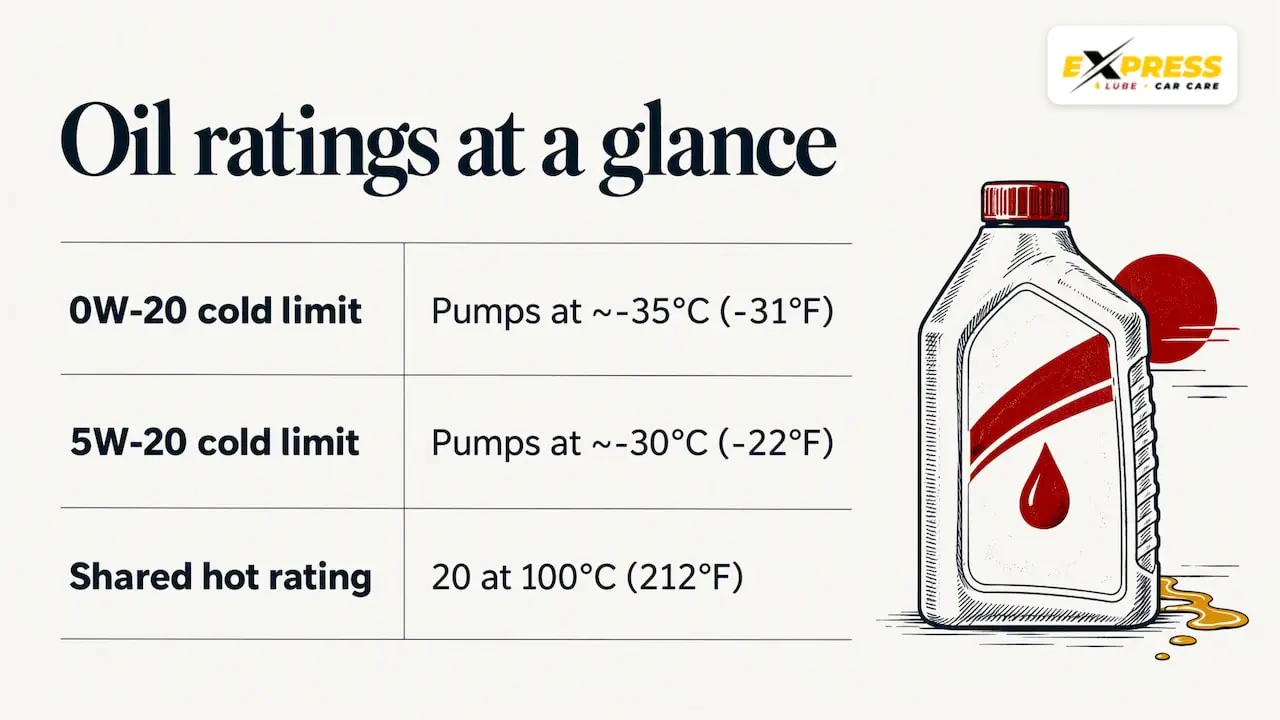
The only real difference is how the oil flows when it is cold. Both grades are a “20” at normal operating temperature, so they protect about the same once the engine is warm. 0W-20 is rated to flow at a lower temperature than 5W-20, about -35°C versus -30°C in the American Petroleum Institute’s example. The right choice for your car is the grade printed in your owner’s manual, not the one with the better reputation.
If you’re in Richland Hills, North Richland Hills, Hurst or Bedford, you almost never see temperatures that separate these two oils. What matters more is what your engine was designed for and how you drive it.
TL;DR
- The “W” number is the cold rating. 0W flows more easily in extreme cold than 5W. The “20” is the same for both.
- Use what your owner’s manual or oil filler cap specifies. If it lists both, either is acceptable for that engine.
- Topping off one with the other is generally not harmful when both are 20-weight oils meeting the same spec, but keep the manufacturer’s grade as your standard.
- 0W-20 does not let you stretch oil change intervals. Intervals follow the vehicle, not the jug.
- Stop-and-go traffic, short trips, idling and towing matter more in North Texas than the 0W versus 5W gap.
Table of Contents
- What do the numbers in 0W-20 and 5W-20 mean?
- Why do so many newer cars call for 0W-20?
- How do 0W-20 and 5W-20 compare side by side?
- What happens if you put 5W-20 in an engine that calls for 0W-20?
- Does 0W-20 let you go longer between oil changes?
- Where does 5W-30 fit in?
- What matters more than 0W versus 5W in Northeast Tarrant County?
- How do you find the right oil for your car?
- What about synthetic oil, and do the grades change anything about engine wear?
- Our view: match the spec, then match the driving
- Need an oil change or a second opinion on the right grade?
- FAQ
- Sources
What do the numbers in 0W-20 and 5W-20 mean?
Every multigrade oil has two numbers. The first, followed by a W for “winter,” tells you how well the oil flows when it is cold. The lower the number, the better it flows in the cold. The second number describes thickness at engine operating temperature, which API tests at 100°C (212°F).
So 0W-20 and 5W-20 share the same hot rating. Per the API guide to choosing motor oil, the 0W grade is designed to pump at roughly -35°C, and the 5W grade at roughly -30°C. In Fahrenheit that’s about -31°F versus -22°F. Fort Worth’s coldest month, January, averages a low near 38°F, and the area rarely drops below 25°F. Neither oil is anywhere near its limit here.
Think of it as a pair of winter coats rated for different extremes. Both keep you comfortable at a Texas bus stop.
Why do so many newer cars call for 0W-20?
Fuel economy. Thinner oil creates less friction in the bearings, oil pump and piston assembly. U.S. Department of Energy research on lubricant formulation points to roughly 2% better fuel economy from lower-viscosity oils, with the biggest benefit during cold starts. Automakers use that gain to help meet federal fuel economy standards.
There’s an engineering reason too. Modern engines have tight internal clearances, variable valve timing components and high-pressure fuel systems that depend on oil reaching them quickly. A 0W-20 oil gets there fast. That’s why many engines are calibrated around it, and why Department of Energy materials describe a sustained march to lighter viscosity grades in North American passenger car oils.
One caution from the same research: switching to a lighter oil without an engine designed for it doesn’t guarantee better mileage and can add wear if the clearances weren’t built for it. Thinner isn’t automatically better.
How do 0W-20 and 5W-20 compare side by side?
| 0W-20 | 5W-20 | |
|---|---|---|
| Cold rating | Flows at a lower temperature | Flows at a slightly higher temperature |
| Hot rating (100°C) | 20 grade | 20 grade |
| Cold-start behavior | Reaches parts a bit faster in deep cold | Slightly slower in deep cold |
| Typical reason it’s specified | Fuel economy, tight tolerances, newer designs | Older or mid-generation engines designed around it |
| Texas relevance | Little real-world gap in our winters | Little real-world gap in our winters |
The table shows why the choice is mostly about compliance with your engine’s specification, not about climate.
What happens if you put 5W-20 in an engine that calls for 0W-20?
In most cases, nothing dramatic. The hot viscosity is the same, and the cold difference is small at Texas temperatures. If you’ve topped off a quart of the wrong one, you haven’t ruined anything. Mixing two 20-weight oils that carry the same API certification is generally not a mechanical problem.
Still, we’d treat it as a one-time fix, not a new habit. Your manufacturer chose a grade for a reason, and some engines, especially newer turbocharged and hybrid designs, are more sensitive than others. If your manual says 0W-20 only, use 0W-20 at the next change. If it lists both, either is fine.
The reverse swap works the same way. Putting 0W-20 in a car that calls for 5W-20 is often allowed, and some manuals list it as an acceptable alternative. Check yours first. If your manual doesn’t mention it, ask us before you assume.

Does 0W-20 let you go longer between oil changes?
No, and this is the most expensive misunderstanding in the category. A better-sounding oil doesn’t rewrite your service schedule. Toyota’s published guidance is a useful example: vehicles that require 0W-20 synthetic have intervals of 10,000 miles or 12 months, whichever comes first, while vehicles that list 0W-20 only as an option to another grade need shorter intervals. The interval is tied to the vehicle’s design, not to whichever oil you pour in.
That’s one manufacturer, and yours may differ. Your owner’s manual or maintenance minder, matched to your VIN, is the authority. We go deeper on timing in our guides on oil change mileage versus time and why oil change intervals matter for your engine.
Where does 5W-30 fit in?
Many people searching 0W-20 versus 5W-20 are really asking about 5W-30. The difference there is bigger than the cold rating. A 5W-30 oil is thicker at operating temperature than any 20-grade, so it creates a thicker film between moving parts and can behave differently in an engine calibrated for 20-weight oil.
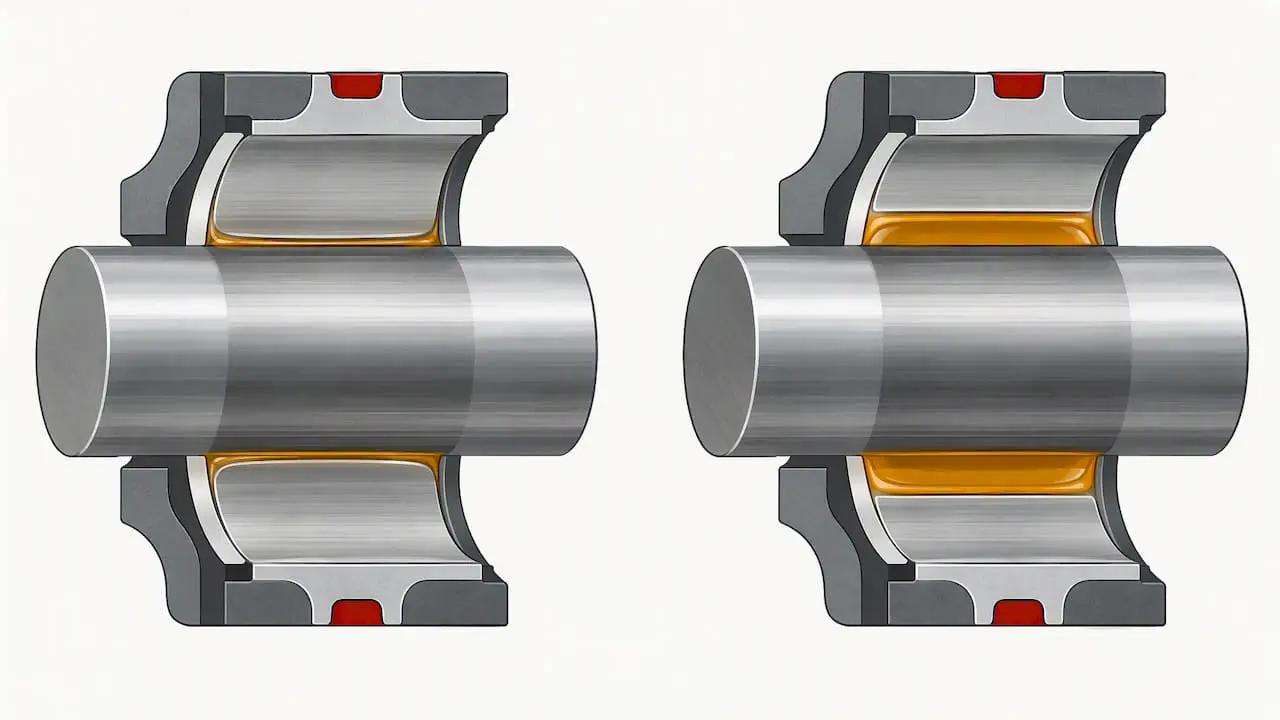
Some engines are specified for 5W-30 in other parts of the world and 0W-20 in the U.S. The manual for the car you own, sold where you bought it, is what counts. Moving up a grade isn’t automatically safer. The API guide notes that oil that is too thick can cause friction and sluggish starts, while oil that is too thin may not give an adequate protective film under load.
If your car lists 5W-30 as an alternative, it’s fine. If it doesn’t, stay with what it asks for. We aren’t going to guess at a specification we haven’t verified for your exact engine.
What matters more than 0W versus 5W in Northeast Tarrant County?
How you drive. The “severe service” conditions that shorten oil life aren’t about cold weather alone. They include frequent short trips, extended idling, stop-and-go traffic and towing. If your commute on Loop 820 or Highway 121 is mostly crawling, or you make short hops all day, your oil is working harder than the schedule for highway driving assumes.
Thin oils are also sensitive to fuel dilution. An SAE study on plug-in hybrids in extreme cold found fuel making up as much as 20% of the oil volume under stop-start conditions, thinning a 0W-20 well below its grade. That was a specialized test in extreme cold, not a Texas result, but the principle carries over: short trips and idling are hard on oil.
A few real-world cases:
- Commuters with long highway runs: usually the easiest on oil. Follow the manual’s normal schedule.
- Rideshare and delivery drivers: lots of idling and stop-and-go. See our guides on rideshare oil change needs and the delivery driver frequency guide.
- Truck and SUV owners who tow: towing is a severe-service condition in nearly every manual.
- Fleets: mixed vehicles mean mixed specs. Our fleet oil change interval guide covers how to organize it.
How do you find the right oil for your car?
- Check the oil filler cap. Many engines print the grade right on it.
- Open the owner’s manual. Look under fluids or specifications. Note the viscosity grade and any required certification, such as the API mark.
- Note alternates. If the manual lists more than one grade, record which is preferred.
- Match the service schedule. Look at the maintenance minder or schedule, and the severe-service section.
- Ask a technician if something doesn’t match. Used cars sometimes have a previous owner’s oil in them, which isn’t proof of what the engine needs.
The API Engine Oil Licensing and Certification System is the program behind the certification marks you see on bottles. Look for the mark, not just the viscosity.
What about synthetic oil, and do the grades change anything about engine wear?
Most 0W-20 on shelves is a full synthetic or synthetic-based product, since low cold ratings are hard to meet with conventional base oil. Your manual specifies whether synthetic is required. If it is, a conventional oil isn’t a substitute even if the number matches. For a closer look at blends, see our synthetic blend interval guide.
Oil also protects far more than it seems from the garage. Cold-start lubrication, friction reduction and heat all affect the engine, and so does what happens downstream. If you’re curious how exhaust-side health ties into overall engine life, how exhaust affects engine longevity is worth a look.
Our view: match the spec, then match the driving
We’re a full-service repair center with ASE-certified technicians, not just a quick-lube stop, and that shapes how we handle this question. When someone pulls in and asks which oil is “best,” we don’t start with a brand. We start with the manual, then ask how the car is used.
A few things we’ve settled on:
- The specification beats the reputation. If the engine calls for 0W-20, that is what goes in.
- Interval advice comes from manufacturer guidance and real operating conditions, not a universal mileage number.
- If something looks off during an oil service, our digital vehicle inspections include photos, so you can see what we’re seeing before you decide anything.
- Oil that’s dirty, low or the wrong grade can be a symptom of something else. Diagnosis comes before a repair recommendation.
Our no-appointment walk-in option exists because oil changes shouldn’t need planning. A walk-in is also a good time to ask us to confirm the grade your engine needs.
— Express Lube & Car Care
Need an oil change or a second opinion on the right grade?
We handle oil changes and preventive maintenance at 7932 Glenview Drive in Richland Hills, with walk-ins welcome or appointments if you prefer. Bring your questions about viscosity and we’ll check them against the manufacturer’s specification for your vehicle. You can also see current offers on our oil change and service specials page, or call us at (817) 284-8478.
FAQ
Can I use 0W-20 instead of 5W-20?
Often yes, but check your manual. The hot rating is the same, and many manuals list 0W-20 as an acceptable alternative. If yours doesn’t, use the grade it specifies or ask a technician to confirm.
Is 0W-20 better than 5W-20?
It’s better only at flowing in extreme cold, which rarely matters in North Texas. For an engine designed around 5W-20, the correct oil is the one in the manual. For an engine designed around 0W-20, that is the right oil.
Can I switch from 0W-20 to 5W-30?
Not without checking. 5W-30 is thicker when hot, and an engine calibrated for a 20-weight oil may not be specified for it. If your manual lists 5W-30 as an alternative, it’s fine. If not, stay with the specified grade.
Does the oil grade change how often I need an oil change?
No. Intervals follow the vehicle’s maintenance schedule and your driving conditions. Short trips, idling, stop-and-go traffic and towing can call for earlier service under the manufacturer’s severe-service guidance.
Is it okay to mix 0W-20 and 5W-20?
For a top-off, mixing two 20-weight oils with the same certification is generally not harmful. Use the specified grade at your next full oil change.
Sources
- API: Which oil is right for you? (motor oil guide)
- API 1509 engine oil licensing documents
- U.S. DOE: A novel lubricant formulation scheme for 2% fuel efficiency improvement
- U.S. DOE: Engine lubricants, trends and challenges
- U.S. DOE: Lubricant effects on combustion and emissions control
- Toyota: Oil change intervals using synthetic oil
- SAE 2025-01-8471: Engine oil performance on plug-in hybrids in extreme cold
- Weather Spark: Fort Worth climate