

Underinflated tires raise rolling resistance and force your engine to burn more fuel — that’s the short answer, a concept detailed in Këshilla thelbësore për mirëmbajtjen e makinës në rrugët. According to the U.S. Department of Energy, keeping tires properly inflated can improve gas mileage by about 0.6% on average and up to 3% in some cases, while every 1 psi drop across all four tires is estimated to reduce fuel economy by a small percentage. The fix is simple: find your vehicle’s recommended PSI on the doorjamb sticker and check your tires cold once a month.
- The mechanism: Low pressure makes tires flex more, which wastes energy as heat and increases the load on your engine.
- The rule of thumb: Each 1 psi drop in average tire pressure costs about 0.2% in gas mileage.
- The immediate action: Check PSI on your driver’s door jamb — not the tire sidewall — before your next fill-up.
Quick stat: The Energy Department’s consumer guide flags the 0.2% per psi loss as a conservative estimate. Multiply that across a full year of driving and the dollars add up faster than most drivers expect. Underinflation is also a safety risk — it raises blowout probability and degrades braking.
Key Takeaways
Keeping tires at the manufacturer’s recommended PSI reduces rolling resistance, improves fuel economy by up to 3%, and protects both tire life and vehicle safety.
| Point | Details |
|---|---|
| Fuel penalty per psi | Each 1 psi drop across all tires costs about 0.2% in gas mileage, per DOE guidance. |
| Correct inflation benefit | Properly inflated tires improve gas mileage by about 0.6% on average, up to 3% in some cases. |
| Where to find your PSI | Use the driver’s door jamb sticker or owner’s manual — never the maximum printed on the sidewall. |
| Check cold, check monthly | Always measure pressure when tires are cold; temperature swings of about 10°F shift pressure by roughly a small amount. |
| Express Lube & Car Care | ASE-certified technicians check and document tire pressure during every service visit in Richland Hills. |
Table of Contents
- Why tire pressure affects fuel economy: the rolling resistance chain
- How big is the real-world fuel economy impact?
- How to check tire pressure correctly and keep it there
- How temperature changes your tire pressure
- Why correct tire pressure matters beyond fuel savings
- What does fixing tire pressure actually save you?
- Five-step action checklist for better MPG
- Our perspective: what we see at the shop every day
- Get a tire pressure check at Express Lube & Car Care
- Sources
- FAQ
Why tire pressure affects fuel economy: the rolling resistance chain
Rolling resistance is the force your tires must overcome to keep rolling forward. When pressure drops, the tire sidewall flexes more with every rotation, deforming the rubber and generating heat. That heat is wasted energy your engine had to produce in the first place. The contact patch — the footprint of rubber touching the road — also grows larger, increasing friction. Your engine has to work harder just to maintain the same speed, so it burns more fuel.
The chain looks like this: lower tire pressure → more tire deformation → larger contact patch → higher rolling resistance → greater engine load → more fuel burned → higher CO₂ output.
According to KBB, underinflated tires flex more at the contact patch and force the engine to use more fuel to maintain speed. A Transportation Research Board special report puts a useful number on the relationship: a 10% reduction in rolling resistance translates to approximately a low single-digit percentage improvement in fuel economy.
Key mechanical contributors:
- Increased tread flex with each rotation
- Enlarged contact area generating more friction
- Heat dissipation from rubber deformation (wasted energy)
- Greater tractive effort required from the drivetrain
How big is the real-world fuel economy impact?
The headline figures come from government guidance: fueleconomy.gov reports an average gain from proper inflation and sometimes higher in favorable cases. EPA fleet analysis found fuel consumption decreases by a fractional percent for each psi increase in the normal operating range, with meaningful fleet-level savings if widespread underinflation were corrected.
A controlled experimental study on a light gasoline vehicle tested pressures at 26, 30, 33, and 36 psi. Moving from 26 psi toward the manufacturer’s recommendation of 33 psi reduced measured fuel use in that single test by a large margin, though this is based on one specific vehicle and condition. That’s a striking result, but it comes from one vehicle under specific test conditions — treat it as directional evidence, not a universal promise.
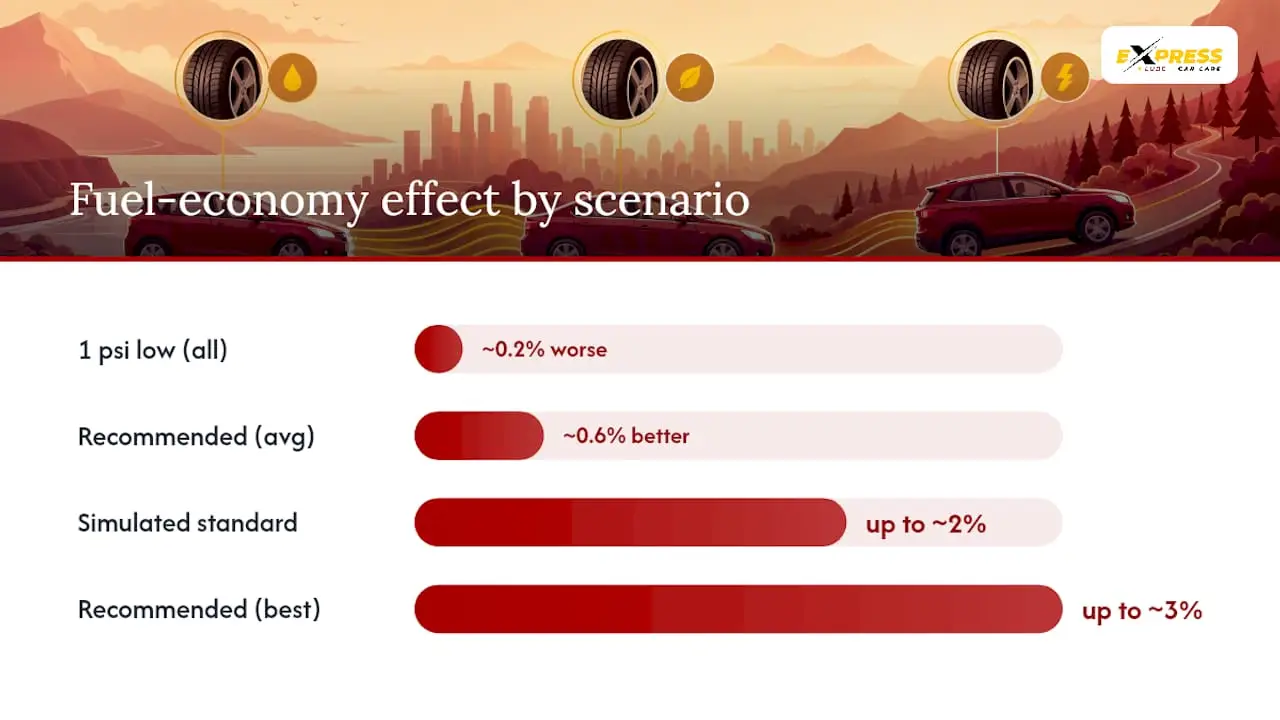
| Pressure scenario | Observed fuel-economy effect | Source |
|---|---|---|
| 1 psi below recommended (all tires) | ~0.2% increase in fuel use | DOE/fueleconomy.gov |
| Tires at manufacturer’s recommended PSI | ~0.6% average improvement | DOE/fueleconomy.gov |
| Tires at recommended PSI (best case) | Up to ~3% improvement | DOE/fueleconomy.gov |
| 26 psi vs. ~33 psi (single-vehicle test) | modest percentage reduction in fuel use | Experimental study (limited sample) |
| Simulated real-world driving at standard PSI | Up to ~2% fuel savings | SAGE journals simulation |
Simulation research published in SAGE journals supports the upper end of that range, finding that maintaining manufacturer-recommended pressure can reduce real-world fuel consumption by a modest percentage.
Confidence note: Results vary by vehicle type, driving route, speed, and whether tires are warm or cold during testing. The DOE figures are the most reliable benchmarks for everyday driving.
How to check tire pressure correctly and keep it there
Check your tires cold — parked for at least three hours or driven less than one mile. Driving heats the air inside the tire and raises pressure artificially, giving you a falsely high reading. Always use the recommended PSI from your doorjamb sticker or owner’s manual, never the maximum figure printed on the tire sidewall. That sidewall number is the tire’s rated limit, not your vehicle’s target.
Step-by-step process:
- Park the vehicle and let tires cool for at least three hours.
- Locate the recommended PSI on the driver’s door jamb sticker or in your owner’s manual.
- Remove the valve cap from the first tire and set it somewhere safe.
- Press a quality gauge firmly onto the valve stem and read the pressure.
- If pressure is low, add air in short bursts and recheck after each burst.
- If pressure is high, press the small pin inside the valve stem to release air, then recheck.
- Replace the valve cap and repeat for all four tires (plus the spare if accessible).
Tools worth having:
- Digital gauge: Easier to read, accurate to ±0.5 psi — worth the small investment.
- Analog dial gauge: Reliable and durable; slightly harder to read in low light.
- Portable inflator: A 12V compressor lets you correct pressure anywhere.
- TPMS warning light: Useful as an alert, but it typically triggers only when pressure drops 25% below recommended — well past the point where fuel economy has already suffered.
Pro Tip: Log the PSI and ambient temperature each time you check. If one tire consistently loses pressure faster than the others, that’s an early sign of a slow leak — catching it early saves you from a roadside flat.
Express Lube & Car Care technicians verify tire pressure during routine visits, so a quick oil change doubles as a pressure check without adding time to your day.
How temperature changes your tire pressure
Tire pressure and ambient temperature move together. As temperature drops, air molecules slow down and pressure falls; as it rises, pressure climbs. A practical rule of thumb: tire pressure changes by roughly 1 psi for every 10°F change in ambient temperature. That means a tire set correctly at 35 psi on a 70°F afternoon could read closer to 32 psi on a 40°F winter morning.
Seasonal actions to stay ahead of it:
- Fall/winter: Check pressure when the first cold snap hits — don’t wait for the TPMS light.
- Spring/summer: Recheck as temperatures climb; tires inflated in winter may run slightly high.
- Before long trips: Always do a cold check the morning of departure, regardless of season.
Why correct tire pressure matters beyond fuel savings
Fuel economy is only part of the story. Proper PSI optimizes braking distance, cornering stability, and tread life simultaneously. Chasing a marginal MPG gain by overinflating is a bad trade — it reduces the contact patch, which hurts wet-road traction and braking, and causes the center of the tread to wear faster than the edges.
Risks from underinflation:
- Excessive heat buildup that can lead to tread separation or blowout
- Uneven wear on the outer tread edges
- Longer braking distances, especially on wet pavement
- Reduced handling response
Risks from overinflation:
- Reduced contact area and loss of traction
- Premature center-tread wear
- Harsher ride and increased susceptibility to impact damage
Safety first: The KBB guidance is clear — correct PSI extends tire life, improves braking and handling, and limits overheating. Always target the manufacturer’s recommended pressure, not a number you’ve chosen to optimize one variable.
For a closer look at how underinflation damages tires over time, the underinflated tire wear guide from Express Lube & Car Care walks through the wear patterns and what they cost you.
What does fixing tire pressure actually save you?
Here’s a straightforward example using conservative DOE estimates. Assume a driver covering 15,000 miles per year in a vehicle averaging 30 mpg, with all four tires running 3 psi below the recommended level.
- Fuel penalty: 3 psi low × 0.2% per psi = 0.6% fuel economy loss
- Effective MPG with underinflation: 30 mpg × (1 − 0.006) = ~29.82 mpg
- Gallons used per year at 29.82 mpg: ~502.7 gallons
- Gallons used per year at 30 mpg: ~500 gallons
- Gallons wasted: ~2.7 gallons per year from this modest underinflation
At $3.50 per gallon, that’s roughly $9–$10 annually from just 3 psi of underinflation. If tires are running 8–10 psi low (not uncommon after a cold winter), the loss climbs toward 1.6–2.0% of fuel economy, which at 15,000 miles/year translates to 7–10 gallons and $25–$35 per year.
Bottom line: The savings from a single correction are modest for mild underinflation, but consistent underinflation compounds across every tank of gas. Combined with tire wear costs and safety risks, the case for monthly checks is clear.
Five-step action checklist for better MPG
- Step 1: Find your vehicle’s recommended PSI on the driver’s door jamb sticker or owner’s manual right now.
- Step 2: Set a monthly calendar reminder to do a cold-tire pressure check — first thing in the morning works well.
- Step 3: Buy a quality digital gauge and keep it in your glove box so there’s no excuse to skip a check.
- Step 4: Correct all four tires to the recommended PSI; don’t stop after fixing the one that looked low.
- Step 5: If your TPMS light stays on after correcting pressure, or if one tire loses pressure repeatedly, schedule a service visit — a slow leak or valve issue won’t fix itself.
For a broader car maintenance checklist that puts tire pressure in context with other routine tasks, Express Lube & Car Care has you covered.
Our perspective: what we see at the shop every day
At Express Lube & Car Care, tire pressure is one of the first things our ASE-certified technicians check during every service visit — and it’s consistently one of the most common findings. We see tires running 5, 8, even 10 psi below the doorjamb spec on vehicles that came in for something completely unrelated. Most drivers have no idea, because the tires don’t look flat and the TPMS light hasn’t triggered yet.
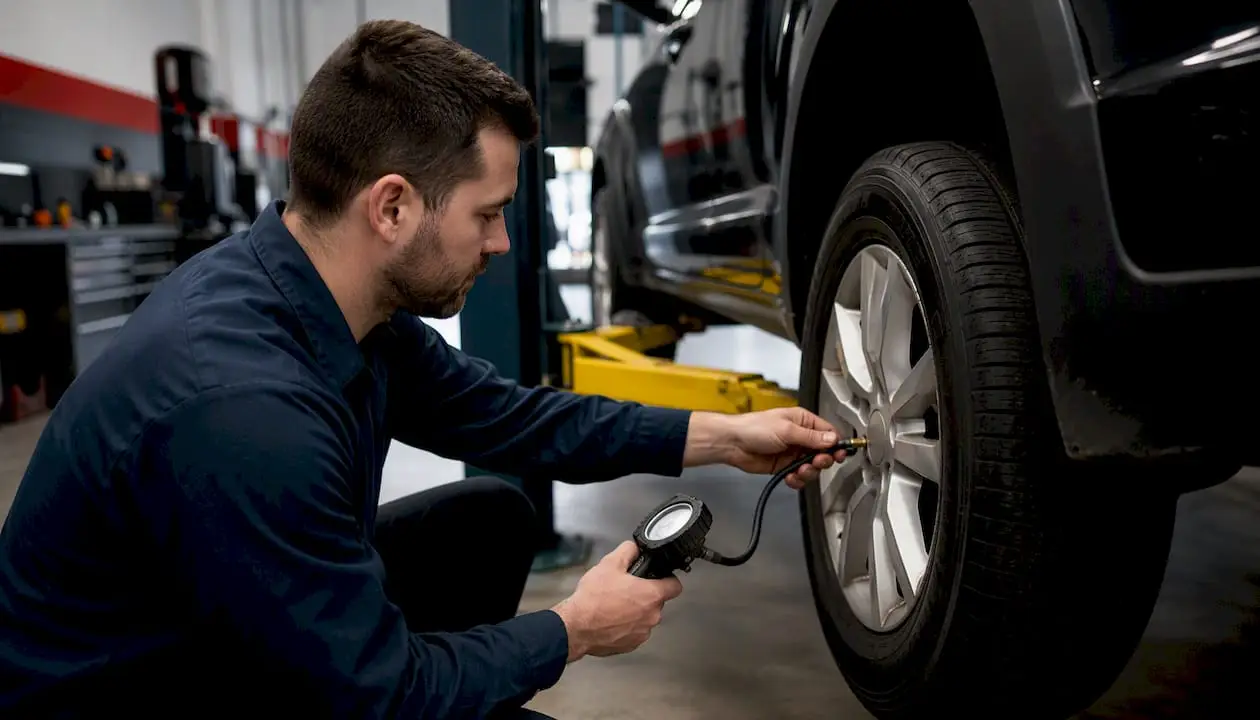
What surprises people most is how gradual it is. Pressure bleeds off slowly through normal permeation and temperature swings, so there’s rarely a dramatic moment that prompts a check. By the time the TPMS light comes on, the fuel economy hit has been accumulating for weeks.
We document PSI readings during every visit and flag anything outside the recommended range. It takes about two minutes, and it’s the kind of small thing that prevents bigger problems — uneven wear, a blowout on the highway, or a slow leak that turns into a flat at the worst possible time. Tire pressure isn’t glamorous maintenance, but in our experience, it’s one of the highest-return habits a driver can build.
Get a tire pressure check at Express Lube & Car Care
Correct tire pressure is one of the easiest ways to protect your fuel budget and your safety — and you don’t need an appointment to get it done right. At Express Lube & Car Care in Richland Hills, our ASE-certified technicians check and correct tire pressure as part of every service visit, document the readings, and flag anything that needs attention.
Walk in any time and we’ll check your PSI, scan your TPMS, and let you know if anything looks off. Current service specials make it easy to combine a tire check with an oil change in a single stop. Every service is backed by our 24-month/24,000-mile warranty, so you leave knowing the work is done and covered. Stop by or book your visit online — it takes less time than you’d think.
Sources
- Gas Mileage Tips – Keeping Your Vehicle in Shape
- Energy
- Tire Pressure and Fuel Economy: Why Proper Inflation Matters – Kelley Blue Book
- Experimental Analysis of Tire Inflation Pressure Effects on Fuel Consumption and CO₂ Emissions in a Gasoline-Powered Light Vehicle
- EPA emission factors / tire inflation analysis (NEPIS)
- Transportation Research Board special report on tires and fuel economy
- Study on active tire pressure management and simulated fuel benefits (SAGE journals)
FAQ
How much does tire pressure affect gas mileage?
Every 1 psi drop in average tire pressure across all four tires reduces fuel economy by about 0.2%, according to the U.S. Department of Energy. Keeping tires properly inflated can improve gas mileage by about 0.6% on average and up to 3% in some cases.
Where do I find the correct tire pressure for my car?
Check the sticker on the driver’s door jamb or your owner’s manual. The maximum PSI printed on the tire sidewall is the tire’s rated limit, not your vehicle’s recommended operating pressure.
How often should I check tire pressure?
Check tire pressure at least once a month and before any long trip. Because temperature changes shift pressure by roughly 1 psi per 10°F, seasonal transitions are especially important times to check.
Does overinflating tires improve fuel economy?
Slightly higher pressure may reduce rolling resistance, but overinflating past the manufacturer’s recommendation poses risks to traction, tire wear, and handling that can outweigh fuel benefits.
Can Express Lube & Car Care check my tire pressure?
Yes. Express Lube & Car Care technicians check and document tire pressure during every service visit in Richland Hills — no appointment needed. Walk-ins are welcome, and tire checks are included as part of routine maintenance services.