

Bulk service pricing turns unpredictable repair spending into predictable, lower-cost monthly or per-mile bills, and that single shift is why fleet managers keep coming back to volume-based maintenance contracts. Tools like Fleetio and resources like FleetOwner confirm what shops like Express Lube & Car Care see every day: contracted fleets spend less, break down less, and budget more accurately than fleets running on a pay-as-you-go basis.
- Typical savings: Volume discounts on parts and labor often run 20–30% through fleet maintenance contracts.
- Budget predictability: Fixed monthly per-vehicle or per-mile pricing replaces surprise invoices with a number you can put in a spreadsheet.
- Operational payoff: Priority scheduling and scheduled preventive maintenance (PM) mean fewer breakdowns and less revenue lost to downtime.
Table of Contents
- The concrete benefits fleets get from volume pricing
- Why shops can actually afford to offer volume discounts
- How to evaluate and negotiate a fleet maintenance contract
- Simple math: does bulk pricing actually pay off?
- How Express Lube & Car Care structures local fleet plans
- Key Takeaways
- A candid note from the shop floor
- Fleet plans at Express Lube & Car Care: get a local quote
- Sources and further reading
- FAQ
The concrete benefits fleets get from volume pricing
Predictable budgets plus lower total cost of ownership plus less downtime equals higher revenue capture. That formula is not marketing language; it reflects what contract maintenance does operationally.
Savings on parts and labor are often substantial through volume-based maintenance contracts, according to Fleetio’s fleet maintenance subscription research.
Scheduled PM catches problems before they become expensive. Autosist’s fleet maintenance data shows that a roadside breakdown typically costs $400–$800 in towing and labor alone, and a major engine failure can exceed $10,000–$20,000. A $100 inspection that catches a failing belt prevents both.
Here is a quick worked example. A five-vehicle delivery fleet runs 2,000 miles per vehicle per month. Without a contract, one unexpected transmission repair at $3,500 wipes out months of “savings” from avoiding a PM plan. With a bulk contract covering scheduled oil changes, brake inspections, and fluid checks, that transmission issue surfaces early, costs a fraction to address, and the fleet’s cost-per-mile drops because reactive repairs shrink.
Additional benefits worth tracking:
- Consolidated invoicing replaces a stack of individual receipts with one monthly statement.
- Digital vehicle inspection records support DOT compliance and simplify audits.
- Access to ASE-certified technicians means you are not paying for on-the-job learning.
Why shops can actually afford to offer volume discounts
Discounts come from predictable workflow, bulk parts purchasing, and reduced per-job admin costs — not from a shop absorbing losses. When a shop knows your fleet’s service schedule weeks in advance, several efficiencies kick in simultaneously:
- Technicians are scheduled against known work, eliminating idle bay time.
- Parts are ordered in advance at wholesale pricing, cutting per-unit cost.
- A single invoice replaces five or ten individual transactions, reducing billing overhead.
- Bay scheduling stability lets the shop prioritize contracted vehicles during peak periods.
That last point matters more than most fleet managers realize. A contracted fleet gets a reserved spot; a walk-in fleet competes with everyone else on a busy Monday morning.
Pro Tip: When negotiating, insist that both labor and parts pricing be explicit and tied to a wholesale-plus formula or a pre-negotiated discount percentage. A contract that says “discounted parts” without defining the baseline is not a contract worth signing.

How to evaluate and negotiate a fleet maintenance contract
Prioritize total cost of ownership, service-level commitments, and clear parts/labor pricing above everything else. Here is a practical checklist for evaluating any provider:
- Dedicated account manager: — Fleetio’s provider evaluation guidance specifically recommends requiring a dedicated account manager during the first 60 days to handle scheduling, billing integration, and driver orientation.
Use this table when you sit down with a potential provider:
| Question to ask | Why it matters | Red-flag answer |
|---|---|---|
| “What is your labor rate per hour?” | Locks in your cost baseline | “It depends on the job” |
| “How do you price parts?” | Prevents hidden retail markups | “We offer bulk discounts” (no formula) |
| “What is your average turnaround for a PM?” | Measures downtime impact | No SLA or “we’ll try our best” |
| “Do you provide DOT-compliant records?” | Compliance and audit protection | Paper logs only |
| “What is the exit clause?” | Protects you if service quality drops | 12+ months with heavy penalties |
After signing, track these KPIs monthly: cost-per-mile, PM compliance rate, mean time to repair, and downtime hours avoided. Those four numbers tell you whether the contract is paying for itself.
Simple math: does bulk pricing actually pay off?
Small fleets (5–10 vehicles) and mid-size fleets (25–50 vehicles) both see predictable budgeting gains; savings scale with utilization.
Scenario A — Fixed monthly per vehicle (small fleet):
Ten vehicles at $120/month each = $1,200/month covering all scheduled PMs. Without a contract, one reactive repair at $1,800 plus two $400 roadside calls already exceeds two months of contract costs.
Scenario B — Per-mile pricing (high-mileage route):
A delivery van running 4,000 miles/month at $0.04/mile = $160/month. That rate includes oil changes and tire rotations. Paying per-job for the same services at retail typically runs $200–$240/month, and that is before any unscheduled repair.
Scenario C — Tiered plan break-even (PM-only vs full repair):
A PM-only tier at $90/vehicle/month keeps costs low but leaves major repairs at retail. Upgrading to a full-repair tier at $160/vehicle/month breaks even the first time a brake job or diagnostic comes in, since those jobs routinely cost $300–$600 at retail. Understanding your fleet oil change intervals helps you model PM frequency accurately before choosing a tier.
A quick spreadsheet formula to test your own numbers:
- Downtime cost: — (vehicles down per month) × (revenue per vehicle per day) × (average days down)
Scheduled maintenance reduces that downtime figure faster than any other single variable.
How Express Lube & Car Care structures local fleet plans
Express Lube & Car Care offers local fleet plans built around priority scheduling, digital vehicle inspections, ASE-certified technicians, and a 24-month/24,000-mile written warranty. For fleet managers in the Richland Hills area, that combination means you get documented service records, transparent pricing, and a shop that knows your vehicles by name.
Typical features in a local fleet plan from Express Lube & Car Care:
- Scheduled PMs (oil changes, brake inspections, fluid checks, tire rotations)
- Discounted parts and labor with itemized invoicing per vehicle
- Digital vehicle inspection reports with photos, stored for your records
- DOT-compliant service documentation
- Designated onboarding contact for the first 60 days of your contract
Trust signals matter when you are handing over a fleet. ASE certification means the technicians working on your vehicles have passed standardized competency tests. A written warranty means any covered repair that fails comes back at no additional cost. Transparent, itemized pricing means no surprises on the invoice.
Key Takeaways
Bulk service pricing reduces fleet maintenance costs and downtime by converting unpredictable repair spending into fixed, volume-discounted contracts with clear labor and parts terms.
| Point | Details |
|---|---|
| Volume discounts are real | Parts and labor savings typically run 20–30% through fleet maintenance contracts. |
| Pricing model choice matters | Fixed per-vehicle, per-mile, and tiered subscriptions each fit different utilization patterns. |
| Onboarding determines success | Require a dedicated account manager for the first 60 days to prevent billing and scheduling friction. |
| Track four KPIs | Cost-per-mile, PM compliance rate, mean time to repair, and downtime hours avoided prove ROI. |
| Express Lube & Car Care | Offers local fleet plans with ASE techs, digital inspections, and a 24-month/24,000-mile written warranty. |
A candid note from the shop floor
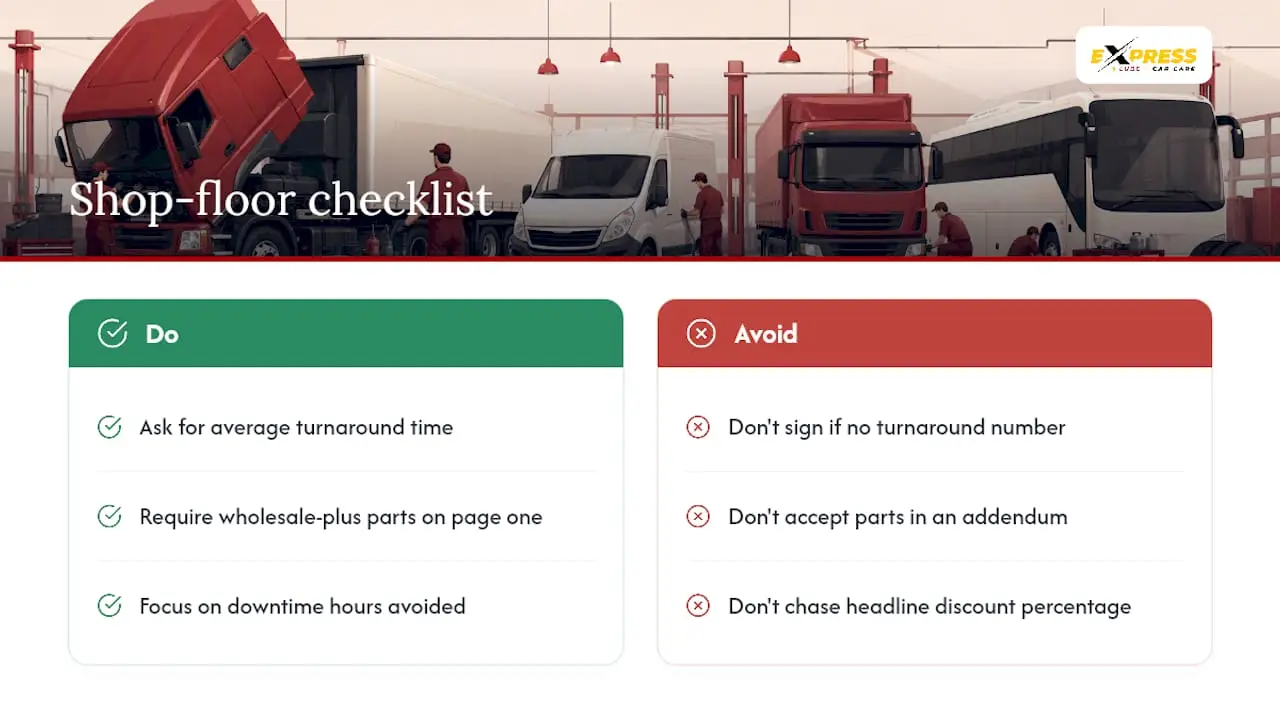
Most fleet managers come in focused on the discount percentage, and that is understandable. But the number that actually moves the needle is downtime hours avoided. A 25% parts discount means nothing if your van sits in a queue for three days because the shop did not prioritize your account. The first thing I tell fleet managers: before you sign anything, ask the shop to show you their current contracted fleet’s average turnaround time. If they cannot produce that number, the contract is not mature enough to trust. And when you do sign, get the wholesale-plus parts language in writing on page one, not buried in an addendum. That single clause is worth more than any headline discount.
Fleet plans at Express Lube & Car Care: get a local quote
Lower maintenance costs and fewer breakdowns are within reach for fleets in the Richland Hills area. Express Lube & Car Care’s fleet plans include priority scheduling, ASE-certified technicians, digital vehicle inspections, and a 24-month/24,000-mile warranty that backs every covered repair in writing. There are no vague “bulk discount” promises here: pricing is itemized, parts terms are explicit, and your first 60 days include a dedicated onboarding contact.
Ready to put a number on what your fleet could save? Visit the Express Lube & Car Care fleet services page to request a fleet quote or schedule your first appointment. Bring your vehicle count and average monthly mileage, and we will build a plan around your actual numbers.
Sources and further reading
- Fleet maintenance subscription pricing strategy
- Optimize your fleet management: The benefits of contract maintenance services for reduced downtime and cost efficiency | FleetOwner
- Fleet scheduled maintenance best practices
- Fleet Maintenance Contract: Pricing, Legal Terms, and Risk — LegalClarity
- Evaluating fleet service providers
- Using contract maintenance to reduce fleet downtime and costs | NationalEASE
- Contract fleet maintenance (Penske) resource library
FAQ
What is bulk service pricing for fleets?
Bulk service pricing, also called fleet contract maintenance, is a volume-based agreement where a shop provides scheduled and repair services at pre-negotiated rates in exchange for a committed fleet account. Pricing typically follows a fixed monthly per-vehicle, per-mile, or tiered subscription model.
How much can a fleet realistically save with a maintenance contract?
Volume discounts on parts and labor typically run 20–30% through fleet maintenance contracts, with additional savings from reduced reactive repairs and downtime.
What should every fleet contract include?
Every contract should specify the labor rate per hour, a wholesale-plus parts pricing formula, warranty terms, itemized invoicing, digital inspection records, and a clear exit clause, as outlined by LegalClarity’s fleet contract guidance.
Does Express Lube & Car Care offer fleet maintenance contracts?
Yes. Express Lube & Car Care offers local fleet plans in the Richland Hills area with priority scheduling, ASE-certified technicians, digital vehicle inspections, and a 24-month/24,000-mile written warranty.
When does a fleet contract not make financial sense?
Seasonal fleets, micro-fleets with fewer than three vehicles, and operations with highly irregular mileage often save more on a per-job basis, since fixed monthly fees require consistent utilization to break even.