

Scheduled service for fleet vehicles is defined as a proactive maintenance program that triggers inspections and repairs based on mileage, engine hours, or calendar intervals before problems develop. Fleet managers who follow structured preventive maintenance schedules spend 28–35% less annually on maintenance than fleets that wait for something to break. That gap exists because planned repairs cost 4–5 times less than reactive breakdown repairs, once you factor in secondary damage, emergency labor, and lost revenue. Understanding why fleet vehicles need scheduled service is not an academic exercise. It is the difference between a fleet that runs on a budget and one that bleeds money every quarter.
Why fleet vehicles need scheduled service: triggers and components
Effective fleet scheduled service runs on three core triggers: mileage, engine hours, and elapsed time. Each trigger captures a different dimension of vehicle wear. Mileage tracks mechanical stress from road use. Engine hours measure wear on components that run regardless of distance, such as idle-heavy utility vehicles. Calendar time catches fluid degradation that happens even when a vehicle sits unused.

The most reliable approach is first-to-occur scheduling, where whichever trigger hits first initiates the service. This prevents two common failures: neglecting a vehicle that racks up engine hours without much mileage, and over-servicing a low-use vehicle that hits a calendar date before it needs attention. Aligning triggers with actual duty cycles makes the schedule reflect real wear, not just assumptions.
Here is what a well-built fleet service trigger system covers:
- Mileage intervals: Standard oil changes, tire rotations, and brake inspections tied to odometer readings
- Engine hour intervals: Filters, belts, and cooling system checks for vehicles with high idle time
- Calendar intervals: Fluid flushes, battery checks, and seasonal inspections regardless of use
- Condition-based triggers: Alerts from telematics or driver reports that override standard intervals when abnormal wear appears
- OEM compliance checks: Manufacturer-specified intervals that protect warranty coverage
Automated Computerized Maintenance Management Systems (CMMS) reduce missed services significantly. These platforms integrate mileage feeds, engine hour data, and calendar tracking, then trigger alerts 10–14 days before a service is due. That lead time lets you schedule shop time without pulling a vehicle off a critical route at the worst possible moment.
Pro Tip: Set your CMMS alerts at 90% of the interval threshold, not at 100%. That buffer gives dispatchers time to slot the vehicle into a low-demand window rather than forcing an emergency pull from service.
How does scheduled maintenance reduce overall fleet operating costs?
The financial case for preventive maintenance is straightforward. Reactive maintenance costs 2.8–3.4 times more per maintenance dollar than planned service, once you account for secondary damage, roadside assistance, and lost productivity. A single roadside breakdown carries a fully burdened cost exceeding $2,000, covering towing, expedited parts, overtime labor, and customer penalties. Scheduled service eliminates most of those costs before they appear.
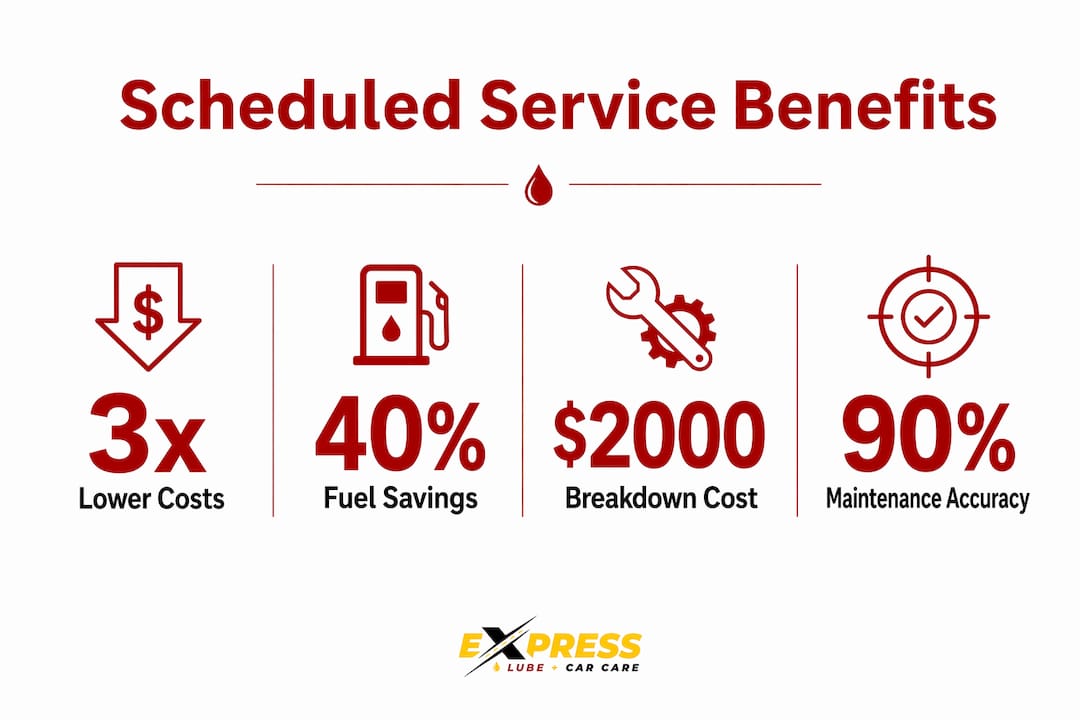
Fuel efficiency is another area where regular maintenance pays directly. Proper tire inflation and engine tuning can improve fuel economy by up to 40% in commercial fleets. For a fleet running dozens of vehicles, that improvement compounds into a material budget line every month.
| Cost category | Scheduled service | Reactive service |
|---|---|---|
| Routine repair labor | Low, planned rate | High, emergency rate |
| Parts cost | Standard pricing | Expedited premium |
| Secondary damage | Minimal | Frequent, expensive |
| Downtime per incident | Hours | Days |
| Roadside assistance | Rare | Common, $2,000+ per event |
Deferred maintenance is the hidden budget killer most fleet managers underestimate. Skipping routine oil changes, which cost $85–$140 each, can lead directly to engine replacements costing $8,000–$22,000. That math is not complicated, but it gets ignored when budgets are tight and the vehicle is still running today.
Scheduled maintenance transforms fleet maintenance from reactive firefighting into a manageable investment that ensures reliability and compliance. Fleet managers who treat service intervals as fixed operating costs, rather than optional line items, consistently outperform those who defer until failure.
The total marginal operating cost per mile for commercial fleets has reached a record $2.260, with non-fuel maintenance costs rising 3.6% annually. That trend makes proactive cost control through scheduled service more financially critical every year.
What safety, compliance, and operational benefits does scheduled service provide?
Scheduled service protects more than your budget. It protects your drivers, your business license, and your insurance coverage. Routine inspections catch brake wear, tire degradation, and lighting failures before they create a roadside emergency or a liability claim.
Here are the four core non-financial benefits that a structured fleet vehicle service schedule delivers:
-
Driver safety and vehicle reliability. Routine brake, tire, and steering inspections catch wear before it becomes a failure. A vehicle that passes a scheduled inspection is statistically far less likely to experience a mechanical breakdown mid-route.
-
Warranty and insurance compliance. Most OEM warranties require documented adherence to manufacturer service intervals. Skipping scheduled service can void coverage on expensive drivetrain components. Insurance carriers also review maintenance records after accidents, and gaps in service history can complicate claims.
-
DOT audit readiness. The Department of Transportation requires commercial fleets to maintain documented maintenance records. Auditors look for consistent, dated service logs. A fleet with a structured program and clean records passes audits without scrambling. A fleet running on informal, memory-based maintenance does not.
-
Driver confidence and retention. Drivers who operate well-maintained vehicles report higher job satisfaction and lower stress. A vehicle that starts reliably, brakes predictably, and runs without warning lights keeps drivers focused on the route rather than worried about the truck. That confidence reduces driver turnover, which is a real operational cost.
A fleet maintenance checklist for managers that covers all four categories gives you a repeatable framework for every vehicle in your program. Consistency across the fleet is what turns individual service events into a system that scales.
How can fleets build and tailor effective scheduled service programs?
No two fleets are identical, and a one-size-fits-all schedule creates gaps. A delivery van running urban stop-and-go routes wears brakes and tires far faster than a highway service truck covering the same mileage. Effective PM programs assign tailored intervals based on vehicle type, route profile, and duty cycle rather than applying a single standard across the board.
Start by auditing your fleet composition. Group vehicles by type, average daily mileage, operating environment, and load profile. That segmentation becomes the foundation for assigning different service intervals to different vehicle classes.
Key factors to build into your program:
- Severe-duty adjustments: Vehicles operating in extreme heat, heavy loads, or dusty environments need shorter oil change and filter intervals than OEM baseline schedules assume
- Seasonal factors: Cold-weather climates require battery, coolant, and tire checks before winter. Hot climates stress cooling systems and require more frequent coolant and belt inspections
- Technology integration: Telematics platforms that feed real-time mileage and engine hour data into a CMMS remove the manual tracking burden and catch interval triggers automatically
- Avoiding deferred maintenance traps: Never “borrow from the future” by pushing a service past its trigger date to meet a short-term dispatch need. That decision compounds into larger failures within weeks
- In-house vs. partner balance: Balancing in-house maintenance with external service partners for complex repairs and overflow improves uptime without requiring costly internal shop expansion
Pro Tip: Review your fleet oil change intervals annually. Engine technology, oil formulations, and operating conditions all shift over time, and an interval set three years ago may no longer reflect your actual wear patterns.
Seasonal and operating environment adjustments to service intervals are underutilized across most commercial fleets. Vehicles in extreme climates or heavy-duty applications wear faster than baseline OEM schedules account for. Adjusting intervals to match real conditions is one of the highest-return changes a fleet manager can make.
Key Takeaways
Scheduled fleet service is the single most effective way to control maintenance costs, protect driver safety, and maintain regulatory compliance across a vehicle operation of any size.
| Point | Details |
|---|---|
| Cost savings are significant | Preventive maintenance costs 4–5 times less per repair than reactive breakdown service. |
| First-to-occur triggers work best | Use mileage, engine hours, and calendar time together; whichever hits first drives the service. |
| Deferred service is expensive | Skipping oil changes at $85–$140 can lead to engine replacements costing $8,000–$22,000. |
| Safety and compliance depend on it | DOT audits, OEM warranties, and insurance claims all require documented maintenance records. |
| Tailor intervals to your fleet | Severe-duty, seasonal, and route-specific factors require adjustments beyond OEM baseline schedules. |
Scheduled service is a financial strategy, not a maintenance chore
We see this pattern constantly at Express Lube & Car Care: fleet managers who treat scheduled service as an optional line item end up spending three times more on emergency repairs within a year. The math is not subtle. A $120 oil change that gets deferred for two months becomes a $14,000 engine replacement six months later. That is not bad luck. That is a predictable outcome of a predictable decision.
What I have found working with fleet operators in the Richland Hills area is that the biggest obstacle is not budget. It is the belief that a vehicle running today does not need service today. That thinking feels rational in the moment. It is not. Wear accumulates silently. Fluids degrade on a schedule that does not care about your dispatch calendar.
The fleets that run well long-term treat their preventive vehicle maintenance program the same way they treat payroll. It is a fixed, non-negotiable operating cost. The ones that treat it as flexible spending pay for that flexibility repeatedly, in towing bills, missed deliveries, and driver turnover.
Data-driven scheduling is not complicated. It requires consistent tracking, honest interval-setting based on actual duty cycles, and a service partner you trust to do the work right the first time. Get those three things right, and your fleet maintenance costs become predictable. Predictable costs are manageable costs.
— Express Lube & Car Care
Fleet service solutions at Express Lube & Car Care
Fleet managers in the Richland Hills area trust Express Lube & Car Care for scheduled service that keeps vehicles on the road and out of the shop. Our certified ASE technicians handle everything from routine oil changes to complex repairs, with no appointment needed for walk-in service.
Every service we perform is backed by a 24-month warranty, giving your fleet consistent, documented coverage that satisfies OEM and DOT requirements. We also offer easy financing options to help fleet operators manage maintenance budgets without deferring critical service. Check our current oil change and service specials for fleet-friendly pricing on the services your vehicles need most. Bring your fleet in and let us build a service schedule that fits your operation.
FAQ
Why do fleet vehicles need scheduled service more than personal vehicles?
Fleet vehicles accumulate mileage and engine hours far faster than personal vehicles, accelerating wear on every major system. Scheduled service aligned to actual duty cycles prevents the compounded failures that high-utilization vehicles are prone to.
What is the first-to-occur scheduling method?
First-to-occur scheduling triggers a service event when any one of three thresholds is reached first: mileage, engine hours, or calendar time. This method prevents both neglect and over-servicing by matching maintenance to real vehicle wear.
How much does a roadside breakdown actually cost a fleet?
A single roadside breakdown carries a fully burdened cost that often exceeds $2,000, including towing, expedited parts, overtime labor, and customer penalties. Scheduled service eliminates most of those events before they occur.
Does scheduled maintenance really improve fuel economy?
Proper tire inflation and engine maintenance can improve fuel economy by up to 40% in commercial fleets. Fuel savings from consistent maintenance often offset the full cost of the service program.
How do I set service intervals for a mixed fleet?
Group vehicles by type, duty cycle, and operating environment, then assign separate interval triggers to each group. A vehicle maintenance schedule guide can help you structure intervals for each vehicle class based on real-world wear patterns rather than generic OEM defaults.