

Changing your car's air filter is easily one of the quickest and most satisfying DIY jobs you can tackle. Think of it as letting your engine finally take a deep, clean breath. A fresh filter is crucial for feeding the engine the clean air it needs to burn fuel efficiently, which directly boosts its performance and your gas mileage.
How a Clean Air Filter Protects Your Engine
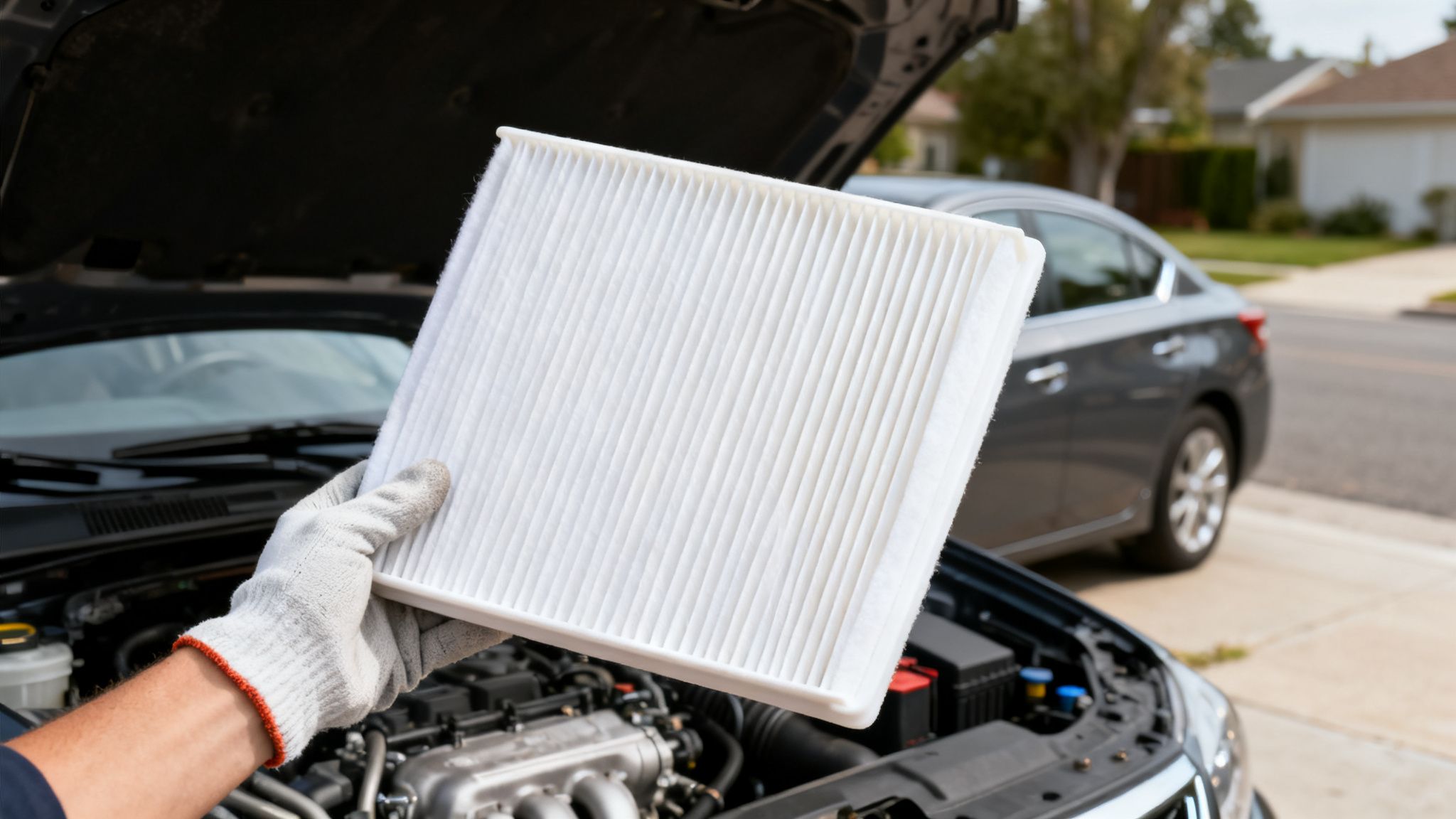
Your engine is a finely-tuned machine, and it depends on a very specific mix of fuel and air to run properly. You might be surprised to learn that for every gallon of gas your car burns, it sucks in up to 10,000 gallons of air. The engine air filter is the only thing standing between all that air and the delicate internals of your engine.
Preventing Premature Engine Wear
Just think about driving around Richland Hills on a windy day or getting stuck in that stop-and-go traffic on I-820. Your car is constantly inhaling dust, pollen, bugs, and all sorts of road grime. Without a good filter, those tiny, abrasive particles would get sucked right into your engine’s cylinders.
Once inside, that grit acts like sandpaper on critical parts, including:
- Piston rings
- Cylinder walls
- Valves
Over time, this microscopic damage adds up, leading to bigger problems like poor compression, burning oil, and eventually, a catastrophically expensive engine failure. That simple filter, which often costs less than $20, is your first line of defense against thousands in potential repair bills.
Maximizing Fuel Efficiency and Performance
When an air filter gets clogged, your engine has to struggle to pull in air. It's essentially being suffocated. That extra work has a direct impact on your wallet. A severely restricted filter can slash your fuel economy by as much as 10%, which adds up fast every time you fill up.
You'll feel it in the driver's seat, too. A dirty filter often leads to sluggish acceleration and a noticeable drop in horsepower. If your car feels hesitant when you step on the gas, a choked-off air supply is a very likely culprit.
By keeping a clean filter in place, you’re ensuring a steady flow of fresh air, which lets your engine's computer maintain that perfect air-to-fuel ratio. The result? Smoother performance, quicker throttle response, and the best possible gas mileage.
These small, routine checks are a cornerstone of smart car ownership. For more tips on how simple tasks keep your vehicle running strong, check out our other posts on vehicle maintenance.
Recognizing the Signs of a Clogged Air Filter
Your car has a way of telling you when things aren't right. A clogged air filter, in particular, sends some pretty clear signals—and you don’t need to be a mechanic to spot them. Learning to recognize these clues helps you fix the small stuff before it snowballs into bigger problems.
One of the first things you'll probably notice is a hit to your fuel economy. A dirty filter makes your engine gasp for air, forcing it to work harder and burn more fuel just to keep up. If you suddenly feel like you're on a first-name basis with the gas station attendant, a clogged filter is a likely culprit.
Performance Problems on the Road
Ever put your foot down to merge onto the highway and feel like your car just doesn't have its usual punch? That sluggish, hesitant feeling is a classic symptom. Your engine is essentially trying to sprint while breathing through a clogged straw.
You might also hear some strange things. A healthy engine has a smooth, consistent hum. But when it's starved for air, you could get rough idling, sputtering, or even a faint whistling sound as air struggles to get through the muck. These are all signs that your engine’s air-fuel mixture is out of whack.
Key Takeaway: A dirty air filter directly impacts your engine's ability to breathe. This can lead to decreased power, strange noises, and even trigger your check engine light if the air-fuel ratio becomes too unbalanced.
If a new filter doesn't clear things up, it might be time for a professional look. A persistent warning light can point to other issues, and our guide to understanding your check engine light can help you figure out what's next.
The Visual Inspection Test
Sometimes, the best diagnostic tool is just a pair of eyes. A quick look at the filter itself can tell you everything you need to know. A new air filter is usually bright white or off-white. One that's past its prime? It’ll be obviously dirty.
This handy table will help you judge what you're seeing when you pull the filter out.
Air Filter Condition Visual Inspection Guide
| Condition | Visual Cues | Action Required |
|---|---|---|
| New or Like-New | Bright white or light gray pleats. No visible dirt, dust, or debris trapped in the folds. | No action needed. The filter is functioning correctly. |
| Moderately Dirty | Pleats appear gray or discolored. You can see a layer of dust and small debris. | Replacement is recommended soon. Performance is likely starting to decline. |
| Severely Clogged | The filter is dark gray or black. Pleats are packed with dirt, leaves, insects, and grime. | Immediate replacement is required. The filter is severely restricting airflow. |
This simple visual check is the most straightforward way to confirm your filter’s condition. Keeping this simple part clean is critical for vehicle health and emissions control, which is why the automotive filters market is so huge.
Most manufacturers recommend a new filter every 15,000 to 30,000 miles. By paying attention to how your car drives and what the filter looks like, you can easily keep your engine running at its best.
A Practical Walkthrough for Changing Your Engine Air Filter
Changing your engine's air filter might sound like a job for the pros, but it's one of the easiest and most satisfying DIY tasks you can do. Honestly, with a couple of basic tools and about 15 minutes of your time, you can give your engine a breath of fresh air and improve its performance. I've done this job hundreds of times, and I'll walk you through it with some real-world tips.
First things first: safety. Always work on a cool engine to avoid getting burned. Make sure you're parked on a flat surface with the car turned completely off. You'll likely only need a screwdriver (usually a Phillips head) or maybe a small socket set to get the job done.
Finding the Air Filter Housing
Your first mission is to find the air filter's home under the hood. You're looking for a big, black plastic box, typically square or rectangular, sitting somewhere near the top of the engine. It will have a large, fat hose coming out of it that leads toward the engine itself.
Where it lives can vary from car to car.
- In many Honda and Toyota models, you'll find the airbox on the driver's side, held shut with a few simple metal clips that you can pop open with your fingers or a flathead screwdriver.
- Ford and Chevy trucks often place it more centrally, and you might need a socket wrench to loosen a few small bolts.
- Some European cars like a BMW or VW can be a bit trickier, sometimes using Torx screws (the star-shaped ones) instead of standard Phillips heads.
If you're stumped, your owner's manual is your best friend—it'll have a map of your engine bay. For a more detailed look at different layouts, check out our guide on where to find the air filter in a car.
This infographic nails the key symptoms of a clogged filter. If you're noticing any of these, it's definitely time for a change.
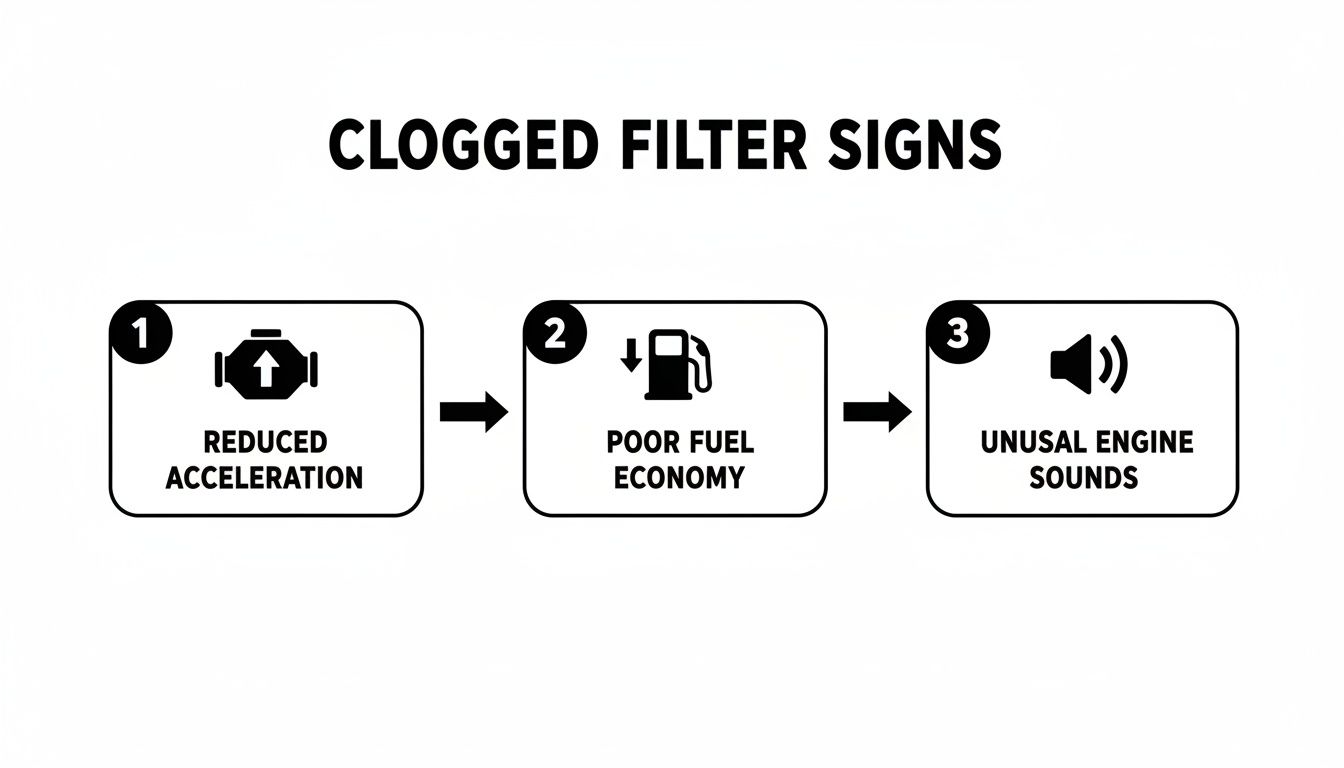
A choked-off filter directly impacts how your engine breathes, leading to poor acceleration, worse gas mileage, and even some strange noises.
Getting the Old Filter Out and Cleaning House
Once you’ve found the housing, it's time to open it up. Unsnap the clips or unscrew the bolts holding the lid down. You usually don’t have to take the screws all the way out; just loosening them is enough to lift the cover. Whatever you do, be gentle—older plastic can get brittle.
Lift the cover off and you'll see the old air filter sitting inside. Pay attention to how it's oriented before you pull it out because the new one needs to fit in the exact same way. Go ahead and lift the old, dirty filter straight out.
Pro Tip: Before you drop the new filter in, grab a shop vac or a damp cloth and clean out the bottom of the housing. You’ll be surprised how many leaves, bugs, and bits of dirt get trapped in there. Cleaning it out ensures none of that gunk gets sucked into your engine when you start it up.
This is a step most people skip, but it takes less than a minute and makes a huge difference.
Installing the New Filter for a Perfect Seal
With a clean housing, you’re ready for the new filter. Just do a quick side-by-side comparison with the old one to make sure you bought the right part—they should be an exact match in size and shape.
Set the new filter into the housing. Make sure it sits down flat and feels snug. That rubber or foam edge around the filter is a gasket, and it needs to create an airtight seal. If it’s crooked, dirty air can bypass the filter and head straight for your engine, which defeats the whole purpose.
Once it looks right, put the lid back on. Line it up correctly before you fasten the clips or tighten the screws. Just get the screws hand-tight; overdoing it can easily crack the plastic housing. Give the box a little shake to make sure it's secure. That’s it! You've just done one of the best things you can do for your engine's health and performance.
How to Choose the Right Air Filter for Your Car
It might seem like a small detail, but picking the right air filter is a decision that has a real impact on your engine's health and performance. When it's time to change the air filter in your car, you’ll see a few different types on the shelf. Knowing which one to grab is key to giving your engine the protection it deserves.
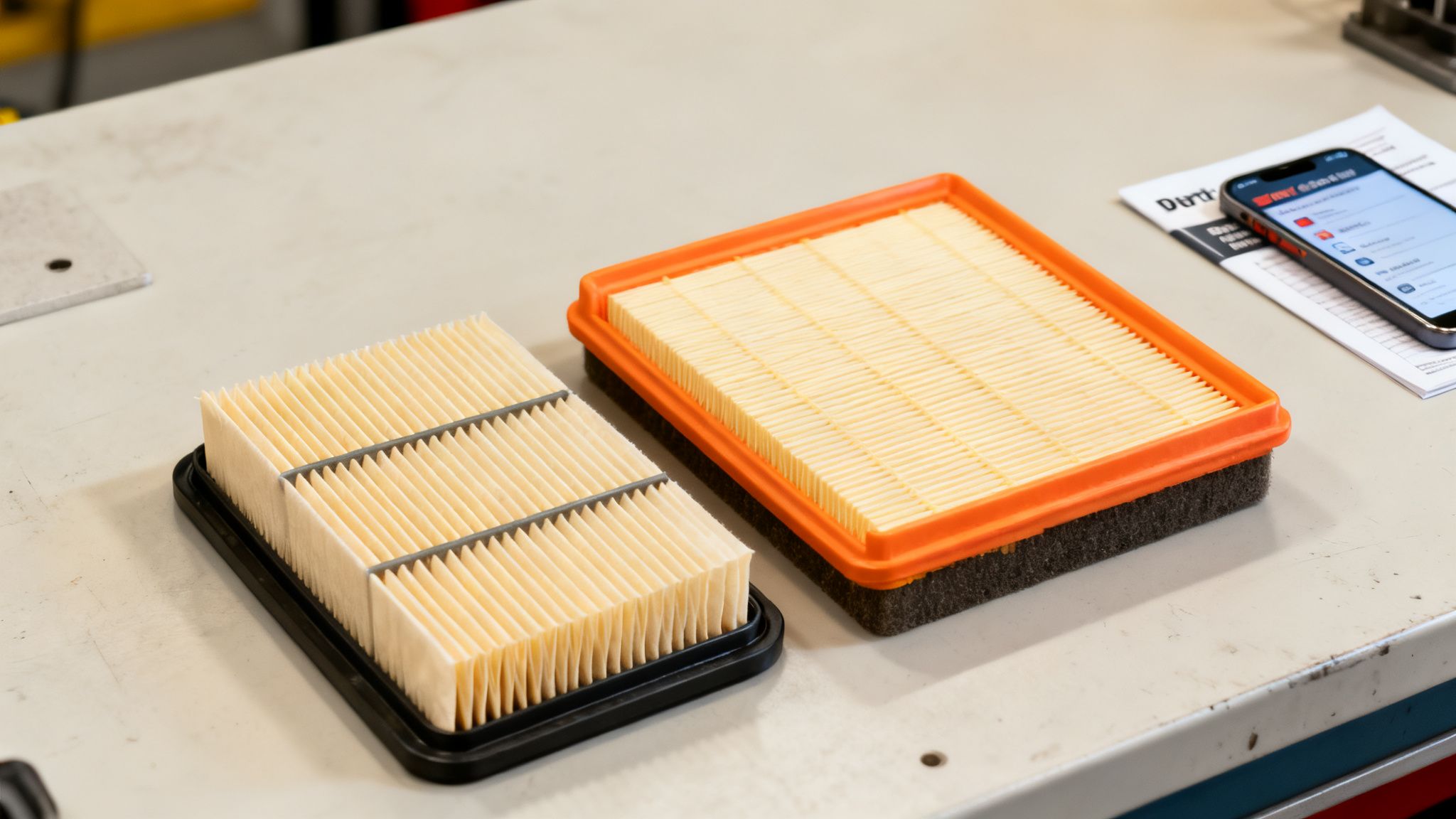
The two main players in the air filter world are the traditional paper filters and the more modern synthetic ones. Each comes with its own pros and cons, usually boiling down to performance, longevity, and of course, price.
Paper vs. Synthetic Filters
The most common and budget-friendly option is the standard paper filter. This is the classic OEM-style filter that most cars roll off the factory line with. For everyday driving and commuting, they do a perfectly good job of trapping dirt and dust until your next service interval.
Then you have the synthetic and performance filters. These are built with more advanced materials designed for better filtration and a longer lifespan. They’re great at catching smaller particles and can improve airflow slightly, which is why you’ll often see them used in performance-oriented vehicles.
Here in Northeast Tarrant County, a high-quality filter is more than just an upgrade—it's smart protection. All the dust and pollen we get in Texas can clog a standard filter fast, making a premium option a wise investment for your engine's long-term health.
The industry is definitely moving in this direction. In fact, projections show that synthetic filters are on track to make up about 48% of global sales by 2025 because of their higher dust capacity and longer life. We see this trend firsthand at Express Lube & Car Care, with more and more customers asking for premium parts. You can learn more about the growth of advanced filter media if you're curious.
Finding Your Car's Exact Part Number
No matter what type of filter you go with, getting the right size is non-negotiable. A filter that doesn't fit correctly will let unfiltered air leak past it, which completely defeats the purpose of having one in the first place.
Luckily, finding the correct part number is easy.
Your owner's manual is always the best place to start. It will have the exact part number or specification your engine requires. Just bring that number with you to the auto parts store.
Can't find the manual? No problem. The parts store websites all have vehicle lookup tools. Just punch in your car's year, make, and model, and it'll show you every compatible filter they have in stock. It’s a foolproof way to make sure you get the perfect fit.
When to Skip the DIY and See a Professional
Taking care of your own car is satisfying, but knowing when to tap out is just as important. A simple air filter swap is one of the easiest DIY jobs out there—until it isn't. We see it all the time at Express Lube & Car Care: a five-minute task turns into a costly headache because of one small hiccup.
If you pop open the air filter housing and find a broken clip or a bolt that’s already stripped, that’s your cue to stop. Trying to force it can easily crack the plastic housing, which costs a whole lot more to fix than the filter itself. This is especially true for older vehicles where plastic parts can get brittle and snap without much warning.
When Complications Arise
Modern cars are packed tight under the hood, and some air filters are a real pain to get to. You might find yours tucked behind other engine parts or needing special tools just to reach the housing. If you're struggling to even see the filter box, let alone open it, that's a good sign to let our ASE-certified technicians take over. We have the tools and experience to get into those tight spots without breaking anything.
Another big red flag is when a new filter doesn't fix your performance problems. If your car still feels sluggish or the check engine light stays on after you’ve put in a fresh filter, the old one wasn't the root of the problem.
This usually points to a deeper issue. It could be a dirty mass airflow sensor, a vacuum leak, or something going on with the fuel system. Our experts can run a full diagnostic to find the real culprit, saving you from playing guessing games and buying parts you don't need.
The Value of an Expert Eye
When you bring your car to Express Lube & Car Care for a filter change, you’re getting more than just a new part. You're getting an expert inspection. While we're under the hood, our technicians can spot early signs of other potential issues, like a worn serpentine belt or a small fluid leak you might have missed.
This kind of proactive care is more important than ever. The automotive air filter market is growing fast—the North American market alone makes up 34.82% of a global market expected to hit $5.9 billion in 2025. As cars get more complex, so does their maintenance. You can learn more about the expanding automotive filter industry and see why expert service matters.
With our no-appointment service and fair pricing, making the right call is easy. Let us handle the tough stuff so you can drive away knowing the job was done right.
Your Top Air Filter Questions Answered
Even for a job this simple, questions are bound to come up. Getting the right answers helps you tackle the task with confidence and gives you a better feel for how your car really works. We've pulled together a few of the most common questions we hear from drivers right here at the shop.
How Often Should I Change My Air Filter in Texas?
Your owner's manual probably gives a recommendation of every 15,000 to 30,000 miles, but that's based on "average" driving conditions. Let's be honest—the dust and high pollen counts we get here in Texas are anything but average.
A much smarter strategy is to just give the filter a quick look every time you get your oil changed.
If you spend a lot of time on dusty roads or live near all the construction happening around Northeast Tarrant County, you'll need to be even more on top of it. In those tougher conditions, you might need to change the air filter in your car as often as every 12,000 miles just to keep your engine breathing clean.
What's the Difference Between an Engine Air Filter and a Cabin Air Filter?
This is a fantastic question, and one we get all the time. They sound almost the same but do two totally different, and equally important, jobs.
- Engine Air Filter: Its only job is to protect your engine. It stops dirt, dust, and other junk from getting sucked into the cylinders, which is critical for performance and avoiding some seriously expensive internal damage.
- Cabin Air Filter: This one protects you. It cleans the air you and your passengers breathe inside the car, filtering out pollen, road grime, and other pollutants.
They are both essential maintenance items, but they live in different parts of your car and are definitely not interchangeable.
Here’s an easy way to remember it: the engine filter acts as the lungs for your engine, while the cabin filter does the same job for your lungs. Both need to be clean to work right.
Can a Dirty Air Filter Really Trigger My Check Engine Light?
You bet it can. When an air filter gets completely clogged, it chokes the engine and messes up the precise air-to-fuel mixture it needs to run efficiently.
Your car’s computer will notice this problem—usually via the mass airflow sensor—and it will flip on the check engine light to let you know something is wrong. It's one of the most common reasons for that little light to pop on, and thankfully, it's also one of the easiest and cheapest to fix.
Are Those Reusable Air Filters Worth the Extra Money?
For the vast majority of people just driving to work and back, a good quality, standard disposable filter is the most sensible and budget-friendly option.
High-performance or "reusable" filters can offer a tiny bit more airflow, but they come with a catch. They have to be regularly and carefully cleaned and then re-oiled, which just adds another chore to your to-do list. If you're not meticulous about it, you could end up doing more harm than good. We can help you figure out if one makes sense for your car and the way you drive.
Still have questions, or just want to hand the job over to the pros? The ASE-certified technicians at Express Lube & Car Care are always ready to help with straight answers and fast, reliable service. Swing by anytime—no appointment needed! Learn more at https://www.expressluberichlandhills.com.