

Let's be honest, "vehicle maintenance" sounds like a chore. It’s that thing on your to-do list that’s easy to push off. But what if you thought of it less as a task and more like a simple health plan for your car? It's really just the practice of regularly inspecting, servicing, and occasionally repairing your vehicle to keep it safe, reliable, and running efficiently.
This means handling proactive tasks like oil changes, tire rotations, and fluid checks to catch small issues before they snowball into massive, expensive problems.
Why Smart Vehicle Maintenance Is Your Best Investment

Your car is a lot like a high-performance athlete. To stay at the top of its game, it needs consistent care, the right fluids, and regular check-ups. Sticking to a vehicle maintenance schedule is hands-down the best way to ensure it performs when you need it most.
This isn’t about just fixing things when they break—that's a reactive, and often costly, approach. It’s about being proactive and preventing problems from ever starting.
The Proactive Approach to Car Care
The whole idea behind proactive maintenance is simple: small, regular services cost way less and are far more effective than giant, emergency repairs. When you ignore the little things, you risk a domino effect where one minor problem leads to a catastrophic failure down the line.
For example, putting off a simple oil change can lead to engine sludge, overheating, and eventually, a seized engine—a repair that can easily run into thousands of dollars. The benefits of staying ahead of the game are huge:
- Prevents Catastrophic Failures: Regular checks catch worn-out parts like belts, hoses, and brake pads before they give out on you in the middle of traffic.
- Maximizes Vehicle Lifespan: A well-cared-for engine, transmission, and cooling system can push past 200,000 miles or more, getting you the most out of your investment.
- Enhances Safety and Reliability: Your brakes, tires, and suspension are what keep you safe. Proper service ensures they can handle anything the unpredictable roads in Richland Hills throw at you.
Ultimately, vehicle maintenance isn't just about dodging repair bills. It's about protecting the value of your car, keeping it efficient, and giving you total peace of mind every time you get behind the wheel.
By spending a little time and effort now, you save yourself the stress, danger, and financial headache of a breakdown later. This guide will walk you through exactly how to set up a smart maintenance plan that will keep your car running like new for years.
The Real-World Payoffs of Regular Car Care
Let’s be honest, nobody enjoys adding another task to their to-do list. But thinking of routine car maintenance as just another chore is missing the point entirely. It's a direct investment in your vehicle, and the returns are very real.
You wouldn't ignore a tiny leak in your roof and just wait for the ceiling to collapse, right? The same logic applies to your car. Taking care of the small stuff now prevents the kind of massive, wallet-draining disasters that always seem to happen at the worst possible time. From battling I-820 traffic to surviving another brutal Texas summer, consistent care is what keeps your car dependable.
Enhanced Safety for Peace of Mind
More than anything else, keeping up with maintenance is about safety. Your car’s ability to stop, steer, and react depends on systems that are in good working order. For example, worn-out brake pads can seriously increase your stopping distance, turning a routine slowdown into a rear-end collision.
The same goes for your tires. If they're underinflated or the tread is gone, your grip on the road is compromised—a huge risk during a sudden Texas downpour. Regular checks and rotations are your first line of defense, making sure your tires wear evenly and keep you safely planted on the pavement.
- Brake System Integrity: Fresh fluid and good pads mean your car stops when you tell it to. No hesitation, no surprises.
- Tire Health: The right pressure and tread depth give you the traction you need, rain or shine.
- Visibility: New wiper blades and clear headlights aren't minor details; they're critical for seeing clearly at night or in a storm.
Significant Cost Savings Over Time
It might sound backward, but spending a little money on maintenance now will save you a fortune down the road. An affordable oil change is nothing compared to the multi-thousand-dollar bill for a new engine that seized up from neglect. It's all about prevention.
This isn't just a local tip; drivers everywhere get it. The global market for routine vehicle maintenance has exploded to USD 936.33 billion. That figure, shared by Precedence Research, shows a massive worldwide investment in simple things like oil changes and brake checks, proving that prevention is the smartest financial strategy for any car owner.
A small leak can sink a great ship. For your car, that means a neglected fluid check or a worn belt can lead to repair bills that are easily 10 to 20 times the cost of the simple maintenance task that would have prevented it.
Optimal Performance and Reliability
Beyond the big issues of safety and savings, regular maintenance just makes your car run better. A clean air filter helps your engine breathe, giving you better horsepower and acceleration. Keeping your tires properly inflated doesn't just make them safer; it also improves your gas mileage, saving you cash every time you fill up.
And here in North Texas, a working air conditioning system isn't a luxury—it's a survival tool. Regular AC checks keep it from failing on a 100-degree day. Ultimately, this commitment means your car starts every morning, runs smoothly on your commute, and doesn’t leave you stranded. It's the difference between a car you can trust and one you constantly worry about.
Your Practical Vehicle Maintenance Schedule
Knowing what your car needs is one thing, but knowing when it needs it is the real secret to smart car care. Think of it like a personal health plan—a consistent schedule stops small issues from turning into expensive, chronic problems. This isn't about memorizing a complicated manual. It's about hitting key milestones that keep your car running safely and reliably for years to come.
Your car’s mileage is the best way to track its age and changing needs. Just like people, cars require different care at different stages of life. We've broken down those milestones into a simple, easy-to-follow schedule.
This timeline gives you a great visual of how a little bit of maintenance pays you back in a big way—with better safety, real savings, and a car that just runs better.
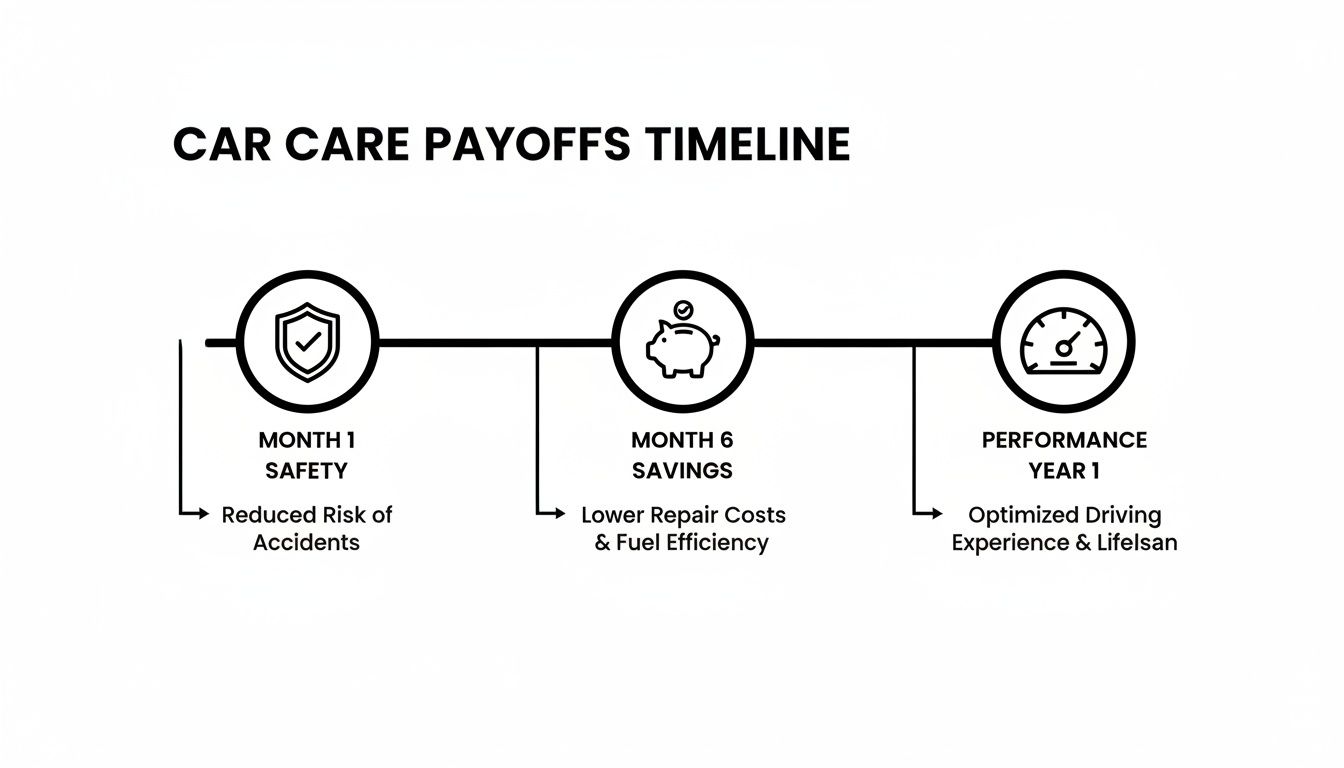
As you can see, small, consistent actions add up fast, protecting both your safety and your wallet down the road.
Recommended Vehicle Maintenance Schedule
Your odometer is your most reliable guide for routine service. Following a mileage-based plan helps you stay ahead of normal wear and tear before it becomes a problem. Here’s a simplified look at what to expect and when.
| Mileage Interval | Key Services to Perform | Why It Matters |
|---|---|---|
| 5,000–7,500 Miles | • Oil & Filter Change • Tire Rotation |
This is the foundation. Clean oil prevents engine damage, and rotating tires ensures they last longer and wear evenly. |
| 15,000–30,000 Miles | • Replace Air Filter • Inspect All Fluids |
A clean air filter boosts fuel economy. Checking fluids (brake, coolant, transmission) prevents major system failures. |
| 50,000–60,000 Miles | • Inspect Battery & Brakes • Flush Coolant & Brake Fluid |
Batteries weaken, and old fluids lose effectiveness. This service keeps your brakes responsive and engine cool. |
| 90,000–100,000 Miles | • Replace Spark Plugs • Inspect/Replace Timing Belt |
New plugs improve engine performance. A timing belt replacement is crucial to prevent catastrophic engine failure. |
This table is a great starting point, but every vehicle is different. For a more in-depth look at what your car might need, grab our complete car maintenance checklist to stay on top of every service.
Seasonal Car Care for North Texas
Living in North Texas means dealing with some serious weather extremes. Our brutal summers and surprise cold snaps put a ton of stress on a vehicle. That’s why seasonal maintenance isn't just a good idea around here—it's essential.
Summer-Proofing Your Ride
Our summers are no joke, and the intense heat is your car’s worst enemy. A little prep work now can save you from being stranded on the side of the road in 100-degree weather.
- A/C System Check: Don't wait for the first heatwave to discover your A/C is just blowing hot air. A quick pre-summer check ensures the system is fully charged and ready to keep you cool.
- Cooling System Inspection: Your engine's cooling system works overtime in the Texas heat. We'll inspect hoses for cracks and check your coolant levels to prevent overheating when you need it most.
Gearing Up for Winter
While our winters are usually milder, a sudden freeze can still catch an unprepared vehicle off guard.
- Battery Health Test: Cold weather is the #1 killer of weak batteries. A quick test tells you if your battery has enough cranking power to get you through the winter without a jump-start.
- Wiper Blade & Fluid Check: Winter often brings sleet and icy rain. Fresh wiper blades and freeze-resistant washer fluid are non-negotiable for keeping your windshield clear and your vision unobstructed.
Knowing When to DIY and When to Call a Pro
One of the best ways to get to know your car and save a few bucks is to handle some basic maintenance yourself. There’s a real sense of accomplishment in it. But knowing your limits is just as important as knowing how to pop the hood.
Drawing the line between a quick weekend project and a complex repair that needs specialized equipment is something every car owner needs to figure out. This isn't about pride—it's about keeping you safe, saving you time, and preventing a small issue from turning into a massive, expensive headache.
Easy DIY Vehicle Maintenance Wins
If you don't mind getting your hands a little dirty, there are plenty of simple jobs you can tackle right in your driveway. These tasks generally require basic tools and have a very low risk of causing bigger problems if you make a mistake. Think of them as the perfect entry point for any aspiring home mechanic.
These simple checks are the bedrock of good vehicle maintenance and usually take less than an hour.
- Checking Fluids: Making a habit of checking your engine oil, coolant, and windshield washer fluid is one of the smartest things you can do. It’s as easy as pulling a dipstick or glancing at a reservoir.
- Replacing Wiper Blades: Don't get caught in a Texas downpour with worn-out wipers. Swapping blades is a snap—usually just a small clip or button—and it’s critical for clear visibility.
- Changing Engine and Cabin Air Filters: This is often a tool-free job. A clean engine filter boosts your car's performance and saves gas, while a fresh cabin filter means you're breathing cleaner air inside.
Tackling these jobs builds your confidence and keeps you connected to your vehicle's health.
When to Trust the Professionals
While DIY is great, some jobs are just too risky to attempt without proper training. These are the complex tasks that involve critical safety systems, require expensive diagnostic computers, or demand an expert touch that only comes from years of experience.
Think of it this way: you might patch a small hole in your drywall, but you'd call a professional electrician to rewire the house. The same logic applies to your car. Some systems are just too important to leave to chance.
Getting one of these repairs wrong isn't just an inconvenience; it can be downright dangerous for you and everyone else on the road.
Leave These Jobs to the Experts
Some repairs should always be handled by a certified technician. For these services, professional expertise isn't just recommended—it's essential.
- Brake System Repairs: Your brakes are the single most important safety feature on your car. Period. Replacing pads, rotors, or calipers demands absolute precision. One mistake here could lead to total brake failure.
- Transmission Service: The transmission is one of the most complicated (and expensive) parts of your vehicle. Diagnosing shifting problems or performing a fluid flush requires specialized equipment and a deep understanding of how it works. A simple DIY error could ruin the entire system.
- Engine Diagnostics and Internal Repairs: A check engine light is your car's way of saying something is wrong, but a cheap code reader doesn't tell the whole story. A professional technician uses advanced diagnostic tools to find the root cause, saving you from guessing and replacing parts you don't need. Anything internal, like a timing belt, has to be perfect.
- Suspension and Alignment Work: Swapping out shocks, struts, or control arms directly impacts how your car handles and how your tires wear. After any of this work is done, a professional wheel alignment is an absolute must to make sure the vehicle drives straight and safely.
What Your Car Is Trying to Tell You

Your car has its own way of communicating, using a specific language of lights, sounds, and even smells to tell you when something’s wrong. Learning to speak this language is a huge part of smart vehicle ownership. It lets you catch small problems early, turning a potential disaster into a simple fix.
Ignoring these signals is like hitting snooze on a fire alarm—the problem doesn’t go away, it just gets worse. When you know what to look for, you can replace that feeling of panic with a clear action plan.
Decoding Dashboard Warning Lights
Your dashboard is the command center. Those little glowing symbols aren't just for decoration; they're urgent messages that demand your attention. While some are simple reminders, others point to critical system failures that need to be addressed right away.
-
Check Engine Light: The most infamous light of all. It can mean anything from a loose gas cap to a serious engine misfire. While it’s not always an emergency, it should never be ignored. A solid light means "get it checked out soon," but a flashing light means "pull over safely and stop driving now."
-
Oil Pressure Light: This one often looks like an old-school oil can, and it signals a dangerous drop in engine oil pressure. This is a stop-immediately warning. Continuing to drive can destroy your engine in a matter of minutes.
-
ABS Light (Anti-lock Braking System): When this light pops on, it means there's a problem with your anti-lock brakes. Your regular brakes will still work, but that critical safety feature preventing skids during a hard stop is offline. You’ll want to get this fixed promptly.
These lights are just the start. To get a better handle on what your car is saying, you can learn more about how to diagnose car problems before they turn into bigger headaches.
Translating Strange Noises and Sensations
Beyond the lights on your dash, your car uses sounds and feelings to tell you something is amiss. Simply paying attention during your daily drive is one of the best forms of proactive maintenance.
Think of your car’s sounds as its vital signs. A sudden change from that familiar purr to an unfamiliar clunk is your vehicle’s way of saying it needs a check-up.
-
A high-pitched squeal when braking: This is almost always the built-in wear indicator on your brake pads. It's a loud, clear warning that your pads are getting thin and need to be replaced soon.
-
A clicking noise when turning: If you hear a rhythmic clicking or popping that gets faster as you accelerate through a turn, it’s a classic sign of a worn-out CV (Constant Velocity) joint in your axle.
-
A deep rumbling that gets louder with speed: This often points to a failing wheel bearing. You might even feel a slight vibration through the steering wheel that goes along with it.
By learning to recognize these common alerts, you can take control of your car's health and handle problems with confidence before they leave you stranded.
How to Budget for Vehicle Maintenance Costs
Let's talk money. We all know that keeping up with car maintenance is the smart thing to do, but let's be honest—it’s the potential cost that makes us put it off. The good news? With a little planning, you can turn those surprise repair bills into a predictable, manageable part of your budget.
The trick is to start thinking of maintenance as a regular bill, just like your insurance or car payment. Instead of getting caught off guard by a sudden expense, you’ll have a plan in place. This simple shift in mindset makes all the difference in keeping your car healthy without draining your savings.
Creating Your Maintenance Fund
The easiest way to get ahead is to set up a dedicated maintenance fund. Think of it as a separate savings account just for your car. By tucking away a small amount each month, you build a safety net that can cover everything from a simple oil change to a new set of brakes.
So, how much should you set aside? A good rule of thumb is to save between $50 and $100 per month. That adds up to an annual fund of $600 to $1,200, which is usually more than enough to cover the routine services most cars need. If you're driving an older car or one with higher mileage, aiming for that $100 mark is a smart move.
Setting aside a small, consistent amount for car care removes the financial panic from maintenance. It turns an unpredictable expense into a planned investment, ensuring you're always ready without having to dip into your emergency savings.
Understanding Average Costs in North Texas
So, what should you actually expect to pay for common jobs around here? Prices will always vary a bit based on your car's make and model, but here’s a general idea of what you might see for essential vehicle maintenance in the North Texas area.
- Oil Change: A standard conventional oil change usually runs $40 to $75. If you need full synthetic, expect something closer to $75 to $125.
- Tire Rotation: This is a cheap and easy way to make your tires last longer, typically costing between $25 and $50.
- Brake Pad Replacement: For just the front or rear pads, you're looking at $150 to $300. This can change depending on the type of pads your car needs and the condition of your rotors.
- New Car Battery: A standard battery replacement, including installation, generally costs between $150 and $250.
Seeing these numbers laid out shows you just how quickly a small monthly savings plan can cover the essentials. For a more detailed breakdown of what goes into these prices, check out our guide comparing local auto repair costs.
The Value Behind the Price Tag
It's always tempting to hunt for the absolute lowest price, but true value is about getting the job done right with quality parts. Paying a little more for a certified technician and premium components means you won't be back in a few weeks with the same problem. It’s an investment in your car's reliability and your own safety.
The numbers back this up. Nationally, the average annual cost for repairs and maintenance on a 5-year-old vehicle is about $1,519.50. As cars get older, people are realizing it’s smarter to invest in quality upkeep than to face a massive repair or a new car payment. You can read more about this trend in the full automotive service market report. Remember, quality care isn’t just an expense—it’s protecting your ride for the long haul.
Finding a Trusted Local Car Care Partner
Knowing what your car needs is one thing, but having a reliable, expert team in your corner to actually do the work is the other half of the battle. When you choose a local auto shop, you're not just finding a place to fix what's broken; you're building a relationship with a partner you can trust with your safety.
Think of a great mechanic like a trusted family doctor for your car. They get to know its history, learn its quirks, and can often spot a small issue before it turns into a major, expensive headache. This kind of relationship is built on straight talk, fair pricing, and the peace of mind that comes from knowing the job was done right by ASE-certified technicians.
Why a Local Partner Matters
A shop that’s part of the community understands what local driving conditions do to a vehicle. They offer more than just repairs—they give you dependable advice and efficient service that gets you back on the road without worry. And that partnership is more important than ever.
The U.S. automotive aftermarket has grown into a $414 billion industry, and it's expected to grow another 5.1% next year. This shows that millions of drivers are choosing to keep their current cars, which now average 12.8 years on the road, instead of buying new. You can dig into more of these stats over at the Auto Care Association website. A trusted local partner is the key to making that investment last.
Choosing the right car care partner means you're not just buying a service; you're investing in reliability and safety for every mile ahead. It's about finding a team that values your trust as much as your business.
At the end of the day, a great local shop gives you the power to keep your vehicle running right for years with convenient, expert care you can count on.
At Express Lube & Car Care, we mix the convenience of a walk-in shop with the expert care your vehicle deserves. For fast, reliable, and honest service in Richland Hills, stop by anytime or check out our latest specials online at https://www.expressluberichlandhills.com.