

The most common signs of a failing car A/C compressor are air that is no longer cold, grinding, squealing or rattling noises when the A/C is on, and a clutch that stops engaging. Some of these also come from cheaper problems like a blown fuse, a bad relay or low refrigerant, so the compressor should be confirmed as the cause before anyone sells you a $1,000 part. If you hear metal-on-metal noise or see a wobbling pulley, skip the A/C and get the car looked at, because that can take the belt out with it.
We see this a lot in Richland Hills, Hurst and Bedford once the Texas heat arrives: a driver turns the A/C on in June and gets a puff of warm air and a strange noise. Here is how to read what you’re seeing, hearing and smelling.
TL;DR
- A failing compressor usually shows up as warm or weak air, new noises when the A/C turns on, a clutch that won’t engage, or a compressor that cycles on and off too often.
- A clutch that won’t engage does not prove the compressor is bad. Fuses, relays, pressure switches, wiring and low refrigerant charge are all more common and far cheaper to fix.
- Loud grinding, a wobbling pulley or a seized compressor can shred the serpentine belt, so stop using the A/C and have it inspected before you drive far.
- Replacement is one of the pricier A/C repairs, and a good shop confirms the root cause first so the new compressor doesn’t fail too.
Table of Contents
- What does a compressor actually do?
- What are the symptoms of a bad A/C compressor?
- What does a bad A/C compressor sound like?
- Why won’t my A/C clutch engage?
- How can you tell if the compressor is seized?
- Is it safe to drive with a bad A/C compressor?
- What else can mimic compressor failure?
- How is A/C compressor failure confirmed?
- What does it take to replace a compressor?
- Our perspective: diagnose first, replace second
- How can you make a compressor last longer?
- Getting your A/C checked in Richland Hills
- FAQ
- Sources
What does a compressor actually do?
The compressor is the pump of your A/C system. Driven by the engine’s serpentine belt, it squeezes refrigerant gas so it can carry heat out of the cabin. J.D. Power’s guide explains that when a failing compressor can’t build the pressure needed to move refrigerant, cooling drops off. No pressure, no cold air.
The front of the compressor has a clutch. When you press the A/C button, an electromagnet pulls the clutch plate against the spinning pulley, and the compressor starts to turn. When the A/C is off, the pulley spins freely and the compressor sits still. Many “compressor problems” are actually clutch or electrical problems, which matters for the diagnosis later.
What are the symptoms of a bad A/C compressor?
No single sign is a guarantee. Look for a pattern.
1. Air that isn’t cold enough
This is the first thing most drivers notice. The air is lukewarm, cools only at highway speed, or is cold on one side and warm on the other. AutoZone lists insufficient or uneven cooling among the possible signs of compressor failure. Keep in mind that low refrigerant from a leak causes the same symptom, and it’s more common.
2. Noises when the A/C turns on
Listen with the radio off and the hood up (carefully, with the engine running and your hands clear of the belt). Different sounds point to different things, and we cover them in the next section.
3. A clutch that doesn’t engage
With the engine running and the A/C on max, watch the center of the compressor pulley. The outer pulley always spins. The center plate should click in and spin with it. If it stays still, the compressor isn’t being driven. Delphi lists a non-engaging clutch among the symptoms, but as you’ll see below, that’s a clue, not a verdict.
4. Short cycling
The clutch clicks on and off every few seconds instead of running steadily. Excessive cycling is another sign AutoZone mentions. It can point to a compressor problem, but also to a low charge or a pressure switch that’s reading wrong.
5. Vibration
A compressor with failing internal parts or bearings can shake the belt or make the engine feel rough when the A/C kicks in. You may feel it in the pedal or the steering wheel at idle.
6. Refrigerant or oil leaks
Compressor shaft seals and body joints can leak. A greasy, dirty residue around the compressor is worth a look. Refrigerant leakage appears on both the AutoZone and Delphi lists of symptoms.
7. Odd smells
AutoZone lists chemical odors among the possible signs. A burning-rubber smell near the front of the engine could be a slipping belt on a dragging compressor. A musty smell, on the other hand, is usually a cabin or evaporator issue. We cover that in our guide to a musty-smelling A/C.
8. Slightly worse fuel economy
A struggling compressor puts extra load on the engine. AutoZone mentions slightly increased fuel consumption. It’s a minor clue, so don’t diagnose from it alone.
9. Total A/C failure
Nothing blows cold at all, and the clutch never engages or the compressor is locked. At this point it’s time to find out why.
What does a bad A/C compressor sound like?
Noise is the symptom that worries drivers most, and it’s where a trained ear helps. J.D. Power identifies squealing, chattering, whining and chirping as possible compressor-related sounds, tied to a faulty clutch, seized shafts or contaminated compressor oil. Delphi adds grinding and rattling to its list.
Here’s a practical way to sort what you hear:
| What you hear | When | What it can mean |
|---|---|---|
| Squeal or chirp | Right when the A/C turns on, or all the time | Slipping belt, worn belt tensioner, or a clutch dragging |
| Rattle or clatter | A/C on, often at idle | Worn clutch bearing, loose mounting, or internal wear |
| Grinding or growl | While the A/C runs | Failing internal parts or bearing; stop using the A/C |
| Whine that rises with RPM | A/C on | Lubrication problems or internal wear |
| Loud clunk or bang on engagement | When the clutch grabs | Clutch problem or a compressor that’s resisting turning |
The key test: turn the A/C off. If the noise goes away, the A/C system is involved. If it stays, you may be hearing the belt, an idler pulley, the alternator or a water pump bearing. That’s why it’s worth having someone listen who knows the difference.
Why won’t my A/C clutch engage?
This is one of the most searched questions on the topic, and the honest answer is that a clutch that won’t engage often has nothing wrong with the compressor itself.
A technical service bulletin from compressor maker MEI says a clutch that fails to engage can usually be traced to an open or faulty circuit. Possible culprits include inadequate voltage, poor grounding, a faulty lead wire, a malfunctioning thermostat or pressure switch, or an incorrect air gap between the clutch plate and pulley.
The same bulletin names other distinct causes of clutch trouble: mismatched components, improper installation, excessive system pressure, loss of lubrication, and compressor slugging or seizure. In other words, the clutch is where several different problems show up.
Here’s what a technician checks, roughly in order:
- Refrigerant pressure. Most systems have a low-pressure cutout. If the charge is low from a leak, the system deliberately keeps the clutch off to protect the compressor. Topping off without finding the leak only delays the issue.
- Fuse and relay. Cheap, quick, and often the answer.
- Power and ground at the clutch coil. If the coil gets proper voltage and still doesn’t pull in, the coil or air gap is the issue.
- Pressure switch and thermostat/sensor inputs. A bad switch can tell the system everything is out of range.
- Whether the compressor turns freely. If the clutch is engaged and the compressor won’t rotate, or the belt squeals, the compressor may be seized.
If your scan tool shows a code, it helps. For example, a code tied to the A/C compressor load signal shows the engine computer and the A/C request aren’t agreeing, which is a circuit-level clue rather than proof the compressor is dead.

How can you tell if the compressor is seized?
A seized compressor won’t turn, even when the clutch is powered. Signs include a belt that squeals or smokes when the A/C is switched on, a burnt-rubber smell, a stalling or bogging engine when the clutch grabs, and a clutch hub that doesn’t spin freely.
GM’s service bulletin gives a good shop-level definition: a compressor is considered seized if the clutch or belt rubber is damaged or melted and the inner hub does not rotate freely. That’s a hands-on check, not something to attempt on a running engine.

Is it safe to drive with a bad A/C compressor?
Sometimes yes, sometimes no. It depends on which part of the compressor is failing.
AutoZone says driving is generally possible with a bad compressor if the clutch and pulley are still sound, but a damaged clutch or pulley can break or derail the serpentine belt and leave you stranded. On many cars the same belt drives the alternator and, in some designs, the water pump or power steering. A broken belt can mean a dead battery, overheating or heavy steering in a hurry.
So the rule we give customers:
- A/C just blows warm, no noises, pulley spins smoothly: you can usually drive while you schedule a visit. Leave the A/C off.
- Grinding, squealing, wobbling pulley, burning smell, or a seized clutch: don’t wait. Get it inspected before a long drive, especially on I-820 or 183 where a breakdown is hard to handle.
AutoZone also warns that ignoring compressor trouble can spread damage to other A/C components through refrigerant and oil loss, raising the repair bill.
What else can mimic compressor failure?
Before a compressor gets blamed, a good diagnosis rules out the look-alikes:
- Low refrigerant from a leak. Very common. Warm air, clutch not engaging or short cycling.
- Blown fuse or bad relay. The clutch never gets power.
- Weak airflow from a clogged cabin filter or blower problem. Kelley Blue Book notes weak airflow may come from a clogged cabin filter or a blower-motor fuse, relay or electrical issue rather than the compressor. If air is cold but weak, start there. We wrote about this in our blower motor guide and how to change a cabin or engine air filter.
- Blend door or HVAC control faults. Cold on one side only, or temperature changes that don’t match the dial.
- A radiator or condenser fan not running. Cooling is fine at highway speed but poor in stop-and-go traffic. The condenser needs airflow to release heat.
- A slipping or worn belt. Squealing and weak compressor drive.
If you want a step-by-step way to narrow it down at home, our walkthrough on how to diagnose car A/C problems covers the basics, and 10 minutes to diagnose A/C that isn’t cold covers the quick checks.
How is A/C compressor failure confirmed?
A proper diagnosis does not start with a recharge can. It starts with questions and measurements.
Manufacturers say the same thing. A 2023 Chrysler bulletin calls for a diagnosis on inoperative or warm A/C, and a leak test if the system is empty, before moving on to repairs. That’s the logic: find out why the refrigerant is gone, not just that it is.
Typically a shop will:
- Ask about the symptoms, when they started and whether anything changed (a recent repair, an accident, a past recharge).
- Do a visual inspection of the belt, pulley, clutch and compressor body for leaks, oil residue, and damage.
- Check system pressures with gauges, static and running.
- Test electrical supply, fuses, relays, grounds, and the clutch coil.
- Check for leaks with dye or an electronic detector.
- Confirm the compressor turns freely and builds pressure.
At Express Lube & Car Care, our ASE-certified technicians use digital vehicle inspections with photos, so you can see what we saw instead of taking our word for it. We would rather show you a blown fuse than quote you a compressor you don’t need.
What does it take to replace a compressor?
If the compressor really is the problem, replacement is more than swapping one part.
The biggest concern is contamination. Kelley Blue Book explains that when a failed compressor may have released metal shards, the system needs to be flushed or solvent-cleaned, because debris can ruin the new components. Many repairs also include replacing the receiver-drier or accumulator and the expansion valve or orifice tube, then vacuuming the system and recharging with the correct refrigerant and oil amount.
MEI’s guidance is also direct about root cause: if you replace a compressor without fixing the electrical, pressure, lubrication, contamination or installation problem behind the failure, the new one can fail too. That’s why you want a shop that finds the cause, not just the casualty.
What does compressor replacement cost?
It depends on the vehicle, the parts and what else needs replacing. J.D. Power puts the average at around $1,100, with parts from $650 to $840 and labor from $160 to $200. Those are national figures, and your car may land above or below them. Some European models and trucks with dual-zone or rear A/C cost more because of the parts or the labor to reach the compressor.
We don’t publish a flat price for compressor jobs, because the honest number depends on what the inspection finds. Ask for a written estimate that lists the compressor, the additional parts, the flush and the labor separately.
Our perspective: diagnose first, replace second
We do a lot of A/C work through a Texas summer, and the pattern repeats. Drivers come in sure the compressor is gone because of a noise or warm air, and a good share of the time the problem is smaller: a leak, a relay, a pressure switch or a belt. The reverse happens too. Someone has been topping off refrigerant for two summers, and the compressor has been starving of oil the whole time.
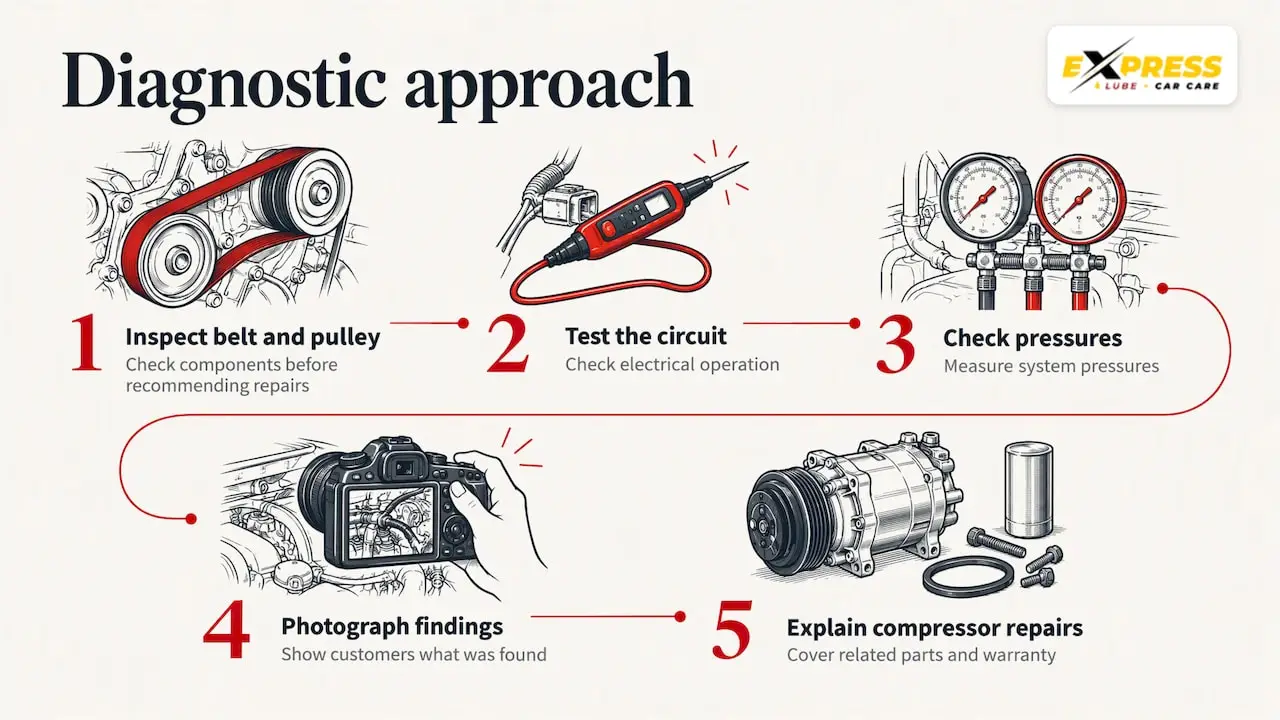
That’s why we put a diagnosis ahead of any recommendation. We look at the belt and pulley, test the circuit, check the pressures and photograph what we find. If it is the compressor, we’ll explain why, what else needs to be replaced with it and what the repair is covered by. Our qualifying repairs carry a 24-month/24,000-mile warranty, and we apply it only where a repair qualifies.
One more thing we tell customers: don’t keep running an A/C that’s making grinding noises just to get through the week. A failed compressor can cost more than a failed compressor and a belt, and a belt that lets go on the freeway is a bad afternoon.
— Express Lube & Car Care
How can you make a compressor last longer?
No maintenance guarantees a compressor lasts a set number of years, and conditions matter more than mileage. A few habits do help:
- Run the A/C briefly now and then, even in cooler months, so seals and oil stay in circulation. Many cars do this automatically when the defrost is on.
- Fix small leaks early. A system that’s low on refrigerant is also low on oil.
- Keep the condenser clear of bugs, leaves and road debris, and make sure the cooling fans work.
- Check the belt and tensioner at regular inspections. Follow your owner’s manual for inspection intervals.
- Have the system serviced properly when it’s opened for any repair, with the correct vacuum, oil and refrigerant charge.
Our radiator and cooling system service page explains how engine cooling and A/C share parts like fans and airflow.
Getting your A/C checked in Richland Hills
If your A/C is blowing warm, making new noises or the clutch isn’t engaging, you don’t need to guess. Our shop at 7932 Glenview Drive, Richland Hills, TX 76180 takes walk-ins, or you can book a visit, and we can inspect the system and show you the findings with photos. Drivers from North Richland Hills, Hurst and Bedford stop by regularly. Learn more about our auto A/C repair service, see the full list of services, or call us at (817) 284-8478.
If a larger repair is on the table, eligible customers may be able to explore financing through third-party providers such as Koalafi, Snap Finance, American First Finance and Synchrony. Approval and terms are set by each provider, and we don’t offer an in-house payment plan.
FAQ
Can an A/C compressor fail without any noise?
Yes. A compressor can lose pressure, seize or stop being driven without making a warning sound. The usual signs are then warm air and a clutch that stays still. Since electrical faults and low refrigerant look the same, it needs testing before replacement.
Will the A/C still run with a bad compressor?
No, the system won’t cool without a working compressor, though the fan will still blow air. The car itself may still drive normally if the clutch and pulley are sound. If the clutch or pulley is damaged, the serpentine belt can break, so have it checked before you drive far.
Does a clutch that won’t engage mean I need a new compressor?
Not necessarily. Blown fuses, relays, wiring, pressure switches, low refrigerant and an incorrect clutch air gap can all keep the clutch from engaging. A technician should test the circuit and pressures first. Sometimes only the clutch or a switch needs repair.
What causes A/C compressors to fail?
Common causes include normal wear, low refrigerant and oil from leaks, contaminated oil or moisture in the system, electrical problems, a failing clutch, and incorrect installation or charge. J.D. Power notes that compressors often fail from wear and tear, long service or neglect. Fixing the underlying cause matters, or the replacement may fail the same way.
How much does it cost to replace a car A/C compressor?
J.D. Power’s national average is around $1,100, with parts and labor listed separately. Your actual cost depends on the vehicle and what else needs replacing. Ask for an itemized written estimate after an inspection.
Sources
- How Much Does It Cost To Replace An AC Compressor? (J.D. Power)
- Signs of a Bad A/C Compressor (AutoZone)
- How Much Does it Cost to Replace Your Car’s AC Compressor? (AutoZone)
- How To Change a Car AC Compressor (Delphi Auto Parts)
- Compressor service bulletin (MEI)
- GM service bulletin PIE0747D (NHTSA)
- Chrysler bulletin 24-011-23 (NHTSA)
- DIY Automotive Air Conditioning Repair and Diagnostics (Kelley Blue Book)
- A/C compressor load signal code 01013 (TuningBot)