

Most water pump replacement jobs in the U.S. land between $310 and $1,100, with labor eating up roughly the majority of that bill. The pump itself is usually the cheap part. What moves your final number the most is whether your pump sits behind the timing belt (more labor) or bolts on externally (less labor). Get a written estimate before you agree to anything.
TL;DR:
- Labor accounts for 60 to 70 percent of the total water pump replacement cost, with job difficulty and engine access being the biggest factors.
- Replacing a timing belt alongside a water pump driven by the belt can save about 25 percent in total labor costs, especially if the belt is near the end of its lifespan.
- The complexity of access and the type of pump (belt-driven or electric) largely determine whether the job costs closer to $400 or exceeds $1,000.
- Expect parts costs to be relatively small compared to labor, but choosing original equipment manufacturer parts over aftermarket can impact the longevity of the repair.
- Always seek a detailed, written estimate that includes warranty, part specifications, and whether additional services like coolant flushing are included.
Table of Contents
- How Much Does Water Pump Replacement Cost?
- What Factors Affect Water Pump Cost the Most?
- What’s the Typical Parts vs. Labor Split?
- Should You Replace the Timing Belt at the Same Time?
- What Are the Warning Signs of a Failing Water Pump?
- How Do You Get an Accurate Water Pump Repair Quote?
- Getting a Water Pump Replaced Right the First Time
- Get a Straight Answer on Your Water Pump Cost
- Sources
- FAQ
How Much Does Water Pump Replacement Cost?
Here’s the range breakdown, and why the same repair can cost $400 for one driver and $1,000 for another.
An economy sedan with an externally mounted, belt-driven pump often lands on the lower end. A mid-range crossover or SUV usually sits in the middle. A luxury vehicle or anything with the pump buried behind the timing cover tends to land highest.
By the numbers: labor typically makes up about 60 to 70 percent of the total invoice on most common vehicles.
- Economy cars (Honda Civic, Toyota Corolla type vehicles): often $310 to $500, with easy pump access keeping labor hours low.
- Mid-range sedans and SUVs: commonly $400 to $800, depending on whether the pump is belt-driven or requires more disassembly.
- Luxury vehicles and complex engine layouts: can push past $1,000 when the water pump lives behind the timing belt or serpentine system and needs several hours of teardown to reach.
Where your vehicle falls in that range comes down almost entirely to the next section: what’s actually driving the price.
What Factors Affect Water Pump Cost the Most?
Two vehicles with the same part price can have wildly different totals, and it usually comes down to four things: pump type, engine access, add-on parts, and where you live.
Belt-driven vs. electric pumps. Belt-driven pumps are the traditional design and tend to cost less as a part. Electric pumps, common on newer and hybrid vehicles, run higher because they’re paired with sensors and sometimes require manufacturer-specific diagnostics to install and calibrate correctly.
Engine layout and access. This is the big one. A pump mounted externally and driven by a serpentine belt might take under two hours to swap. A pump buried behind the timing belt or timing chain cover can turn into a half-day job, since the technician has to remove the belt, tensioner, and often the water pump pulley just to reach it. That labor difference alone can push a $400 job into $1,000-plus territory on complex engines.
Add-on parts. Expect the shop to also quote gaskets, a new pulley if yours is worn, and a coolant flush. These are small individual costs, but they add up, and skipping them to save money often means a return visit.
OEM vs. aftermarket. OEM parts cost more upfront but usually match your vehicle’s exact specs. Aftermarket pumps vary in quality, and cutting corners here is a common cause of premature failure.
Regional labor rates. Shop labor rates vary significantly by market, so the same job can cost noticeably more in a major metro area than in a smaller town.
- Belt-driven pump: lower part cost, moderate labor
- Electric pump: higher part cost, sometimes added diagnostic time
- Timing-belt-area access: highest labor hours
- External, serpentine-driven access: lowest labor hours
Pro Tip: Ask the shop upfront whether your engine’s water pump is timing-belt-driven or externally mounted. That single question tells you more about where your quote will land than the make or model of your car.
What’s the Typical Parts vs. Labor Split?
Parts are rarely the expensive part of this repair. Labor is what separates a $400 estimate from a $1,000 one.
Across most published cost data, labor accounts for the majority of the invoice, often 60 to 70 percent of the total. Parts pricing swings widely on its own, from inexpensive aftermarket pumps to several hundred dollars for OE or electric units, but even a pricier pump usually stays a smaller line item than the hours it takes to install it.
The variance inside each row comes from the same factors above: pump type, regional labor rates, and whether the shop bundles in a coolant flush or new gaskets. Two “luxury SUV” quotes can differ by several hundred dollars purely based on how many hours the job takes at that shop’s labor rate.
Should You Replace the Timing Belt at the Same Time?
If your water pump is driven by the timing belt, yes, in most cases. Once a technician has the belt, tensioner, and covers off to reach the pump, leaving a worn belt in place just means paying for that same disassembly again in a year or two.
Mechanics commonly recommend combining the jobs because it avoids duplicate labor, and the combined service can run roughly 25 percent lower in total labor compared to two separate visits. A shop that’s already discussing timing belt replacement with you should walk through this math directly.
- Timing-belt-driven pump: replace belt and tensioner together
- Externally mounted, serpentine-driven pump: no timing belt involved, service the pump alone
- Belt already replaced recently: pump-only service is reasonable
Pro Tip: Ask your shop how many miles are left on your current timing belt before you approve a pump-only repair. If you’re within 15,000 to 20,000 miles of the belt’s replacement interval, doing both now almost always beats paying for labor twice.
What Are the Warning Signs of a Failing Water Pump?
Water pumps don’t usually fail without warning. Catching the signs early is the difference between a scheduled repair and a tow truck.
- Coolant leaking under the front of the car, often a sweet-smelling puddle near the front center of the vehicle.
- Engine temperature gauge climbing toward the red zone, especially at idle or in traffic.
- A high-pitched whining or grinding noise from the front of the engine, which can signal a failing bearing inside the pump.
- Steam or a burning smell from under the hood, a sign coolant is already leaking onto hot engine parts.
Typical water pump lifespan runs 60,000 to 100,000 miles, though neglected coolant, heavy towing, and extreme heat can shorten that window considerably. If your temperature gauge spikes while you’re driving, pull over and shut the engine off. Continuing to drive an overheating car risks warping the cylinder head, a repair that costs far more than the pump itself.
How Do You Get an Accurate Water Pump Repair Quote?
A vague quote is the biggest red flag in this whole process. Before you approve any work, ask the shop these questions directly.
- Is the replacement pump OE or aftermarket, and what’s the brand?
- How many labor hours are quoted for this specific vehicle?
- What warranty covers both the part and the labor?
- Does the estimate include timing belt or tensioner replacement, or is that separate?
- Is a coolant flush included, and what’s the total with that added?
- Can I get this in writing before work starts?
Ask whether the technicians doing the work are ASE-certified, and whether the shop backs up its diagnosis with photos rather than a verbal explanation. A quote with no warranty listed, or one that’s noticeably cheaper with no explanation of scope, is worth a second look before you sign off.
Pro Tip: If two quotes for the same repair differ by more than a couple hundred dollars, ask both shops for their labor hour estimate specifically. That single number usually explains the entire gap.
Getting a Water Pump Replaced Right the First Time
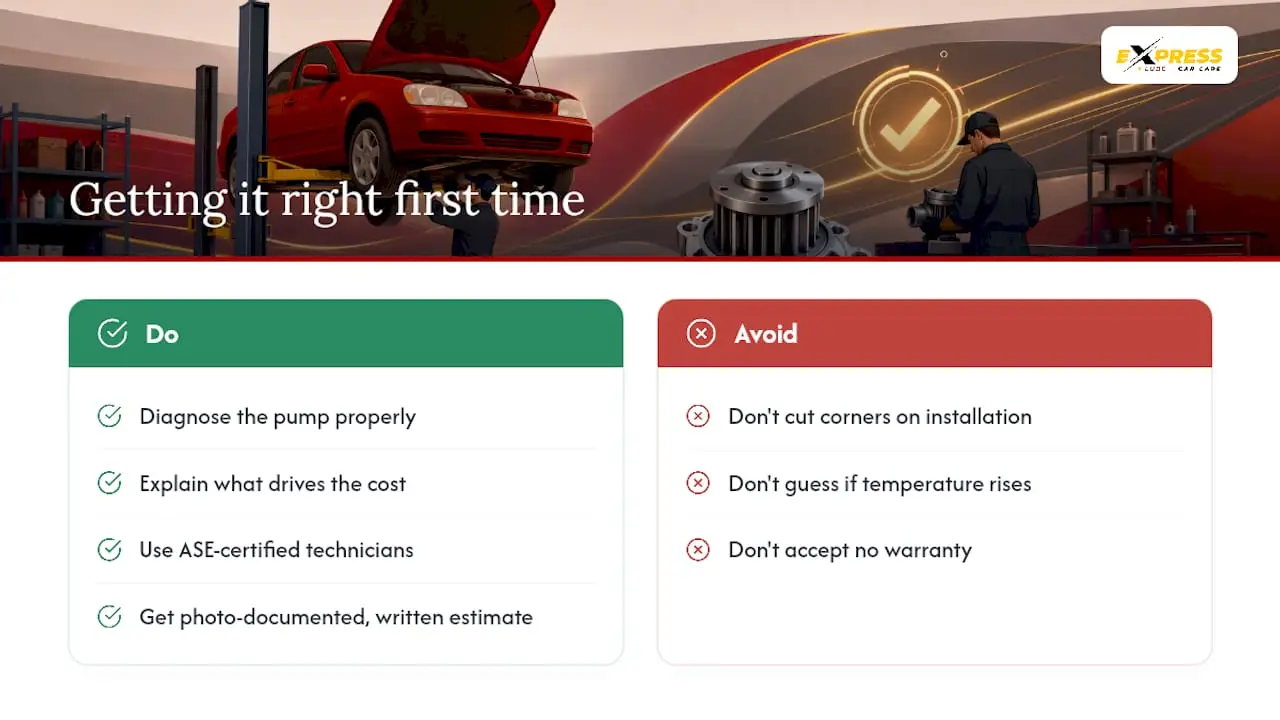
We see water pump jobs come through fairly often, and the ones that go smoothly share a pattern: the shop diagnosed it properly, explained what was driving the cost, and didn’t cut corners on installation. Our ASE-certified technicians handle these repairs with that same approach, and most vehicles are back on the road same-day or next-day depending on parts availability and how the pump is positioned in your engine.
Every repair we complete carries our 24-month/24,000-mile warranty, and we back our estimates with photo documentation so you can see exactly what we found. If your check engine light isn’t the issue but your temperature gauge is climbing, don’t guess. Schedule an inspection and get a written number before you decide anything.
— Express Lube & Car Care
Get a Straight Answer on Your Water Pump Cost
Guessing at a repair cost from a forum post or a friend’s story isn’t the same as getting a real number for your actual vehicle. Express Lube & Car Care gives Richland Hills drivers photo-backed digital inspections and written estimates before any work starts, so you know exactly what you’re paying for and why, whether your pump is a straightforward external swap or a full timing-belt-area job.

Our ASE-certified technicians back every repair with a 24-month/24,000-mile warranty, and if the total catches you off guard, easy financing options can spread the cost out instead of hitting your budget all at once. Bring your vehicle in and schedule an appointment to get a real number, not a guess, on what your water pump replacement will actually cost.
Sources
- Water Pump Replacement Cost: $310 – $1,100 (2026) | AutOwner
- Water Pump Replacement Prices | Kelley Blue Book
- Carparts
- ConsumerAffairs water pump replacement cost guidance
FAQ
How much should labor cost to replace a water pump?
Labor typically makes up 60 to 70 percent of the total bill, often running $250 to $900 depending on how difficult the pump is to access.
How much should it cost to have my water pump replaced?
Most U.S. repairs fall between $310 and $1,100 total, with many mid-range vehicles landing around $400 to $800.
What is the typical lifespan of a water pump?
Water pumps commonly last 60,000 to 100,000 miles, though heat, towing, and neglected coolant can shorten that lifespan.
Is it worth replacing a water pump?
Yes. A failing pump that isn’t replaced can lead to overheating and serious engine damage, and if it’s timing-belt-driven, combining it with a belt replacement can reduce total labor by roughly 25 percent compared to two separate repairs.