

A clunk from your suspension usually points to a handful of worn parts: sway bar end links, tired shocks or struts, ball joints, or worn bushings. Limit driving until you know which one it is, pay attention to when the noise happens, and get it inspected soon. If you’re near Richland Hills, a local shop with ASE-certified technicians can run a full diagnostic and tell you exactly what’s loose, worn, or failing.
TL;DR:
- A sharp metallic clunk over small bumps often points to sway bar links, while bouncing after larger bumps suggests worn shocks or struts.
- Loose steering, wheel wobble, severe vibration, or visible separation at a joint means pull over safely and arrange a tow rather than continuing to drive.
- Cold weather can make worn rubber bushings louder; a heat shield usually rattles with engine speed, while suspension clunks track bumps, braking, or turns.
- Ask for an inspection documented with photos and a written estimate; repairs can take longer if rust, seized bushings, parts delays, or alignment complicate work.
Table of Contents
- 1. What causes that clunking sound, and how urgent is it?
- 2. Driveway checks: step-by-step tests to narrow the source
- 3. When a clunk is dangerous: signs to stop driving immediately
- 4. What repairs involve and what to expect
- 5. How Express Lube & Car Care diagnoses clunks
- 6. Step-by-step diagnostic procedures technicians use
- 7. Preventive maintenance that helps avoid clunking
- 8. When to seek professional repair versus a temporary fix
- 9. Repair options and parts quality to consider
- 10. Why prompt diagnosis matters
- Schedule a suspension inspection today
- FAQ
- Sources
1. What causes that clunking sound, and how urgent is it?
Not every clunk means the same thing, and the sound itself often gives away the culprit before a technician ever lifts the car. Several common causes tend to show up again and again, and they range from a cheap fix to something that needs attention right away.
- Sway bar end links: a sharp, metallic clunk over small bumps or dips, usually worse at low speed; this is the most frequent cause of bump-related clunking and one of the least expensive to fix. Urgency: safe to drive, but get it checked soon.
- Weak or failed shocks/struts: a deeper thud or clunk over larger bumps, often paired with bouncing after you cross a dip or a nose dive when braking. Urgency: caution, worsens handling over time.
- Worn ball joints: a clunk when turning or going over bumps, sometimes with a vague or loose feeling in the steering. Urgency: stop driving if you notice looseness or a knocking that changes with steering input.
- Control arm bushings: a dull clunk or knock when accelerating, braking, or turning, caused by play in the rubber bushing that lets metal parts shift slightly. Urgency: caution, inspect soon.
- Strut mounts or bearings: a creak or clunk when turning the wheel at low speed, often most noticeable in a parking lot. Urgency: caution.
- Tie rod ends: a clunk when turning combined with steering that feels loose or imprecise. Urgency: stop driving if play is noticeable, since this affects steering control directly.
- CV axle issues: a clicking or clunking noise during turns, especially under acceleration, rather than over bumps alone. Urgency: caution, schedule an inspection.
- Loose exhaust or heat shield: a rattle or light clank rather than a true clunk, often changing with engine speed rather than bumps. Urgency: safe to drive, inexpensive to fix.
- Subframe or trailing arm bushings: a heavier clunk from underneath the car, often on uneven pavement or sharp turns. Urgency: caution, can affect alignment and handling if left unresolved.
Cold mornings can make several of these louder than usual, since rubber bushings stiffen in low temperatures and any existing play becomes more noticeable until things warm up. It’s also worth ruling out things that aren’t suspension at all. A loose heat shield rattles and buzzes more than it clunks, and it tends to come and go with engine RPM rather than road bumps. Worn motor mounts produce a clunk during acceleration or shifting into gear, not specifically over bumps, which is a useful way to tell the difference before you start checking suspension parts.
2. Driveway checks: step-by-step tests to narrow the source
You don’t need a lift to get a good read on where the noise is coming from. A few simple tests, done carefully, can point you toward the right component before you ever bring the car in.
- Bounce test each corner. Push down firmly on each corner of the car and let go. A corner that bounces more than once or twice usually has a worn shock or strut on that side.
- Dry park check. With the car parked and the engine off, have someone turn the steering wheel back and forth slightly while you watch and listen near the front wheels for clunks or looseness, which often points to tie rod ends or ball joints.
- Wheel shake test. With the front end safely raised, grab each wheel at the 12 and 6 o’clock positions and rock it; vertical play suggests a wheel bearing or ball joint issue.
- Visual inspection underneath. Look for cracked or torn bushings, oily residue on shocks or struts (a sign of leaking fluid), loose bolts, or a heat shield hanging loose. Popular Mechanics recommends checking carefully around mounting points where rubber meets metal, since that’s where wear shows up first.
- Use a jack and stands correctly. Lift the car on a hard, flat surface, support it on jack stands rated for the vehicle’s weight, and never rely on a jack alone while working underneath.
- Listen with a probe. A long screwdriver or broom handle pressed against suspension components while a helper bounces the car or drives slowly over a bump can act like a stethoscope, helping you pinpoint the exact spot the noise is coming from, a trick Popular Mechanics walks through in detail.
- Passenger-assisted press test. With the engine off, have a passenger press down on each bumper or fender corner while you listen from outside the car for clunks at specific points.
Pro Tip: If you hear a sharp clunk paired with any looseness in the steering wheel, stop testing and call for a tow instead of continuing to drive the car to a shop.
3. When a clunk is dangerous: signs to stop driving immediately
Most clunks are annoying rather than dangerous, but a few point to parts that keep your wheels pointed where you want them to go. Ball joints, tie rod ends, and a severely collapsed strut or spring all fall into that category, since they directly affect steering and ride control.
AAA’s guidance is clear on this point: drivers should stop and arrange assistance if they notice loose steering, unusual vehicle behavior, visible wheel misalignment, or severe vibration, since these symptoms suggest a suspension component is failing in a way that reduces control of the vehicle.
Watch for these warning signs specifically:
- Sudden looseness or play in the steering wheel that wasn’t there before.
- Pronounced wheel wobble, especially at highway speed.
- Visible separation or gap at a ball joint, tie rod, or control arm connection.
- Severe vibration or the car pulling hard to one side.
If any of these show up, pull over at the next safe spot, avoid highway driving entirely, and call for a tow rather than trying to limp the car to a shop. A failed strut or ball joint can affect braking and handling, and some failures carry catastrophic risk if the connection separates while you’re driving.
4. What repairs involve and what to expect
Once a technician identifies the source, the fix itself is usually straightforward, though cost and time vary by what’s worn and how accessible it is.
- Sway bar end links: quick to replace and one of the least expensive repairs on this list.
- Shocks or struts: moderate complexity, often replaced in pairs for even handling, with cost depending on vehicle type and parts quality.
- Ball joints or control arms: higher complexity, especially when the ball joint is pressed into a control arm assembly rather than replaceable on its own.
- Bushings: moderate cost, though labor can run longer if the old bushing is seized or rusted in place.
- Loose exhaust hangers or heat shields: usually a quick tighten or resecure rather than a parts replacement.
A few things tend to stretch out repair time or add cost: rust and corrosion on fasteners, parts availability for less common vehicles, the need for an alignment after certain suspension work, and discovering a second worn part once the first is off. Before authorizing any work, ask for a documented inspection with photos and a written estimate so you know exactly what’s being replaced and why.
5. How Express Lube & Car Care diagnoses clunks
We start every suspension complaint the same way: a lift inspection, measured checks for play at the ball joints and tie rods, and a test drive to reproduce the noise in real conditions. Every finding gets documented in a digital inspection with photos, so you can see the worn bushing or leaking strut for yourself instead of taking our word for it.
- Certified technicians handle the diagnosis and the repair, with no appointment required for a walk-in inspection.
- Same-day service is often available when parts and scheduling allow it.
- Some repairs come with a warranty covering parts and labor for a limited time or mileage.
- Bringing a short video or audio clip of the noise, along with notes on recent suspension work or any lowering modifications, helps us zero in faster.
If you’ve already noticed symptoms like a sagging ride height or a harsh ride, our page on signs you need new shocks walks through what to look for, and our steering and suspension repair page covers the full range of what we handle.
6. Step-by-step diagnostic procedures technicians use
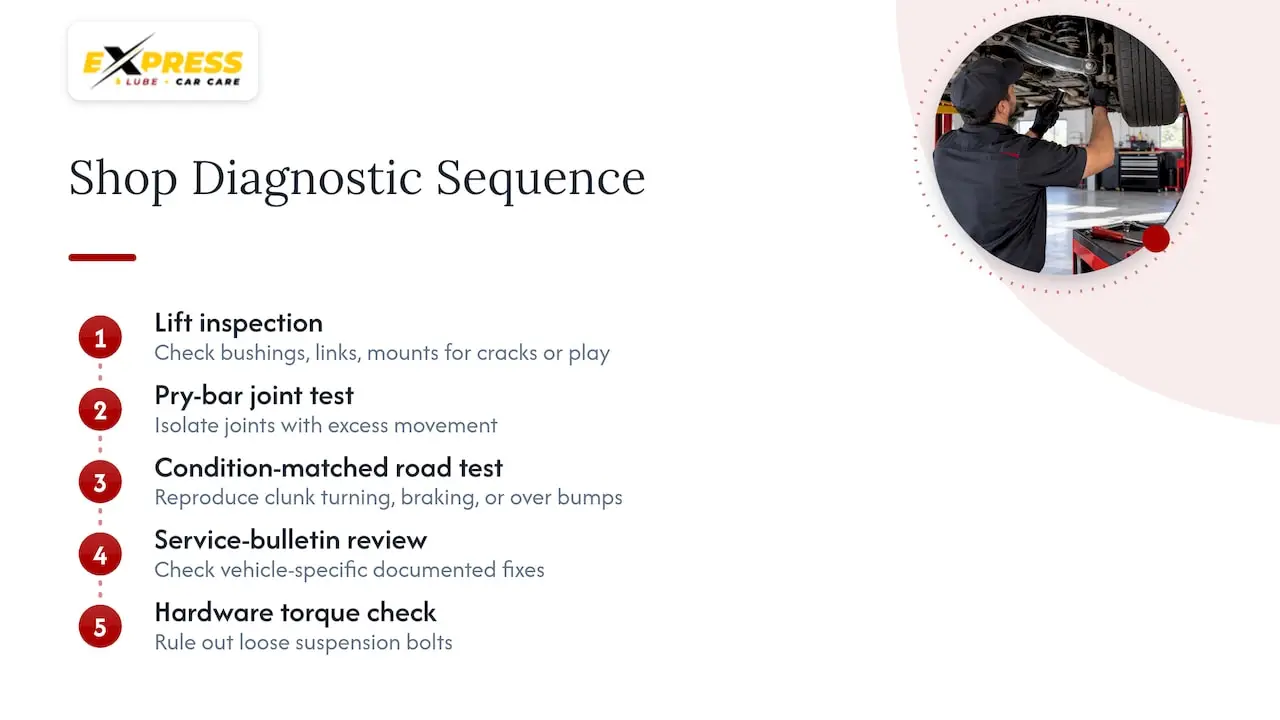
Beyond the driveway checks you can do yourself, a shop visit typically follows a more structured sequence. We start with a visual inspection on the lift, checking every bushing, link, and mount for cracking or play. From there, a pry bar test applies controlled leverage to suspension joints one at a time, isolating exactly which connection has excess movement rather than guessing from the sound alone.
A road test follows, often with the radio off and windows down, to reproduce the clunk under the same conditions you described: turning, braking, or crossing a specific type of bump. Technicians also check for any manufacturer technical service bulletins tied to your vehicle, since some suspension noises are known issues with a documented fix already in place. Finally, torque checks on suspension hardware rule out a simply loose bolt before anything gets replaced, which saves you from paying for a part that didn’t need swapping in the first place.
7. Preventive maintenance that helps avoid clunking
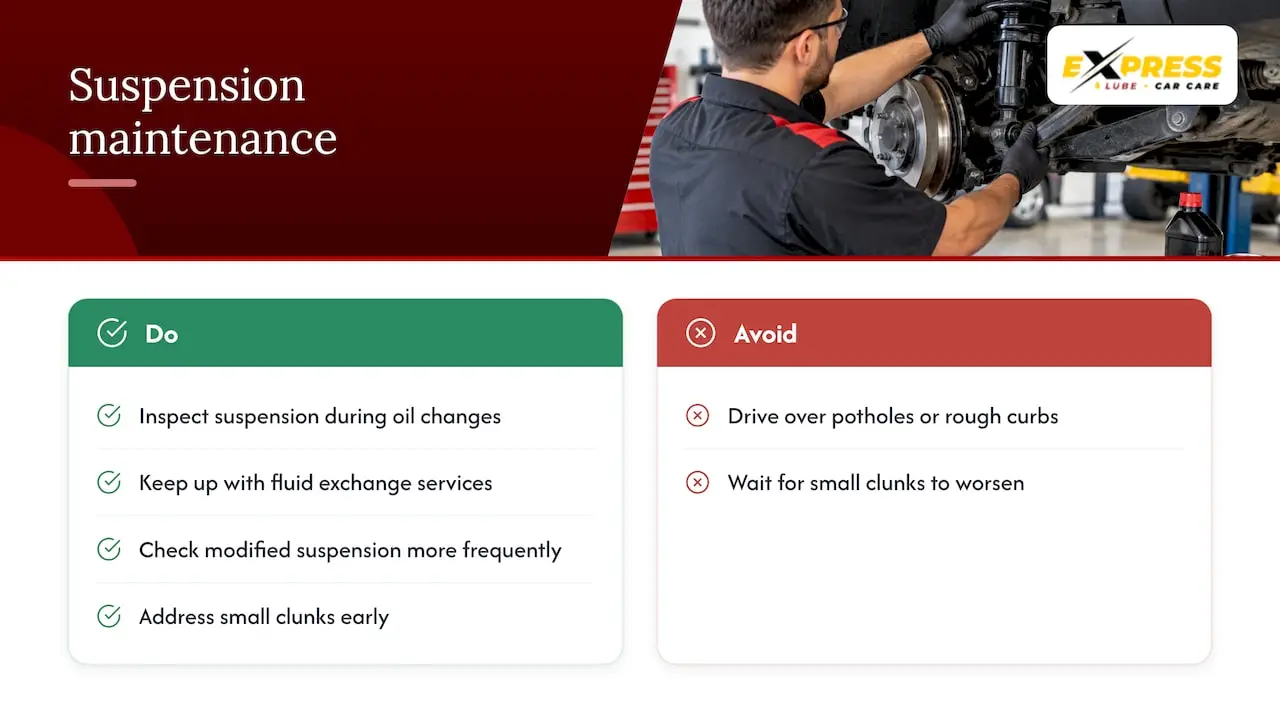
A lot of suspension noise can be delayed or avoided with routine attention. Regular inspections during oil changes give a technician a chance to spot a cracking bushing or a slightly loose end link before it turns into a clunk you can hear from the driver’s seat. Keeping up with fluid exchange services and general maintenance also means problems get caught during a scheduled visit rather than as an unexpected noise on the road.
Avoiding potholes and rough curbs when you can reduces the sudden impact loads that wear out end links and bushings faster than normal driving. If you’ve had any suspension modifications, like a lift or lowering kit, those parts tend to wear differently than stock components and benefit from more frequent checks. Addressing small clunks early, rather than waiting for them to get worse, is often the simplest form of prevention there is.
8. When to seek professional repair versus a temporary fix
Some fixes genuinely can wait a short while, and others can’t. A loose heat shield rattle or a minor sway bar end link clunk is safe to drive on for a bit, though it’s worth scheduling a repair since end links are inexpensive and easy to replace. Anything involving steering feel, like play in a tie rod end or a ball joint, isn’t something to patch temporarily. Zip ties, tape, or aftermarket “quick fixes” don’t restore the structural integrity those parts need to keep your wheels aligned and controlled.
If the noise is new, getting louder, or paired with any change in how the car steers or rides, that’s your signal to get a professional inspection rather than waiting. A shop visit also protects you from misdiagnosing the issue yourself and replacing a part that wasn’t actually the problem.
9. Repair options and parts quality to consider
When it comes to parts, quality matters more on suspension components than almost anywhere else on the car, since these are the pieces keeping your tires in contact with the road. OEM replacement parts match the original specifications exactly, while quality aftermarket parts can offer comparable performance depending on the brand and application. What matters most is that whatever part goes on the car meets or exceeds the original durability and fit, since a poorly made bushing or end link can wear out again within months.
Ask your shop what brand of parts they’re installing and whether the repair is backed by a warranty. A repair covered under our 24-month/24,000-mile warranty gives you a safety net if the same part fails prematurely, which is worth asking about no matter where you get the work done.
10. Why prompt diagnosis matters
Most suspension clunks trace back to an inexpensive part like a sway bar end link, but ignoring the noise lets small wear turn into bigger, costlier damage down the line. Documenting when the clunk happens and bringing that information to a trusted ASE-certified shop helps ensure the right part gets fixed on the first visit, not the third. Many shops handle walk-ins and scheduled appointments with thorough inspections.
— Express Lube & Car Care
Schedule a suspension inspection today
A clunk you can hear is worth a diagnosis you can trust, and that’s exactly what our team provides. 
Walk in without an appointment or schedule a visit through our suspension repair page, and our ASE-certified technicians will put your car on the lift, run the checks, and show you the results with a digital inspection complete with photos. Qualifying repairs come with a 24-month/24,000-mile warranty, so you’re covered after the work is done. If you’ve recorded the noise on your phone or have notes on recent repairs, bring them along: it helps us zero in faster. Call us at (817) 284-8478 or book online to get your suspension checked this week.
FAQ
Is it safe to drive with a clunking suspension?
It depends on the cause: a loose heat shield or worn sway bar link is generally safe to drive on short-term, but a clunk paired with loose steering or wheel wobble is not. AAA recommends stopping and arranging assistance if you notice loose steering, unusual handling, or severe vibration.
How much does it cost to fix a suspension clunk?
Cost depends heavily on which part has failed: sway bar end links and heat shields are among the least expensive fixes, while ball joints, control arms, and shocks or struts cost more due to parts and labor. We provide a documented estimate after inspection so you know the cost before any work begins.
Is it expensive to fix a car’s suspension overall?
Suspension repair costs vary widely based on the specific components involved and the vehicle itself, ranging from a quick, inexpensive end link swap to a more involved job replacing shocks, struts, or control arms. Our shocks and struts guide breaks down the factors that affect pricing on that specific repair.
What does a failing suspension sound like?
A failing suspension typically produces a clunk, knock, or thud over bumps, when turning, or when braking, depending on which part is worn. Nine common causes range from sway bar end links producing a sharp clunk to worn bushings causing a duller, knocking sound.
Could the noise be something other than the suspension?
Yes, a clicking noise during turns can sometimes point to a worn CV axle or driveline component rather than the suspension itself, and driveline symptoms like U-joint wear can sound similar at first. A proper inspection distinguishes between suspension, steering, and driveline causes before any repair is recommended.
Sources
- Vehicle Noises You Should Never Ignore | AAA Club Alliance
- What Causes a Clunking Noise Over Bumps? 9 Common Causes Explained | TheCarBuzz
- How To Fix Car Suspension Clunks and Rattles | Popular Mechanics