

Your import’s maintenance schedule is the manufacturer’s mileage- and time-based checklist — follow the normal vs. severe rules, use factory-approved fluids, and document every service to protect your performance and warranty.
TL;DR for import owners:
- Use the Normal schedule unless your driving mainly fits severe-use criteria (short trips, heavy stop-and-go, towing, extreme heat or cold)
- Three key services at every interval: oil and filter change, brake inspection, and a full multi-point inspection
- The Magnuson-Moss Warranty Act protects your right to use any qualified independent shop — as long as you document services and follow manufacturer intervals
- Keep receipts, fluid spec sheets, and inspection reports in a dedicated folder (digital or physical)
Pro Tip: If your import has a turbocharged engine, don’t rely on the factory’s extended oil interval alone. Many experienced technicians recommend changing oil every 5,000–7,000 miles on turbo imports to prevent varnish buildup and protect the turbo’s oil supply.
Table of Contents
- What is a manufacturer’s maintenance schedule for import cars?
- Normal vs. severe driving: which schedule applies to you?
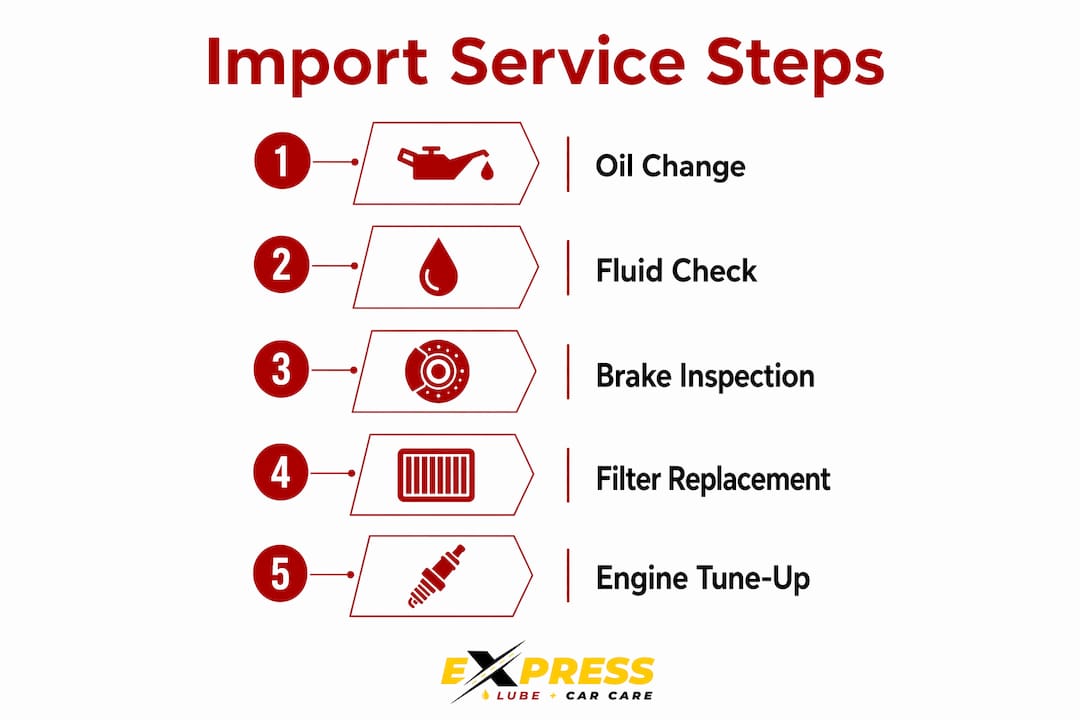
- Mileage-based checklist: what to do at each interval
- Import-specific issues that change how you follow a schedule
- How do you find the exact maintenance schedule for your vehicle?
- How to choose a shop for your import vehicle
- Key Takeaways
- What we see on import cars — and what prevents the expensive repairs
- Your import deserves more than a quick-lube guess
- Useful sources
- FAQ
What is a manufacturer’s maintenance schedule for import cars?
A manufacturer’s maintenance schedule is a structured list of inspections and service items tied to specific mileage milestones or time intervals, whichever comes first. Think of it as the factory’s blueprint for keeping your car alive and performing the way it was engineered to. For import vehicles, these schedules carry extra weight because European and Japanese engines are built to tighter tolerances and are less forgiving when the wrong fluid or a skipped service catches up with them.
Most schedules group services into categories. Some brands use letter-based labels (BMW’s “Oil Service” and “Inspection I/II”), others use mileage tiers (Porsche’s 10,000-mile and 20,000-mile intervals), and some use condition-based systems that adapt to your actual driving. Regardless of the label, the underlying logic is the same: certain items need attention at short intervals, others at major milestones, and a few are time-triggered regardless of miles driven.
Following the factory-scheduled maintenance plan also protects your resale value. A documented service history tells the next buyer that the car was cared for properly, and it gives you a paper trail if a warranty dispute ever comes up. Under the Magnuson-Moss Warranty Act, you are not required to use a dealership for routine maintenance. You just need to use an ASE-certified technician and keep clear records showing the work was done to manufacturer standards.
Normal vs. severe driving: which schedule applies to you?
Most owner’s manuals publish two tracks: Normal and Severe. The Normal schedule assumes moderate highway and city driving, mild weather, and no commercial use. The Severe schedule shortens key intervals because harder operating conditions wear components faster.
Common severe-use triggers (per Honda and Kia owner’s manuals):
- Frequent short trips under 5–10 miles, especially in cold weather
- Prolonged stop-and-go traffic or heavy idling
- Towing, hauling, or carrying heavy loads regularly
- Driving on dusty, unpaved, or heavily salted roads
- Operating in extreme heat or extreme cold consistently
- Commercial use (rideshare, delivery, fleet)
Honda’s maintenance guidance is clear on this: follow Normal unless the vehicle is mainly used under those conditions. Occasional exposure — a road trip through the mountains, one towing job — doesn’t automatically push you into the Severe column. But if two or three of those triggers describe your daily routine, the Severe schedule is the right call.
Pro Tip: If you plan to keep your import past 150,000 miles, default to the Severe schedule for oil changes and transmission service even if your driving is technically “normal.” The cost difference is small; the protection is real.
Mileage-based checklist: what to do at each interval
This table maps the most common service milestones to the typical tasks for import vehicles. Exact intervals vary by make and model, so always cross-check with your owner’s manual.
| Interval | Typical Service Tasks |
|---|---|
| Every 5,000–7,500 miles | Oil and filter change (turbo engines: every 5,000 miles), tire rotation, visual inspection of brakes and fluid levels |
| Every 10,000 miles | Cabin air filter check, brake pad measurement, top off all fluids, inspect belts and hoses |
| 30,000 miles | Engine air filter replacement, brake fluid inspection, coolant level and condition check, inspect suspension components |
| 60,000 miles | Spark plug replacement (many imports), transmission fluid service, coolant flush, comprehensive brake inspection, timing belt inspection if applicable |
| 90,000 miles | Repeat 30k services, inspect timing belt/chain tensioners, replace coolant, check CV axles and boots |
| 100,000+ miles | Timing belt replacement if not done (interference engines), transmission drain-and-fill, full high-mileage inspection, battery load test |
A few items deserve special attention at every visit, regardless of mileage:
- Brake pads and rotors: imports often use softer compounds that wear faster than domestic equivalents
- Tire pressure and tread depth: temperature swings affect pressure more than most owners realize
- Fluid levels and color: dark or milky fluids are early warning signs, not just low-level problems
- Lighting and warning lamps: a burned bulb or a stored code can mask a more serious issue
For a detailed inspection checklist to bring to your next appointment, the car safety inspection checklist covers the key points a technician should walk through at each service visit.
One commonly overlooked item on European imports is the gasoline particulate filter (GPF) or diesel particulate filter (DPF). These require specific regeneration cycles and, in some cases, scheduled cleaning. Skipping this can trigger warning lights and eventually require expensive filter replacement.
Import-specific issues that change how you follow a schedule
OEM fluid approvals matter more than viscosity
Choosing the right oil for a European import isn’t as simple as grabbing a 5W-30 off the shelf. Manufacturers like VW, BMW, and Mercedes-Benz publish specific oil approvals — VW 504.00/507.00, BMW Longlife-01, Mercedes-Benz 229.5 — that govern detergent levels, heat stability, and additive chemistry. These approvals protect timing chains, particulate filters, and seal materials in ways that a generic oil with the same SAE number simply cannot match. OEM oil specifications exist for a reason, and using only viscosity as your guide can cause real damage over time.
Turbocharged engines need shorter oil intervals
Factory extended intervals on many European turbocharged cars are calibrated for fleet use and average driving conditions. For owners who plan long-term ownership, technician guidance consistently points toward 5,000–7,000 mile oil changes to reduce varnish buildup and protect the turbo’s oil supply lines. At each oil change, it’s worth visually checking the PCV system and charge pipes for oil mist or residue — early signs of a developing problem that’s cheap to address and expensive to ignore.
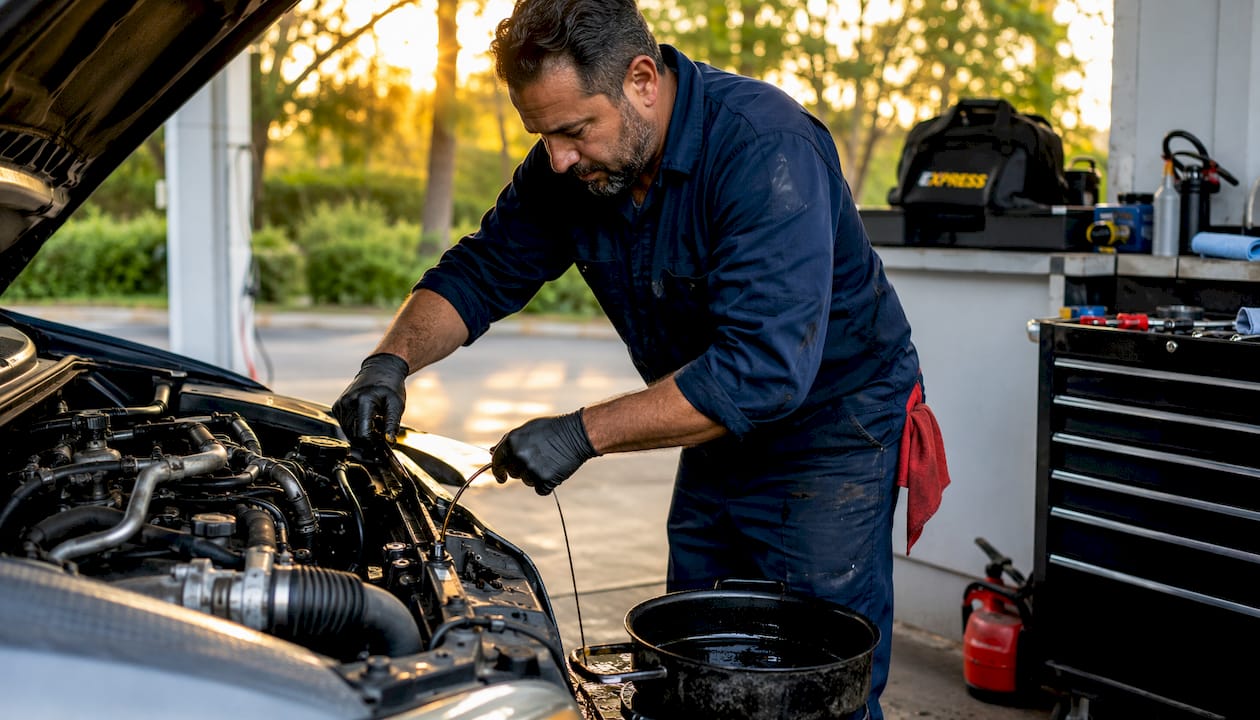
Pro Tip: Ask your shop to note PCV condition and charge-pipe cleanliness on the invoice. That documentation becomes useful if a turbo warranty question ever comes up.
Condition-based systems: follow the dashboard, but verify the manual
BMW’s Condition-Based Service (CBS) system and Mercedes-Benz’s Flexible Service System (FSS) adjust intervals based on actual driving inputs — engine temperature cycles, idling time, driving profile. These are genuinely useful tools, and you should treat dashboard maintenance prompts as your primary trigger. But they don’t replace the owner’s manual for hard-interval items. Timing belt replacement, coolant changes, and brake fluid service often have fixed time limits that the CBS counter doesn’t track. BMW’s maintenance documentation.pdf) confirms this: the system handles oil and inspection scheduling, but time-based items still require manual cross-checking.
“Lifetime” fluid claims: what they actually mean
“Lifetime” transmission fluid is one of the most misunderstood claims in import ownership. In practice, “lifetime” typically means the fluid is designed to last through the warranty period, not the life of the car. For owners who plan to exceed warranty mileage, a transmission drain-and-fill at intermediate intervals before warranty expiry is a prudent step. Dual-clutch and CVT units have their own service requirements and often need attention sooner. The same skepticism applies to “lifetime” coolant claims — a flush at 90,000–100,000 miles is standard practice for most imports regardless of what the label says.
The same principle applies to aftermarket parts. Just as “lifetime” fluid claims deserve scrutiny, so do “lifetime” quality claims on accessories. OEM-grade standards exist precisely because longevity depends on materials and engineering, not marketing language.
How do you find the exact maintenance schedule for your vehicle?
-
Check your owner’s manual first. The maintenance section contains the official schedule for your specific model year. Look for a table with mileage columns and a separate column for time intervals. Both triggers apply — whichever comes first.
-
Use the manufacturer’s VIN-based lookup tool. Most major brands (Toyota, Honda, BMW, Mercedes-Benz, Audi, VW) offer online maintenance guides where you enter your VIN and get a model-specific schedule. This is especially useful for used imports where the manual may be missing.
-
Check the in-car maintenance display. If your vehicle has a condition-based or flexible service system, the instrument cluster or infotainment screen will show upcoming service items. Use this as a real-time prompt, not a replacement for the manual.
-
Call the dealer with your VIN. If you’re unsure which schedule applies or whether a recall or software update is pending, a quick call to the service department with your VIN will get you the official answer. This is also how you find out about any outstanding technical service bulletins (TSBs) that affect your maintenance timing.
-
Read the interval table carefully. Most manuals list items as “every X miles OR X months, whichever comes first.” Don’t ignore the time column — brake fluid, for example, is typically on a 24-month cycle regardless of mileage on many European brands.
Pro Tip: Photograph the maintenance table in your owner’s manual and save it to your phone. When you visit a shop, you can pull it up instantly and confirm the tech is working from the right spec. Also scan your fluid approval stickers or manual pages — shops that see you’ve done your homework tend to be more thorough.
How to choose a shop for your import vehicle
Picking the right shop matters as much as following the right schedule. A technician who doesn’t know the difference between VW 504/507 and a generic 5W-40 can undo months of careful ownership in a single oil change.
What to look for:
- ASE certification: Technicians certified by the National Institute for Automotive Service Excellence have demonstrated competency across service categories. For imports, look for shops with experience on your specific brand.
- OEM-level diagnostic tools: European and Japanese vehicles often require brand-specific scan tools to read fault codes and reset service counters. A generic OBD-II reader won’t cut it for a BMW CBS reset or a VW adaptation procedure.
- Digital vehicle inspection with photos: A shop that provides photo documentation of your car’s condition at each visit gives you a record you can use for warranty claims, resale, and your own peace of mind. This is the standard you should expect.
- Transparent invoices: Every service record should list the fluid brand and specification used, part numbers where applicable, and the technician’s findings. Vague invoices like “oil change performed” without a fluid spec are a red flag.
Questions worth asking before you commit:
- Which oil approval do you use for my make and model?
- How do you document services for warranty purposes?
- Do you follow OEM torque and fill-temperature procedures for transmission service?
- Do you use OEM or OEM-equivalent parts?
Red flags to watch for: A shop that can’t tell you the fluid approval they use, dismisses “lifetime” fluid concerns without explanation, or hands you a one-line invoice is not the right fit for an import.
Express Lube & Car Care checks every one of these boxes. ASE-certified technicians, digital vehicle inspections with photos and notes, and transparent invoices that document exactly what was used and why. That’s the standard import owners should hold every shop to.

Key Takeaways
Following your import’s manufacturer schedule — on the correct Normal or Severe track, with OEM-approved fluids and documented service records — is the single most effective way to protect performance, warranty rights, and long-term value.
| Point | Details |
|---|---|
| Normal vs. Severe schedule | Use Severe if your driving mainly includes short trips, stop-and-go, towing, or extreme climates. |
| OEM fluid approvals | Match the manufacturer’s specific approval (e.g., VW 504/507, BMW Longlife-01) — viscosity alone is not enough. |
| Turbo oil intervals | Change oil every 5,000–7,000 miles on turbocharged imports for long-term engine and turbo protection. |
| “Lifetime” fluid reality | Transmission and coolant “lifetime” claims typically cover the warranty period; plan a service at 50,000–60,000 miles. |
| Express Lube & Car Care | ASE-certified techs, digital inspections with photos, and documented service history for import owners in Richland Hills. |
What we see on import cars — and what prevents the expensive repairs
We see a lot of import vehicles come through the shop, and the pattern is consistent. The cars that arrive with real problems almost always have one thing in common: the owner followed the schedule loosely, or trusted “lifetime” claims without question.
Varnished turbos are probably the most common preventable failure we encounter on European imports. The turbo runs at extreme temperatures and depends entirely on clean, properly specified oil to stay lubricated. When owners stretch oil changes beyond what the engine actually needs — especially in stop-and-go driving — the oil breaks down and leaves deposits in the turbo’s oil supply passages. By the time the driver notices a problem, the repair bill is significant.
Neglected transmissions are a close second. A dual-clutch or CVT that’s never been serviced past 80,000 miles is living on borrowed time. The fluid degrades, clutch material accumulates, and what would have been a $200 drain-and-fill becomes a $3,000 rebuild conversation.
The fix is straightforward: follow the schedule, use the right fluids, and get a multi-point vehicle inspection at every major service. Ask your shop to document PCV condition and charge-pipe cleanliness at oil changes on turbo cars. That one habit catches problems early, when they’re still cheap.
Your import deserves more than a quick-lube guess
Import owners who’ve done the research know what their car needs. The gap is usually finding a shop that actually delivers it.
Express Lube & Car Care in Richland Hills is built for exactly this. Our ASE-certified technicians work with European and Asian import vehicles, use manufacturer-approved fluid specifications, and provide digital vehicle inspections with photos at every service. You leave with a clear record of what was done, what was found, and what’s coming up next.
Every service is backed by our 24-month/24,000-mile warranty — because documented, quality work should come with a guarantee. No appointments needed for most services, and if a larger milestone service is coming up, car care financing is available to keep your schedule on track without the sticker shock.
Check our current oil change and service specials and book your next import service today.
Useful sources
When you need the official schedule or fluid approvals for your specific vehicle, go straight to the primary sources. Here’s where to look:
- Your owner’s manual: The maintenance section contains the definitive interval table for your model year. If you don’t have a physical copy, most manufacturers offer free PDF downloads on their official websites.
- Manufacturer VIN-based maintenance tools: Honda, Toyota, BMW, Mercedes-Benz, Audi, and VW all offer online portals where you enter your VIN to retrieve the exact maintenance schedule for your vehicle.
- BMW’s official maintenance documentation: Covers the CBS system, service categories, and time-based items that the dashboard counter doesn’t track independently.
- FTC guidance on the Magnuson-Moss Warranty Act: The Federal Trade Commission’s Magnuson-Moss guidance explains your rights as a consumer to use independent repair providers without voiding your factory warranty, provided services are documented.
- Kia owner’s manual maintenance tables: Kia’s published interval guidance is a useful reference for understanding how Normal and Severe schedules are structured across import brands.
- OEM fluid approval references: AMSOIL’s technical application guides explain the specific European oil approvals and what each one requires in terms of additive chemistry and heat stability.
- Transmission service guidance: Tri City Transmission’s interval guidance covers the practical case for servicing “lifetime” fluids before they cause failures.
FAQ
What is the 30-60-90 maintenance schedule?
The 30-60-90 schedule refers to the major service milestones at 30,000, 60,000, and 90,000 miles, where more comprehensive inspections and replacements are performed — including spark plugs, belts, transmission fluid, and coolant — on top of the routine oil and filter changes done at shorter intervals.
How do you maintain an imported car properly?
Follow the manufacturer’s Normal or Severe schedule from your owner’s manual, use only OEM-approved fluids for your specific make, document every service with receipts and inspection reports, and choose a shop with ASE-certified technicians who have experience with your brand.
What is the basic maintenance schedule for a car?
At minimum, a basic schedule covers oil and filter changes every 5,000–7,500 miles (turbo engines: every 5,000 miles), tire rotations every 5,000–7,500 miles, brake inspections at each oil change, and a comprehensive inspection at every 30,000-mile milestone.
Does using an independent shop void my import’s warranty?
No. Under the Magnuson-Moss Warranty Act, manufacturers cannot void your warranty solely because you used an independent shop, as long as services are properly documented and follow manufacturer specifications. Keep all receipts and service records.
How often should I change the oil on a turbocharged import?
Most experienced technicians recommend every 5,000–7,000 miles for turbocharged imports, even when the factory interval is longer, to prevent varnish buildup and protect the turbo’s oil supply. Express Lube & Car Care follows OEM fluid specifications and can advise on the right interval for your specific engine.