
Verifying auto repair shop credentials is the most direct way to protect yourself from shoddy repairs and unnecessary costs. The industry term for this process is “credential verification,” and it covers state business licenses, technician certifications like ASE, collision repair standards like I-CAR Gold Class, and Bureau of Automotive Repair (BAR) registration. Skipping this step is like handing your car keys to a stranger and hoping for the best. The good news is that official tools make it faster and easier than most car owners realize.
What credentials should you verify before choosing an auto repair shop?
Auto repair shop credential verification covers two distinct categories: shop-level licenses and individual technician certifications. Both matter, and neither substitutes for the other.
Shop-level licenses and registrations
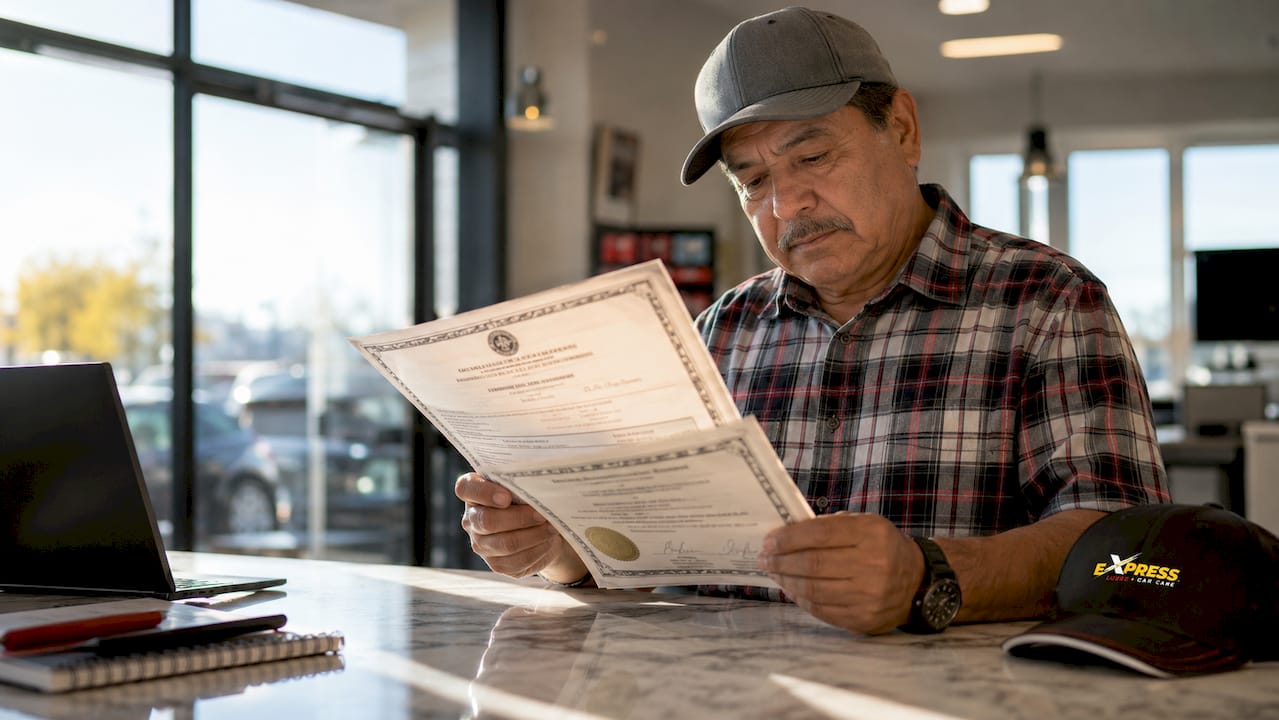
Every legitimate auto repair shop must hold an active state business license and, in most states, a specific automotive repair license. In California, the Bureau of Automotive Repair (BAR) issues and tracks these licenses. In Texas, the Texas Department of Licensing and Regulation (TDLR) serves the same function. Checking these databases confirms the shop is legally authorized to perform repairs and has not had its license suspended for violations.
ASE technician certifications
The National Institute for Automotive Service Excellence (ASE) certifies individual mechanics, not shops. ASE certifications require recertification every five years to confirm ongoing competence. That five-year clock matters because a technician certified in 2019 may be operating on expired credentials today. Always ask for the specific ASE certification relevant to your repair, whether that is engine repair (A1), brakes (A5), or electrical systems (A6).
ASE shop certification means the shop meets minimum administrative and staffing requirements. It does not guarantee every technician holds the right certification for your specific repair. That distinction is critical.
I-CAR Gold Class and OEM certifications
For collision repairs, I-CAR Gold Class is the benchmark credential. Fewer than 10% of collision repair shops in North America hold this status. That rarity means a Gold Class shop has made a real, ongoing investment in training. OEM certifications go one level further. They are issued directly by vehicle manufacturers and are often model-family specific. A certification for a body-on-frame truck does not qualify a shop to repair a unibody sedan. Always confirm the OEM certification matches your vehicle’s make and model.
| Credential | Issued by | Who it covers | Renewal required |
|---|---|---|---|
| State repair license | BAR, TDLR, or state equivalent | The shop | Varies by state |
| ASE certification | National Institute for Automotive Service Excellence | Individual technicians | Every 5 years |
| I-CAR Gold Class | I-CAR | The shop | Annual training |
| OEM certification | Vehicle manufacturer | The shop, model-specific | Program-specific |
Pro Tip: Ask the shop for the license number before your visit. Run it through your state’s online database yourself. A shop that hesitates to share that number is telling you something.
How do you verify an auto repair shop’s credentials using official tools?
The verification process takes about 15 minutes when you know where to look. Work through these steps before authorizing any repair.
-
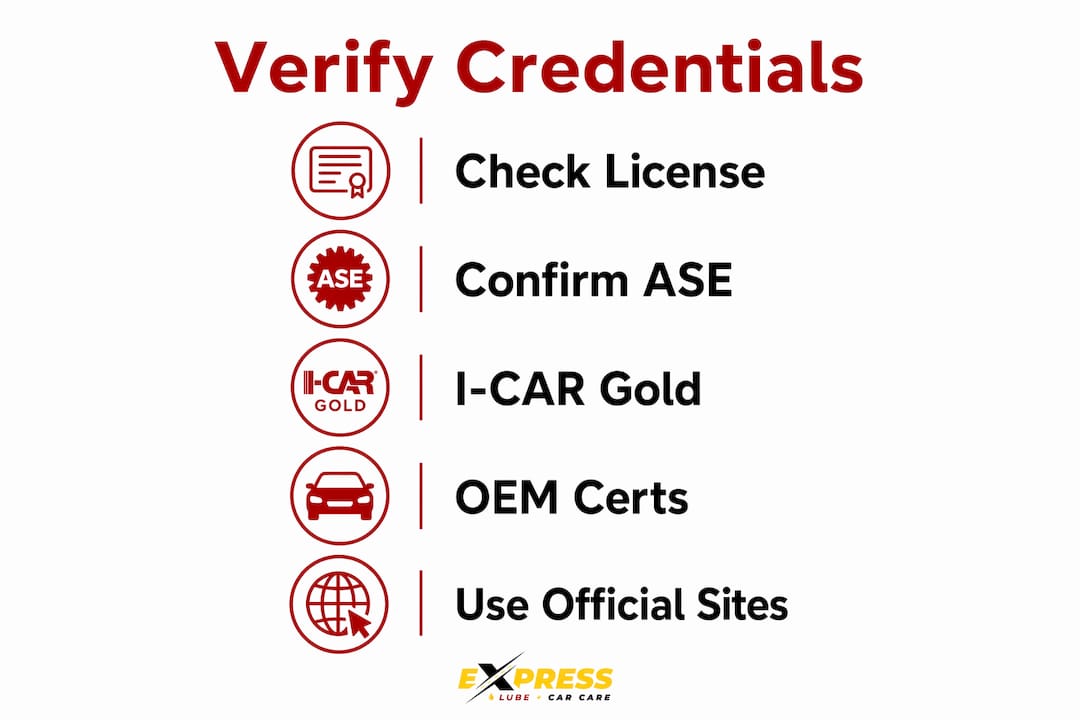
Check the state license database. Visit your state’s automotive repair licensing portal (BAR in California, TDLR in Texas) and search by shop name or license number. Confirm the license is active, not expired or suspended.
-
Search the I-CAR Gold Class locator. The I-CAR website hosts a public shop locator. Enter the shop’s zip code or name to confirm current Gold Class status. Displayed certificates alone are not proof of current certification. Certification can lapse due to staff turnover or missed training, and a framed certificate on the wall will not tell you that.
-
Verify ASE technician credentials. The ASE website allows consumers to look up individual technician certifications by name or shop. Confirm the certification covers the specific system your vehicle needs repaired, and check the expiration date.
-
Confirm OEM certification through the manufacturer’s portal. Most major automakers, including Ford, Toyota, and Honda, maintain public-facing certified shop locators. Search by zip code and cross-reference the shop’s name. OEM certification programs are specific to vehicle model types, so verify against your car’s VIN if the portal allows it.
-
Check the Secretary of State’s business registry. This confirms the shop is a registered legal entity. An unregistered business has no formal accountability structure, which creates real risk if a repair goes wrong.
| Verification step | Official resource | What to confirm |
|---|---|---|
| State repair license | BAR, TDLR, or state portal | Active status, no suspensions |
| I-CAR Gold Class | I-CAR shop locator | Current enrollment, not lapsed |
| ASE technician | ASE consumer lookup | Correct specialty, valid expiration |
| OEM certification | Manufacturer’s certified shop portal | Match to your vehicle’s make and model |
| Business registration | Secretary of State portal | Active legal entity |
Pro Tip: Screenshot every verification result with the date visible. If a dispute arises later, you have a timestamped record of what the shop claimed and what the official database showed.
What red flags should you watch for when confirming repair shop qualifications?
Some warning signs are obvious. Others are easy to miss if you do not know what to look for.
- No license number on display or in writing. Legitimate shops post their state license number on invoices and at the front desk. A shop that cannot produce one is likely unlicensed.
- Expired or unverifiable ASE certifications. ASE certification is role-specific; confirming the correct certification for your precise repair is more reliable than trusting a generic “ASE-certified shop” claim.
- Vague or heavily restricted warranties. A warranty with paragraphs of exclusions is designed to avoid paying out. A trustworthy shop offers clear, reasonable coverage with minimal carve-outs. You can learn more about what fair coverage looks like by reviewing warranty exclusion language before you sign anything.
- Refusal to reference OEM repair procedures. Any shop doing structural or collision work should be able to name the OEM procedure document they follow. Shops that cannot or will not are improvising.
- No process documentation available. Shops that disclose calibration certificates and written repair plans demonstrate real discipline. A shop that cannot produce these documents on request is a shop that probably does not have them.
“Certification status can lapse due to staff turnover, equipment issues, or training lapses. Certificates on walls are unreliable without official verification through public-facing locator tools.” — Crash Lab
If a shop triggers two or more of these red flags, walk away. The signs of an honest auto repair shop are consistent and recognizable once you know what to look for.
What questions should you ask a shop to confirm its credentials in person?
Asking the right questions in person is the final layer of auto shop license verification. A qualified shop answers these questions without hesitation. Evasiveness or vague answers are data points.
-
“What is your state repair license number, and can I see it in writing?” This is the baseline. Any licensed shop has this number and will share it without drama.
-
“Which ASE certifications does the technician working on my car hold?” Do not accept “we’re an ASE shop” as an answer. Asking specific questions about repair procedures puts vehicle safety control back with you. Push for the specific certification code relevant to your repair.
-
“Do you follow OEM repair procedures for my vehicle’s make and model?” The answer should be yes, with a specific reference to the procedure source. If the technician looks confused by the question, that is your answer.
-
“Can I see a sample warranty or the written warranty for this repair?” Read it carefully. A clear, reasonable warranty with minimal exclusions signals a shop that stands behind its work. Pair this with a look at how auto repair warranties work so you know what fair terms look like before you ask.
-
“Is your shop I-CAR Gold Class certified, and when was the last renewal?” For collision work, this question separates shops that invest in training from those that do not.
-
“Can you provide calibration certificates or a written repair plan after the work is complete?” Shops with genuine discipline say yes immediately. Shops that are improvising change the subject.
Pro Tip: Bring a printed checklist to the shop. It signals that you are an informed customer, and informed customers consistently receive better service and more transparent communication.
Key Takeaways
Verifying auto repair shop credentials requires checking state licenses, ASE technician certifications, I-CAR Gold Class status, and OEM approvals through official databases before authorizing any repair.
| Point | Details |
|---|---|
| State license is the baseline | Confirm active status through your state’s BAR or TDLR portal before anything else. |
| ASE certifications expire | Check the specific certification and expiration date for the technician doing your repair. |
| I-CAR Gold Class is rare | Fewer than 10% of shops hold this status, making it a reliable quality signal for collision work. |
| OEM certifications are model-specific | A certification for one vehicle type does not cover another; always match to your car’s make and model. |
| Warranty terms reveal shop character | Clear, minimal-exclusion warranties indicate a shop that expects its work to hold up. |
What I’ve learned from years of watching credential verification go wrong
At Express Lube & Car Care, we see the aftermath of poor verification decisions more often than we would like. A car comes in after a repair somewhere else, and the work does not hold up. When we dig into it, the pattern is almost always the same: the customer trusted a certificate on the wall instead of running a 10-minute check through an official database.
The uncomfortable truth about credential verification is that most car owners skip it because it feels awkward to question a shop’s legitimacy. But asking for a license number is no different from asking a contractor for their bonding information before a home renovation. It is a normal, reasonable request, and any shop worth your business expects it.
What I have found actually works is building a short, repeatable habit. Before any repair, I run the state license check, pull up the ASE lookup, and ask two or three direct questions in person. The whole process takes less time than the average oil change. The shops that welcome those questions are the ones I trust. The ones that get defensive are the ones I leave.
Developing a long-term relationship with a verified, certified shop is the real goal. Once you find one that passes every check and communicates clearly, stick with them. That relationship pays dividends every time your vehicle needs attention.
— Express Lube & Car Care
Certified service you can confirm before you arrive
Express Lube & Car Care makes credential verification straightforward. Our ASE-certified technicians hold current certifications across the repair systems your vehicle actually needs, and we follow OEM procedures on every job. You do not have to take our word for it. Our license information is posted and available, our technician certifications are current, and our warranty terms are written in plain language with no paragraph-length exclusion lists.
Walk-in service is available with no appointment needed, and our service estimates are transparent before any work begins. Check our current oil change and service specials to see what certified, honest service looks like in practice. Richland Hills drivers have a verified option close to home.
FAQ
How do I check if a mechanic is ASE certified?
Visit the ASE website and use the consumer-facing technician lookup tool. Search by the technician’s name or the shop’s name, and confirm the certification covers the specific system your vehicle needs repaired.
What does I-CAR Gold Class mean for a collision shop?
I-CAR Gold Class means the shop meets ongoing training requirements set by the Inter-Industry Conference on Auto Collision Repair. Fewer than 10% of shops in North America hold this status, making it one of the strongest quality signals in collision repair.
Is a shop required to show me its repair license?
Yes. In most states, auto repair shops are legally required to display their license number on invoices and at the place of business. If a shop cannot produce a license number on request, treat that as a serious red flag.
Can I file a complaint if a shop’s credentials turn out to be false?
Yes. In California, the Bureau of Automotive Repair mediates complaints and typically responds within 7–10 business days. Most states have an equivalent licensing authority that handles consumer complaints against unlicensed or misrepresenting shops.
Does ASE shop certification mean all technicians are fully certified?
No. ASE shop certification confirms the shop meets minimum administrative and staffing standards. It does not guarantee every technician holds the right certification for your specific repair. Always ask for the individual technician’s credentials.