

Reading auto shop ratings before you book a service appointment is the single most reliable way to avoid overcharges, shoddy repairs, and wasted time. 97% of consumers check online reviews before visiting a local business, which tells you that crowd-sourced feedback has become the default trust signal for automotive decisions. The industry standard for a reputable shop is a minimum 12-month or 12,000-mile warranty on most repairs, and ASE certification for its technicians. Shops like Express Lube & Car Care in Richland Hills meet both benchmarks, making them a useful reference point as you evaluate any shop near you.
How to check auto shop reviews before visiting
Not all reviews carry equal weight. A shop with a perfect 5-star average and only a dozen reviews tells you far less than one with 4.2 stars across 300 reviews. Volume and pattern matter more than a single number.
3- and 4-star reviews contain the most useful detail. Customers who leave these ratings usually experienced something genuinely mixed, so they explain what went right and what did not. A 5-star review that says “great service!” gives you almost nothing to work with. A 4-star review that says “oil change was fast but the waiting area was cramped and they forgot to reset my maintenance light” tells you exactly what to expect.

Repeated patterns across reviews are the real signal. If five separate customers mention that the shop quoted one price and charged another, that is a pricing transparency problem. One complaint about a long wait on a busy Saturday is just noise. Train yourself to look for themes, not outliers.
How a shop responds to negative reviews is just as revealing as the reviews themselves. Constructive responses with specific remedies signal that management actually reads feedback and cares about fixing problems. A defensive or generic reply like “We’re sorry you feel that way” is a red flag. It suggests the shop treats complaints as PR problems rather than service failures.
- Look for reviews that mention specific repairs, not just general satisfaction
- Check whether the shop replies to negative reviews with real solutions
- Note how recent the reviews are. A strong 2022 reputation means little if the shop changed ownership in 2024
- Watch for mentions of surprise fees, unclear estimates, or pressure to approve unplanned repairs
- Favor shops where reviewers mention being shown the old parts or given a written estimate
Pro Tip: Filter reviews by lowest rating first. The 1- and 2-star reviews reveal worst-case scenarios. If those complaints describe honest mistakes that the shop addressed, you can feel reasonably confident. If they describe repeated dishonesty, walk away.
How do certifications and warranties confirm shop reliability?
Online reviews tell you what past customers experienced. Certifications and warranties tell you what the shop has committed to professionally. You need both.
ASE certification is the clearest credential to look for. The National Institute for Automotive Service Excellence requires technicians to retest every five years to maintain certification. That ongoing requirement means an ASE-certified tech is not coasting on a credential earned a decade ago. Ask any shop directly whether their technicians hold current ASE certifications, and check whether the shop displays its certificates visibly.
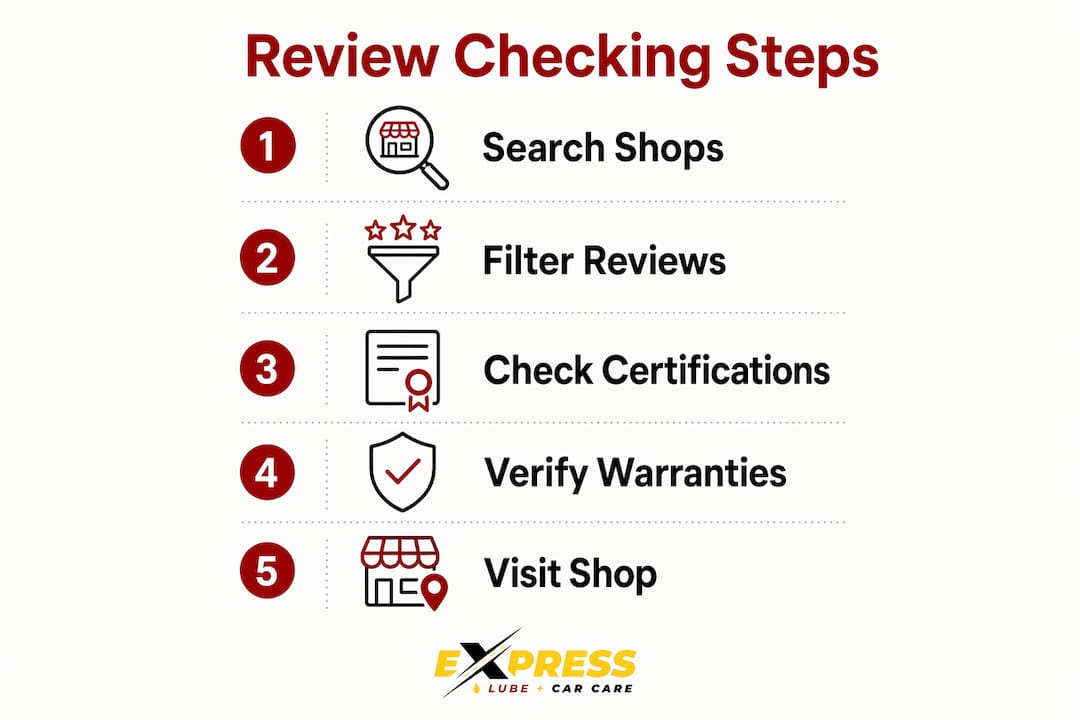
A 12-month or 12,000-mile warranty on repairs is the industry benchmark for quality shops. If a shop offers less than that, or nothing in writing, treat it as a warning sign. Written warranties protect you if a repair fails within a reasonable time frame. Always ask for the warranty terms in writing before you approve any work. Understanding how auto repair warranties work before you visit puts you in a much stronger position to ask the right questions.
Labor rates vary significantly depending on shop type. Dealership service departments charge $150–$200 per hour, while independent shops typically run $20–$40 less per hour. That gap shows up frequently in customer feedback on auto repairs, where reviewers compare value rather than just quality. A shop charging dealership rates without dealership credentials is worth scrutinizing carefully.
| Credential | What it means | What to ask |
|---|---|---|
| ASE certification | Technician passed standardized tests, retested every 5 years | Are your techs currently certified? |
| 12-month/12,000-mile warranty | Shop stands behind repairs for a defined period | Do you provide this in writing? |
| BBB accreditation | Business has a verified dispute resolution record | What is your BBB rating and complaint history? |
| Written estimate | Shop commits to a price before starting work | Can I get this estimate in writing? |
Pro Tip: Ask the shop whether their warranty covers both parts and labor. Some shops warranty parts only, which means you pay labor again if the same part fails within the warranty period.
Steps to combine online research with a physical shop visit
Reading reviews online gets you 70% of the way to a confident decision. The other 30% comes from physically visiting the shop before you commit to any service. A clean, organized shop with attentive staff confirms what good reviews describe. A chaotic, dismissive environment contradicts them.
A shop that invests in modern tools and staff training signals long-term commitment to quality. You can spot this during a quick visit. Look at the equipment in the bays. Ask a service advisor a direct question about your vehicle and notice whether they answer clearly or deflect. A shop that communicates well during a casual conversation will communicate well when your car is on the lift.
Use this sequence when you visit a shop for the first time:
- Walk the waiting area. Is it clean and reasonably organized? A shop that maintains its customer-facing space usually maintains its service bays the same way.
- Observe how staff greet walk-ins. Are they acknowledged promptly and treated with respect? Dismissive front-desk behavior predicts dismissive service communication later.
- Ask about experience with your specific vehicle make and model. A shop that has worked on your car type regularly will flag common issues specific to it. One that has not may miss them.
- Request a sample written estimate. You do not need to commit to service. Ask how they structure estimates and whether they contact you before adding unplanned repairs.
- Check for visible certifications. ASE certificates, state inspection licenses, and warranty policies should be posted where customers can see them.
- Notice the equipment. Outdated or poorly maintained tools in the bays are a quiet signal about how the shop invests in quality.
This local auto repair shop checklist covers additional warning signs worth reviewing before your visit. Combining it with your online review research gives you a complete picture of what to expect.
Common mistakes to avoid when reading car repair reviews
The biggest mistake car owners make is treating a high star rating as a final answer. A 4.8-star average sounds great until you realize the shop has 11 reviews, all posted within the same two-week window. Context always matters more than the number itself.
Diagnostic fees catch many car owners off guard. Shops charge these fees to identify what is wrong with your vehicle, and policies on refunding them vary widely. Some shops credit the diagnostic fee toward your repair bill. Others do not. Ask about this policy before you drop off your car, and look for mentions of it in the shop’s reviews. Customers who felt blindsided by a diagnostic fee almost always mention it.
The Better Business Bureau is an underused resource. BBB ratings reflect how a shop handles unresolved disputes over time, which is something Google reviews rarely capture. A shop can maintain a solid star rating while quietly accumulating unresolved BBB complaints. Check both sources. They measure different things.
- Do not rely on a single review platform. Cross-check ratings across multiple sources for a fuller picture
- Avoid shops with no negative reviews at all. A shop with hundreds of reviews and zero complaints is statistically unlikely to be genuine
- Do not ignore warranty and certification details in reviews. When customers mention a shop honored its warranty without hassle, that is a strong positive signal
- Watch for reviews that mention hidden fees, pressure tactics, or repairs completed without prior approval
- Avoid choosing a shop based on price alone. The auto repair cost comparison between shops matters, but the cheapest option rarely delivers the best value
Reading reviews on how to find trusted auto mechanics gives you a practical framework for filtering out shops that look good on paper but underdeliver in practice.
Key takeaways
Checking auto shop ratings thoroughly, combining online reviews with in-person visits and credential verification, is the most reliable method for finding a trustworthy mechanic.
| Point | Details |
|---|---|
| Prioritize review patterns | Repeated complaints about the same issue are a real signal; isolated complaints are not. |
| Read 3- and 4-star reviews first | These contain the most detailed and balanced customer feedback. |
| Verify ASE certification | Certified technicians retest every 5 years, confirming current expertise. |
| Demand a written warranty | A minimum 12-month or 12,000-mile warranty is the industry benchmark for quality shops. |
| Visit before you commit | A physical shop visit confirms or contradicts what online reviews describe. |
What we’ve learned from helping drivers make confident service choices
At Express Lube & Car Care, we see car owners walk in every week who chose their previous shop based on a flashy website or a handful of glowing reviews. A surprising number of them arrive frustrated by surprise charges or repairs that did not hold. That pattern has taught us something clear: reviews are a starting point, not a finish line.
The car owners who make the best decisions are the ones who treat review research like a first interview. They read the mixed reviews carefully, check for warranty information, and then show up in person to ask direct questions. They notice whether the shop communicates clearly or talks around their concerns. Those small signals predict the entire service experience.
We also believe cost comparisons deserve honest context. Independent shops generally offer lower labor rates than dealerships, but the gap only matters if the shop backs its work with a real warranty and certified technicians. A lower hourly rate with no written guarantee is not a bargain. It is a gamble.
Our advice: build a short list of shops that pass the review and certification test, then visit each one. The shop that answers your questions directly, posts its certifications visibly, and offers a written warranty without hesitation is the one worth trusting with your vehicle.
— Express Lube & Car Care
Express Lube & Car Care: transparent service backed by certified technicians
Express Lube & Car Care in Richland Hills gives you exactly what good reviews promise: ASE-certified technicians, written warranties, and honest pricing with no appointment required.
Whether you need a routine oil change or a full engine diagnostic, our team communicates clearly before any work begins. Check out our current oil change specials for fast, affordable maintenance from technicians who stand behind their work. For more complex issues, our engine repair services include full diagnostics and transparent pricing at every step. Walk in when it works for you, and leave knowing exactly what was done and why.
FAQ
Why should I check auto shop reviews before visiting?
97% of consumers rely on online reviews to evaluate local businesses before visiting. Reviews reveal patterns in pricing transparency, repair quality, and customer communication that you cannot assess from a shop’s website alone.
What star rating should I look for in auto shop ratings?
A rating between 4.0 and 4.7 across a high volume of reviews is generally more trustworthy than a perfect 5.0 with few reviews. 3- and 4-star reviews often contain the most detailed and useful feedback about real service experiences.
How do I know if an auto shop’s certifications are legitimate?
Ask the shop directly whether their technicians hold current ASE certification, and look for posted certificates in the waiting area. ASE requires technicians to retest every five years, so current certification confirms active, up-to-date expertise.
What should I ask about warranties before approving repairs?
Ask whether the warranty covers both parts and labor, get the terms in writing, and confirm the minimum duration. The industry benchmark for a quality shop is at least 12 months or 12,000 miles on most repairs.
Should I check the BBB in addition to reading car repair reviews?
Yes. BBB ratings track unresolved disputes over time, which standard review platforms do not capture. Cross-checking both sources gives you a more complete picture of a shop’s long-term integrity.