

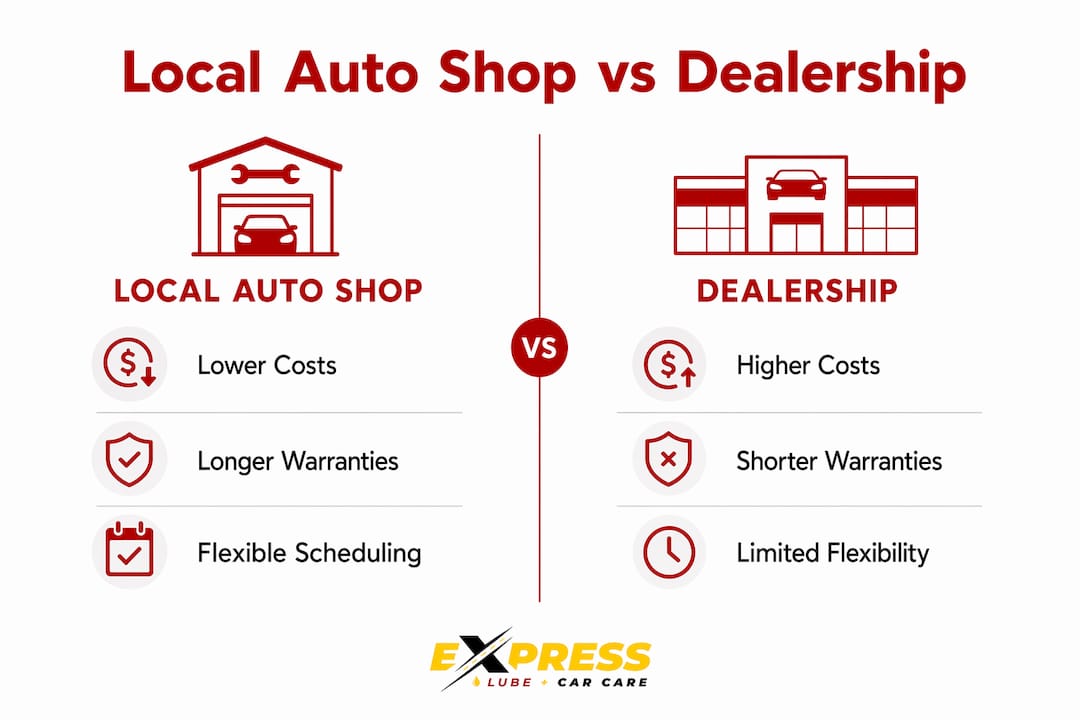
Choosing a local auto shop over a dealership is the most cost-effective decision most car owners can make for routine maintenance and repairs. Local independent shops offer lower labor rates, longer repair warranties, and more personalized service than franchise dealerships. About 70% of car owners use independent shops even during their factory warranty period. That number tells you something important: most drivers have already figured out what the dealership model doesn’t want you to know.
How do costs and warranties compare between local shops and dealerships?
Local auto shops consistently charge less for the same work. Lower overhead means lower labor rates, and independent mechanics can source aftermarket or OEM-equivalent parts rather than being locked into a single manufacturer’s parts catalog. That flexibility translates directly into savings on everything from brake jobs to timing belt replacements.
The warranty story surprises most car owners. Independent shops often provide warranties of 2–3 years or 24,000–36,000 miles on repairs. Dealerships typically offer 1 year or 12,000 miles. A local shop’s warranty can cover you twice as long for the same repair.
The biggest myth in auto repair is that going to an independent shop voids your factory warranty. The Magnuson-Moss Warranty Act protects you here. As long as you follow the manufacturer’s service schedule and keep your receipts, a dealership cannot void your warranty because you used a local shop. You have that right by federal law.
Dealerships also tend to follow a replacement-first approach. When a sensor throws a code, the dealership replaces the whole assembly. Independent mechanics favor component-level repairs, fixing the specific part that failed rather than swapping out an entire unit. That approach saves real money on parts and labor.
| Factor | Local Auto Shop | Dealership |
|---|---|---|
| Typical labor rate | Lower, varies by region | Higher, set by manufacturer guidelines |
| Repair warranty | 2–3 years / 24,000–36,000 miles | 1 year / 12,000 miles |
| Parts options | Aftermarket, OEM-equivalent, or OEM | Manufacturer OEM only |
| Factory warranty impact | Protected under Magnuson-Moss Act | No advantage over local shop |
| Repair approach | Component-level fixes | Replacement-first model |
Pro Tip: Keep every service receipt from your local shop in a dedicated folder. If a dealership ever questions your warranty, those records are your legal protection under the Magnuson-Moss Warranty Act.
What service quality differences exist between local shops and dealerships?
Quality at a local shop is not a compromise. Consumer Reports surveys show independent shops rate higher than dealerships in customer satisfaction and overall value. Many local shops employ technicians who spent years at dealerships before going independent. They bring manufacturer-level training without the dealership’s high-volume churn.
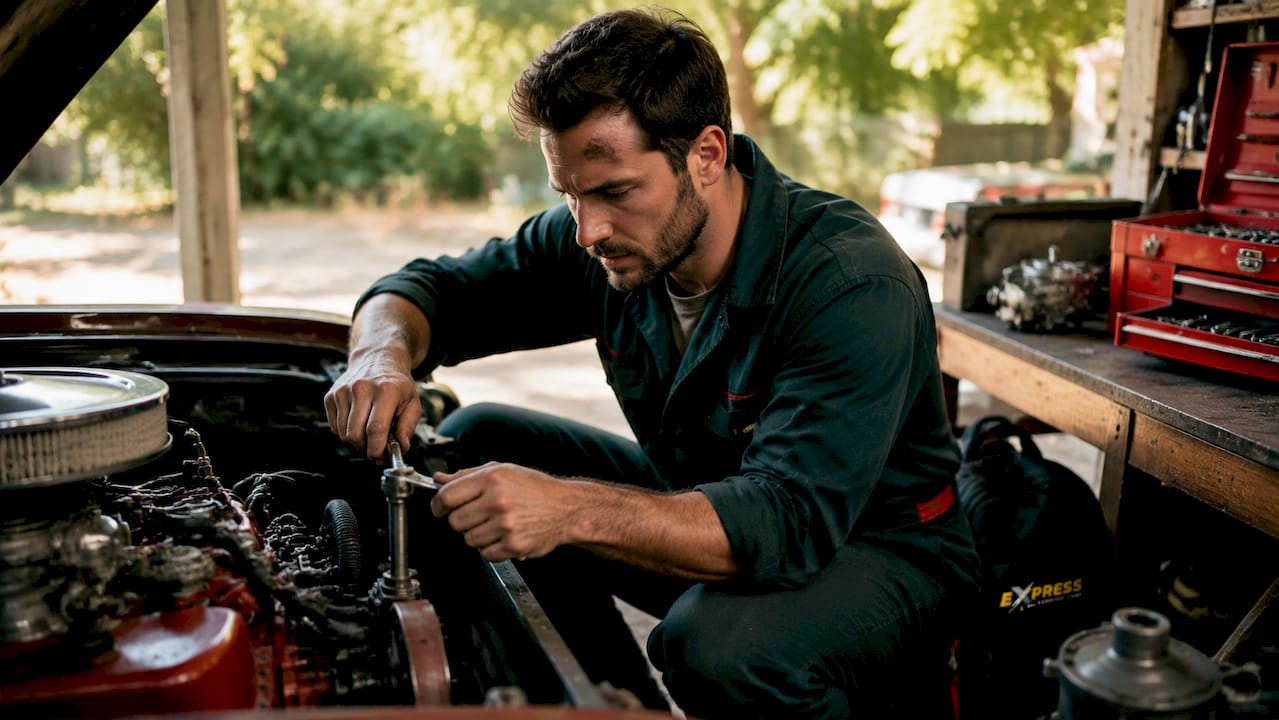
ASE certification is the industry standard for measuring technician competence. The National Institute for Automotive Service Excellence awards ASE credentials after technicians pass rigorous exams in specific repair categories. A shop staffed with ASE-certified or Master Technician-credentialed mechanics meets the same professional bar as any dealership service bay.
Local shops also tend to work on a wide range of vehicle makes and models. That broad expertise across many vehicles means a technician has seen your problem before, probably on three different brands. Dealership technicians, by contrast, often specialize in one manufacturer, which narrows their diagnostic perspective.
Here is what the local shop advantage looks like in practice:
- Direct mechanic access. You can talk to the person actually working on your car, not a service writer relaying messages.
- Fewer unnecessary upsells. Local shops rely on repeat customers and community reputation, so they have a strong incentive to recommend only what you need.
- Personalized maintenance advice. A technician who knows your car’s history gives better guidance than one reading your file for the first time.
- Access to technical service bulletins. Quality independent shops subscribe to the same manufacturer technical bulletins that dealerships use.
- Diagnostic depth. Because independent mechanics perform component-level repairs, they diagnose more thoroughly before recommending parts.
Pro Tip: Ask any shop you’re considering whether their technicians hold current ASE certifications. A shop that’s proud of its credentials will tell you immediately. One that hesitates is worth a second look.
How does a local shop improve convenience for car owners?
Speed and flexibility are two areas where the local shop wins every time. Dealership service departments run like large bureaucracies. Your car moves through a check-in desk, a service writer, a dispatcher, and finally a technician. Each handoff adds time. A local shop often gets your car in front of a mechanic the same day you call.
Local shops offer direct communication and flexible scheduling that dealerships simply cannot match. When something unexpected comes up during a repair, the mechanic calls you directly, explains the issue in plain language, and waits for your decision. No voicemail chains, no service writer playing telephone.
Community reputation is a powerful motivator for honest service. A local shop lives and dies by its neighborhood reviews. That accountability keeps recommendations honest and pricing fair. Consumer surveys confirm drivers appreciate local shops for a better overall experience and real savings on routine maintenance.
Here is a practical sequence for getting the most out of a local shop relationship:
- Call ahead for an estimate. A trustworthy shop gives you a ballpark figure before you bring the car in.
- Drop off and get a direct contact. Ask for the technician’s name and a number to reach them directly.
- Approve work in writing. Any shop worth using will provide a written estimate before starting repairs.
- Pick up and review the invoice. Line-item invoices show exactly what was done and what parts were used.
- Follow up after the repair. A good local shop welcomes a call if something feels off after the visit.
What steps should you follow to find a good auto shop?
Finding a trustworthy independent mechanic takes about 30 minutes of research and one test visit. The payoff is a shop you can rely on for years. Use this checklist as your starting point.
- Look for ASE certification displayed in the shop or on the website. It signals trained, tested technicians.
- Read Google and Yelp reviews with a focus on how the shop handles problems, not just praise.
- Ask about warranty terms before any work begins. A shop offering 2+ years on repairs stands behind its work.
- Visit the shop in person. Cleanliness and organization in a service bay reflect how carefully technicians handle your car.
- Ask whether they have experience with your specific make and model. Broad experience is good; direct experience is better.
- Start with a small job like an oil change or tire rotation to test communication and pricing before committing to major repairs.
- Request a written estimate every time. Walk away from any shop that resists putting the price in writing.
- Watch for red flags: pressure to approve work immediately, vague estimates, or reluctance to explain what was found.
A useful resource for this process is the local auto repair checklist at Express Lube & Car Care, which walks through exactly what to look for before trusting a shop with your vehicle.
| What to check | Why it matters |
|---|---|
| ASE certification | Confirms technician training and tested competence |
| Written estimate | Protects you from surprise charges |
| Warranty terms | Shows the shop’s confidence in its own work |
| Customer reviews | Reveals how the shop handles real problems |
| Shop cleanliness | Reflects care and professionalism in repairs |
Key takeaways
Independent auto repair shops offer lower costs, longer warranties, and higher customer satisfaction than dealerships for most routine and repair work.
| Point | Details |
|---|---|
| Warranty protection | The Magnuson-Moss Warranty Act keeps your factory warranty intact at any licensed independent shop. |
| Longer repair warranties | Local shops commonly offer 2–3 year warranties versus the dealership standard of 1 year. |
| Lower costs | Independent shops use flexible parts sourcing and component-level repairs to reduce your bill. |
| Higher satisfaction | Consumer Reports rates independent shops above dealerships for value and customer experience. |
| Better communication | Direct mechanic access and community accountability produce more honest, transparent service. |
What we’ve learned from years on the local side
At Express Lube & Car Care, we have seen the same pattern play out hundreds of times. A driver comes in after a dealership quoted them $800 for a repair. We diagnose the same issue, fix the actual failing component rather than the whole assembly, and the bill is closer to $300. That is not a fluke. That is the difference between a component-level repair and a replacement-first model.
The relationship piece matters more than most car owners realize. When we know your car, we catch things early. A technician who has serviced your vehicle three times notices when something sounds slightly different. That kind of history-based diagnostic accuracy is impossible at a dealership where a different technician touches your car every visit.
My honest advice: use the dealership for recalls and warranty-covered repairs where they have no-cost leverage. For everything else, a quality local auto repair shop gives you better value, more transparency, and a mechanic who actually remembers your name. That relationship is worth more than any loyalty points program a dealership can offer.
— Express Lube & Car Care
Express Lube & Car Care: local auto repair done right
Express Lube & Car Care in Richland Hills is ASE and RepairPal certified, which means every technician working on your vehicle has passed the same rigorous exams that set the industry standard. No appointments needed for most services, so you can walk in on your schedule, not ours.
We back our repairs with honest pricing, transparent invoices, and workmanship you can count on. Whether you need a quick oil change or a more involved repair, we treat every vehicle like it belongs to a neighbor, because it usually does. Check out our current oil change specials and see how much you can save on routine maintenance without giving up an ounce of quality.
FAQ
Does using a local shop void my factory warranty?
No. The Magnuson-Moss Warranty Act protects your factory warranty when you use any licensed independent shop, as long as you follow the manufacturer’s service schedule and keep your service records.
Are local auto shops as qualified as dealership technicians?
Yes. Many independent mechanics hold ASE certifications or Master Technician credentials and often have prior dealership experience. Consumer Reports rates independent shops higher than dealerships in customer satisfaction and value.
How do local shop repair warranties compare to dealerships?
Independent shops commonly offer warranties of 2–3 years or 24,000–36,000 miles. Dealerships typically offer 1 year or 12,000 miles, making local shop warranties significantly stronger in most cases.
When should I still go to a dealership?
Dealerships are the right choice for manufacturer recalls and repairs covered under your original factory warranty, since those services cost you nothing. For routine maintenance and most repairs, a local independent shop is the better value.
How do I know if a local auto shop is trustworthy?
Look for current ASE certification, positive community reviews, written estimates before any work begins, and clear warranty terms on repairs. Starting with a small job like an oil change is a low-risk way to evaluate the shop before committing to larger work.