

An engine misfire means one or more cylinders failed to ignite the air-fuel mixture properly. If your check engine light is flashing, minimize driving and get it looked at soon: the catalytic converter is at risk of damage. If the light is steady instead of flashing, you can usually schedule a diagnosis without treating it as an emergency, though long trips aren’t a great idea until you know what’s going on.
TL;DR:
- A flashing check engine light indicates a severe misfire that actively damages the catalytic converter and requires immediate diagnosis and repair.
- Misfires caused by ignition issues are usually the simplest and cheapest to fix, involving spark plugs, coils, or wires, and tend to occur on a single cylinder.
- Random or multi-cylinder misfires often stem from fuel or vacuum system problems, such as clogged injectors or leaks, and may take longer to diagnose.
- Routine maintenance, including regular spark plug replacement and OBD scans during service, can catch misfires early and prevent costly repairs.
- Severe mechanical issues like head gasket failure or worn piston rings require advanced testing and tend to involve higher costs, especially if replacement or engine rebuilds are necessary.
Table of Contents
- Symptoms and severity: how misfires present and why they matter
- What causes a misfire: ignition, fuel and air, or compression
- Understanding OBD-II misfire codes and the check engine light
- How to diagnose a misfire: DIY checks and professional tests
- Repair options and what they typically involve
- Preventing engine misfires with routine maintenance
- Why routine diagnostics catch problems before they become expensive
- How Express Lube & Car Care handles misfire diagnosis
- Get your misfire diagnosed the right way
- Sources
- FAQ
Symptoms and severity: how misfires present and why they matter
A misfire rarely hides. You’ll usually feel it before you see a warning light, and once you know what to look for, it’s hard to miss.
- The engine idles rough or shakes at a stoplight
- You feel a stumble or sputter under acceleration
- Power drops noticeably, especially climbing a hill or merging
- The car struggles to start or stalls
- Fuel economy takes an unexplained dip
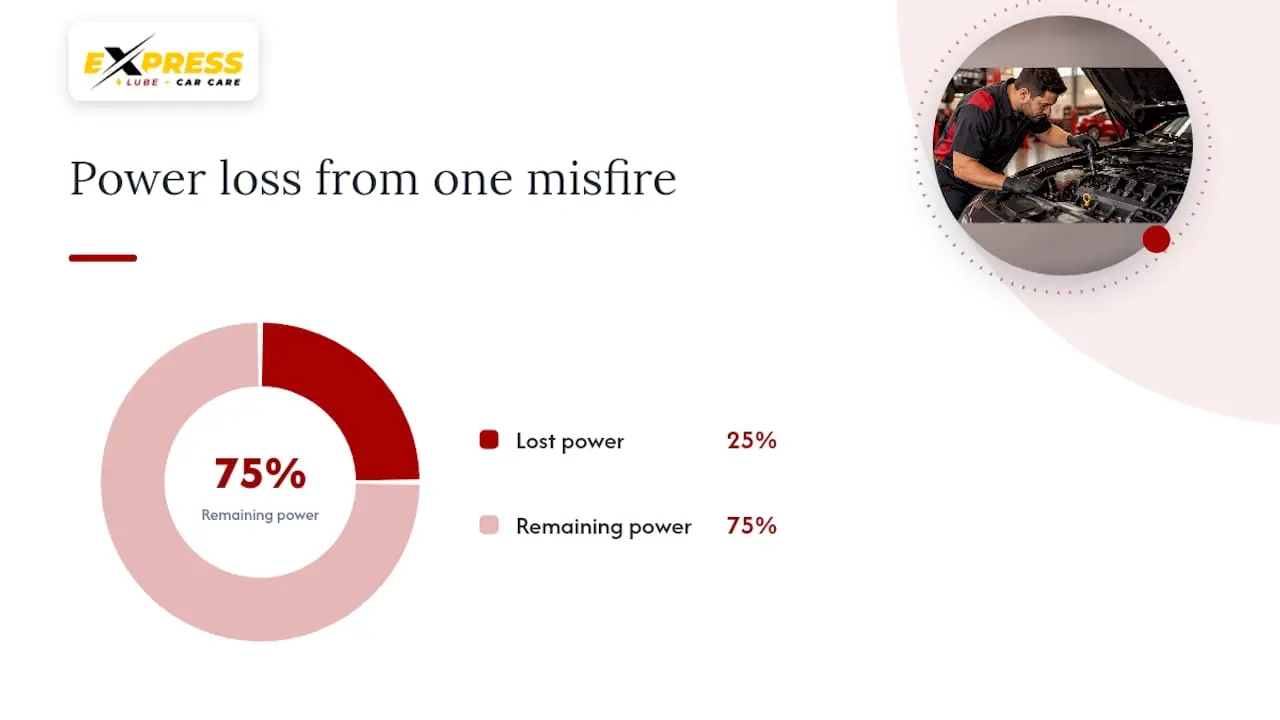
A misfire on just one cylinder in a four-cylinder engine can cut output by roughly 25% of that engine’s power, which explains why even a “small” misfire feels like a real loss of pep. Left alone, misfires also push more unburned fuel into the exhaust, raising hydrocarbon emissions and stressing the catalytic converter.
Pay attention to the check engine light’s behavior. A steady light means the computer caught a misfire and wants it checked soon. A flashing light means the misfire is severe enough, right now, to threaten expensive emissions hardware.
What causes a misfire: ignition, fuel and air, or compression
Diagnosing a misfire gets a lot less mysterious once you sort the possible causes into three buckets; for interior-related odor issues during diagnosis, check out how to diagnose the source to stop car odour for good. Nearly every misfire traces back to one of these groups.
- Ignition problems. Worn spark plugs, failing ignition coils, cracked boots, or bad plug wires are the most common culprits and usually the cheapest fix.
- Fuel and air problems. Clogged or dirty injectors, low fuel pressure, vacuum leaks, a stuck EGR valve, or poor-quality fuel can starve a cylinder or flood it.
- Mechanical or compression problems. Burned valves, a blown head gasket, or worn piston rings let a cylinder lose the pressure it needs to fire properly.
This framework, laid out by AA1Car’s misfire diagnostic guide, also helps explain the pattern you’re seeing. A misfire that always points to the same cylinder usually means a localized problem: one bad coil, one fouled plug, one leaking valve. A random or multiple-cylinder misfire more often points upstream, to something shared across cylinders like fuel pressure or a vacuum leak, since random misfires commonly trace back to air and fuel delivery issues rather than one failed part.
Understanding OBD-II misfire codes and the check engine light
Your scan tool speaks in a specific code language once a misfire trips the computer’s threshold, and knowing what those codes mean saves you a lot of guesswork.
- P0300 means a random or multiple-cylinder misfire, not tied to one location.
- P0301 through P0312 point to a specific cylinder, so P0303 means cylinder three is misfiring.
- These codes come from the OBD-II system’s continuous monitoring of combustion events, comparing each cylinder’s performance against the others.
- A steady MIL logs the fault for a technician to review; a flashing MIL signals the misfire rate is high enough that unburned fuel is actively hitting the catalytic converter.
That last point is why the EPA’s guidance on the check engine light treats a flashing MIL as a different situation entirely from a steady one. It’s not a scare tactic. It’s the difference between “get this checked this week” and “reduce driving until it’s fixed.” Our guide to what the check engine light means covers this distinction in more depth if you want the full picture.
How to diagnose a misfire: DIY checks and professional tests
You can rule out a few simple things yourself before it’s time to bring the car in, and doing so often saves diagnostic time later.
- Check the gas cap. A loose or damaged cap can trigger fuel-system codes that sometimes get lumped in with misfire complaints.
- Note the pattern. Does it misfire at idle, only under load, or only when cold? Write it down; it matters.
- Look at accessible spark plugs or boots for obvious cracking, corrosion, or oil fouling if you’re comfortable popping the hood.
- Stop and get it towed if the MIL is flashing, the engine is stalling repeatedly, you smell fuel or coolant, or you see smoke. That’s beyond a “drive carefully” situation.
Once it’s in a shop, the diagnostic order matters. A technician will pull codes and check Mode 06 misfire counts, which reveal patterns even before a full-blown DTC sets, using the kind of OBD-II data logging that spots trouble early. From there, cylinder balance and spark tests narrow down ignition versus fuel issues, and a compression test, sometimes followed by a wet compression test, separates worn rings from valve or head-gasket damage: if compression improves after adding oil, the rings are the likely problem; if it stays flat, the valves or head gasket are more likely at fault. Fuel pressure and injector electrical tests round things out.
Pro Tip: Resist the urge to swap parts and see what sticks. Verifying the actual fault first, under the same driving conditions that trigger it, is cheaper than replacing coils, plugs, and injectors one at a time hoping something works.
Repair options and what they typically involve
Once the cause is confirmed, the fix tends to fall into one of three cost tiers, and knowing which tier you’re likely in helps set expectations before you get a quote.
- Lower-cost fixes: spark plugs, ignition coils, or plug boots and wires. These are common, often same-day jobs.
- Mid-range fixes: a failing fuel pump, a faulty pressure regulator, EGR valve cleaning, or an intake gasket replacement. These take a bit more diagnostic time since fuel and vacuum systems interact with several components at once.
- Higher-cost repairs: head gasket replacement, valve work, or in severe cases an engine rebuild or replacement. These usually follow a compression test that points to mechanical damage rather than a simple part failure.
Intermittent misfires, or ones that hit multiple cylinders, generally take longer to pin down than a misfire confined to one cylinder, which can add diagnostic time before any parts are even ordered. Whatever the shop finds, ask for a written estimate before work begins, and ask whether the inspection included photos so you can see what they saw. A warranty on the repair itself is worth asking about too, since it tells you how confident the shop is in the fix.
Preventing engine misfires with routine maintenance
Most misfires are preventable with maintenance you’d probably be doing anyway.
- Replace spark plugs on the schedule your manufacturer recommends rather than waiting for symptoms.
- Use quality fuel and avoid a steady diet of short trips, which can foul injectors over time.
- Ask for an OBD scan during routine service visits so minor codes get caught before they become misfires.
- Keep oil changes, cooling system service, and intake cleaning on schedule, since neglect in any of these areas can eventually show up as a compression or air-delivery problem.
Pro Tip: A five-minute scan during a routine oil change can catch a pending misfire code weeks before you’d ever feel it behind the wheel.
Why routine diagnostics catch problems before they become expensive
Most drivers wait for a symptom before they think about diagnostics, and that’s usually the more expensive way to do it. A misfire that gets caught early, through a routine scan rather than a dashboard warning, is almost always cheaper to fix. That’s the case for building regular OBD checks into your maintenance routine instead of treating your scan tool as a last resort. Our guide on why engine diagnostics matter goes deeper into how early detection changes the cost equation, and it’s worth a read if you’ve never had a misfire before and want to understand what you’re avoiding.
— Express Lube & Car Care
How Express Lube & Car Care handles misfire diagnosis
A misfire diagnosis is only as good as the process behind it, so here’s what happens when you bring one to us.
- Our ASE-certified technicians start with an OBD-II scan and review live data, not just the trouble code itself.
- We run compression tests and other targeted checks to confirm the actual cause before recommending a repair.
- Every visit includes a digital vehicle inspection with photos, so you can see exactly what we found instead of taking our word for it.
- Qualifying repairs come with a 24-month/24,000-mile warranty.
You don’t need an appointment. Walk-ins are welcome, and we offer same-day service when the schedule allows, along with repair financing options if a bigger repair catches you off guard. If your check engine light is on and you’re not sure what it means, our check engine diagnostics service page covers what a scan involves before you even come in.
Get your misfire diagnosed the right way

A misfire that keeps getting put off tends to get more expensive, not less, the longer it sits. Express Lube & Car Care in Richland Hills runs the full diagnostic sequence, OBD-II scans, live data, compression testing, and a digital inspection with photos, so you know exactly what’s wrong before you agree to a repair. Every qualifying repair carries a 24-month/24,000-mile warranty, and you don’t need an appointment to get started.
If you’d rather book ahead, our engine diagnostics and repair page has more on what’s included. Either way, call us at (817) 284-8478 or stop by for a walk-in inspection and we’ll get you a straight answer.
Sources
- What to do with the Check Engine Light (EPA)
- P0300 trouble code explanation (OBDeleven)
- How To Diagnose & Repair Engine Misfires (AA1Car)
- Compression testing guide (Apex Tech Nation)
FAQ
What does an engine misfire feel like?
A misfire usually feels like a stumble, shake, or momentary loss of power, often most noticeable at idle or when accelerating. Some drivers also notice a popping sound from the exhaust or a rougher-than-normal idle at stoplights.
How do I fix an engine misfire?
The fix depends on the cause: worn spark plugs or coils are a straightforward swap, while fuel delivery or vacuum leak issues need testing to pinpoint the source. Diagnosis, using OBD-II scans and Mode 06 misfire data, should come before any parts are replaced so you’re not guessing.
Can I still drive if my engine is misfiring?
If the check engine light is flashing, minimize driving since the catalytic converter is at immediate risk. If the light is steady, driving short distances to a shop is generally fine, but avoid long trips until it’s diagnosed.
Is fixing a misfire expensive?
It depends entirely on the cause. Spark plug or coil replacement tends to be a quick, lower-cost repair, while compression-related issues like a head gasket or valve damage take more diagnostic time and cost more to fix.