

The most common signs of a bad EGR valve are a check engine light, a rough or unstable idle, hesitation or weak power, worse fuel economy, pinging or knocking under load, and a failed emissions test. A valve stuck open tends to show up as rough idle and stalling. A valve stuck closed tends to show up as knocking and surging. None of these signs proves the valve itself is bad, because sensors, hoses and wiring around it can cause the same trouble. That is why we test the system before we recommend a part.
TL;DR
- Typical signs: check engine light, rough idle, stalling, hesitation, lower fuel economy, engine knock and a failed emissions test.
- Stuck open usually means rough idle and stalling, especially on a cold engine. Stuck closed usually means pinging or knocking and surging.
- An EGR code does not automatically mean a bad valve. Hoses, solenoids, sensors and clogged passages can set the same code.
- Carbon buildup is the biggest cause of EGR trouble, so cleaning is sometimes possible, but it depends on the vehicle and the valve’s condition.
- Parts cost anywhere from under $50 to $1,000 or more, with labor on top, so the right diagnosis protects your budget.
Table of Contents
- What does an EGR valve actually do?
- What are the symptoms of a bad EGR valve?
- How can you tell if an EGR valve is stuck open or stuck closed?
- What else can mimic a bad EGR valve?
- How is an EGR valve diagnosed?
- Can a clogged EGR valve be cleaned, or does it need replacing?
- How much does EGR valve replacement cost?
- Is it safe to keep driving with a faulty EGR valve?
- Our perspective: diagnose first, then decide
- Prevent EGR trouble: what helps
- Get your EGR symptoms checked in Richland Hills
- FAQ
- Sources
What does an EGR valve actually do?
EGR stands for exhaust gas recirculation. The valve lets a small, controlled amount of exhaust flow back into the intake. That lowers combustion temperatures, which cuts nitrogen oxide (NOx) emissions and helps keep the engine from pinging. When the valve works, you never think about it. When it sticks, the engine’s air and fuel balance gets thrown off, and you feel it in how the car idles, accelerates and sounds.
Depending on the vehicle, the valve may be vacuum operated or electronically controlled, and some systems add a position sensor, a solenoid or a pressure converter. More parts means more places for a fault to hide, which matters later when we get to diagnosis.
What are the symptoms of a bad EGR valve?
AutoZone’s list of possible EGR symptoms covers sluggish acceleration, reduced power going uphill, higher fuel consumption, rough or uneven idle, pinging or knocking, and a failed emissions test. Here is how those show up in daily driving around Richland Hills, North Richland Hills, Hurst and Bedford.
Check engine light
The light is often the first sign. If the engine computer commands EGR flow and does not see the response it expects, it can set a code such as P0401 or a similar one, as this EGR diagnosis article explains. The code tells you where the computer saw a problem. It does not tell you which part caused it.
Rough idle or stalling
You sit at a light on Rufe Snow or Grapevine Highway and the engine shakes, hunts for a steady rpm, or dies as you come to a stop. This is the classic pattern of a valve that will not close fully. If this sounds like your car, our guide on live data scans for rough idle shows how we separate EGR problems from misfires, vacuum leaks and other causes.
Hesitation, surging and weak power
The car bogs when you press the pedal to merge onto Loop 820 or struggles on a grade with a load. Some drivers describe a surge at steady speed, like the car is breathing unevenly. Weak power has a lot of causes, so do not stop at the EGR valve. Our article on engine misfire checks covers a close neighbor of this symptom.
Pinging or knocking
A light metallic rattle under acceleration is called detonation or pinging. Without enough recirculated exhaust to keep combustion temperatures in check, the mixture can ignite unevenly. Do not ignore it. Repeated knock is hard on the engine.
Worse fuel economy
If you fill up more often and your driving has not changed, an EGR fault is one possible reason among many. A tune-up item, an oxygen sensor or tire pressure can do the same.
A failed emissions inspection
Because the EGR system exists to control NOx, a fault can push a vehicle out of compliance. We handle Texas emissions inspections, so if you were turned away elsewhere, bring the failure report with you.
How can you tell if an EGR valve is stuck open or stuck closed?
The symptom pattern points you in a direction, but it is not a diagnosis. According to a technical bulletin on the EGR valve, a valve stuck open can cause rough idle, especially on a cold engine, and stalling at idle. A valve stuck closed can cause knocking or detonation at low rpm and higher NOx emissions. Samarins describes the same split, noting that a stuck-closed valve or clogged system can bring higher combustion temperature, pinging and surging.
| Stuck open | Stuck closed | |
|---|---|---|
| What happens | Exhaust enters the intake when it should not | No exhaust recirculates when it should |
| Typical feel | Rough idle, stalling at idle, worse when cold | Pinging or knocking, surging, hesitation |
| Emissions effect | Often a code or poor idle quality | Higher NOx, possible failed test |
| Common cause | Carbon holding the valve off its seat, a failed actuator | Carbon clogging the valve or passages, a failed actuator |
Treat that table as a starting point. Carbon can partially jam a valve so it behaves differently at different temperatures, and a clogged passage can mimic a stuck-closed valve even when the valve itself moves perfectly.
What else can mimic a bad EGR valve?
This is where many repair bills go sideways. The same bulletin warns that an EGR fault code does not automatically mean the valve is faulty, and that blocked pipes, cracked hoses, faulty exhaust temperature sensors, blocked ducting or a faulty EGR pressure converter can set similar codes. AutoZone adds that problems with the EGR solenoid, vacuum hoses or electrical connections can keep the valve from operating correctly.
On our side of the counter, the look-alikes we think about are:
- Vacuum leaks and cracked or disconnected hoses
- Worn spark plugs or ignition parts, which cause rough running too (see our guide to signs of bad spark plugs)
- A stuck-open thermostat, which can affect warm-up behavior and idle quality
- Dirty or failing sensors that feed the engine computer bad data
- Carbon-clogged passages between the exhaust and intake
- A position sensor that misreports where the valve actually is
That last one deserves a note. A diagnostic lesson on driveability faults points out that comparing commanded and actual valve position helps, but a valve that moves correctly can still have a faulty or misreporting position sensor.

How is an EGR valve diagnosed?
Good diagnosis moves from the cheap and simple to the specific. Delphi’s EGR basics article describes a process that includes reading fault codes, checking vacuum lines and electrical connections, testing vacuum supply, checking valve-stem movement, applying vacuum to the valve, and inspecting the valve and passages for carbon. A manufacturer service bulletin published through NHTSA for a Mercedes-Benz EGR diagnosis and cleaning procedure takes the same approach: diagnose electrical faults and check related EGR components, sensors and the vacuum system before assuming anything else.
Here is the order we follow:
- Talk to you first. When does it happen: cold start, idle, highway, under load? What changed recently?
- Scan for codes and freeze-frame data. We write them down, but we do not stop there.
- Look at live data. The EGR command, valve response, MAP readings and fuel-trim changes show what the engine is actually doing. Innova’s guide to confirming EGR issues makes the same point: overlapping symptoms mean data beats guesswork.
- Inspect hoses, connectors and the solenoid. Many EGR codes end here.
- Test the valve and its movement. Depending on the design, that means vacuum or electronic actuation and checking the stem or position feedback.
- Look at the carbon. Where access allows, we inspect the valve and passages. Some shops use a borescope to look inside engine components without tearing things apart, which can save labor when the question is whether passages are clogged.
- Show you what we found. Our digital vehicle inspections include photos, so you see the same thing we do before you approve anything.
For a broader look at how this process works on any warning light, see how mechanics find car problems and why engine diagnostics matter.
Can a clogged EGR valve be cleaned, or does it need replacing?
Sometimes cleaning is a real option. Delphi names carbon buildup as the single biggest cause of EGR valve failure, since it can clog passages and the valve plunger and make the valve stick open or closed. Where the parts can be reached, carbon can be removed from the valve and passages.
But cleaning is not a universal fix. Samarins calls cleaning a temporary measure and recommends replacing the valve and its gasket. Our view sits between the two, and it depends on what we see:
- Clean it when the valve and its electronics test good, the carbon is the only problem, and the valve is not worn or damaged.
- Replace it when the actuator or position sensor fails testing, the valve will not seal, or the housing is damaged.
- Fix something else when the valve is fine and a hose, solenoid, sensor or passage is the real cause. Replacing a good valve will not clear the code.
Cleaning a valve that is already failing electrically just spends labor twice. That is one more reason diagnosis comes first.
How much does EGR valve replacement cost?
We do not publish a flat price for EGR work because the range is wide and depends on the vehicle. AutoZone says EGR parts can run from under $50 to $1,000 or more, with an average under $100, and labor is charged on top of that.
Three things move the total most:
- The part itself. Design varies a lot between a simple vacuum valve and an electronic one built into a larger assembly.
- Access. On some engines the valve sits in plain view. On others, other components have to come off first, which adds labor.
- What else is wrong. If clogged passages, a sensor or a hose are involved, those add to the repair, but they also decide whether the repair holds.
We give you a written estimate after diagnosis, and we do not start work you have not approved. If a repair is larger than you planned for, eligible customers may be able to explore financing through third-party providers such as Koalafi, Snap Finance, American First Finance and Synchrony, subject to provider approval and terms. These are outside lenders, not an in-house payment plan, and approval is never guaranteed.
Is it safe to keep driving with a faulty EGR valve?
For a short time, often yes, but it is not something to leave alone. A steady check engine light with mild symptoms usually allows a drive to the shop. A flashing light, heavy knocking or stalling is a different story. Stalling at an intersection or on a highway on-ramp is a safety problem in its own right, and repeated knock is not good for the engine. If your car does either, have it inspected soon, and call us if you are unsure.
Other reasons not to wait:
- A stuck valve can leave the engine running poorly, which wastes fuel.
- A failed emissions inspection will block your registration renewal until it is fixed.
- Small problems, like a loose hose, cost less to fix than the same problem after it has spread.
We will not tell you a specific mileage or timeline for how long you can drive, because it depends on the fault and the vehicle. What we can do is look at it and tell you what we see.
Our perspective: diagnose first, then decide
We see the same mistake over and over. A car arrives with an EGR code, someone has already replaced the valve, and the light is back in a week. The valve was never the problem. A cracked vacuum hose, a clogged passage or a sensor was.
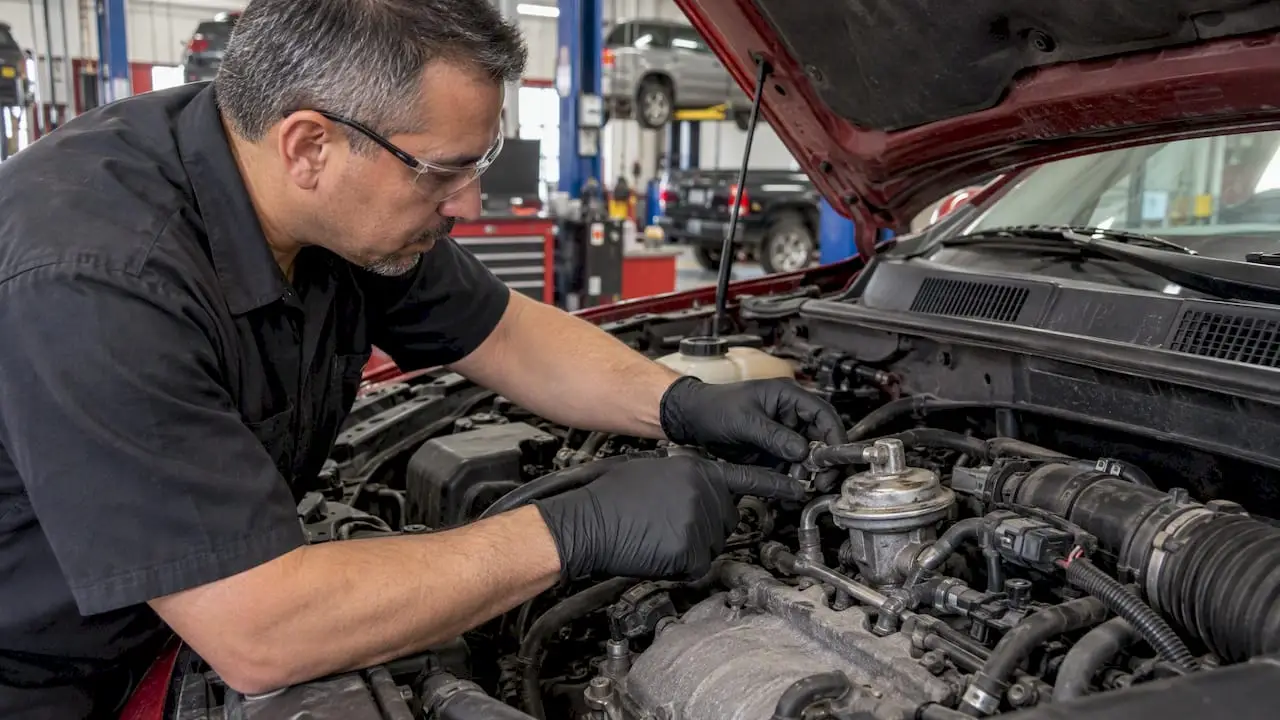
That is why we run codes as the start of the conversation, not the end. Our ASE-certified technicians check live data, inspect the hardware and show you photos from the digital inspection. If the answer is a $0 fix like a reconnected hose, we would rather tell you that than sell a part. If the valve does need replacing, we explain why, and qualifying repairs are backed by our 24-month/24,000-mile warranty.
We also work on a lot of SUVs, trucks, rideshare cars and European vehicles around Northeast Tarrant County, and each has its own EGR design and quirks. We follow the manufacturer’s service information for your specific vehicle, not a one-size-fits-all rule.
— Express Lube & Car Care
Prevent EGR trouble: what helps
No habit guarantees an EGR valve will last, and we will not promise one. But some things reduce the conditions that feed carbon buildup and help catch trouble early:
- Follow your owner’s manual for oil changes and tune-up items. Maintenance intervals should come from the manufacturer and your real driving, not a universal number. Short trips, heavy traffic, towing and idling are harder on an engine than steady highway miles.
- Fix small drivability issues early. Misfires, rough idle and sensor codes can pile up. A tune-up check is a good place to start.
- Do not ignore the check engine light. A scan costs far less than guessing.
- Use the fuel and oil your manufacturer specifies.
- Mention changes in how the car idles or accelerates when it is in for an oil change. Small details help us decide where to look.
Get your EGR symptoms checked in Richland Hills
If your check engine light is on or the car idles rough, we can scan it, check live data and tell you what we find before any repair begins. We take walk-ins or appointments, and same-day service is available when possible. See everything we handle on our services page, or look at our engine diagnostics and repair page.

We are at 7932 Glenview Drive, Richland Hills, TX 76180, and you can call us at (817) 284-8478. Drivers from North Richland Hills, Hurst, Bedford and the surrounding area stop by too.
FAQ
What are the first signs of a bad EGR valve?
Usually a check engine light, a rough idle or a hesitation when you accelerate. Some drivers also notice pinging or a drop in fuel economy. The signs overlap with many other problems, so a scan and live-data check is the reliable way to tell.
Can I clean an EGR valve myself?
Some people do, but results depend on the vehicle and the cause. If the underlying problem is a sensor, a hose or a clogged passage, cleaning the valve will not fix it. A shop can test the valve and the system first, so you know what is worth cleaning or replacing.
Will a bad EGR valve cause a failed emissions test?
It can. The system exists to control NOx emissions, and a fault can also set codes that affect inspection results. We perform Texas emissions inspections and can diagnose the cause if your vehicle did not pass.
How long does an EGR valve repair take?
It depends on the fault and how easy the valve is to reach, so we do not quote a standard time. After diagnosis we tell you what is involved. If you need to plan around work or rideshare shifts, say so when you arrive and we will give you an honest estimate.
Does a new EGR valve fix every EGR code?
No. A code can come from hoses, solenoids, sensors, pressure converters or blocked passages, so replacing the valve alone may not clear it. Diagnosis tells us whether the valve is the real cause.
Sources
- The crucial role of the EGR valve, TechASSIST Bulletin 01
- Symptoms of a Bad EGR Valve, AutoZone
- How to Replace an EGR Valve, AutoZone
- EGR valve: problems, symptoms, testing, replacement, Samarins
- EGR System Diagnosis: Stuck Open, Stuck Closed, and Carbon
- The basics of EGRs, Delphi Auto Parts
- EGR Valve Diagnosis and Cleaning Procedure, NHTSA service bulletin
- How to Confirm EGR Valve Issues with Data, Innova
- Diagnosing driveability problems caused by EGR faults, MasterTech Prep
- Valve Inspection Borescopes: Engine and Pump Checks Without Teardown