

Most stalling comes down to four systems: fuel delivery, air intake, ignition, or a failing sensor feeding bad data to the engine computer. Pay attention to when it happens (idle, shifting, accelerating, hot or cold) because that detail narrows things down fast. If the stall repeats, don’t just top off gas and hope: get the codes read or book a diagnostic scan before it strands you somewhere inconvenient.
TL;DR:
- Most stalls are caused by fuel delivery, air intake, ignition, or sensor faults, with specific triggers related to engine temperature and driving conditions.
- Diagnostic steps should prioritize checking the check engine light, pulling codes, and performing visual inspections before expensive tests like fuel pressure or live-data analysis.
- Intermittent stalls are especially difficult to diagnose, as patterns vary with engine temperature, weather, and vehicle load, requiring detailed record-keeping.
- Professional diagnostic methods include live-data monitoring, waveform testing, and visual inspection, supported by warranties on qualified repairs.
- Regular maintenance such as replacing filters, inspecting sensors, and checking the charging system can help prevent stalls caused by buildup or marginal components.
Table of Contents
- What causes a car to stall?
- What should you check first when your car stalls?
- What to do if your car stalls while driving
- Why intermittent stalls are harder to diagnose
- When to call a mechanic and what the shop process looks like
- Preventive maintenance that lowers your stall risk
- Our take on chasing stalls without guessing
- A stalling car eats away at your schedule fast, between the uncertainty and the trips back and forth to a shop that never quite nails it down. Diagnostics are handled consistently: certified technicians pull codes, run live-data checks, and walk you through a digital inspection with photos before any repair begins.
- Sources
- FAQ
What causes a car to stall?
Stalling happens when the engine loses the precise air-fuel mix it needs to keep running, and that balance can get thrown off by several different systems. Here’s where problems usually start.
- Fuel system failures: a clogged fuel filter, a weakening fuel pump, or a bad relay can starve the engine of fuel, especially under load or at low idle
- Air metering problems: a dirty mass airflow (MAF) sensor, a faulty manifold absolute pressure (MAP) sensor, a gunked-up throttle body, or a vacuum leak can all throw off the air-fuel ratio the engine relies on.
- Ignition and timing faults: worn spark plugs, a failing ignition coil, or a glitchy crankshaft or camshaft sensor can interrupt the spark that keeps combustion going.
- Charging and electrical issues: a weak battery, a failing alternator, or corroded grounds can starve the engine computer and fuel injectors of steady voltage.
- Emissions or exhaust restrictions: a stuck EGR valve or a clogged catalytic converter can choke the engine’s airflow enough to cause a stall, particularly at idle.
The MAF and MAP sensors deserve special mention because they’re common troublemakers. According to UTI’s breakdown of MAF and MAP sensor diagnostics, these sensors are supposed to help the engine maintain a precise air-fuel ratio, and when they fail, they often trigger specific trouble codes, like P0101 for a MAF fault, along with hesitation, rough idle, and stalling. A weak fuel pump can produce a similar pattern, particularly when the engine is hot, because internal wear sometimes causes pressure to drop exactly when you need it most.
What should you check first when your car stalls?
Before assuming the worst, work through a short list of checks. This order moves from the fastest, cheapest steps to the ones that call for a shop.
- Look for a check engine light. If it’s on, that’s your engine computer telling you it already logged a fault.
- Pull the codes with an OBD-II scanner. A basic code like P0101 points toward the MAF sensor, according to UTI, while other codes point toward ignition or fuel delivery.
- Do a quick visual check. Look at battery terminals for corrosion, check for loose or cracked vacuum hoses, confirm you’re not running on fumes, and glance at the air filter and throttle body for buildup.
- Test battery voltage with a multimeter if you have one, since a weak charging system can mimic a fuel or ignition problem.
- Bring in the scan data. A simple OBD-II reader captures codes and freeze-frame information that a technician can use as a starting point.
Owner checks only go so far, though. Shops use live-data capture, fuel pressure testing, injector balance tests, and oscilloscope waveform checks to catch faults that a basic scan misses entirely. That kind of testing matters most with intermittent stalls, since the engine performance diagnostic coursework from Northwest Technical College notes that simple scans can miss transient faults that only show up under live monitoring.
Pro Tip: Write down exactly what the dash looked like the moment your car stalled, since freeze-frame data captured at that instant is often more useful to a technician than the code itself.
What to do if your car stalls while driving
A stall in traffic is unsettling, but staying calm and following a few steps keeps you safe.
- Signal and steer toward the shoulder or the nearest exit ramp as soon as it’s safe to move over.
- Turn on your hazard lights immediately so other drivers know something’s wrong.
- If power steering or power brakes feel heavy, downshift and apply the parking brake gently to help slow the car without locking the wheels.
- If you can’t get off the road, stay inside with your hazards on and call 9-1-1 or roadside assistance rather than stepping into live traffic.
- Follow local move-over guidance and use flares or reflective triangles if you have them, since state roadside safety guidance recommends getting off the travel portion of the road and calling for help right away.
Keeping a small emergency kit in your trunk, with a flashlight and reflective triangles, makes this whole situation less stressful if it ever happens.
Why intermittent stalls are harder to diagnose
An intermittent stall, one that happens once and then disappears for weeks, is genuinely one of the tougher problems to chase down. Recognizing the pattern helps.
- Hot-only stalls often point to a fuel pump or sensor that only fails once it reaches operating temperature.
- Cold-only stalls tend to trace back to idle air control issues or a sensor that hasn’t warmed up yet.
- Stalls when shifting into drive can suggest a vacuum leak, a failing idle control valve, or a weak battery under sudden load.
- Stalls under load or at idle point toward air metering or fuel delivery struggling to keep up.
Marginal crankshaft or camshaft sensors, a weak fuel pump, and loose grounds or wiring are frequent culprits behind intermittent stalls, since these faults tend to shift with temperature and vibration. When you experience one, jot down the engine temperature, the RPM when it happened, the gear you were in, your fuel level, and the weather. A quick smartphone video with a timestamp, plus any stored codes or freeze-frame data, gives a technician something concrete to work from instead of guessing.
When to call a mechanic and what the shop process looks like
Some situations call for professional diagnostics right away rather than more troubleshooting at home. If your car has stalled more than once in traffic, won’t restart reliably, or seems to be losing power randomly, it’s time to bring it in.
- A shop visit starts with an OBD-II scan to pull any stored codes, followed by live-data capture while the engine runs.
- Fuel pressure testing and sensor waveform checks help confirm whether a part is actually failing or just reading oddly.
- A visual inspection covers wiring, connectors, vacuum lines, and grounds that a scan alone won’t catch.
- ASE-certified technicians run this process and document findings with a digital vehicle inspection, complete with photos, so you can see exactly what they found before agreeing to any work.
- Qualifying repairs come with a warranty that covers repairs for an extended period, giving you some peace of mind once the fix is made.
A straightforward code scan is often a same-day job. Intermittent faults sometimes take longer, occasionally requiring a monitored test drive or a return visit if the stall doesn’t reproduce on the first try.
Preventive maintenance that lowers your stall risk
Most stalling problems don’t appear overnight. They build up slowly, which means a little routine maintenance goes a long way toward avoiding one.
- Replace your fuel filter and service the fuel system on the schedule your manufacturer recommends.
- Swap out spark plugs and have ignition coils and wiring inspected at the intervals listed in your owner’s manual.
- Have your battery and charging system checked periodically, and clean corroded terminals and grounds when you spot them.
- Replace your air filter and have the throttle body serviced, since buildup here quietly starves the engine of clean airflow.
- Schedule a routine digital inspection so a technician can catch a marginal sensor or a fraying wire before it turns into a stall on the highway.
Our car maintenance checklist walks through these same tasks in more detail if you want a schedule to follow. Cold weather and hot summers both put extra strain on these systems, so seasonal checks matter as much as mileage-based ones.
Our take on chasing stalls without guessing
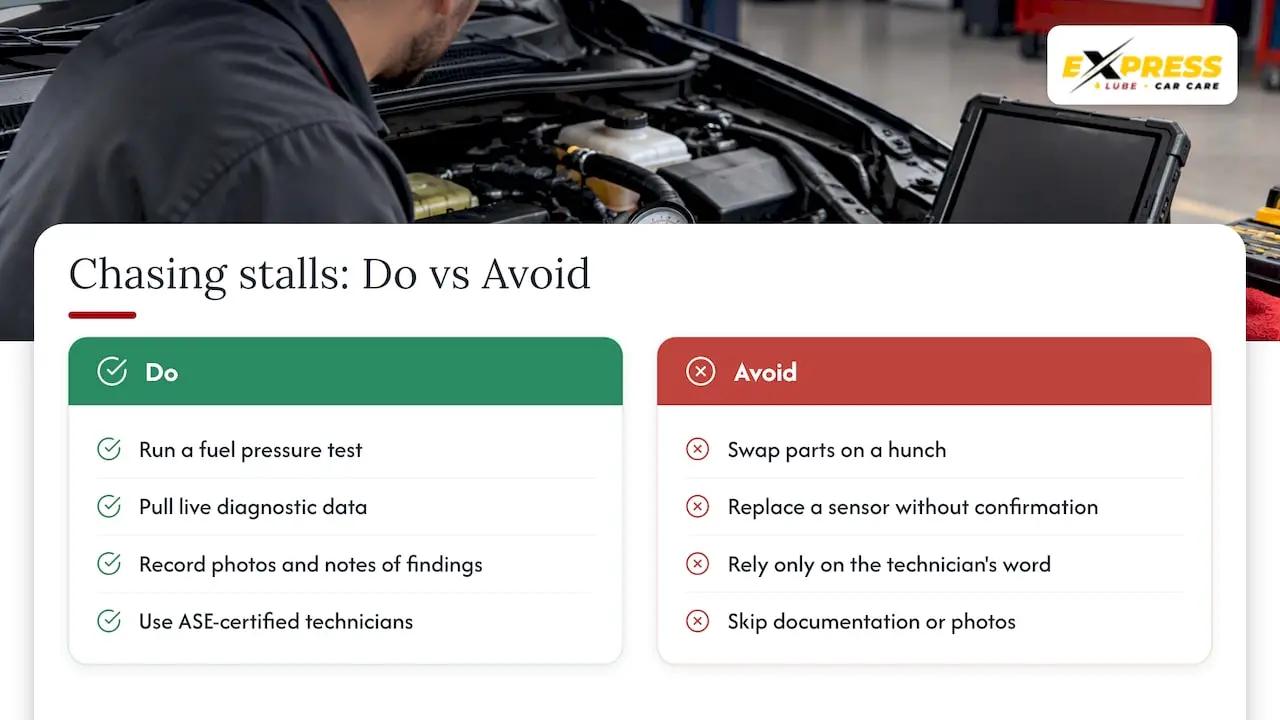
We’d rather run a fuel pressure test and pull live data than swap parts on a hunch, because guesswork tends to cost owners more in the long run, not less. A sensor that looks suspicious isn’t always the actual failure point, and replacing it without confirmation just delays finding the real problem.
That’s why digital vehicle inspections include photos and notes on exactly what is found, so you’re not taking the technician’s word for it. Combined with ASE-certified technicians and a warranty on qualifying repairs, it’s a process built around getting the diagnosis right the first time.
— Express Lube & Car Care
A stalling car eats away at your schedule fast, between the uncertainty and the trips back and forth to a shop that never quite nails it down. Diagnostics are handled consistently: certified technicians pull codes, run live-data checks, and walk you through a digital inspection with photos before any repair begins.
- Appointments and walk-ins are available, with same-day service when possible.
- Every diagnostic uses a live-scan approach described above, not a quick guess based on symptoms alone.
- Qualifying repairs are supported by a warranty, so you’re covered after you leave.
If your car has stalled more than once, don’t wait for it to happen at a worse moment. Check out our full range of services, browse our engine diagnostics page for more detail, or call us directly at (817) 284-8478 to get on the schedule.
Sources
The technical claims above draw from a few solid references worth a look if you want more detail.
- MAF vs. MAP Sensors: Differences and Diagnosis | UTI
- AUTOMOTIVE ENGINE PERFORMANCE ADVANCED (III)
- Roadside Emergency: What To Do in a Car Crash or Breakdown – Zero Deaths MD
FAQ
What does it mean when a car is stalling?
It means the engine is losing the fuel, air, or spark it needs to keep running, often due to a fuel delivery issue, a failing sensor, or an ignition fault. The exact cause depends on when it happens, so note whether it’s at idle, while accelerating, or during a specific temperature.
What does a car stalling feel like?
It usually feels like the engine suddenly loses power and shuts off, sometimes with a jerk or shudder right before it happens. Dashboard warning lights may flicker or the RPM gauge may dip sharply just before the engine dies.
Is stalling a car a serious fault?
It can range from a minor sensor glitch to a more serious fuel or electrical failure, so it’s worth taking seriously rather than ignoring. A single stall might be a fluke, but repeated stalling, especially in traffic, means it’s time for a professional diagnostic scan.
How do you fix a stalled car?
The fix depends entirely on the cause, whether that’s a fuel pump, a sensor, a spark plug, or a wiring issue found through diagnostic testing. Start by pulling any stored trouble codes, then have a technician run live-data and fuel pressure tests to confirm the actual failure point before any parts are replaced.
Why does my car stall only when it’s cold or hot outside?
Temperature-sensitive stalling often points to a sensor or fuel pump that behaves differently once it reaches a certain temperature, according to UTI’s diagnostic notes. Documenting whether the stall happens in cold starts or after extended hot running helps a technician narrow down the cause faster.