

Expect to pay between a few hundred dollars per ball joint at a shop, with the low end covering a single easy-access joint on a common sedan and the high end covering pressed-in joints on trucks or luxury vehicles. DIY parts alone cost tens to over a hundred dollars per joint. Either way, budget extra for a wheel alignment afterward, and if you’re feeling looseness in the steering or a clunk over bumps, get it inspected before you drive it much further.
 Part prices swing based on quality and design. J.D. Power’s cost guide notes parts commonly run $20 to $150 depending on whether you’re buying a basic aftermarket joint or an OEM piece, and labor averages $80 to $200 per hour. Most jobs take one to three hours per joint, depending on how buried it is behind the steering knuckle and control arm.
Real-world totals get messier once you’re replacing more than one joint. Crowdsourced repair receipts collected by CostHelper show DIY parts for all four joints running $125 to $400, while professional totals for four joints range from $350 all the way to $2,200 when control arms or other suspension parts need attention too.
A few sample budgets to put this in perspective:
Part prices swing based on quality and design. J.D. Power’s cost guide notes parts commonly run $20 to $150 depending on whether you’re buying a basic aftermarket joint or an OEM piece, and labor averages $80 to $200 per hour. Most jobs take one to three hours per joint, depending on how buried it is behind the steering knuckle and control arm.
Real-world totals get messier once you’re replacing more than one joint. Crowdsourced repair receipts collected by CostHelper show DIY parts for all four joints running $125 to $400, while professional totals for four joints range from $350 all the way to $2,200 when control arms or other suspension parts need attention too.
A few sample budgets to put this in perspective:
 Every repair carries the 24-month/24,000-mile warranty, and if the estimate covers more than the joints themselves, easy financing keeps a bigger suspension repair manageable. If you’re already noticing a clunk over bumps or looser steering, check our 10-point safety inspection checklist for what else to watch for, then stop by for a diagnosis. Walk in, or book an appointment if you’d rather lock in a time.
TL;DR:
- Costs increase significantly for trucks, multiple joints, or integrated control arm assemblies, sometimes reaching up to $2,200 for four joints on certain vehicles.
- A proper wheel alignment after replacement is essential to prevent premature tire wear and maintain safe handling, adding extra to the total cost.
- DIY replacement saves money on parts but requires specialized tools, mechanical confidence, and an immediate alignment to avoid further damage.
- Factory and extended warranties can cover some suspension repairs, but regular wear and tear like ball joint failure are generally not covered by standard insurance.
Table of Contents
- How Much Does Ball Joint Replacement Cost?
- What Makes One Ball Joint Job Cost More Than Another?
- Bad Ball Joint Symptoms: When Should You Worry?
- Is DIY Ball Joint Replacement Worth It?
- What Happens During a Professional Ball Joint Replacement?
- How Can You Save Money on Ball Joint Repairs?
- Express Lube & Car Care: Built for Safe Ball Joint Repairs
- Does Insurance Cover Ball Joint Replacement?
- Why This Repair Gets Oversimplified
- Ready to Get Your Ball Joints Checked?
- Sources
- FAQ
How Much Does Ball Joint Replacement Cost?
Here’s the real breakdown, not the vague range you see plastered across search results. RepairPal’s cost estimator puts the average total for a single ball joint replacement at roughly $312 to $456, with labor typically landing between $213 and $313 and parts between $99 and $144. That’s for one joint, on one side, at a shop.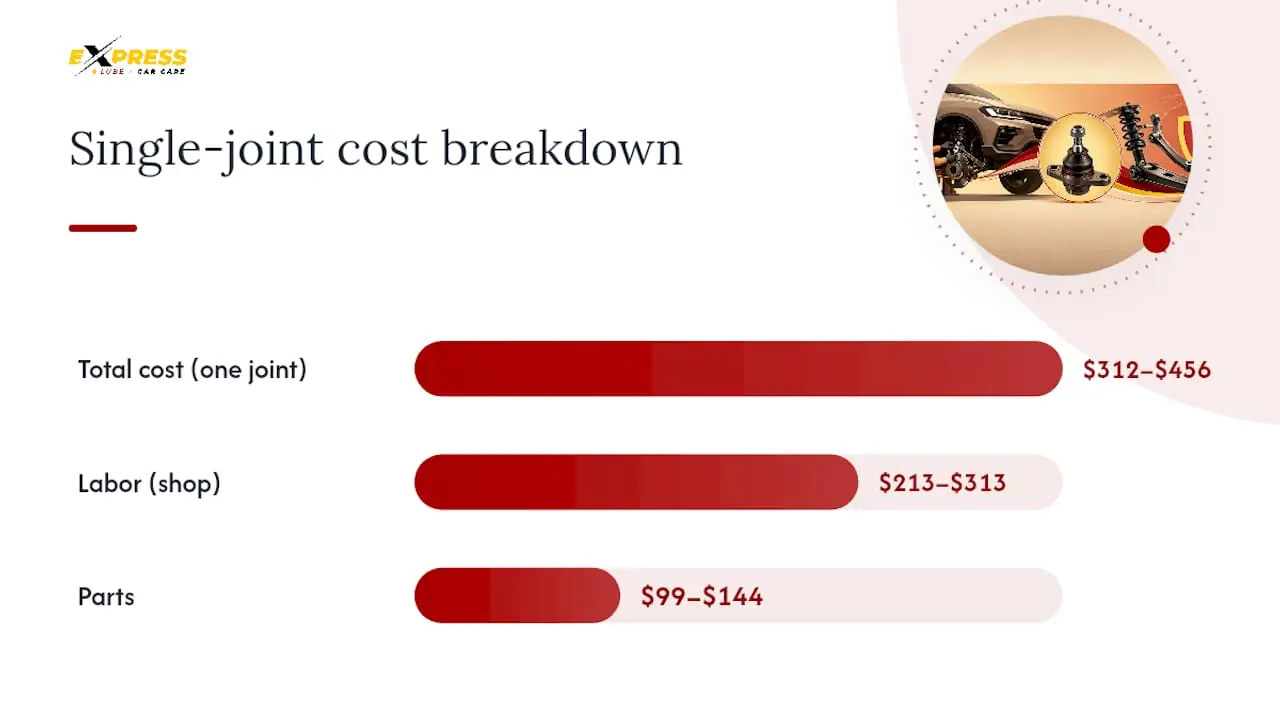 Part prices swing based on quality and design. J.D. Power’s cost guide notes parts commonly run $20 to $150 depending on whether you’re buying a basic aftermarket joint or an OEM piece, and labor averages $80 to $200 per hour. Most jobs take one to three hours per joint, depending on how buried it is behind the steering knuckle and control arm.
Real-world totals get messier once you’re replacing more than one joint. Crowdsourced repair receipts collected by CostHelper show DIY parts for all four joints running $125 to $400, while professional totals for four joints range from $350 all the way to $2,200 when control arms or other suspension parts need attention too.
A few sample budgets to put this in perspective:
Part prices swing based on quality and design. J.D. Power’s cost guide notes parts commonly run $20 to $150 depending on whether you’re buying a basic aftermarket joint or an OEM piece, and labor averages $80 to $200 per hour. Most jobs take one to three hours per joint, depending on how buried it is behind the steering knuckle and control arm.
Real-world totals get messier once you’re replacing more than one joint. Crowdsourced repair receipts collected by CostHelper show DIY parts for all four joints running $125 to $400, while professional totals for four joints range from $350 all the way to $2,200 when control arms or other suspension parts need attention too.
A few sample budgets to put this in perspective:
- Mainstream sedan, one front ball joint, independent shop: $250 to $400 including a basic alignment check.
- Half-ton pickup, both front lower ball joints, dealership: $600 to $1,000, since trucks often need more labor time and pricier parts.
- Compact SUV, full lower control arm assembly (joint integrated): $300 to $550 per side, because you’re paying for the whole assembly, not just the joint.
What Makes One Ball Joint Job Cost More Than Another?
Two vehicles with the same worn-out joint can produce wildly different invoices, and the reasons come down to design, access, and geography.- Greaseable vs. sealed joints: Greaseable ball joints have a grease fitting you can service periodically, which can extend their life. Sealed joints can’t be topped off, and once they wear out, replacement is the only fix. Moog’s wear-indicator guide explains that many joints include a built-in wear pin or collar that tells you visually when it’s time.
- Integrated vs. stand-alone joints: Some vehicles let you replace just the ball joint. Others build it into the control arm, so a worn joint means buying the whole arm assembly, which costs more in parts but sometimes less in labor since there’s no press-out step.
- Vehicle type: Luxury cars, heavy-duty trucks, and specialty imports routinely cost more, both because parts are pricier and because labor guides allow more time for extra bolts, shields, or tight clearances.
- Regional labor rates: A shop in a major metro area may charge $150 an hour where a rural independent charges $90. Parts availability matters too. Common domestic models get same-day parts; less common imports sometimes mean a wait.
Bad Ball Joint Symptoms: When Should You Worry?
A failing ball joint doesn’t fail quietly, and catching the warning signs early is what keeps this a $300 repair instead of a much scarier one. Common bad ball joint symptoms include a persistent clunking or knocking sound over bumps or during slow, tight turns, steering that feels loose or wanders on its own, uneven wear across the inner and outer edges of a tire, and vibration through the steering wheel at speed. Technicians check for wear with a wheel-rock test, grabbing the tire at the 12 and 6 o’clock positions and rocking it to feel for play. Manufacturer specs on some vehicles flag as little as 0.040 inches of movement as out of tolerance, which is a shockingly small margin for something holding your wheel to the car. Pro Tip: If you hear clunking only on rough roads and it stops on smooth pavement, don’t assume it’s minor. Ball joints often announce themselves exactly that way before getting dramatically worse within a few weeks. Worst case, a completely failed ball joint separates and the wheel folds under the car, usually while you’re driving. That’s not a “schedule it for next month” repair. If the play is confirmed, stop driving it beyond getting to a shop.Is DIY Ball Joint Replacement Worth It?
DIY can genuinely save money on parts, but it’s one of those jobs where the tool investment and skill requirement catch a lot of people off guard.- Price out your parts first. A DIY joint runs $50 to $150, versus $99 to $144 built into a typical shop parts quote. The savings mostly come from skipping labor, not from cheaper parts.
- Get the right tools before you start. A ball joint press kit with the correct adapters, a torque wrench, and breaker bars are non-negotiable for pressed-in joints. Auto parts stores like AutoZone often run loaner tool programs that make this cheaper, though you still need the mechanical confidence to use them correctly.
- Know the common failure points. Skipping the correct press adapter is the single most expensive DIY mistake. Using the wrong adapter frequently damages the control arm cup, which turns a $100 parts job into a $400 control-arm replacement.
- Don’t skip the alignment. Even a flawless DIY joint swap changes suspension geometry slightly. Skipping alignment afterward burns through tires and can leave the car pulling to one side.
What Happens During a Professional Ball Joint Replacement?
A shop visit follows a predictable sequence, and knowing it helps you compare quotes apples to apples.- Technicians inspect the suspension, confirm play with a wheel-rock test, and check related parts like tie rods and control arm bushings.
- You get a written estimate before any work starts, broken down by parts and labor.
- The joint (or assembly) gets pressed out and replaced, torqued to manufacturer spec.
- The car gets a wheel alignment and a short road test to confirm the fix.
How Can You Save Money on Ball Joint Repairs?
There are honest ways to cut the bill without cutting corners on safety.- Match parts quality to how you drive. If you put heavy miles on your vehicle, like rideshare or delivery driving, premium aftermarket parts usually cost less over time than cheap joints you’ll replace twice.
- Ask about bundled pricing. Many shops offer better per-joint rates when replacing both sides at once, or when a control-arm assembly swap ends up cheaper than pressing individual joints.
- Check warranty coverage before you pay. A shop backing its work with a real parts-and-labor warranty protects you if a joint fails early, which matters more than saving $30 on a bargain part.
- Ask about financing on bigger jobs. If your estimate includes control arms, tie rods, or an alignment on top of the joints, financing options can spread out a repair that would otherwise strain a monthly budget.
Express Lube & Car Care: Built for Safe Ball Joint Repairs
Every ball joint replacement at Express Lube & Car Care goes through ASE-certified technicians who explain the wheel-rock findings and show you the worn parts through digital inspection photos before you approve anything. You get a transparent written estimate up front, no appointment required for walk-ins, and every repair is backed by a 24-month/24,000-mile warranty. If the estimate includes more than the joints themselves, easy financing keeps a bigger suspension repair from blowing up your month.Does Insurance Cover Ball Joint Replacement?
Standard auto insurance, whether liability or full coverage, doesn’t pay for ball joint wear. Insurers treat suspension parts like ball joints the same way they treat brake pads or tires: normal wear-and-tear maintenance, not something a policy covers. The one exception is if the damage traces to a covered event, like hitting a deep pothole hard enough to cause sudden failure, or a collision that bent the control arm. In those cases, collision coverage may apply, though you’ll usually need a repair estimate that documents the joint damage resulted from that specific incident, not gradual wear. Warranty coverage is where you actually have leverage. If your vehicle is still under its factory powertrain or suspension warranty, check the mileage and time limits before paying out of pocket, since ball joints on some models are covered longer than you’d expect. Once you’re paying independently, ask any shop what warranty backs the repair itself. A joint replacement backed by a real parts-and-labor warranty, like the 24-month/24,000-mile coverage Express Lube & Car Care offers, protects you if a part fails early or the install turns out imperfect. That warranty matters more than shaving a few dollars off the initial quote, since a repeat repair costs far more than what you saved the first time.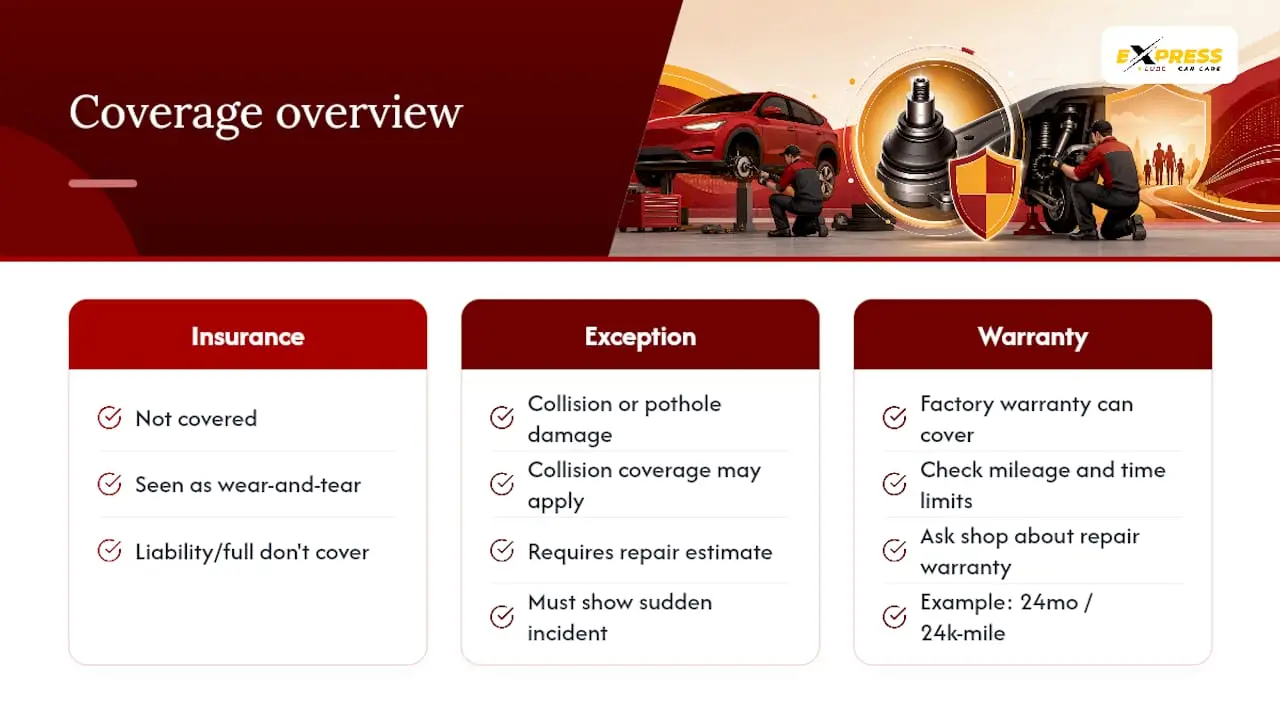
Why This Repair Gets Oversimplified
Most cost guides treat ball joint replacement like a single number you can Google and move on. It isn’t. The gap between a $250 job and a $1,000 job usually comes down to whether the joint is greaseable or sealed, whether it’s built into the control arm, and whether the shop finds a related part already failing. Readers who walk in expecting one flat price end up feeling like they’re getting overcharged when the real answer is that their vehicle’s design dictates the range. The bigger blind spot is alignment. Plenty of DIY guides treat it as optional, an upsell to skip if you’re trying to save money. It isn’t optional. Suspension geometry shifts the moment you disturb a ball joint, and driving on a misaligned front end quietly destroys a set of tires worth more than the alignment itself. If there’s one thing worth prioritizing over price alone, it’s diagnosis quality. A shop that shows you the actual worn joint, explains the wheel-rock test result, and backs the repair with a real warranty is worth more than a slightly cheaper quote from somewhere that won’t show its work.— Express Lube & Car Care
Ready to Get Your Ball Joints Checked?
Express Lube & Car Care is the walk-in alternative to booking a dealership appointment weeks out for suspension work in the Richland Hills area. No appointment, no waiting on a callback. You come in, an ASE-certified technician runs the wheel-rock test, and you get a written estimate with digital inspection photos so you can see exactly what’s worn before you approve anything. Every repair carries the 24-month/24,000-mile warranty, and if the estimate covers more than the joints themselves, easy financing keeps a bigger suspension repair manageable. If you’re already noticing a clunk over bumps or looser steering, check our 10-point safety inspection checklist for what else to watch for, then stop by for a diagnosis. Walk in, or book an appointment if you’d rather lock in a time.
Sources
For readers who want to dig deeper or double check a quote against real data:- 4 bad ball joint symptoms
- Suspension Ball Joint Replacement Cost Estimate
- How much does it cost to replace a suspension ball joint on a car?
- Symptoms of bad ball joints