

A car tune-up is a periodic maintenance service that keeps your vehicle running efficiently, safely, and reliably by inspecting and replacing key components like spark plugs, filters, and fluids. Despite advances in automotive technology, the core reason why cars need regular tune-ups has not changed: engines wear down, components degrade, and small problems become expensive ones when ignored. The term “tune-up” has evolved since the days of carburetors and distributors, but the principle is the same. Modern vehicles still depend on timely maintenance to protect complex electronic systems, fuel delivery components, and ignition hardware. Skipping that maintenance does not save money. It delays a bill while making it larger.
What does a modern tune-up actually include?
A modern tune-up covers far more than swapping out spark plugs. It is a thorough inspection and service of the systems that keep your engine running cleanly and efficiently. Understanding what gets checked helps you ask the right questions at the shop.
The core components of a current tune-up include:
- Spark plugs. Modern iridium and platinum plugs last 60,000–100,000 miles, but they still need replacement on schedule. Waiting too long lets them seize in the cylinder head, turning a simple swap into a complex and costly repair.
- Air filter. A clogged air filter restricts airflow to the engine, reducing power and fuel economy. Replacement is quick and inexpensive.
- Fuel filter. Dirty fuel filters restrict flow and stress the fuel pump. On many vehicles, the filter is inside the tank, making neglect expensive.
- Ignition coils. Modern coil-on-plug systems can fail independently on each cylinder, causing misfires and power loss. A tune-up includes inspection of each coil.
- Fuel system cleaning. Direct injection engines are especially prone to carbon buildup at 60,000+ miles, which impairs throttle response and fuel efficiency. Cleaning is now a standard part of a thorough tune-up.
- Throttle body, belts, and fluids. Technicians inspect the throttle body for deposits, check drive belts for cracking, and verify coolant, brake fluid, and transmission fluid levels.
What a modern tune-up does not include is adjusting a carburetor or setting ignition timing manually. Those tasks disappeared with older engine designs. Today’s tune-up is about protecting electronic systems and preventing buildup, not mechanical adjustment.
Pro Tip: Check your owner’s manual for the manufacturer’s recommended service intervals before your next shop visit. The manual tells you exactly what your specific engine needs and when, which prevents both over-servicing and under-servicing.
Why regular tune-ups protect your wallet and your safety
The benefits of tune-ups go well beyond a smoother idle. Regular maintenance directly affects fuel economy, emissions, safety, and the long-term cost of owning your vehicle.
“Maintenance is always cheaper than repair. Skipping tune-ups forces systems to work harder, causing cascading failures.” — A Complete Guide to Auto Tune-Up Services
That quote reflects what we see every day at Express Lube & Car Care. A misfiring engine from worn spark plugs forces the catalytic converter to process unburned fuel. Over time, that destroys the converter, which costs far more to replace than a set of plugs. The same logic applies to filters, fluids, and belts.
On the cost side, the average car costs about $900 annually for maintenance and repairs, with AAA recommending budgeting around $103 per month for routine upkeep. Engine replacements can exceed $10,000. That gap shows exactly why routine tune-ups are an investment, not an expense.
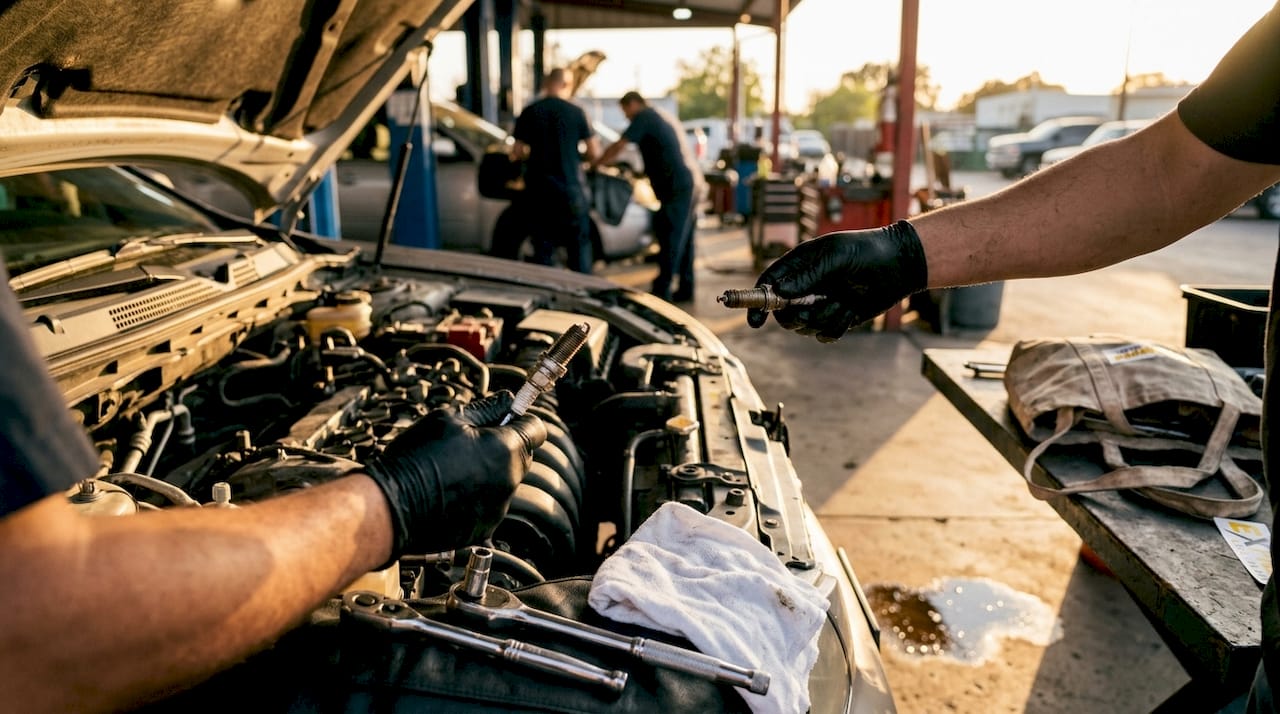
Fuel economy is another direct benefit. A clean fuel system, fresh spark plugs, and a new air filter all contribute to complete combustion. Incomplete combustion wastes fuel and pushes excess hydrocarbons through the exhaust, which degrades the catalytic converter faster. Properly timed tune-ups enhance fuel economy and vehicle reliability, turning maintenance costs into long-term savings.
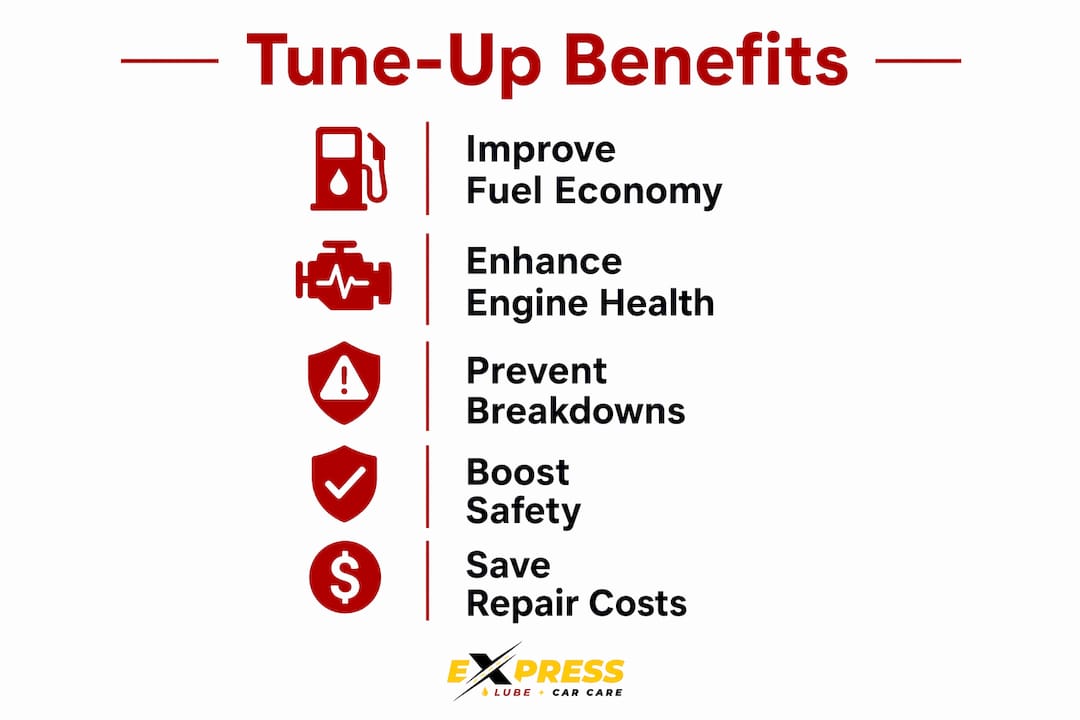
Safety is the piece drivers often overlook. Headlights can degrade to just 22% of their original output after three years without attention. Worn brake pads, ignored during routine checks, lead to metal-on-rotor damage that significantly increases repair costs and reduces stopping power. A tune-up is not just about the engine. It is a full check of the systems that keep you and your passengers safe.
What happens when you skip or delay tune-ups?
Neglecting tune-ups does not just mean a rougher ride. It sets off a chain of failures that gets more expensive with every mile you drive.
- Spark plugs seize. When plugs are left past their service life, they can seize in the cylinder head. Extracting a seized plug often requires specialty tools and additional labor hours. What should cost $150–$300 can balloon to $600 or more.
- Ignition coils fail. A misfiring cylinder from a bad plug puts extra stress on the ignition coil for that cylinder. Coil replacement adds cost on top of the overdue plug service.
- Catalytic converter damage. Unburned fuel from misfires reaches the catalytic converter and burns there instead. Repeated exposure destroys the converter’s internal structure. Catalytic converter replacement is one of the most expensive repairs on a modern vehicle.
- Cabin and engine air filters clog. A packed cabin filter strains the HVAC blower motor. A clogged engine air filter reduces power and fuel economy noticeably. Both are cheap to replace and expensive to ignore.
- Fluid degradation causes permanent damage. Oil breakdown leads to engine wear, and coolant leaks cause overheating and permanent engine damage. Neither problem announces itself loudly until the damage is done.
- Resale value drops. A vehicle with no maintenance records sells for less. Buyers and dealers check service history, and gaps in that record lower their offer.
Pro Tip: If you notice rough idling, hesitation during acceleration, or a drop in fuel economy, those are signs your car needs a tune-up right now. Do not wait for the check engine light to confirm what your driving experience is already telling you.
Most roadside breakdowns are preventable. Battery issues account for the majority of roadside assistance calls, and most stem from terminals that were never cleaned or a battery that was never load-tested during routine service. Small checks during a tune-up catch these problems before they strand you.
How often should you schedule a tune-up?
Tune-up frequency depends on your vehicle’s age, engine type, and how you drive. There is no single answer, but there are clear guidelines that apply to most drivers.
| Vehicle type | Recommended tune-up interval | Key service items |
|---|---|---|
| Modern car with iridium plugs | Every 60,000–100,000 miles | Spark plugs, fuel system cleaning, filters |
| Older car with standard plugs | Every 30,000–45,000 miles | Spark plugs, distributor cap, wires, filters |
| High-mileage or fleet vehicle | Every 25,000–30,000 miles | Full inspection plus all consumables |
| Severe driving conditions | More frequent than standard | Filters, fluids, belts checked at each oil change |
Severe driving conditions include frequent short trips, stop-and-go city traffic, towing, and extreme heat or cold. All of these accelerate wear on spark plugs, filters, and fluids. If your commute is mostly short city drives, your engine never fully warms up, which causes fuel and moisture to accumulate in the oil faster than highway driving would.
Your owner’s manual is the most reliable source for your specific vehicle. Experts recommend following manufacturer schedules and targeting 200,000 miles of vehicle life through consistent upkeep. A car maintenance schedule by mileage breaks this down into clear milestones so nothing gets missed.
For drivers who are unsure where to start, a vehicle maintenance schedule guide walks through the full picture, from oil changes to major service intervals, in plain language.
Key Takeaways
Regular tune-ups are the single most effective way to protect engine health, maintain fuel economy, and avoid repair bills that dwarf the cost of routine maintenance.
| Point | Details |
|---|---|
| Tune-ups protect modern systems | Direct injection engines, coil-on-plug ignition, and electronic controls all require scheduled service. |
| Cost of neglect far exceeds maintenance | Engine replacements can exceed $10,000; routine upkeep averages around $900 per year. |
| Spark plug timing is critical | Plugs left past 60,000–100,000 miles can seize, turning a simple job into a costly repair. |
| Frequency depends on your driving | Severe conditions like city stop-and-go or towing require more frequent service than highway driving. |
| Safety systems depend on tune-ups | Brake pads, headlights, and fluids checked during tune-ups directly affect driver and passenger safety. |
What we’ve learned from years of deferred maintenance
At Express Lube & Car Care, we see a pattern that repeats itself constantly. A driver comes in with a rough idle, a check engine light, and a fuel economy problem that has been building for months. Nine times out of ten, the root cause is a service that was due 20,000 miles ago.
The uncomfortable truth is that deferred maintenance feels like savings right up until it does not. Drivers who skip tune-ups are not avoiding costs. They are trading a predictable $200–$400 service for an unpredictable $1,500–$4,000 repair. That is not a good trade.
What I tell every driver who comes through our doors is this: your car is telling you what it needs. Rough idling, hesitation, a slight drop in fuel economy, a smell you cannot quite place. These are not quirks. They are early warnings. Catching them during a scheduled tune-up costs a fraction of what ignoring them will.
The other thing worth saying plainly is that not all tune-up services are equal. A shop that replaces spark plugs without checking ignition coils, cleaning the throttle body, or inspecting belts is not doing a complete job. Ask what is included before you approve any service. A trustworthy shop will give you a clear answer and a written estimate. That transparency is exactly what we build our service around at Express Lube & Car Care.
— Express Lube & Car Care
Tune-up and maintenance services at Express Lube & Car Care
Keeping your car in top shape does not have to mean long waits or surprise bills. At Express Lube & Car Care in Richland Hills, our ASE-certified technicians handle everything from spark plug replacement and fuel system cleaning to full inspections, with no appointment needed.
We use quality parts, give you straight answers, and back our work with a commitment to honest pricing. Whether you are due for a routine oil change or a more thorough engine service, our oil change and service specials make it easy to stay on schedule without stretching your budget. Walk in when it works for you, and we will get you back on the road quickly.
FAQ
What is a tune-up and what does it include?
A tune-up is a scheduled maintenance service that inspects and replaces key engine components like spark plugs, air and fuel filters, and ignition coils. Modern tune-ups also include fuel system cleaning and fluid checks to keep the engine running efficiently.
How often does a car need a tune-up?
Most modern vehicles with iridium or platinum spark plugs need a tune-up every 60,000–100,000 miles. Older vehicles or those driven in severe conditions may need service every 25,000–45,000 miles.
What are the signs your car needs a tune-up?
Common signs include rough idling, hesitation during acceleration, reduced fuel economy, and a check engine light. Any one of these symptoms warrants a prompt inspection by a certified technician.
Is a tune-up the same as an oil change?
No. An oil change replaces engine oil and the oil filter, while a tune-up covers a broader set of components including spark plugs, air filters, ignition coils, and fuel system components. Both are part of a complete routine car maintenance plan, but they serve different purposes.
What happens if you never get a tune-up?
Skipping tune-ups leads to misfires, catalytic converter damage, seized spark plugs, and accelerated wear on ignition coils and fuel system components. Repair costs for these failures far exceed the cost of the maintenance that would have prevented them.